
10 Tray Combi Oven Price: Industrial Procurement Guide 2026
The lowest 10 tray combi oven price often signals the highest long-term operational expense for a UAE commercial kitchen. While procurement teams focus on initial capital expenditure, the real impact on margins comes from utility consumption and sensor-driven precision. You likely recognize that selecting high-performance equipment requires balancing immediate costs against the rigorous demands of high-volume production. This guide provides a technical breakdown of 10-tray combi oven pricing tiers and performance factors specific to the UAE market for 2026.
We analyze the Total Cost of Ownership (TCO) by evaluating energy efficiency, maintenance requirements, and the integration of IoT capabilities. You'll gain a clear understanding of why premium models, including Rational iCombi Pro units, command higher market rates compared to entry-level alternatives. This guide previews current industrial trends, technical specification comparisons, and the essential factors that ensure equipment reliability in professional environments. We focus on providing the data needed for informed procurement decisions without the distraction of marketing filler. Our objective is to streamline your equipment selection process through technical clarity and operational facts.
Key Takeaways
- Categorize equipment by technology levels to distinguish between entry-level units and intelligent premium systems.
- Evaluate the 10 tray combi oven price landscape in the UAE based on power source variations and steam generation methods.
- Benchmark performance using Rational iCombi Pro standards to understand the impact of sensor-driven moisture control on production.
- Calculate Total Cost of Ownership by factoring in energy consumption and critical water filtration requirements for UAE mineral levels.
- Identify supplier selection criteria focused on technical literacy and the ability to support high-volume industrial kitchen operations.
10 Tray Combi Oven Price: Market Overview and Tiers
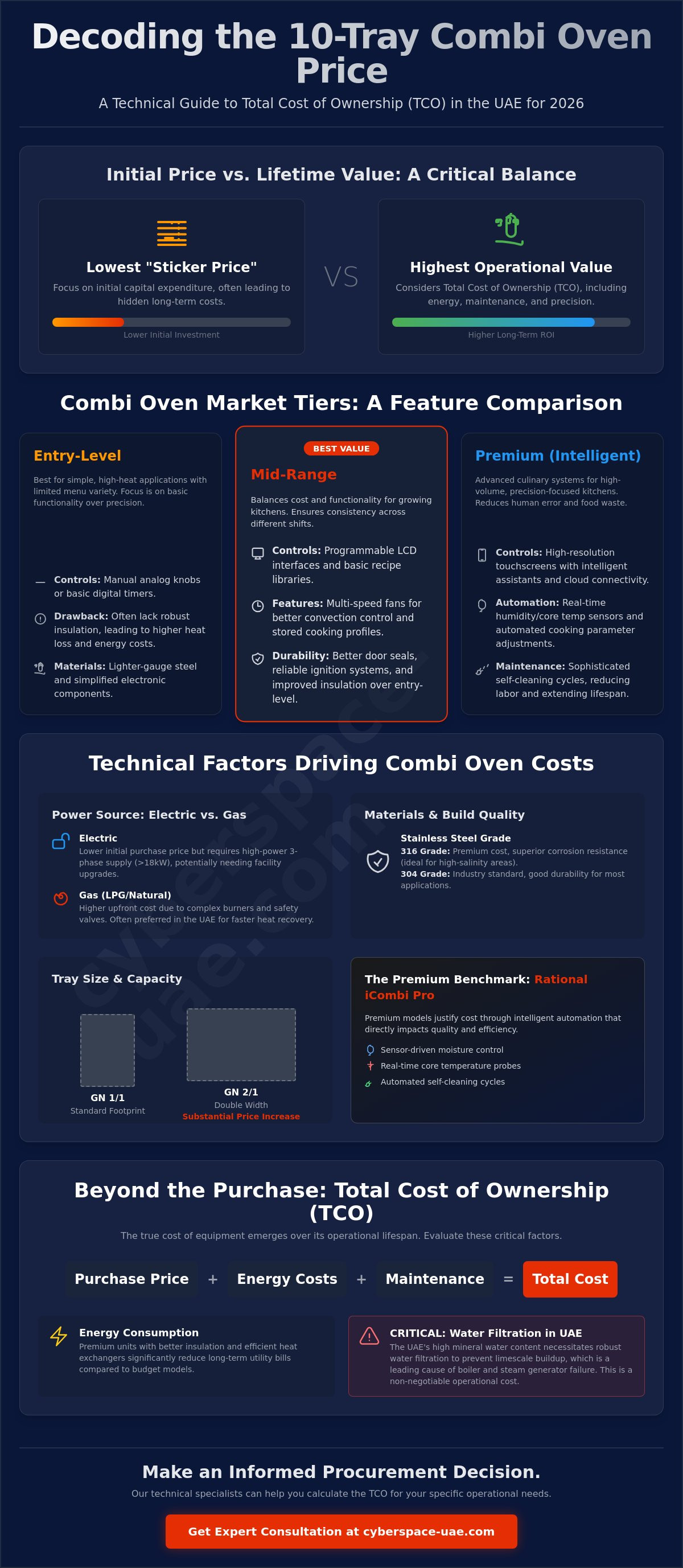
The 10 tray combi oven price in the UAE is dictated by engineering complexity and sensor integration. Professional kitchens must distinguish between basic heating units and advanced culinary systems. Understanding Combi steamer technology is essential for identifying why two units with identical tray counts vary so significantly in cost. European-manufactured units, particularly from Germany and Italy, represent the upper tier of the market. These brands prioritize thermal insulation and high-grade 304 or 316 stainless steel. Asian-manufactured models often provide a lower entry cost but may utilize lighter-gauge materials and simplified electronic components.
Tray dimensions also shift the price point. A standard 10-tray GN 1/1 unit occupies a smaller footprint and serves medium-volume requirements. In contrast, GN 2/1 units double the horizontal capacity. Procurement teams should expect a substantial price increase for GN 2/1 configurations, as these require larger heat exchangers and more powerful fan systems to maintain uniform convection across the wider chamber. The investment reflects the increased raw material costs and the mechanical requirements of circulating air through a larger volume.
Entry-Level vs. Mid-Range Pricing
Entry-level models typically feature manual controls or basic digital timers. These units are suitable for operations focusing on repetitive tasks like bulk steaming or roasting where precision is secondary. Mid-range ovens introduce programmable interfaces and multi-speed fans. These features allow chefs to store specific cooking profiles, ensuring consistency across different shifts. While entry-level units offer the lowest 10 tray combi oven price, they often lack the robust insulation found in mid-range models. This results in higher heat loss and increased energy consumption during long service hours.
- Manual Models: Rely on analog knobs; best for simple, high-heat applications with limited menu variety.
- Mid-Range Digital: Feature LCD screens and basic recipe libraries; balance cost and functionality for growing kitchens.
- Durability: Mid-range units generally offer better door seals and more reliable ignition systems for gas models compared to budget alternatives.
Premium Intelligent Combi Ovens
Premium units justify their cost through comprehensive automation. These systems utilize multi-sensor technology to monitor humidity levels and core temperatures in real-time. Market leaders like Rational integrate intelligent assistants that adjust cooking parameters automatically based on load size. This reduces human error and minimizes food waste. A critical factor in premium pricing is the inclusion of sophisticated self-cleaning cycles. These systems use chemical tabs or liquid detergents to descale the boiler and sanitize the chamber without manual intervention. This automation reduces labor costs and extends the operational lifespan of the equipment in harsh, high-mineral water environments found in the UAE.
Technical Factors Determining Combi Oven Costs
Technical specifications determine the 10 tray combi oven price more than tray capacity alone. Material selection, specifically the grade of stainless steel in the cooking chamber, impacts longevity and heat retention. Units utilizing high-grade 316 stainless steel offer superior corrosion resistance compared to standard 304 grades. Control interfaces also influence cost; high-resolution touchscreens with multi-language support command a premium over basic mechanical dials. According to Global Combi Ovens Market Analysis, the demand for these technologically advanced units continues to grow as kitchens prioritize precision and connectivity. These digital systems allow for remote monitoring and cloud-based recipe management, which increases the initial investment while improving operational consistency.
Electric vs. Gas Configuration Prices
The choice between electric and gas power sources creates an immediate price differential. Electric models generally feature a lower initial purchase price. However, they require a 380-415V three-phase power supply, often exceeding 18kW for a 10-tray unit. This infrastructure may necessitate electrical upgrades in older facilities. Gas models, compatible with LPG or Natural Gas, involve a higher upfront cost due to the complexity of the burner systems, heat exchangers, and integrated safety valves. In the UAE, gas units are often preferred for their faster recovery times and lower utility costs, despite the higher equipment price. Gas units also require specialized ventilation and fire suppression systems, which adds to the total installation cost beyond the equipment price.
Boiler vs. Injection Steam Systems
Steam generation methods represent a significant technical divide in the market. Boiler-based systems use a dedicated tank to produce saturated steam. This is the preferred method for heavy steaming applications, such as bulk vegetable production or sous-vide cooking. Injection systems, or boilerless models, spray water directly onto the heating elements and fan. While injection models reduce the initial 10 tray combi oven price, they may struggle to maintain consistent steam saturation during back-to-back high-volume cycles. Maintenance requirements differ between these two systems:
- Boiler Systems: Require regular descaling to prevent calcification of the tank; essential for kitchens with high-volume steaming needs.
- Injection Systems: Feature a more compact design and lower price point; best for roasting and varied menu requirements.
- Water Quality: Both systems require high-quality filtration to prevent component failure in high-mineral environments.
For operations requiring maximum versatility and reliable steam production, exploring a high-performance combi oven ensures technical specifications align with production demands. Choosing the correct steam generation method is a balance between the upfront capital expenditure and the long-term maintenance schedule of the kitchen.
Rational iCombi Pro 10-Tray: The Premium Benchmarking
Rational units define the upper limit of the 10 tray combi oven price bracket in the UAE. This positioning isn't arbitrary; it reflects the integration of iDensityClimate technology. This system utilizes high-performance dehumidification and cross-flow fan geometry to ensure uniform energy distribution. By maintaining precise chamber conditions, the unit achieves up to 50% higher productivity compared to previous models. Adherence to ENERGY STAR efficiency standards further validates the engineering, ensuring that the high initial investment is offset by reduced utility overheads. When evaluating the 10 tray combi oven price for a new facility, the software capabilities often outweigh the hardware footprint.
The iProductionManager software allows for complex sequencing of different food products simultaneously. It monitors each rack individually, adjusting cooking times based on door openings and load changes. Maintenance is handled via the iCareSystem, which uses phosphate-free cleaner tabs to eliminate scale. In the high-mineral water environments common across the UAE, this automated descaling is critical for preventing heating element failure and avoiding unscheduled downtime. Unlike manual descaling processes, this system provides a standardized cleaning log, which is essential for HACCP compliance and internal audit trails.
Intelligent Cooking Paths
Automated cooking paths remove the requirement for constant manual supervision. The iCookingSuite sensors detect the size, quantity, and condition of the products, adjusting the temperature and air speed in real-time. This ensures consistent results across multiple kitchen shifts, regardless of the operator's skill level. For industrial kitchens, this predictability is a core component of the ROI calculation. It minimizes overcooking and product shrinkage, directly impacting food cost percentages. The system's ability to learn preferred browning levels means that customized culinary standards are maintained without manual intervention.
Longevity and Resale Value
Rational equipment maintains high residual value due to its industrial-grade construction and the widespread availability of certified technical support in the UAE. Procurement teams often favor these units because they're built for heavy-duty cycles in demanding environments. Access to genuine spare parts and factory-trained technicians throughout the UAE ensures that the machinery remains operational for its full intended lifespan. This reliability makes the brand a staple in high-volume F&B operations where equipment failure translates to significant revenue loss. Even after years of service, these units command a premium on the secondary market compared to generic alternatives. The robust housing and high-grade components ensure that the unit's structural integrity remains intact despite constant exposure to high heat and moisture.
Beyond the Purchase: Total Cost of Ownership (TCO)
The initial 10 tray combi oven price represents only a fraction of the long-term capital requirement for an industrial kitchen. Operating a facility in the UAE necessitates a detailed analysis of recurring expenses, ranging from utility loads to specialized chemical consumables. High-performance units often feature superior insulation and triple-glazed doors. These components minimize heat transfer to the kitchen environment, which reduces the load on HVAC systems. In high-ambient temperature regions like Dubai and Abu Dhabi, these secondary energy savings are significant for maintaining a functional workspace without overworking cooling infrastructure.
Consumables represent a fixed operational cost that varies by brand and technology level. Automated cleaning systems require proprietary detergent and rinse tabs to maintain warranty compliance and hygiene standards. While these chemicals ensure the longevity of the cooking chamber, they must be factored into the annual budget. Neglecting these proprietary cleaning protocols often leads to grease buildup, which impairs sensor accuracy and increases the risk of component failure.
Energy and Water Efficiency
Efficiency directly impacts the monthly operational budget. High-tier combi ovens utilize heat exchangers to preheat incoming water using exhaust heat, reducing the energy required for steam generation. Industry data suggests that energy-efficient models can reduce consumption by up to 30% compared to conventional technology. Water consumption also varies significantly between brands. Automated cycles use specific volumes of water and energy based on the soil level detected by internal sensors. Efficient systems prioritize resource conservation during both the cooking and cleaning phases, ensuring that high-volume production doesn't lead to excessive utility overheads.
Maintenance and Warranty Provisions
UAE water profiles are characterized by high mineral content due to desalination processes. Without adequate filtration, calcification occurs rapidly. This leads to boiler failure or inaccurate temperature readings. A high-quality water filtration system is a non-negotiable expense that protects the equipment's internal components from scale. Standard warranty terms in the region typically cover 12 to 24 months, but the availability of local technical support is more critical than the policy duration itself.
- Preventative Care: Scheduled inspections by certified technicians reduce the risk of emergency repairs.
- Emergency Repair Costs: Unscheduled industrial repairs often carry premium labor rates and expedited parts shipping fees.
- Downtime Impact: In a high-volume production environment, one hour of equipment failure can result in thousands of AED in lost revenue and wasted ingredients.
Investing in a reliable combi oven backed by a robust local service network is essential for maintaining production continuity. Balancing the purchase price with these ongoing technical requirements ensures a sustainable return on investment over the machine's operational lifespan.
Industrial Procurement: Sourcing 10-Tray Ovens in the UAE
Procuring industrial kitchen equipment requires a focus on technical alignment and logistical reliability. While comparing the 10 tray combi oven price across different distributors, procurement managers must evaluate the supplier's technical literacy. A partner should understand the integration of these units into a broader production line. For instance, high-volume bakeries often synchronize their combi steaming workflows with Professional Baking Deck Ovens to manage diverse product requirements. Cyberspace Kitchen & Bakery Equipment facilitates this by providing brand-new, high-performance machinery designed for the rigorous standards of the UAE hospitality sector. Our focus remains on delivering reliable tools that meet specific operational demands without the complexity of unverified third-party services.
Selecting a Reliable Equipment Partner
Distributor selection hinges on post-sale support and spare part availability. Verify that the supplier offers authentic manufacturer origins and strictly brand-new inventory. Refurbished units often lack the software updates necessary for modern kitchen management systems. Technical support capabilities are non-negotiable for complex cooking systems. Ensure the provider has a localized service network capable of handling the specific electrical and gas configurations standard in the region. Rapid response times minimize production bottlenecks during peak service hours. A reliable partner acts as a facilitator for operational excellence, not just a hardware vendor.
The principle of choosing a specialized partner for high-performance hardware applies beyond the kitchen; for those requiring precision in computing, you can learn more about Budget Gamer UAE to discover specialized systems tailored for the local market.
Finalizing the Procurement Process
A comprehensive Request for Quotation (RFQ) should include specific technical parameters to avoid pricing discrepancies. Include power requirements, steam generation preferences, and water filtration needs. Lead times for specialized industrial machinery vary depending on stock availability and customization requirements. Cyberspace Kitchen & Bakery Equipment provides streamlined kitchen solutions, offering a direct path to acquiring Rational and other professional-grade equipment. Professional site inspections are recommended before delivery to confirm utility compatibility and ventilation clearances. This methodical approach ensures that the 10 tray combi oven price you pay translates into immediate operational utility.
- RFQ Essentials: Specify GN 1/1 or GN 2/1 capacity and preferred power source.
- Site Inspections: Confirm drainage, water pressure, and electrical phase alignment before delivery.
- Technical Consultation: Contact Cyberspace Kitchen & Bakery Equipment for detailed equipment specifications and industrial procurement support.
Optimizing Your Industrial Kitchen Investment for 2026
Identifying the correct 10 tray combi oven price requires a shift from initial expenditure to long-term operational efficiency. Procurement success in the UAE depends on selecting machinery that balances advanced sensor technology with robust material durability. High-tier units provide the necessary precision for high-volume production while minimizing utility overheads through superior insulation and automated climate control. Evaluating the Total Cost of Ownership ensures that equipment choices remain profitable over their full operational lifespan.
Cyberspace serves as an authorized supplier of high-performance Rational solutions, specializing exclusively in brand-new industrial machinery. We provide expert technical support to ensure your commercial kitchen maintains maximum uptime in demanding environments. Aligning your technical requirements with professional-grade equipment ensures consistent culinary results and a sustainable return on investment. Request a Professional Quote for 10-Tray Combi Ovens to secure the tools required for your facility's expansion.
Frequently Asked Questions
What is the average price of a 10-tray Rational combi oven in the UAE?
Market data for 2026 indicates that a new 10-tray Rational iCombi Pro electric unit typically retails around 44,800 AED. Gas models are positioned at a higher price point, often exceeding 52,500 AED. These figures represent the standard market range for premium intelligent units in the UAE. Procurement teams should verify current availability and specific model variations, as these baseline rates exclude auxiliary components like stands or extraction hoods.
Is a gas or electric 10-tray combi oven more cost-effective?
Electric units offer a lower initial 10 tray combi oven price but often incur higher utility costs over time. Gas models require a larger upfront investment due to burner complexity and integrated safety valves. However, they provide faster recovery times and lower monthly operational expenses in UAE kitchens. The choice depends on your facility's existing utility infrastructure and the volume of back-to-back cooking cycles required.
What is the difference between a 10-tray and a 20-tray combi oven in terms of ROI?
A 10-tray unit provides flexibility for medium-volume, diverse menus, whereas a 20-tray oven is engineered for high-density production and banqueting. ROI for the 20-tray model is achieved through significant labor reduction in mass production settings. Conversely, the 10-tray configuration offers a faster return for restaurants that prioritize menu variety and frequent, smaller batches over bulk output.
Do 10-tray combi oven prices include installation and water filtration?
Standard equipment quotes generally exclude installation fees and water filtration systems. In the UAE, specialized filtration is a technical necessity to prevent rapid scale buildup from high-mineral water. These additional costs, along with professional commissioning and staff training, should be budgeted as part of the total capital expenditure for the installation project.
How often do 10-tray combi ovens require professional servicing?
Professional technical inspections are recommended at least twice per year for high-volume industrial kitchens. While modern automated cleaning cycles manage daily descaling, a technician must verify door seals, fan motor bearings, and heating element integrity. Regular preventative maintenance prevents the high costs associated with emergency repairs and unscheduled production downtime.
Can a 10-tray combi oven replace a traditional deck oven for baking?
A combi oven can handle many baking tasks but cannot fully replicate the specific bottom-heat characteristics of a deck oven. It's highly effective for pastries and rolls that require steam injection and convection. However, for stone-baked products or specialty sourdoughs, a dedicated deck oven remains the industrial standard for achieving specific crust textures and heat distribution.
What are the power requirements for an electric 10-tray combi oven?
Most electric 10-tray models require a 380-415V three-phase power supply. The connected load for these units is usually between 18kW and 19kW. It's essential to confirm that the facility's electrical panel can support this demand before procurement. High-power cooking equipment requires dedicated circuit breakers and specific cabling gauges to ensure safe operation.
Are there significant price differences between boiler and boilerless models?
Boiler-based models command a higher 10 tray combi oven price because they include a dedicated steam generator tank. Injection models are more compact and cost-effective initially but may struggle with steam saturation in heavy-duty applications. The price difference reflects the mechanical complexity and the superior steam quality provided by the boiler system for bulk vegetable or sous-vide production.