
Advanced Combi Oven Cooking Programs: An Industrial Technical Guide
68% of commercial kitchens now prioritize electric units, yet many operations fail to master the combi oven cooking programs that ensure consistent results. Relying on manual input leads to inconsistent food quality and high energy wastage across shifts. You're likely aware that manual programming is too complex for junior staff and results in unnecessary shrinkage.
This guide delivers a technical breakdown of programming logic and the environmental control algorithms that drive industrial efficiency. We'll analyze multi-stage cooking and the January 2026 software updates, such as version LM100-18.0.40 for the Rational iCombi Pro. You'll gain insights into optimizing kitchen workflows through automation to ensure standardized output and improved yield.
Key Takeaways
- Analyze the logic of climate parameter sequences and sensor-driven monitoring to maintain precise humidity and core temperature control.
- Execute high-performance combi oven cooking programs by differentiating between technical steam and convection mode applications for industrial output.
- Deploy multi-stage programming to automate climate shifts within a single cycle, ensuring standardized results while reducing manual labor requirements.
- Apply specialized configurations like delta-T cooking for protein yield optimization and moisture-controlled stages for commercial bakery production.
- Integrate Rational iCookingSuite and iProductionManager logic to facilitate automated path detection and efficient mixed-load management in high-volume kitchens.
Understanding Combi Oven Cooking Program Logic
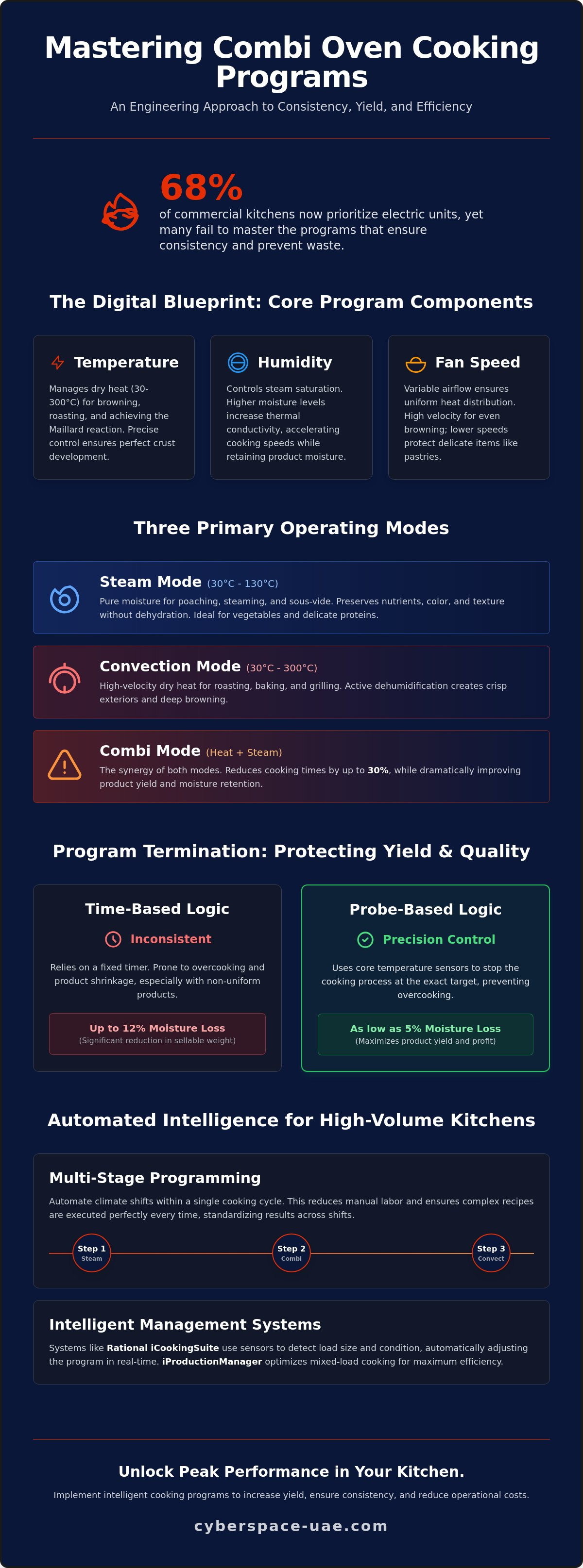
A cooking program is a digital blueprint of heat transfer. It consists of a structured sequence of climate parameters that dictate the exact environment within the cabinet. Modern combi oven cooking programs don't simply run a timer; they utilize a network of internal sensors to monitor humidity, core temperature, and airflow in real-time. These solid-state sensors provide the data required for the system to make micro-adjustments during the cycle. The Combi steamer relies on this logic to maintain a stable atmosphere, regardless of external ambient temperatures or frequent door openings.
Program termination is handled through two primary methods: time-based or probe-based logic. Time-based cycles are predictable and useful for standardized products with uniform thickness. However, probe-based termination is superior for industrial yield. It uses multi-point core temperature sensors to stop the process exactly when the product reaches its target state. This prevents overcooking and significantly reduces product shrinkage. For high-volume operations, precise termination means higher sellable weight and consistent texture across every shift. It's the difference between a 5% and 12% moisture loss in proteins.
The Core Components of a Program
Temperature settings manage dry heat for Maillard reactions and crust development. Humidity control involves managing steam saturation levels. Higher saturation increases thermal conductivity, which accelerates cooking speeds. Fan speed variables are equally critical. High-velocity airflow ensures uniform browning in dense loads, but it can damage delicate products. Variable fan speeds allow for high-volume baking without compromising the integrity of light pastries or sponges. Every parameter works in tandem to stabilize the internal climate.
Software-Driven Climate Management
An advanced commercial combi steamer oven uses proprietary software to calculate moisture requirements. The logic assesses the load size and the initial state of the product, such as whether it's chilled or frozen. The system then adjusts energy output and steam injection in real-time. This level of software-driven management is vital for high-capacity 20-tray units. Large loads require more energy to maintain uniformity between the top and bottom racks. Precise calibration ensures that every tray receives identical treatment, which is the primary goal of professional combi oven cooking programs. It eliminates the need for manual monitoring and provides a standardized output for junior staff.
Primary Operating Modes in Commercial Combi Steamer Ovens
Operating modes define the functional capability of combi oven cooking programs. These modes manipulate the thermodynamic properties of the cooking cabinet to achieve specific culinary outcomes. By switching between moist and dry heat, industrial kitchens can execute diverse menu items within a single footprint.
Steam Mode operates between 30°C and 130°C. At the lower end (30°C to 95°C), it provides the precision required for sous-vide and delicate seafood. At 100°C, it facilitates rapid blanching and steaming of high-volume vegetable loads. Convection Mode ranges from 30°C to 300°C. It utilizes high-velocity dry heat for roasting, grilling, and baking. The primary advantage here is the Maillard reaction, achieved through controlled dehumidification of the cabinet air.
Combi Mode represents the integration of both environments. By introducing moisture into a high-heat convection cycle, the oven accelerates heat transfer. Steam has a higher thermal conductivity than dry air. This synergy reduces cooking times by up to 30% while maintaining product yield. Modern intelligent cooking systems automatically calculate the necessary moisture-to-dry-heat ratio based on the selected program parameters.
Steam Saturation and Pressure Logic
Industrial units utilize either forced steam injection or boiler-based systems. Boiler systems provide a constant reservoir of saturated steam, ideal for back-to-back high-volume production. Injection systems offer faster response times for smaller, varied loads. Maintaining 100% humidity is critical for vegetable production to prevent oxidative browning and nutrient loss. Low-temperature steaming (65°C to 85°C) ensures protein fibers in seafood remain tender without tightening, which is a common failure in manual setups.
Dry Heat and Airflow Dynamics
Browning is controlled through active dehumidification programs. These systems vent excess moisture to ensure a crisp exterior on roasted products. Multi-speed fans are essential for even distribution. While baking deck oven suppliers focus on static, radiant heat, combi systems rely on forced convection. High-speed settings are used for dense proteins, while low speeds prevent delicate pastries from collapsing. The integration of these modes into combi oven cooking programs ensures that complex recipes are executed with technical precision. In 20-tray configurations, airflow must be precisely channeled to prevent cold spots and ensure uniformity.
Standardizing these modes across a kitchen fleet ensures operational consistency and reduces waste. If you're looking to upgrade your facility's efficiency, explore our range of professional combi oven solutions.
Manual vs. Intelligent Multi-Stage Cooking Programs
Advanced combi oven cooking programs utilize multi-stage logic to execute complex culinary tasks without manual intervention. A multi-stage program is a sequence where the oven automatically shifts climate parameters based on pre-defined triggers. Manual programming requires the operator to specify the exact duration, temperature, and humidity for every step. This offers total control for specialized artisan products where the chef's intuition is paramount. In contrast, intelligent systems use sensor data to override static time settings. If the oven detects a significant temperature drop after loading a full 20-tray rack, the software adjusts energy output and time to maintain the programmed path. This ensures the final result is identical to a single-tray test batch.
Industrial production favors intelligent logic for high-volume standardization. Manual mode is typically reserved for recipe development or highly specific finishing techniques. The transition between stages occurs seamlessly; the product never leaves its optimal thermal window. Intelligent systems analyze the product state in real-time, making manual adjustments unnecessary for the staff on the line. This shift from time-based to goal-based cooking is the foundation of modern kitchen efficiency.
The Logic of Multi-Stage Transitions
The logic of multi-stage transitions is rooted in thermodynamic sequencing. Transitions allow for distinct phases within a single cycle. A protein program often begins with a high-heat searing stage at 220°C with 0% humidity to develop color. The next stage automatically shifts to 120°C with 60% humidity for gentle cooking and moisture retention. For baking, the program initiates with a steam injection stage to facilitate maximum oven spring. It then transitions to dry convection heat with high fan speeds to develop the crust. Some advanced sequences even include a resting phase. During this stage, the fan speed drops to a minimum and the temperature stabilizes. This equalizes internal juices before the cycle ends, improving the final yield and texture.
Standardisation Through Digital Recipes
Digital recipe management ensures identical results across multiple kitchen locations. Operators can upload verified combi oven cooking programs via USB or cloud-based platforms. This eliminates the variability inherent in manual input. Locking these programs is a critical security feature; it prevents unauthorized changes to critical parameters like humidity levels or fan speeds. In high-turnover commercial environments, this level of control reduces operator error. Junior staff simply select the correct icon, and the oven executes the technical logic. This ensures that a large load of roasted poultry remains consistent regardless of which staff member is operating the equipment or the time of day.
Industry-Specific Programming for High-Volume Food Service
Industrial food service requires specialized logic to maintain quality at scale. Professional combi oven cooking programs facilitate this by offering industry-specific presets that handle complex thermodynamic tasks. These programs eliminate the variability of manual input, ensuring that high-volume output remains consistent across different shifts and locations.
Protein optimization relies on delta-T cooking logic. The oven maintains a fixed temperature gap between the cooking chamber and the product core. If you set a 20°C delta, the cabinet temperature rises slowly as the internal meat temperature increases. This gentle process minimizes fiber contraction. It results in maximum juice retention and significantly higher yield percentages compared to standard roasting. Overnight programs utilize this logic at even lower temperatures. They operate during off-peak hours, reducing energy costs while tenderizing tough cuts of meat through long-duration thermal breakdown. This maximizes equipment utility during downtime.
Finishing and banquet programs are essential for large-scale events. These programs use a specific mix of steam and convection to reheat plated meals. The logic prevents the typical degradation associated with reheating by maintaining high humidity levels to protect the product surface. This ensures that the 500th plate is identical in quality to the first.
Bakery and Pastry Parameters
Baking precision is a key factor when analyzing the 10 tray combi oven price. The ROI is realized through consistent crust development and crumb structure. Sourdough and baguette production require precise steam pulses during the first few minutes of the cycle. This allows for maximum oven spring before the crust sets. Following this, dehumidification stages remove excess moisture to ensure a crisp, golden finish. Proofing programs provide a controlled environment with 30°C to 40°C heat and high humidity, replacing the need for standalone provers in smaller footprints.
Safety and Compliance Integration
Modern combi oven cooking programs serve as the primary tool for safety compliance. HACCP data logging is integrated directly into the software. The system records every cycle, including core temperature data, time, and climate parameters. This digital record is essential for food safety audits and eliminates the risk of manual logging errors. Core temperature verification ensures that every batch of protein reaches the required thermal kill-point. Additionally, the software monitors usage and triggers automatic cleaning cycle prompts after heavy protein programs. This prevents grease accumulation and ensures the unit remains in peak operational condition. To optimize your kitchen's safety and output, view our latest Rational combi oven models.
Implementing Advanced Programming with Rational iCombi Systems
Rational iCombi Pro systems represent the current benchmark for automated combi oven cooking programs. These units utilize the iCookingSuite to execute intelligent path detection. The software continuously monitors the product's state and compares it to the target result. If the internal sensors detect deviations, such as a drop in cabinet temperature from a door opening, the system recalibrates the heat and humidity levels in real-time. This ensures the final output remains consistent with the original recipe parameters without requiring manual intervention.
Managing mixed loads in high-volume environments requires iProductionManager logic. This system tracks every rack individually within the 10-tray or 20-tray cabinet. It identifies which products can be cooked together based on shared climate requirements. The interface provides clear visual cues, signaling the operator exactly when to load or unload specific trays. This level of coordination maximizes throughput and ensures that disparate menu items reach the serving line at the correct temperature and quality. For UAE-wide commercial fleets, deploying these standardized programs across multiple sites ensures operational parity and eliminates the variability of local staff skills.
Maximising Equipment Longevity
Correct programming directly impacts the lifecycle of industrial hardware. Efficient combi oven cooking programs reduce unnecessary strain on heating elements and steam generators by optimizing energy output. Running high-temperature dry heat cycles beyond the required duration accelerates component wear. These sequences must be paired with Rational combi oven self cleaning protocols. The iCareSystem monitors soil levels and prompts for the appropriate cleaning intensity, preventing grease carbonization and scale buildup. High-steam programming also necessitates precision water filtration. Mineral deposits from regional water supplies can foul steam injection systems, leading to costly downtime and reduced thermal efficiency.
Operational Training and Support
Professional commissioning is a technical requirement for new industrial units. It ensures that the software is calibrated to the specific utility inputs of the facility. Cyberspace provides specialized support for industrial kitchen staff training to ensure operators can navigate complex multi-stage logic. This training focuses on translating traditional culinary techniques into digital parameters. Moving from manual equipment to intelligent combi systems represents a significant shift in workflow. A structured implementation plan ensures that the facility realizes the full ROI of its technology investment. Operators should prioritize staff proficiency to maintain the standardized output required for high-volume commercial service.
Optimizing Industrial Kitchen Output
Professional kitchen efficiency depends on the precise execution of climate parameters. Mastering sensor-driven logic and multi-stage transitions allows for reduced product shrinkage and significantly improved yield across every load. By automating complex tasks through standardized combi oven cooking programs, industrial operations ensure consistent food quality regardless of staff turnover or shift timing. This technical approach is essential for maintaining high-volume output and meeting strict HACCP safety standards through integrated data logging and core temperature verification.
As an authorized dealer for Rational industrial systems, Cyberspace provides the technical expertise required for high-volume kitchen automation. We offer comprehensive national UAE support and professional equipment commissioning to ensure your systems are calibrated for peak performance from day one. View Professional Rational Combi Ovens to upgrade your facility's operational capabilities and efficiency. Implementing these advanced solutions will streamline your workflow and secure long-term equipment reliability.
Technical Frequently Asked Questions
What is the difference between manual and intelligent combi oven programs?
Manual programs require fixed time and temperature inputs from the operator. Intelligent combi oven cooking programs utilize internal sensors to detect product state and load size. The software makes real-time adjustments to energy output and climate. This ensures a consistent result regardless of door openings or initial product temperature. It removes the need for manual monitoring and provides a standardized output across all shifts.
Can I use a combi oven program for baking bread and pastries?
Combi oven programs are engineered for professional bakery and pastry production. These sequences manage proofing at low temperatures and high humidity before shifting to high-heat convection. Precise steam pulses facilitate oven spring for baguettes and sourdough. Following the steam phase, the program activates dehumidification to develop a crisp, golden crust. This multi-functional capability allows one unit to replace several pieces of specialized equipment.
How does a core temperature probe affect a cooking program?
A core temperature probe acts as a digital trigger for program termination. It measures the internal heat of the product at multiple points. This ensures the cycle stops at the exact moment the target temperature is reached. It eliminates the guesswork associated with time-based cooking. Using a probe prevents overcooking, reduces shrinkage, and guarantees that every batch meets the required internal safety standards.
What are multi-stage cooking programs and why are they used?
Multi-stage programs are structured sequences that shift between different climate parameters automatically. They're used to perform complex tasks like searing, steaming, and resting in a single uninterrupted cycle. This logic is essential for industrial kitchens because it reduces manual labor and prevents errors during climate transitions. It ensures that the product receives the optimal thermodynamic treatment at every phase of the cooking process.
How do I transfer cooking programs between different combi oven units?
Operators transfer combi oven cooking programs using USB ports or cloud-based management platforms. Systems like Rational's ConnectedCooking allow for the simultaneous distribution of recipes to an entire fleet of ovens. This digital synchronization is vital for multi-site commercial operations. It ensures that every kitchen in the network produces identical results. Digital transfer also allows for rapid implementation of menu changes and recipe updates.
Do combi oven programs help with HACCP compliance and food safety?
Combi oven programs facilitate HACCP compliance by automatically recording all relevant cooking data. The system logs core temperatures, cabinet humidity, and cycle durations in real-time. This digital record replaces manual logging and provides a verifiable audit trail for food safety inspectors. Integrated software also prompts for cleaning cycles to maintain hygiene standards. This automation reduces the risk of human error in critical safety documentation.
What is Delta-T cooking in a commercial combi steamer oven?
Delta-T cooking is a specialized program logic that maintains a fixed temperature gap between the oven cabinet and the product core. The cabinet temperature rises gradually as the internal product temperature increases. This gentle heating method prevents aggressive fiber contraction in proteins. It results in a more tender texture and significantly higher moisture retention. It's particularly effective for large roasts and high-volume protein production.
How does humidity control in a program improve food yield?
Precise humidity control improves food yield by managing the moisture saturation within the cooking cabinet. Advanced programs prevent the product surface from drying out during high-heat cycles. By maintaining optimal humidity, the system reduces weight loss caused by evaporation. This leads to a higher final product weight and improved texture. Industrial kitchens use this logic to maximize the number of sellable portions from every raw batch.