
Commercial Blast Chiller Technology: An Industrial Food Safety Guide
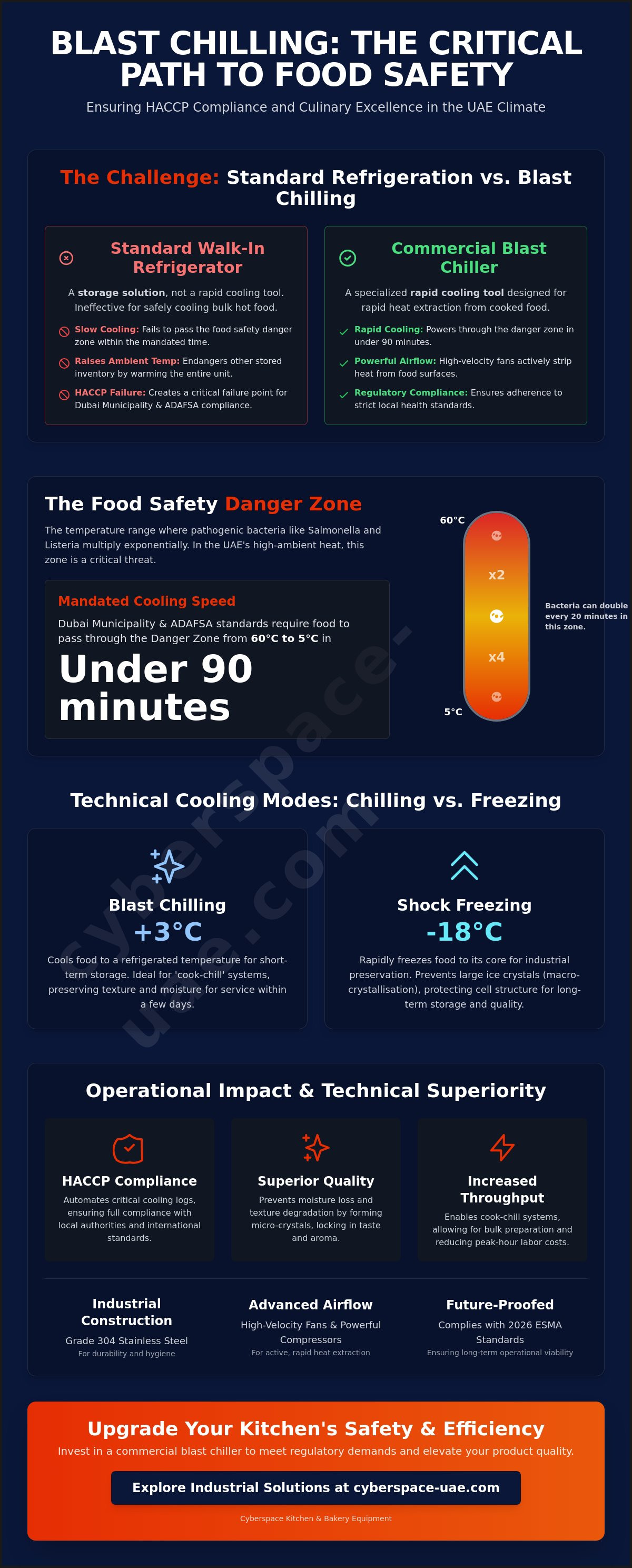
A standard walk-in refrigerator is a storage solution, not a cooling tool for food safety. In the high-ambient heat of the UAE, relying on static refrigeration to cool bulk cooked product creates a critical failure point for HACCP compliance. Integrating a commercial blast chiller Dubai into your workflow ensures that food passes through the 60°C to 5°C danger zone in under 90 minutes. This is a technical requirement mandated by Dubai Municipality and ADAFSA standards for professional food service operations.
Maintaining consistent texture in baked goods and preventing moisture loss requires precise thermodynamic control that standard units cannot provide. You likely recognize the pressure of local health inspections and the operational cost of food spoilage during slow cooling cycles. This guide details the technical mechanics of industrial chilling, the specific regulatory requirements for ZAD registration, and the operational impact on kitchen throughput. You'll understand how Grade 304 stainless steel construction and advanced airflow systems extend shelf life while ensuring full compliance with the 2026 ESMA electrical standards and UAE climate laws.
Key Takeaways
- Identify the thermodynamic mechanics required to bypass the 5°C to 60°C bacterial danger zone within the mandated 90-minute window.
- Evaluate the performance differences between +3°C blast chilling for short-term quality and -18°C shock freezing for industrial preservation.
- Specify technical requirements for a commercial blast chiller Dubai regarding compressor power and Grade 304 stainless steel construction.
- Analyze how high-performance cooling systems facilitate HACCP compliance and improve kitchen throughput in high-volume environments.
What is a Commercial Blast Chiller?
A commercial blast chiller is a specialized refrigeration unit designed for the rapid extraction of thermal energy from cooked food. It's not a storage device. Its primary function is to lower the core temperature of hot products at high speeds, moving them through the bacterial danger zone far faster than standard equipment. While a walk-in freezer maintains a set temperature, it lacks the airflow and compressor strength to cool bulk hot items without risking system failure or food spoilage. Placing hot trays in a standard refrigerator also raises the ambient temperature, which can compromise the safety of other stored inventory.
The machinery relies on a specific mechanical configuration to achieve industrial-grade results. High-velocity fans circulate chilled air constantly across the product surface. Powerful compressors manage the intense heat load without cycling off, and evaporator coils with high surface areas facilitate the rapid exchange of heat. For any professional operation, a commercial blast chiller Dubai is a technical necessity to meet modern production demands and local safety regulations. Understanding What is Blast Chilling helps operators recognize the difference between static cooling and active heat extraction.
The Role of Rapid Temperature Reduction
The cooling process relies on high-speed airflow to strip heat from the surface of the product continuously. This isn't passive cooling; it's an active thermodynamic process. Integrated core temperature probes are essential for precision. These sensors provide real-time data from the center of the food, allowing the system to adjust fan speeds and temperatures automatically. This prevents surface freezing while the core remains warm. By cooling rapidly, the unit prevents the formation of large ice crystals. This protects the cellular structure of the food, ensuring that moisture and nutrients remain trapped inside rather than leaching out during reheating.
Industrial Applications Across Food Service
High-volume catering facilities use these units to implement "cook-chill" systems. This operational model allows chefs to prepare large quantities of food, chill them rapidly, and store them safely for later service. It increases kitchen throughput and reduces labor costs during peak hours. Professional bakeries also utilize this technology. A blast chiller can instantly stop the fermentation process in dough, giving bakers total control over the production timeline. This speed preserves the organoleptic properties of the food. Taste, texture, and aroma are maintained at peak levels because the rapid temperature drop locks in the product's original state. Integrating a commercial blast chiller Dubai into a bakery or catering workflow ensures that quality remains consistent from the first batch to the last.
The Science of Food Safety and the Danger Zone
Food safety in industrial kitchens is a matter of thermodynamic management. The food safety Danger Zone represents the temperature range between 5°C and 60°C where microbial activity is most aggressive. Pathogenic bacteria can double in number in as little as 20 minutes within this range. In high-volume environments, allowing large batches of food to cool at room temperature or in standard chillers is a violation of international safety protocols. It's a risk that professional operators cannot afford.
A commercial blast chiller Dubai provides the necessary cooling power to bypass this zone in under 90 minutes. This speed is critical for inhibiting the growth of Salmonella, Listeria, and Clostridium perfringens. Standard walk-in units cannot handle the latent heat of bulk cooked product. Attempting to do so causes the internal temperature of the refrigerator to rise, endangering all other stored inventory. Industrial-grade machinery uses high-capacity evaporator coils and powerful compressors to maintain a constant descent in temperature regardless of the external ambient heat, which often exceeds 45°C in the UAE.
Regulatory compliance in Dubai and the wider UAE focuses on the implementation of Hazard Analysis and Critical Control Points (HACCP). Local authorities like the Dubai Municipality and ADAFSA require strict adherence to these cooling timelines. Failure to document these processes can result in failed inspections and operational shutdowns. Professional kitchens can view industrial cooling options that automate these safety requirements through precision engineering.
Micro-crystallisation vs. Macro-crystallisation
The speed of cooling directly affects food quality at a cellular level. Slow cooling leads to macro-crystallisation. This is where large ice crystals form and rupture the cell membranes of the food. It results in significant "drip loss" and a degraded, mushy texture upon thawing. Rapid cooling through a commercial blast chiller Dubai facilitates micro-crystallisation. Small, uniform ice crystals form without damaging the product's structure. This is vital for delicate items like puff pastry, laminated doughs, and high-protein meats. It ensures that the organoleptic properties, specifically texture and moisture retention, remain identical to the freshly cooked state.
HACCP Documentation and Temperature Logging
Modern food safety requires verifiable data. Digital logging systems in industrial chillers record temperature fluctuations automatically via internal sensors and core probes. This provides a verifiable digital trail for health inspectors and internal quality control teams. Modern kitchens don't rely on manual temperature logs, which are prone to human error. Automated logging ensures a 100% accurate cold chain from the moment food leaves the oven until it reaches storage. This level of documentation is a standard requirement for ZAD registration and ECAS conformity in the UAE.
Blast Chilling vs. Shock Freezing: Technical Differences
Blast chilling and shock freezing serve distinct operational goals. Blast chilling targets a core temperature of +3°C. This mode is intended for short-term preservation, typically extending shelf life up to 5 days without quality loss. Shock freezing is more aggressive. It drives the core temperature down to -18°C. This process allows for long-term storage across several months. Industrial rapid cooling equipment often features dual-mode functionality to handle both requirements. Selecting a commercial blast chiller Dubai with multi-mode capability provides maximum flexibility for high-volume kitchens managing diverse menus.
Dedicated chillers are optimized for the +3°C range. They use specific evaporator configurations to prevent surface freezing. Dual-function units require more sophisticated control logic and powerful compressors to transition between chilling and freezing cycles. The operational choice depends on the production cycle. Cook-chill workflows favor blast chilling for immediate service. Cook-freeze workflows require the -18°C capability of shock freezing for inventory building. It's a technical distinction that defines equipment ROI and kitchen efficiency.
Performance Metrics and Tray Capacities
Throughput is measured by the weight of food cooled per cycle. Standard industrial units utilize Gastronorm (GN) tray configurations. Common sizes include 5, 10, or 20 GN 1/1 trays. A 10-tray unit might handle 25kg for chilling and 15kg for freezing. Energy consumption is a critical metric. High-capacity units must balance rapid extraction with electrical efficiency. Operators should verify the compressor's kilowatt rating against the intended load to ensure the 90-minute safety window is consistently met. Using a commercial blast chiller Dubai with the correct tray capacity prevents overloading, which can lead to uneven cooling and safety risks.
Choosing the Right Mode for Bakery Products
Bakery applications require specific temperature paths. Par-baked bread should be blast chilled to +3°C if finishing is scheduled for the same day. This stops the cooking process immediately while maintaining crumb moisture. For long-term inventory, shock freezing raw dough portions or pastry shells to -18°C is the standard. Humidity control is vital here. Advanced units manage internal moisture levels to prevent "skinning" or surface cracking on dough. Controlled airflow prevents the dry, cold air from stripping moisture from laminated doughs and delicate puff pastries. This preservation of moisture ensures the final baked product maintains its intended texture and volume.
Selection Criteria for Industrial Cooling Systems
Selecting a commercial blast chiller Dubai requires a technical evaluation of the unit's thermal capacity. Standard refrigeration compressors often fail under the extreme ambient heat of UAE kitchens, which frequently exceeds 45°C. Industrial-grade units must feature tropicalized condensing units. These components are engineered to maintain high-velocity heat extraction even when external temperatures are high. A failure to match compressor power to the kitchen environment leads to extended cooling cycles and compromised food safety.
Material specifications define the equipment's lifespan. Grade 304 stainless steel is the industrial standard for both internal and external surfaces. It provides superior corrosion resistance against food acids and cleaning chemicals. Internal configurations must include adjustable runners. This allows operators to customize tray spacing, ensuring unobstructed airflow between GN pans. Sanitation is equally critical. High-performance units feature coved internal corners and removable magnetic gaskets. These design choices eliminate bacterial harbor points and simplify daily maintenance routines.
Control Systems and User Interface
Modern industrial units offer programmable cycles for various food profiles. Hard chill modes use aggressive air temperatures for dense proteins like beef or poultry. Soft chill modes protect delicate items, such as creams or pastries, from surface freezing. Touch-screen interfaces provide precision and data logging capabilities, while manual dials offer industrial durability in high-traffic environments. Visual and audible alarms are mandatory. These notify staff of cycle completion or system errors, ensuring food doesn't remain in the unit longer than the safety protocol allows.
Sizing and Ventilation Requirements
Footprint and clearance are essential for condenser health. Units require specific air gaps to prevent heat recirculation, which can lead to compressor burnout. For high-volume bakeries, integrating the chiller with existing baking deck ovens optimizes the cook-chill workflow. Remote refrigeration systems are an option for larger facilities. These move the heat and noise of the compressor outside the kitchen area. This improves the working environment and reduces the load on the facility's HVAC system. Examine our industrial cooling inventory to match a system to your specific kitchen dimensions.
Industrial Solutions from Cyberspace Kitchen & Bakery Equipment
Cyberspace Kitchen & Bakery Equipment provides high-performance, brand-new industrial blast chillers designed for the rigorous demands of the Middle Eastern market. Every unit in our inventory meets current commercial food standards. This includes adherence to ZAD registration requirements and the thermodynamic performance levels mandated by Dubai Municipality. We focus on delivering machinery that integrates seamlessly into high-volume production lines. For industrial facilities, we specialize in aligning cooling stages with industrial rotary baking ovens. This ensures that high-temperature products move immediately into a controlled cooling environment. This transition is critical for preserving structural integrity and moisture levels in bulk baked goods.
Our role as a direct supplier for professional F&B clients ensures access to specialized bakery and kitchen machinery. We do not supply residential appliances or refurbished units. Every piece of equipment, from spiral mixers to a commercial blast chiller Dubai, is sourced for its industrial durability and technical precision. This focus on brand-new, high-spec hardware reduces the risk of mechanical failure in high-ambient environments. We provide the tools necessary for facilities to maintain a verifiable cold chain and achieve full HACCP compliance without operational delays.
Professional Consultation and Equipment Sourcing
Selecting the correct tray capacity is vital for maintaining kitchen momentum. Our technical support team assists in calculating throughput requirements based on your specific daily production volume. We provide guidance on units that feature integrated HACCP-compliant temperature logging and digital data exports. This simplifies the auditing process required for local health inspections. Our procurement process is streamlined for new commercial kitchen setups. We ensure that technical specifications match the electrical and ventilation requirements of your facility. This prevents installation issues and ensures the machinery operates at peak efficiency from day one.
Supporting the UAE Food Service Industry
Reliable delivery and accurate technical specifications are the foundations of our service. We prioritize operational longevity. Every commercial blast chiller Dubai supplied is engineered for continuous industrial use in extreme climates. We understand the practical realities of the local food service industry. Precision in temperature control and efficiency in heat extraction are mandatory for business continuity. Our inventory includes advanced solutions for deck ovens, dough sheeters, and planetary mixers to complete your production line. Contact Cyberspace for a professional equipment consultation to review technical data and sourcing options for your facility.
Optimizing Industrial Food Safety Standards
Implementing thermodynamic cooling is a technical requirement for high-volume food service operations. Rapid extraction of heat prevents microbial growth and ensures full compliance with local municipality safety standards. Integrating a commercial blast chiller Dubai into your facility protects food texture and extends shelf life by bypassing the bacterial danger zone within the required 90-minute window. This process is essential for maintaining the organoleptic properties of bulk cooked products across your inventory.
Proper equipment selection focuses on tropicalized compressors and Grade 304 stainless steel construction for long-term operational reliability. As specialized industrial bakery suppliers, Cyberspace provides professional-grade new equipment backed by comprehensive technical support. We ensure your machinery meets the rigorous environmental and regulatory demands of the UAE market. Our focus on precision engineering helps facilities achieve consistent results and improved kitchen throughput without compromising safety.
View Our Range of Professional Blast Chillers to streamline your production workflow and maintain peak safety standards. Your facility deserves the efficiency and reliability of high-performance industrial tools.
Frequently Asked Questions
What is the difference between a blast chiller and a regular commercial freezer?
Blast chillers use high-velocity fans and powerful compressors to extract heat rapidly, whereas regular freezers are designed only to maintain the temperature of already-cooled food. A standard freezer lacks the airflow to move hot food through the danger zone quickly. Using a regular freezer for hot food also risks raising the internal temperature, which can compromise other stored inventory.
How long does a typical blast chilling cycle take for hot food?
A standard blast chilling cycle reduces the core temperature of food from +70°C to +3°C in approximately 90 minutes. For shock freezing, the cycle typically takes 240 minutes to reach -18°C. These timelines are critical for meeting safety standards. Total cycle time depends on food density and tray loading. Utilizing a high-performance commercial blast chiller Dubai ensures these safety windows are maintained consistently regardless of external heat.
Is a blast chiller mandatory for HACCP compliance in the UAE?
Yes, blast chilling is a functional requirement for HACCP compliance under Dubai Municipality and ADAFSA regulations. UAE law mandates that cooked food passes through the 60°C to 5°C danger zone within strict time limits. Standard refrigeration cannot achieve these speeds for bulk quantities. Failure to meet these cooling parameters results in non-compliance during health inspections and compromises food safety protocols in professional kitchens.
Can I put hot food directly from the oven into a blast chiller?
Yes, industrial blast chillers are specifically engineered to accept food at temperatures of +70°C or higher. Unlike standard refrigerators, these units use tropicalized compressors and high-capacity evaporators to manage extreme heat loads instantly. This immediate transition stops the cooking process and prevents bacterial multiplication. It's a standard practice in cook-chill and industrial bakery production environments.
What tray sizes are standard for commercial blast chillers?
Most industrial units utilize Gastronorm (GN) tray standards, specifically GN 1/1 measuring 530 x 325 mm. Capacity is usually defined by the number of trays the unit can hold, such as 5, 10, or 20 GN 1/1 levels. Some specialized bakery models also accommodate 600 x 400 mm EN trays. Selecting the correct configuration depends on your existing oven racks and production volume.
How does blast chilling improve the quality of bakery products?
Rapid cooling facilitates micro-crystallisation, which prevents large ice crystals from damaging the cellular structure of doughs and pastries. This process locks in moisture and prevents the product from becoming dry or crumbly. For bakeries, a commercial blast chiller Dubai is essential for stopping fermentation precisely and maintaining the organoleptic properties of par-baked goods. This ensures consistent quality from production to service.
What maintenance is required for an industrial blast chiller?
Daily maintenance includes cleaning the internal chamber and checking the core temperature probe for debris. Condenser coils require monthly cleaning to ensure efficient airflow, especially in high-dust or high-grease environments. Operators should also inspect door gaskets for a proper seal. Regular calibration of the digital sensors ensures the unit continues to meet HACCP logging requirements accurately and prevents mechanical downtime.