
Professional Baking Deck Oven Suppliers: Industrial Procurement Guide 2026
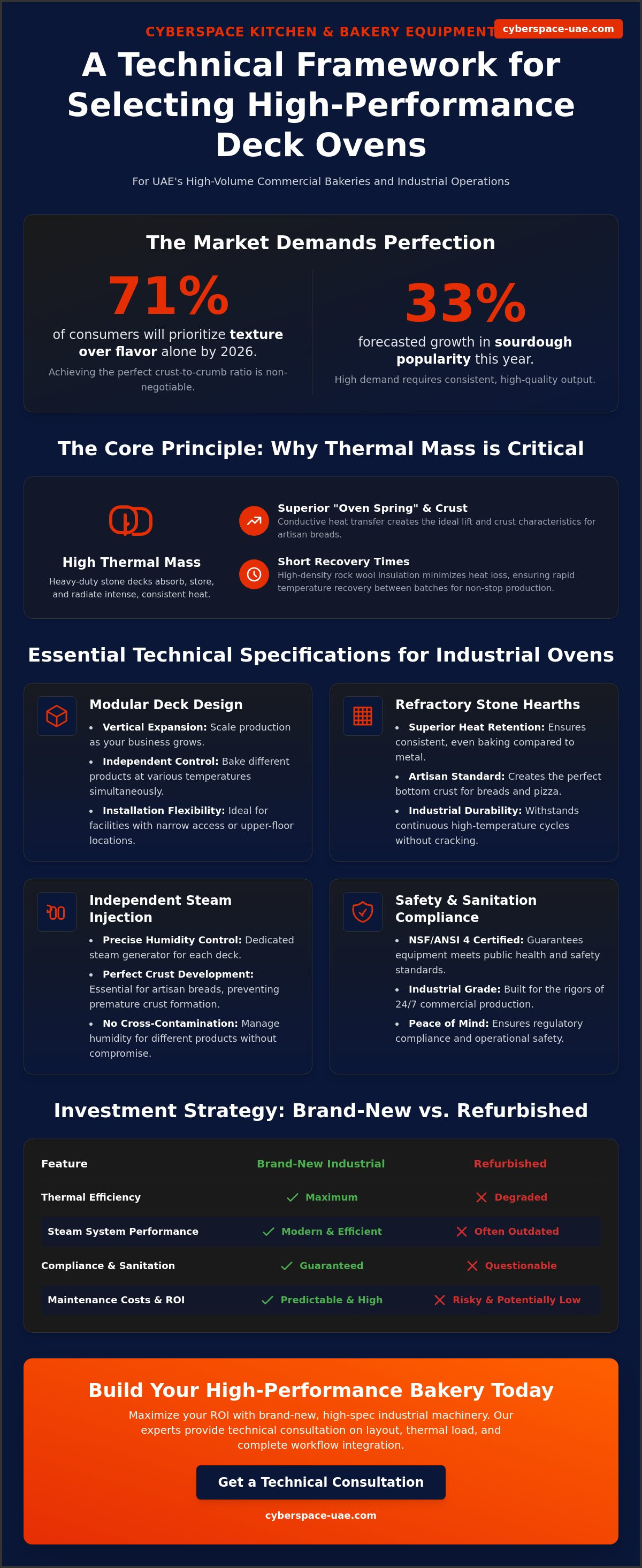
71% of consumers prioritize texture over flavor alone in 2026. For UAE commercial bakeries, achieving the perfect crust-to-crumb ratio depends on precise thermal mass and moisture control. You understand that inconsistent heat and failing steam systems in low-end models destroy product consistency. Sourcing brand-new, high-spec machinery requires a rigorous technical evaluation of baking deck oven suppliers to ensure operational excellence.
This guide provides a technical framework for selecting high-performance deck ovens. It focuses on equipment that delivers consistent artisan quality and long-term durability. We'll examine modular deck systems, the latest NSF/ANSI 4 standards, and procurement criteria for high-volume industrial operations. This information ensures your production line meets the demands of a market where sourdough popularity is forecasted to grow by 33% this year. You'll gain the clarity needed to invest in machinery that supports both artisan craftsmanship and industrial efficiency.
Key Takeaways
- Evaluate baking deck oven suppliers using a technical framework that prioritizes thermal mass and expert layout consultation for industrial operations.
- Identify critical specifications including stone hearth composition and modular designs to ensure consistent artisan bread quality.
- Analyze operational cost differences and heat distribution profiles between electric modular systems and high-volume gas configurations.
- Maximize ROI by selecting brand-new industrial machinery instead of refurbished units to ensure equipment longevity and sanitation compliance.
- Optimize production workflow by integrating high-performance deck systems with compatible industrial equipment like spiral mixers.
Identifying High-Performance Baking Deck Oven Suppliers
Industrial deck ovens are high-thermal-mass baking systems designed for heavy-duty commercial use. Unlike convection models, these units utilize conductive heat transfer through stone or ceramic decks to achieve specific crust characteristics. Leading baking deck oven suppliers categorize these machines as Industrial Ovens due to their specialized insulation and high-capacity heating elements. In the UAE's competitive bakery sector, selecting a supplier involves more than comparing price lists. It requires a partner capable of technical consultation regarding floor load limits, electrical requirements, and ventilation for multi-deck configurations.
Sourcing brand-new equipment is critical for industrial longevity. While some market players offer refurbished units, these often lack the thermal efficiency and updated steam injection systems required for modern production. New machinery ensures compliance with current safety standards and provides a predictable ROI through reduced maintenance costs. Professional deck systems are essential for artisan bread and pastry production, where precise temperature control determines the final product's quality.
The Role of Thermal Mass in Professional Baking
Heat retention is the primary performance metric for professional decks. Stone-lined decks absorb and store thermal energy, transferring it directly to the dough. This process ensures consistent crust development and "oven spring" in artisan breads. Professional baking deck oven suppliers prioritize heavy-duty insulation materials like high-density rock wool to minimize heat loss between batches. Short recovery times allow high-volume bakeries to maintain throughput without temperature fluctuations. This is vital for meeting the 33% forecasted growth in sourdough popularity for 2026, where texture is a primary consumer priority.
Supplier Capabilities and Industrial Standards
Industrial standards dictate equipment reliability in the UAE market. Suppliers must provide technical documentation confirming compliance with safety and sanitation regulations, such as NSF/ANSI 4. A capable partner evaluates your specific facility layout to determine if a modular or fixed multi-deck configuration is optimal. Key evaluation criteria for an industrial supplier include:
- Technical Expertise: Ability to calculate total thermal load and utility requirements.
- Modular Solutions: Availability of modular ovens for facilities with restricted access or upper-floor locations.
- Compliance: Verification of integrated electrical safety and sanitation certifications.
- Equipment Integration: Knowledge of how deck ovens interface with other machinery like spiral mixers and provers.
Working with a specialized supplier ensures that the machinery matches the specific throughput needs of your operation. High-spec industrial machinery provides the durability needed for 24-hour production cycles common in large-scale UAE bakeries.
Essential Technical Specifications for Industrial Deck Ovens
Industrial procurement requires precise technical evaluation. High-performance deck ovens must meet specific output requirements while maintaining structural integrity. Professional baking deck oven suppliers offer modular designs that allow for vertical expansion as production volume increases. Unlike fixed multi-deck units, modular systems facilitate easier installation in UAE facilities with narrow access points or upper-floor locations. This flexibility is critical for urban bakeries where floor space is at a premium. Each deck operates as an independent unit, allowing for diverse product baking at various temperatures simultaneously.
Stone Hearth and Deck Construction
Refractory stone decks are the industry standard for artisan bread production. These materials provide superior heat retention compared to metal alternatives. High-thermal-mass stone ensures consistent conductive heat transfer to the dough. This is essential for achieving the 55% increase in texture contrast demanded by 2026 consumers. Deck height also impacts performance; lower decks are optimized for pastries and flatbreads, while higher decks accommodate large artisan loaves. Durable refractory materials withstand continuous industrial cycles without cracking or losing thermal efficiency under high-volume stress.
Steam Injection and Humidity Control
Artisan production requires independent steam generators for each deck. This configuration allows bakers to manage different products without cross-contamination of humidity levels. High-quality steam injection ensures maximum bread volume and a characteristic crust shine. Technical specifications must include robust water filtration systems to prevent scale buildup in steam nozzles. Reliable baking deck oven suppliers specify water quality requirements to maintain long-term equipment durability. Precise humidity management is a non-negotiable feature for bakeries targeting the growing sourdough market, which is forecasted for 33% growth this year.
Digital control panels provide micro-adjustments for top and bottom heat. These systems allow for pre-programmed baking profiles, reducing operator error in high-volume environments. Modern interfaces monitor energy consumption and steam duration with precision. Structural requirements include heavy-gauge 304 stainless steel for all exterior and interior surfaces. This material choice ensures industrial hygiene and resistance to corrosion in high-humidity bakery environments. Adherence to Kitchen Equipment Safety Standards is mandatory to protect operators during high-temperature cycles. Selecting the right professional deck oven ensures your facility meets both safety and performance benchmarks.
Performance Comparison: Electric vs. Gas Deck Systems
Energy source selection determines the operational flexibility and utility requirements of a commercial bakery. High-performance baking deck oven suppliers provide both electric and gas configurations, each serving distinct production goals. Electric modular systems offer superior precision for temperature-sensitive products. Gas-powered units provide the aggressive thermal output required for continuous, high-volume bread production. Deciding between these systems requires an analysis of facility infrastructure, including available electrical load and gas ventilation capacity in UAE industrial zones.
Electric Deck Oven Advantages
Electric systems utilize independent heating elements for top and bottom heat control. This allows for micro-adjustments essential for delicate pastries and desserts where texture contrast is critical. Modular electric decks facilitate easy scaling; bakeries can add individual decks as demand grows without overhauling the entire system. These units have lower maintenance requirements because they lack complex burner assemblies and gas valves. Adherence to American National Standards for Baking Equipment ensures that electric models meet modern safety and sanitation benchmarks for industrial use. They are ideal for urban UAE facilities where gas line installation is restricted or cost-prohibitive.
Gas Deck Oven Considerations
Gas systems are the industry standard for heavy artisan bread production. They offer rapid temperature recovery speeds, which is vital for maintaining throughput during 24-hour production cycles. In the UAE, industrial gas installations must follow strict safety protocols, including specialized ventilation and fire suppression systems. While the initial installation is more complex, gas ovens often provide lower long-term energy consumption for large-scale national operations. These systems deliver the high-thermal-mass heat necessary for the 33% forecasted growth in sourdough production, ensuring deep crust development and consistent crumb structure across all decks.
Temperature recovery is a primary performance metric in industrial environments. Electric models have improved significantly, with high-wattage elements now rivaling gas recovery times. However, gas remains superior for extremely high-volume plants where the oven door is frequently opened. Installation requires a thorough audit of the facility's utility capacity. Electric units demand high amperage, while gas units require specific BTU ratings and exhaust ducting. Professional baking deck oven suppliers conduct site surveys to ensure the chosen power source aligns with the bakery's long-term operational costs and production targets.
Strategic Procurement: Evaluating Commercial Bakery Equipment Partners
Industrial procurement requires a shift from transactional purchasing to strategic partnership. Reliable baking deck oven suppliers provide more than just machinery; they offer technical integration and long-term operational security. Buyers must evaluate the supplier's ability to maintain high-volume production schedules without interruptions. A partner's technical literacy regarding relevant utility regulations is a non-negotiable requirement for large-scale operations. Procurement teams should focus on suppliers that demonstrate a deep understanding of thermal load calculations and facility layout optimization.
Inventory and Brand-New Equipment Priority
Prioritize suppliers that exclusively stock brand-new machinery. Refurbished units present significant risks in commercial environments, including inconsistent thermal mass and compromised steam systems. New equipment carries manufacturer warranties and ensures compliance with the latest NSF/ANSI 4 standards. Nationally, high-efficiency models reduce utility costs and provide a predictable ROI over a 10-year operational lifecycle. Investing in new technology avoids the hidden costs associated with used parts and outdated insulation materials. This ensures your facility meets the strict sanitation requirements of the national food service sector.
Technical Support and Maintenance Logistics
Operational downtime in industrial baking results in immediate revenue loss. Evaluate the supplier’s response time for critical repairs and the availability of specialized technicians across the nation. Technical support must include pre-installation site inspections to verify electrical loads and ventilation requirements. Regular calibration of deck temperatures is essential to maintain the texture quality 71% of consumers demand according to 2026 market data. A supplier that stocks essential spare parts locally minimizes the risk of extended production halts during peak seasons.
Integrated solutions extend beyond the oven itself. A strategic partner offers a complete ecosystem of machinery, including high-capacity spiral mixers for dough development and provers for humidity-controlled fermentation. Ensuring compatibility between these systems and your deck oven streamlines the production workflow and reduces manual labor. High-performance baking deck oven suppliers understand how each component, from dough sheeters to blast chillers, impacts the final product's quality and consistency. To ensure your facility operates at peak efficiency, view our commercial baking equipment range for high-spec industrial machinery.
Integrated Bakery Solutions from Cyberspace Kitchen & Bakery Equipment
Cyberspace Kitchen & Bakery Equipment operates as a specialized facilitator for industrial baking operations in the UAE. We provide high-spec machinery designed for seamless technical integration. Compatibility between deck ovens and our spiral mixers ensures uniform dough development and consistent results. This synergy reduces mechanical stress and optimizes production timelines. As established baking deck oven suppliers, we deliver cohesive equipment packages that meet the rigorous demands of high-volume facilities. Our focus remains on functional clarity and operational excellence.
Streamlining a commercial bakery requires more than isolated machinery. Integrated dough sheeters and provers allow for a continuous workflow from preparation to the final bake. For kitchens requiring multi-functional capabilities, we supply Rational combi ovens to handle diverse culinary tasks alongside specialized baking lines. This modular approach ensures that each piece of equipment contributes to a streamlined user journey and maximum throughput.
The Complete Industrial Baking Line
Coordinating deck ovens with high-capacity spiral and planetary mixers is essential for large-scale production. Proper dough development in the mixer directly impacts the oven spring and final texture of the bread. Our provers and retarders provide precise fermentation control, which is vital for the 33% forecasted growth in sourdough popularity. For pastry operations, blast chillers play a critical role in high-volume production. They allow for rapid temperature reduction, preserving product integrity and meeting strict UAE food safety standards. This integrated machinery ecosystem minimizes manual intervention and maximizes consistency.
Consultation and Equipment Selection
Technical literacy is required to select the correct equipment configuration. Our experts provide guidance on oven tray capacity and the number of decks needed to meet specific hourly output targets. We analyze your facility's utility requirements and floor space to ensure the machinery fits the industrial reality of your operation. Customizing equipment packages allows for precise alignment with your culinary applications, whether focusing on artisan loaves or miniature desserts. Precision matters in industrial procurement. Contact Cyberspace Kitchen & Bakery Equipment to secure professional-grade baking solutions tailored to your operational requirements.
Optimizing Industrial Baking Output for 2026
Industrial procurement requires a focus on high-thermal-mass systems and modularity. You've seen how technical specifications like refractory stone hearths and independent steam generators directly impact product quality. Selecting reliable baking deck oven suppliers ensures your facility meets the 2026 market demand for superior texture and artisan consistency. Prioritize brand-new machinery to guarantee compliance with NSF/ANSI 4 sanitation standards and long-term durability. Avoiding refurbished units protects your ROI and operational uptime in the UAE's competitive food sector.
Cyberspace Kitchen & Bakery Equipment provides the technical expertise needed for large-scale operations. We offer a comprehensive range of industrial tools, from high-capacity spiral mixers to blast chillers and dough sheeters. Our inventory includes high-end brands like Rational and specialized deck systems designed for the UAE's specific industrial environment. We facilitate a streamlined production line through expert consultation and equipment integration. This approach ensures your machinery works as a cohesive unit from dough preparation to final bake.
Contact Cyberspace Kitchen & Bakery Equipment for Professional Procurement to secure your facility's operational future. Your production excellence starts with the right industrial tools.
Frequently Asked Questions
What are the main advantages of a stone deck oven for bakeries?
Stone deck ovens provide high thermal mass and direct conductive heat transfer. This is essential for achieving the crunchy exterior and soft interior consumers demand. Refractory stone decks absorb moisture from the dough, facilitating superior crust development and oven spring compared to standard metal surfaces.
How many decks should a commercial bakery oven have for high volume?
Commercial bakeries usually require 3 to 4 decks for high-volume operations. Total capacity depends on tray dimensions, typically 600x400mm or 460x760mm. Modular systems allow you to stack additional decks as production increases, ensuring your facility remains efficient without utilizing excessive floor space.
What is the difference between an electric and gas deck oven in performance?
Electric deck ovens offer independent top and bottom heat control for micro-adjustments and precision. Gas systems provide faster temperature recovery for continuous baking cycles in heavy-duty environments. Leading baking deck oven suppliers recommend electric models for delicate pastries and gas models for continuous artisan bread production.
Why is steam injection critical in a professional deck oven?
Steam injection is critical for crust gelatinization and maximum bread volume. High-quality steam prevents the dough surface from drying too quickly, allowing the loaf to expand fully before the crust sets. It also creates the characteristic shine and crispness that 71% of consumers prioritize when evaluating baked goods.
How do I choose between a deck oven and a rotary rack oven?
Choose a deck oven for artisan products requiring direct contact heat and stone-baked characteristics. Rotary rack ovens are better for high-volume production of uniform items like buns or cookies using convective heat. Deck ovens prioritize texture contrast, while rotary ovens focus on throughput and ease of loading.
What maintenance is required for an industrial deck oven?
Maintenance involves daily stone cleaning and periodic steam generator descaling. Technicians should inspect door seals and heating elements every six months. In the UAE, robust water filtration systems are mandatory to prevent mineral buildup in steam nozzles, ensuring long-term equipment durability and consistent performance.
Can a deck oven be used for both bread and pizza production?
Yes, deck ovens are versatile enough for both bread and pizza production. High-temperature refractory stones can reach the 350°C to 400°C required for thin-crust pizza. Ensure the deck height is sufficient for large artisan loaves while the digital controls allow for the rapid heat needed for pizza.
What are the electrical requirements for a 3-deck electric oven?
A 3-deck electric oven typically requires a 3-phase 380V to 415V power supply. Amperage varies by model but often ranges between 30A and 60A depending on the kW rating of the heating elements. Consult with baking deck oven suppliers to verify your facility's total electrical load and breaker capacity before installation.