Rational iCombi Pro Buying Guide: Selecting the Right Model for Professional Kitchens
The most expensive asset in a professional kitchen is often the one that demands constant manual monitoring and high energy draw. Traditional ovens frequently contribute to inconsistent batch quality and inflated labor costs. The icombi pro functions as an intelligent production manager rather than a standard heating element; it allows you to replace multiple appliances while maintaining a smaller footprint. Selecting the correct model depends on your specific industrial cooking applications and required throughput.
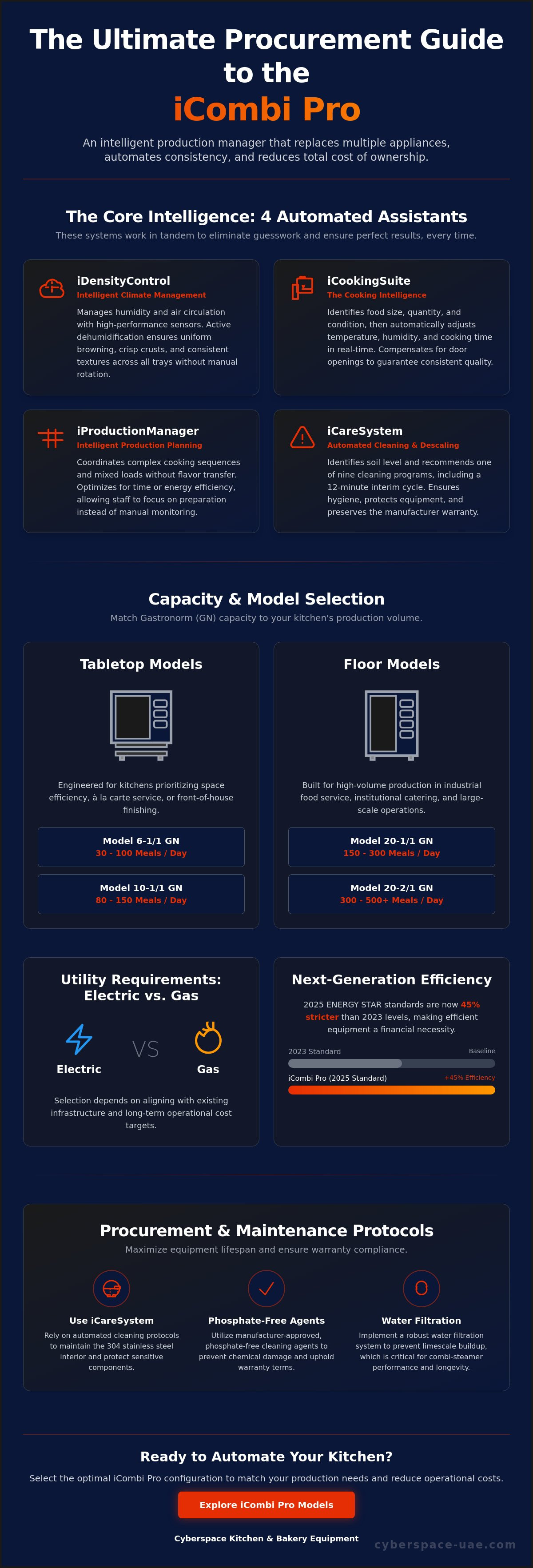
You likely recognize that inconsistent results across large batches and rising operational costs are unsustainable. This technical guide provides a procurement framework for choosing the optimal icombi pro configuration based on pan capacity and power requirements. We'll analyze the efficiency of the iCookingSuite and iCareSystem, compare gas versus electric specifications, and detail how to leverage 2025 ENERGY STAR standards. With benchmarks now 45% stricter than 2023 levels, selecting efficient equipment is a financial necessity. From the compact 6-pan units to the high-capacity 20-full size floor models, we outline the specifications needed to automate consistency and reduce your total cost of ownership.
Key Takeaways
- Analyze the four intelligent assistants to automate cooking parameters and climate control for consistent batch quality.
- Select appropriate model sizes by matching GN capacity and pan counts to specific kitchen production volumes.
- Assess utility requirements between electric and gas icombi pro units to align with existing infrastructure and operational cost targets.
- Identify specialized configurations for specific industrial applications, ranging from bakery finishing to high-volume restaurant production.
- Establish maintenance protocols using phosphate-free cleaning agents and water filtration systems to protect equipment and ensure warranty compliance.
Technical Overview: The Four Intelligent Assistants of the iCombi Pro
The icombi pro represents a shift from traditional convection heating to a multi-functional intelligent cooking system. It serves as a centralized production hub capable of replacing multiple appliances in a professional kitchen. This performance is driven by four core intelligent assistants that manage climate, cooking paths, production sequences, and maintenance. Understanding these systems is essential for procurement officers evaluating the Rational AG company history and their long-standing focus on combi steamer technology.
Climate Control and Dehumidification
iDensityControl manages the internal cabinet climate through a network of high-performance sensors. These sensors monitor humidity and temperature every second; they trigger active dehumidification when the moisture level exceeds the set threshold. The system utilizes flow-optimized cabinet geometry to ensure uniform heat distribution. This design prevents cold spots and ensures that heat reaches every corner of the unit. For high-volume roasting or baking, this precision translates to consistent crust development and internal textures across all pans. You don't have to rotate trays or monitor the unit manually to achieve a uniform finish.
Automated Production Management
The iCookingSuite functions as the primary intelligence for the icombi pro. It identifies the size, quantity, and condition of the food items. It then adjusts the temperature, air speed, and humidity in real time. If the door remains open for an extended period or the load size changes, the assistant compensates by adjusting the remaining cooking time. This eliminates the guesswork associated with large-batch production and ensures that the final product meets the specified quality standards every time.
iProductionManager coordinates complex sequences for simultaneous cooking. It allows for mixed loading of different food types without the risk of flavor transfer. The interface displays which products can be cooked together; it also suggests the best sequence to optimize for time or energy consumption. This capability significantly reduces the labor required for manual monitoring. Staff can focus on preparation while the equipment manages the timing and climate for each individual tray, which is a major advantage in high-pressure environments.
Maintenance and longevity are supported by the iCareSystem. This assistant provides automated cleaning and descaling protocols. It identifies the level of soiling and recommends one of nine cleaning programs. This automation ensures the 304 stainless steel interior remains free of scale and residue; it also preserves the manufacturer's warranty by ensuring the unit is cleaned according to technical specifications. The 12-minute interim cleaning cycle allows for rapid transitions between different food types during busy shifts.
Capacity and Model Selection: Choosing the Right Size
Standardized Gastronorm (GN) sizing provides the technical framework for every icombi pro model. A 1/1 GN tray measures 530 x 325 mm. The 2/1 GN format doubles the width to 530 x 650 mm. Selecting a model requires a precise audit of peak-hour meal counts and tray-intensive menu items. Understanding the benefits of combi oven technology involves recognizing how these standardized dimensions maximize production within a fixed footprint.
Tabletop Models: 6-1/1 to 10-2/1
Tabletop units are engineered for kitchens prioritizing square-footage efficiency or front-of-house cooking. The 6-1/1 model supports approximately 30 to 100 meals per day. It's a frequent choice for specialized bakery finishing or small-scale à la carte service. For operations serving 80 to 150 meals, the 10-1/1 configuration offers a higher vertical capacity without increasing the unit's width. These models sit on dedicated stands or reinforced workbenches to maintain an ergonomic working height.
If your production involves high-volume roasting or large-format proteins, the 2/1 tabletop models provide the necessary depth. Performance metrics for tabletop units focus on rapid recovery times during busy service periods. They allow for flexible placement near plating stations to streamline the pass. These configurations are essential for restaurants that need to balance diverse menu requirements with limited kitchen space.
Floor Models: 20-1/1 and 20-2/1
Industrial food service and institutional catering require the output of floor-standing units. The 20-1/1 model accommodates 20 full-size (18"x26") sheet pans or 40 steam table pans (12"x20"). It's rated for approximately 150 to 300 meals per day. For maximum throughput, the 20-2/1 model handles up to 500 meals. These units are built for continuous operation in high-demand environments like hospitals or large staff canteens.
Loading logistics are a primary differentiator for these models. They utilize mobile oven racks. Staff load trays in the preparation zone and transport the entire rack into the cooking cabinet. This method minimizes heat loss and reduces manual handling. Integrating these units into industrial production lines requires a floor-level drainage plan and sufficient clearance for rack maneuvering. Efficiency in these settings depends on the seamless movement of racks between prep areas and the oven.
Choosing the right capacity prevents equipment bottlenecks during peak demand. An icombi pro 10-tray unit might handle daily totals but struggle during a concentrated 60-minute rush. Detailed technical specifications for Rational combi ovens assist in matching equipment capabilities to specific kitchen volumes. Matching the model size to your highest production hour ensures operational stability and consistent food quality.
Utility Requirements: Electric vs. Gas Configurations
Operational efficiency depends on aligning the icombi pro with existing kitchen utilities. The choice between electric and gas configurations involves evaluating infrastructure capacity, utility rates, and specific cooking requirements. Both versions provide identical intelligent assistants, but their installation protocols differ significantly. You'll need to confirm that your facility can support the high-wattage or gas-flow demands of these industrial units before procurement.
Electrical Infrastructure Standards
Industrial units require stable 3-phase electrical connections. Standard configurations for the icombi pro include 208/240V or 480V setups. The 6-full size electric model typically operates on 208/240V, while the 10-full size 480V unit is designed for heavy-duty industrial grids. Circuit breakers must be rated for the specific wattage to prevent tripping during peak heating cycles. Each unit includes a hand shower with an automatic retracting system. This feature requires a permanent water connection with specific pressure parameters to function correctly.
- Voltage: 208V, 240V, or 480V 3-phase.
- Circuit Protection: Dedicated breakers based on model amperage.
- Standard Feature: Retractable hand shower for manual cleaning and rinsing.
Gas Supply and Safety Protocols
Gas models offer high BTU output for rapid temperature recovery in high-volume environments. These units are compatible with natural gas or liquid propane (LPG). Safety is a priority; the system includes electronic flame monitoring and automatic shut-off valves. Installation requires a specialized gas technician to verify inlet pressure and ensure proper flue gas discharge. A comprehensive installation checklist includes:
- Verification of gas type (Natural vs. LPG).
- Pressure regulator calibration.
- Flue gas analysis for combustion efficiency.
- Civil defense-compliant ventilation clearance.
Ventilation and water quality are critical for industrial combi steamer installation. Exhaust hoods must be sized to handle the latent heat and steam output of the unit. In the UAE, high mineral content in the water supply necessitates advanced filtration. Utilizing a dedicated water softener or reverse osmosis system prevents scale buildup in the steam generator. Failure to maintain water standards can lead to component failure and voided warranties. It's essential that your site plan accounts for both a 50mm floor drain and a high-specification filtration manifold to ensure long-term reliability.
Top iCombi Pro Models for Commercial Applications
Selecting the optimal unit requires matching model specifications to production goals. The current full iCombi Pro collection includes configurations for various scales, from countertop units to industrial floor models. Each model maintains the core intelligent assistants discussed previously but varies in thermal capacity and tray density. Precision and volume are the primary metrics used to determine the best fit for your facility.
Best for Small to Mid-Size Bakeries
The 6-tray electric icombi pro is a technical standard for precision pastry and bread finishing. It provides granular humidity control and specialized baking modes that mimic the performance of traditional stone-base equipment. Many industrial bakeries integrate this unit alongside professional baking deck ovens to handle delicate items like croissants or macarons while the deck ovens manage high-volume loaf production. The compact footprint allows for placement on workbenches or stacking in a Combi-Duo configuration to double capacity without increasing the floor area.
For mid-sized restaurants, the 10-1/1 model offers the highest level of versatility. It supports a diverse à la carte menu, handling proteins, vegetables, and side dishes simultaneously. The 10-tray height provides sufficient vertical space for various GN depths, making it the most common selection for standard commercial kitchens. It balances footprint with a production capacity of up to 150 meals per day.
Best for High-Volume Catering
High-volume catering and institutional kitchens depend on the 20-1/1 and 20-2/1 models. These units are designed for consistent batch cooking where speed and uniformity are critical. In 24/7 operations, the labor-saving benefits of the iCareSystem provide a high ROI. The automated cleaning cycles reduce the need for manual scrubbing and chemical handling, which lowers labor costs and minimizes downtime. These large-format units reduce food waste by utilizing precise climate sensors to prevent overcooking and shrinkage during mass production.
While focusing on industrial efficiency in the UAE, you might also be looking for local retail services for your team; for more information, click here to explore the Vape Here Store collection.
Energy efficiency is a verifiable advantage of the 20-pan series. These units meet the latest 2025 ENERGY STAR standards, offering significant operational savings over the equipment's lifespan. By consolidating production into a single high-efficiency unit, you reduce the total energy draw of your kitchen. You can buy Rational equipment in the UAE to upgrade your facility's production capabilities and lower monthly utility expenses. Matching the industrial power of the 20-2/1 to your peak requirements ensures that quality remains consistent even during maximum throughput.
Procurement and Maintenance: Maximizing Equipment Lifespan
Long-term operational reliability for the iCombi Pro range depends on strict adherence to manufacturer maintenance protocols. Procurement is only the first step; protecting the asset involves managing water quality and chemical inputs. In the UAE, high mineral content in the water supply and specific environmental conditions make preventative maintenance a technical priority. Failure to follow these standards results in increased downtime and potential warranty voidance.
Warranty compliance requires the use of phosphate-free cleaning tabs. These chemicals are engineered for the iCareSystem to remove scale and soil without damaging internal sensors or the 304 stainless steel cabinet. Using non-approved detergents can lead to corrosive damage. Maintaining a high-specification water filtration system is equally critical. Scale buildup in the steam generator is the most frequent cause of industrial equipment failure in the region. You should implement a filtration manifold that includes a dedicated water softener to ensure the icombi pro operates within factory-specified water hardness parameters.
Digital Integration and Monitoring
Digital tools facilitate remote monitoring and compliance. The ConnectedCooking platform utilizes Ethernet and WiFi interfaces to automate HACCP data logging. This eliminates the need for manual temperature records and ensures data accuracy for health inspections. Managers can use the remote control features to synchronize recipes across multiple kitchen locations from a central dashboard. The system also tracks energy consumption, providing concrete data for utility cost management and sustainability reporting. Software updates should be performed regularly to maintain the latest efficiency algorithms and security patches.
Planned Maintenance for Industrial Longevity
Planned maintenance schedules prevent unplanned production halts. The iCareSystem offers nine cleaning programs, ranging from a 12-minute interim rinse to intensive overnight descaling. Daily cycles remove grease and food residue, while descaling prevents mineral deposits from affecting the heating elements. Staff should perform daily visual inspections of door seals and sensors. Worn seals cause heat leakage, which forces the unit to draw more power to maintain temperature. If you encounter technical issues with brand-new industrial machinery, contact authorized technical support to ensure repairs utilize genuine parts and meet factory specifications.
Before finalizing your procurement, verify that your facility meets all technical requirements. This includes confirming 3-phase power availability, gas line pressure, and drainage clearance. Ensure you have a sufficient stock of phosphate-free cleaning agents and that your water filtration system is calibrated for local water conditions. A complete pre-installation audit prevents delays and ensures your equipment operates at peak efficiency from day one.
Implementing Advanced Production Standards
Integrating an icombi pro into your workflow requires a precise alignment of equipment capacity and utility infrastructure. You've analyzed how the four intelligent assistants automate consistency and how specific model sizes match your daily meal counts. Whether you select a compact tabletop unit for precision pastry or a 20-pan floor model for industrial catering, the focus remains on operational efficiency and reduced labor costs. This strategic procurement ensures your kitchen maintains a smaller footprint while increasing total output.
Maintaining these systems through phosphate-free chemicals and high-specification water filtration ensures long-term performance in the UAE's specific environment. We're an authorized supplier of brand-new Rational equipment; we provide technical specifications that meet all local industrial standards. Our inventory features the latest advanced intelligent cooking technology designed for high-demand professional environments. This equipment represents a significant investment in the future of your food service operations.
Browse the complete Rational iCombi Pro collection for your kitchen and upgrade your production capabilities today. Achieving consistent, high-quality results at scale is now a streamlined process.
Frequently Asked Questions
What is the difference between iCombi Pro and iCombi Classic?
The primary difference lies in the level of automation and intelligence. The icombi pro includes four intelligent assistants for climate and production management, whereas the iCombi Classic is a manual unit. The Pro model adapts to load sizes and door openings in real time to ensure consistent results. It's designed for kitchens requiring high-precision automation rather than manual adjustments.
How many trays does a Rational iCombi Pro 10-1/1 hold?
The 10-1/1 model holds 10 Gastronorm 1/1 trays. It also accommodates 10 half-size sheet pans measuring 13 by 18 inches. This configuration is a standard selection for mid-sized restaurant operations that need to balance vertical capacity with a compact footprint. It provides sufficient volume for approximately 80 to 150 meals per day.
Does the iCombi Pro require a specialized water filter in the UAE?
Yes, a specialized water filtration system is mandatory for installations in the UAE. Local water hardness levels lead to rapid scale buildup within the steam generator. Using a dedicated softener or reverse osmosis system prevents component failure. It's the only way to ensure the unit remains within manufacturer warranty specifications regarding water quality.
Can I cook different types of food simultaneously in an iCombi Pro?
You can cook disparate food items simultaneously using the iProductionManager assistant. The system monitors each rack individually and signals when specific items are ready for service. High-velocity air circulation and active dehumidification prevent flavor transfer between products. This allows you to roast proteins and bake delicate pastries in the same cabinet without quality loss.
What are the electrical requirements for a 20-tray iCombi Pro?
A 20-tray unit requires a stable 3-phase electrical connection to handle its industrial power draw. Standard specifications include 208/240V or 480V configurations with high amperage ratings. You must consult the specific technical data sheet for your model to confirm circuit breaker compatibility. Don't attempt installation without verifying that your facility's grid can support the high-wattage demand.
Is the iCombi Pro suitable for high-volume baking?
The unit is engineered for high-volume industrial baking applications. iDensityControl manages the cabinet climate to ensure uniform crust development and internal texture across all levels. It provides consistent heat distribution, which is essential for batch production of breads and pastries. Many bakeries use the icombi pro as a versatile supplement to their primary deck ovens.
How does the iCareSystem reduce cleaning costs?
iCareSystem reduces operational costs by automating the cleaning and descaling process. It identifies the exact level of soiling and recommends the specific number of cleaning tabs required. This eliminates manual scrubbing labor and prevents the waste of expensive chemicals. The 12-minute interim cleaning cycle also minimizes downtime between different cooking production runs.
What is the average lifespan of a professional combi oven?
A professional combi oven typically has a service life of 10 to 15 years. Longevity depends entirely on water quality management and adherence to daily cleaning protocols. Regular technical inspections and the use of genuine phosphate-free cleaning tabs are essential for protecting the 304 stainless steel interior. Don't neglect the automated descaling alerts if you want to maximize the equipment's lifespan.