
Blast Chiller Installation Requirements in the UAE: Technical Guide 2026
In the UAE, industrial blast chiller performance depends more on environmental control than hardware capacity. Operating a commercial kitchen in ambient temperatures reaching 43°C creates immediate technical hurdles for standard refrigeration systems. You're likely aware that adhering to the 2026 unified national food safety system demands precise planning to avoid costly compliance failures. Meeting the blast chiller installation requirements UAE authorities mandate is essential for maintaining operational reliability and food safety standards.
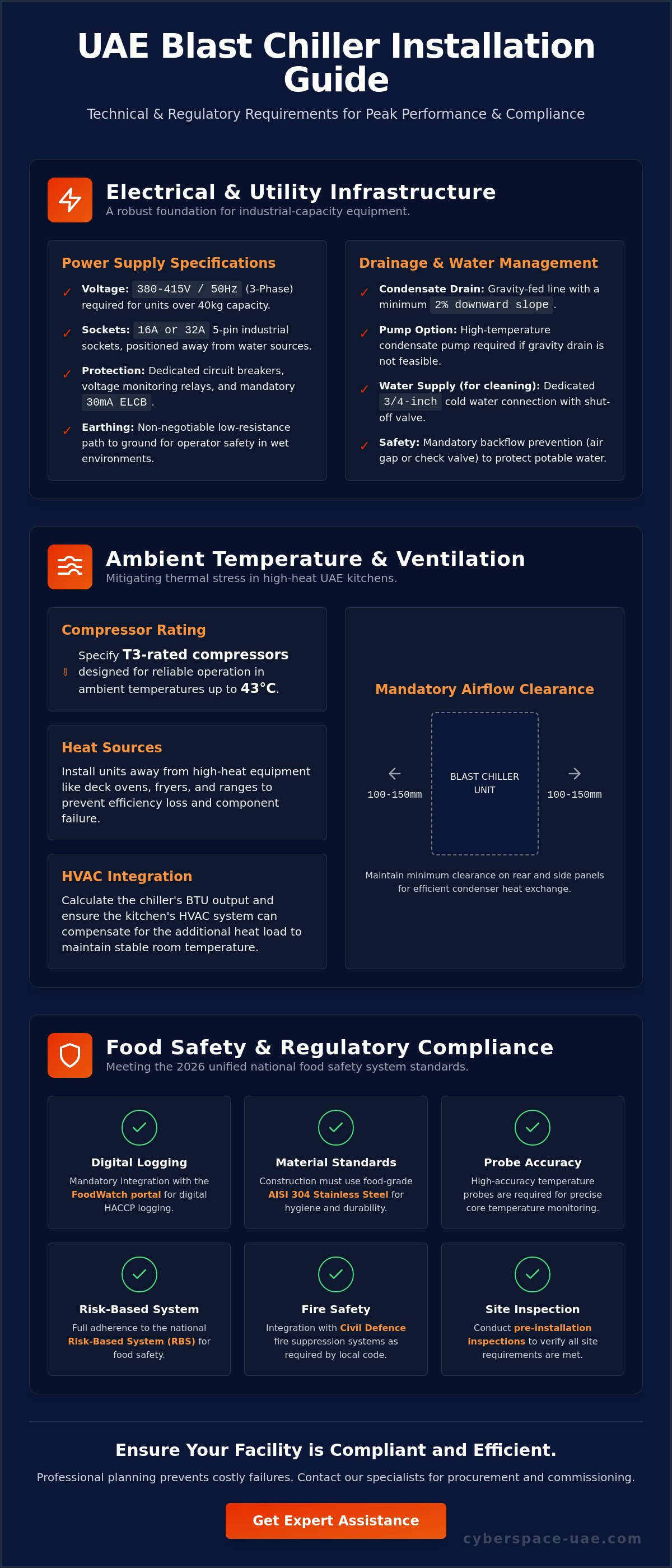
This technical guide provides a direct breakdown of the electrical, plumbing, and regulatory benchmarks required for a successful installation. It covers the transition to the national Risk-Based System (RBS) and the mandatory digital logging via the FoodWatch portal. You'll find specific details on 380-415V three-phase power configurations, the necessity of T3-rated compressors for high-heat environments, and mandatory 30mA ELCB circuit protections. We'll examine the integration of Civil Defence fire suppression requirements and the specific drainage needs for high-capacity units. This overview ensures your facility moves from equipment delivery to full regulatory compliance with maximum efficiency.
Key Takeaways
- Verify 3-phase power supply (400V/50Hz) and dedicated circuit breakers to handle industrial-capacity loads and prevent electrical surges.
- Mitigate high ambient heat impacts by specifying T3-rated compressors and maintaining minimum clearance for efficient condenser airflow.
- Ensure full compliance with 2026 food safety standards by meeting the specific blast chiller installation requirements UAE regulators demand for AISI 304 stainless steel and probe accuracy.
- Assess floor loading capacity and door swing radius to optimize workflow integration within narrow kitchen layouts.
- Conduct pre-installation site inspections to align equipment throughput and recovery times with facility operational requirements.
Electrical and Utility Infrastructure Requirements
Industrial capacity equipment requires a robust utility foundation to maintain consistent performance. In the UAE, the primary infrastructure hurdle involves matching the electrical load of high-performance machinery with existing facility capabilities. Adhering to the specific blast chiller installation requirements UAE authorities mandate prevents equipment failure and ensures food safety compliance. Precise planning during the fit-out phase eliminates the need for costly electrical retrofitting once the unit arrives on site.
Power Supply Specifications
Commercial blast chillers with capacities exceeding 40kg typically require a three-phase power supply (380-415V, 50Hz). This configuration balances the load across three conductors, which reduces the amperage per phase and improves motor efficiency. Installers must use 16A or 32A 5-pin industrial sockets, depending on the unit's specific power draw. The socket should be positioned at a height that prevents water ingress during floor cleaning but remains accessible for maintenance.
Voltage stability is a critical factor for long-term reliability. Fluctuations in the local grid can damage sensitive electronic control boards and touchscreens. Facility managers should install voltage monitoring relays to disconnect power if levels deviate beyond safe parameters. Every unit must have a dedicated circuit breaker. This prevents operational surges from affecting other kitchen equipment and simplifies maintenance lock-out procedures. Earthing is non-negotiable. High-voltage machinery requires a low-resistance path to ground to protect operators from electrical faults in wet kitchen environments.
Drainage and Waste Management
Blast chilling generates significant amounts of condensate as warm food releases moisture during the rapid cooling process. Efficient removal of this liquid is essential to prevent ice buildup on the evaporator coils and maintain hygiene. Stagnant water inside the unit creates a biological hazard and can lead to foul odors that affect food quality.
Gravity drains are the preferred method for condensate removal. The drain line must have a consistent downward slope of at least 2% toward the floor hub. If a gravity drain isn't feasible due to floor levels, a high-temperature condensate pump is required. UAE municipal standards often require these lines to connect to grease traps before entering the main sewage system. This prevents fats and oils from solidifying in the pipes, which is a common cause of kitchen drainage blockages.
Integrated cleaning cycles in modern units require a dedicated water supply. These units need a 3/4-inch cold water connection with a shut-off valve within one meter of the machine. Backflow prevention is mandatory. Air gaps or check valves must be installed to ensure that wastewater cannot siphon back into the potable water system during high-volume production shifts.
Ambient Temperature and Ventilation Standards
Industrial blast chillers in the UAE operate under extreme thermal stress. Standard refrigeration systems often fail when ambient kitchen temperatures exceed 38°C. To ensure operational stability, units must feature T3-rated compressors designed for 43°C environments. Failing to address these ambient conditions is a primary cause of equipment downtime and shortened lifespans. Meeting the blast chiller installation requirements UAE climate dictates involves more than just physical placement. It requires a calculated ventilation strategy to manage heat rejection effectively.
Airflow and Clearance Zones
Proper clearance is mandatory for efficient heat exchange. Rear and side panels require a minimum of 100mm to 150mm of unobstructed space to allow the condenser to breathe. Don't install these units in direct proximity to high-heat equipment like rotary ovens or deck ovens. This proximity raises the intake air temperature, forcing the compressor to run longer and increasing energy consumption. Condenser coils must remain clear of dust and grease. Intake air quality is critical. If the air is laden with grease from nearby cooking stations, the condenser will clog, leading to high-pressure trips and system failure.
HVAC Load Integration
A blast chiller acts as a high-powered heat pump. It removes thermal energy from food and rejects it into the immediate environment. High-capacity units can significantly impact the facility's total cooling load. Engineers must calculate the BTU output of the unit during peak chilling cycles to ensure the kitchen's HVAC system can compensate. If the existing cooling infrastructure is insufficient, the kitchen temperature will rise, affecting the performance of all other refrigerated storage.
Maintaining these standards isn't just about machinery health. It's about food safety. Rapid cooling follows the HACCP Principles & Application Guidelines by moving food through the bacterial growth "danger zone" as quickly as possible. If ventilation is poor, the chiller won't meet the required pull-down times, resulting in regulatory non-compliance and potential health risks. For ultra-high-volume facilities, utilizing remote condenser options moves the heat rejection outside the building entirely. This setup maintains a stable internal climate and reduces the strain on kitchen AC units. Selecting the right blast chillers for your specific facility layout ensures your HVAC system remains balanced even during maximum production shifts.
HACCP and Food Safety Regulatory Compliance
The UAE's unified food safety framework implemented in 2026 mandates strict adherence to temperature control protocols for all commercial catering operations. Hardware selection is the first technical step in meeting the blast chiller installation requirements UAE municipal inspectors prioritize during site audits. All food-contact surfaces must be constructed from AISI 304 food-grade stainless steel. This material ensures high resistance to corrosion from salt and acidic food products while facilitating the high-temperature sanitization cycles required in industrial environments.
Compliance isn't limited to material durability; it extends to the precision of temperature monitoring. Core probes must be calibrated to ensure accuracy within +/- 0.5°C. This level of precision is necessary to verify that high-risk foods move through the bacterial growth "danger zone" (60°C to 10°C) within the maximum 90-minute window specified by national standards. Equipment lacking these calibrated monitoring systems will fail mandatory HACCP certification audits.
Data Logging and Monitoring
Digital accountability is central to the current regulatory landscape. Modern blast chillers must feature integrated USB ports or Wi-Fi-enabled temperature recording systems to facilitate real-time data export. These systems automate the collection of pull-down data, which is essential for compliance with Dubai's FoodWatch portal and the national Raqeeb smart inspection platform. Automated alarm systems are a technical necessity to alert kitchen staff of power failures or temperature deviations during the chilling cycle. Municipal health inspectors require facilities to maintain these digital records for a minimum of 90 days, though high-risk facilities often retain data for up to one year to mitigate liability.
Sanitary Design Requirements
Physical design elements dictate the long-term hygiene of the unit. Internal chambers should feature coved corners to eliminate debris traps where bacteria can proliferate. Removable magnetic gaskets are the industrial standard for hygiene; they allow for daily removal and deep cleaning without the use of specialized tools. Temperature probes require specific sanitation protocols after every cycle. Multi-point probes are recommended for large-scale production to account for temperature variations within high-density food loads. Ensuring the probe is properly cleaned and stored in its designated holder prevents cross-contamination between batches.
Physical Space Planning and Workflow Integration
Space planning is a critical phase that dictates the long-term efficiency of a commercial kitchen. Physical dimensions and structural readiness are core components of the blast chiller installation requirements UAE facilities must address to ensure operational success. A unit that fits the physical footprint but disrupts the logical flow of production will lead to increased labor costs and compromised food safety. Technical literacy regarding floor loads and clearance zones is mandatory before procurement.
Floor and Structural Integrity
Industrial blast freezers and high-capacity chillers exert significant point loads on kitchen flooring. Standard tile and screed often crack under the weight of a fully loaded 15-tray or roll-in unit. Reinforced flooring is a prerequisite for walk-in models to prevent structural subsidence over time. Leveling the unit during the commissioning phase is essential. Uneven surfaces cause chassis torque. This leads to door misalignment and compromised magnetic seal integrity, which forces the compressor to work harder to maintain internal temperatures. For roll-in trolley units, the floor must be perfectly flush or fitted with a heavy-duty stainless steel ramp. This allows for smooth entry without jarring food trays and causing spills.
Workflow Optimisation
Efficiency in a high-volume kitchen depends on the logical sequence of equipment. Minimize the distance between your Rational combi ovens and the blast chiller. Every second spent transporting hot food across a kitchen floor allows the core temperature to drop and increases the risk of atmospheric contamination. The goal is a seamless transition from the cooking zone to the chilling zone to the final cold storage holding area.
Compatibility with tray standards is a technical requirement that prevents production bottlenecks. Most UAE facilities utilize GN 1/1 pans or 600x400 mm bakery trays. Verify that the internal racking system supports the specific tray dimensions used in your existing production line. This eliminates the need for manual re-plating, which is a major source of cross-contamination and labor inefficiency.
In narrow kitchen aisles, the door swing radius is a primary constraint. Many industrial chillers feature reversible doors or 90-degree stop hinges to prevent collisions with prep tables. Maintain at least 1.2 meters of clearance in front of the unit. This provides sufficient space for trolley maneuvering and the safe extraction of heavy trays by staff. View our full range of industrial blast chillers to find the specific footprint that fits your facility's structural capacity and production volume.
Professional Procurement and Commissioning
Procurement is the final technical phase where planning translates into operational reality. Equipment selection must align with specific throughput requirements and recovery times. In high-volume UAE catering, recovery time—the interval needed for the evaporator to return to the setpoint temperature after a cycle—is as critical as total tray capacity. Selecting a unit based solely on footprint without calculating these recovery cycles leads to production bottlenecks. Adhering to the final blast chiller installation requirements UAE technicians verify during commissioning ensures the machinery operates within its engineered parameters from day one.
Site Inspection and Validation
Utility readiness must be confirmed before equipment delivery to prevent costly logistical delays. This involves a final check of the three-phase power sockets and drainage points established in the early fit-out stages. Logistics managers must verify the entire facility path. Measure all doorway clearances and elevator capacities from the loading dock to the final installation site. Industrial units often require specialized lifting equipment; a 15-tray model's weight can exceed 200kg. During the physical placement, technicians must perform a final validation of the refrigerant charge. Transport-related vibrations can occasionally cause micro-leaks in the capillary tubes. Checking the standing and suction pressures before the initial start-up protects the compressor from running under-charged.
Industrial Performance Testing
Commissioning requires more than a simple power-on test. Technicians must execute a full test cycle under a simulated or actual food load to verify pull-down times. This performance data is recorded in the initial commissioning report, which serves as the baseline for warranty activation and future maintenance comparisons. If the unit fails to reach the target core temperature within the 90-minute regulatory window, the ventilation and refrigerant levels require immediate recalibration.
Staff training is the final step in the commissioning process. Operators must be proficient in navigating industrial control interfaces, which often include multi-program cycles for different food densities. Training should focus on commercial blast chiller Dubai safety protocols, specifically the correct placement of core probes and the interpretation of digital error codes. Key training points include:
- Selection of hard-chill versus soft-chill cycles based on food delicacy.
- Manual defrost initiation procedures to manage heavy ice buildup.
- Data export protocols for daily HACCP logging requirements.
- Emergency shut-off procedures and breaker reset locations.
Documenting these steps in a formal handover ensures that the facility meets all municipal standards and that the equipment is positioned for long-term reliability in the UAE's demanding climate.
Optimizing Industrial Chilling Infrastructure
Achieving full compliance with the 2026 national food safety standards requires strict adherence to technical benchmarks. Success depends on verifying 415V three-phase power stability and ensuring T3-rated compressors have sufficient clearance for high-heat rejection. These blast chiller installation requirements UAE authorities mandate are the foundation for equipment longevity and food safety. Integrating digital data logging and optimizing the workflow between cooking and storage zones ensures maximum efficiency during high-volume shifts. Every technical detail, from drain slope to core probe calibration, contributes to the reliability of your cold chain.
Proper physical planning and professional commissioning eliminate the risks of structural floor failure or regulatory non-compliance. We're a specialized industrial machinery supplier offering high-end commercial kitchen solutions tailored for the regional climate. Our team provides national UAE delivery and technical support to ensure your facility remains operational and compliant. Secure your kitchen's productivity today. Browse our range of high-performance industrial blast chillers for the UAE.
Frequently Asked Questions
What is the standard electrical requirement for a blast chiller in the UAE?
Industrial blast chillers in the UAE operate on a 380-415V AC, 50Hz power supply. Smaller 5-tray units may utilize a single-phase 220-240V connection. All installations must include an Earth Leakage Circuit Breaker (ELCB) or RCD rated at 30mA. This is a non-negotiable safety standard for commercial kitchen electrical circuits across all emirates to protect staff from electrical faults in wet environments.
Does a blast chiller require a dedicated floor drain?
A dedicated drainage point is necessary for efficient condensate removal during the chilling cycle. Most municipal standards require these units to connect to a floor hub or grease trap to prevent blockages. Gravity drains must maintain a 2% downward slope. In facilities where floor levels don't allow for gravity drainage, a high-temperature condensate pump must be integrated into the system to prevent water stagnation.
How much clearance is needed around an industrial blast chiller?
Rear and side panels require a minimum clearance of 100mm to 150mm for consistent airflow. This space prevents the air-cooled condenser from overheating in high-ambient conditions. Front clearance should be at least 1.2 meters to accommodate the full door swing and trolley maneuvering. Maintaining these zones is a key part of the blast chiller installation requirements UAE technicians check during mandatory site inspections.
Can a blast chiller be installed next to a baking oven?
Don't install a blast chiller directly adjacent to high-heat equipment like rotary ovens or deck ovens. The heat rejected by ovens raises the ambient air temperature, which significantly reduces the chiller's condenser efficiency. This proximity forces the compressor to run continuously, increasing energy costs and the risk of mechanical failure. Maintain a thermal buffer zone or use heat shielding if kitchen space is limited.
What are the HACCP temperature logging requirements for chillers?
UAE national food safety codes require digital temperature logging with a minimum 90-day data retention period. Systems must record the pull-down time from 60°C to 10°C within 90 minutes. Integrated Wi-Fi or USB monitoring is essential for compliance with the Dubai FoodWatch portal and national inspection platforms. Core probes must maintain an accuracy of +/- 0.5°C to pass municipal health audits and ensure food safety.
Do I need a 3-phase power supply for a commercial blast chiller?
Three-phase power is mandatory for most industrial-scale chillers with capacities exceeding 40kg. This configuration ensures a balanced electrical load and provides the necessary torque for high-performance compressors. Utilizing three-phase power improves operational efficiency and prevents the voltage drops often associated with heavy-duty single-phase equipment. It's the standard requirement for maintaining consistent cooling performance in professional catering environments.
How does ambient heat in the UAE affect blast chiller performance?
High ambient temperatures in the UAE can cause standard refrigeration systems to trip on high-pressure faults. Units must be specified with T3-rated compressors capable of operating in 43°C environments. Without adequate HVAC integration and ventilation, the blast chiller will fail to meet mandatory pull-down times. This leads to regulatory non-compliance and shortened equipment lifespans due to excessive compressor strain in the desert climate.
Is professional commissioning mandatory for blast chiller warranties?
Professional commissioning is a mandatory requirement for activating manufacturer warranties in the commercial sector. A certified technician must document the initial start-up, refrigerant pressures, and successful load testing. This report provides the baseline data needed for future technical support. Failing to provide a documented commissioning report often voids the warranty if a compressor failure occurs during the initial period of operation.