
Commercial Deck Oven Temperature Control: Industrial Precision Guide
Thermal mass equilibrium dictates product quality more than simple thermostat accuracy in high-volume industrial baking. When production scales, minor temperature fluctuations across different decks result in uneven crust formation and inconsistent internal textures. Achieving precise commercial deck oven temperature control isn't merely about setting a target; it's about managing independent heat zones and maintaining thermal stability during rapid loading cycles. These variables directly impact your operational bottom line and product reliability.
You likely recognize the operational strain caused by heat loss and the resulting downtime required for frequent recalibration. This guide provides a technical breakdown of thermal regulation mechanics designed for professional environments. We focus on the implementation of independent deck management and high-density insulation to ensure uniform output across every tray. By mastering these industrial precision techniques, you'll secure consistent batch quality while significantly reducing energy consumption. The following sections detail the calibration protocols, PID controller applications, and hardware configurations necessary for optimized oven performance. Transitioning from basic operation to technical mastery ensures your facility maintains peak efficiency without compromising on the strict standards of professional baking.
Key Takeaways
- Implement independent deck regulation and dual-zone heating to stabilize commercial deck oven temperature control across multi-level baking systems.
- Assess the role of thermal mass in heat retention by comparing refractory stone hearths with reinforced steel decks for improved batch consistency.
- Integrate PID technology to utilize predictive algorithms that prevent temperature overshoot and maintain strict industrial precision.
- Adopt rigorous calibration protocols using digital pyrometers to ensure long-term thermal accuracy and minimize production interruptions.
- Analyze the operational differences between electric and gas configurations to optimize energy consumption within the UAE industrial infrastructure.
The Fundamentals of Independent Deck Temperature Regulation
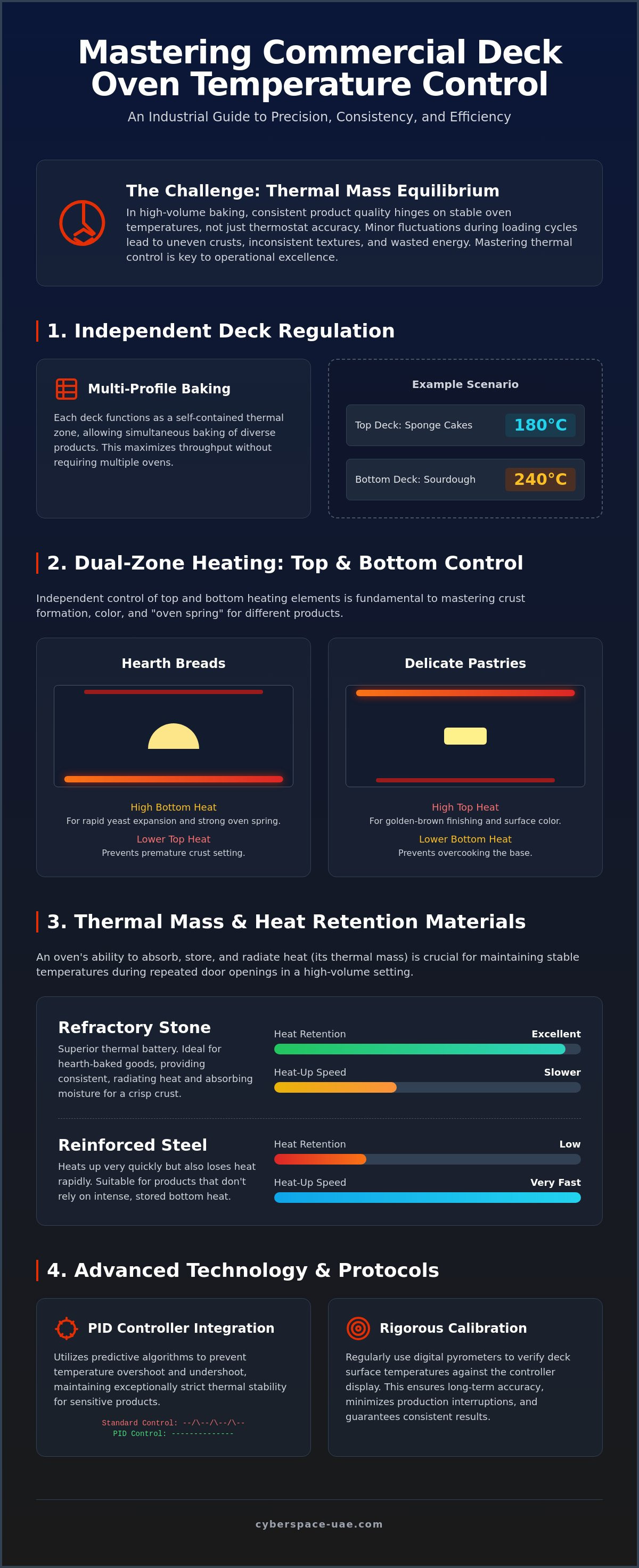
Independent deck control refers to the mechanical isolation of thermal zones within a multi-level baking system. Each deck functions as a self-contained unit. This configuration allows operators to execute different baking profiles simultaneously. For example, a bakery can maintain 240°C on the bottom deck for sourdough while the top deck sits at 180°C for delicate sponge cakes. This versatility is essential for high-volume industrial kitchens that require diverse product throughput without investing in multiple separate units. Efficiency depends on zone isolation; without it, heat bleed from one level compromises the precision of another.
Dual-zone heating involves the separate regulation of top and bottom heating elements. This is the foundation of commercial deck oven temperature control. By adjusting these elements independently, bakers control the "oven spring" and crust development. High bottom heat provides the immediate thermal energy required for yeast expansion. Lower top heat prevents the crust from setting too early. This balance ensures maximum volume and optimal crumb structure. It's a technical requirement for consistency. Professional grade Industrial ovens are designed specifically to manage these distinct thermal cycles across different stages of the baking process.
Top and Bottom Heat Ratios
The technical necessity of higher bottom heat for hearth-baked breads is undeniable. Stone decks store significant energy. When dough hits the stone, conduction triggers rapid expansion. Conversely, delicate pastries require higher top heat ratios to achieve golden-brown finishes without overcooking the base. Achieving thermal equilibrium within a single enclosed chamber requires the calibration of top and bottom element intensities relative to the product's moisture content. If the top heat is too high, surface charring occurs before the core is fully baked. Proper commercial deck oven temperature control allows for these micro-adjustments, ensuring the final product meets industrial quality standards every time.
Conduction vs. Radiation in Deck Systems
Deck systems rely on two primary heat transfer methods to cook products thoroughly. Stone decks facilitate conduction. This direct contact transfers heat from the refractory material into the dough, which is vital for base formation. Upper elements provide infrared radiation. This radiant heat penetrates the product surface, driving the Maillard reaction for crust browning and flavor development. Managing airflow is critical here. Unlike rotary ovens, deck environments must minimize convection. Excessive airflow causes moisture loss and uneven drying. Maintaining a static, humid atmosphere within the deck ensures the radiation and conduction work in tandem without convective interference.
Thermal Mass Management and Heat Retention Materials
Thermal mass represents the oven's capacity to absorb, store, and release heat energy. It functions as a thermal battery. In high-volume industrial baking, this stored energy is what maintains stability when cold dough enters the chamber. Effective commercial deck oven temperature control relies on high thermal inertia to prevent drastic fluctuations during production cycles. Without sufficient mass, the oven's internal temperature drops sharply every time the door opens, leading to uneven browning and stalled yeast activity.
Material selection determines this thermal behavior. Refractory stone hearths offer superior heat retention compared to reinforced steel decks. While steel heats up quickly, it loses energy just as fast. Stone provides a consistent, radiating heat source that is essential for hearth-baked products. In the UAE, where industrial kitchen ambient temperatures can be high, insulation density becomes a critical factor. High-performance ovens utilize high-density mineral wool or ceramic fibers to trap heat within the chamber. This prevents the equipment from overworking and reduces the load on facility HVAC systems. Selecting the right Deck Ovens with optimized insulation ensures that heat stays where it's needed most.
Refractory Stone Performance
The porosity of refractory stone is a functional advantage. It extracts moisture from the bottom of the dough, facilitating a crisp, well-developed crust. Stone thickness directly impacts saturation times. A standard 20mm stone deck typically requires 30 to 45 minutes to reach full thermal saturation. In contrast, heavy-duty 40mm stone decks may require 60 to 90 minutes to preheat. While the 40mm option takes longer to prep, it provides significantly better stability for back-to-back batches in 24-hour operations. These materials are designed for durability, resisting cracks even under the stress of continuous industrial use.
Oven Recovery Times
Recovery time is the duration required for the oven to return to its setpoint after a loading event. Every door opening causes an immediate loss of heated air. In a low-mass oven, this loss can result in a temperature drop of 20°C or more. High thermal mass mitigates this by radiating heat back into the air quickly. To maintain consistent commercial deck oven temperature control, operators should implement strategic loading patterns. Don't load all decks simultaneously. By staggering the loading times between different levels, you allow the system to recover more efficiently, ensuring each batch receives the same thermal energy from start to finish.
Advanced Digital Control Systems and PID Technology
Mechanical thermostats rely on bimetallic strips that lack the responsiveness required for industrial baking. Modern systems utilize Proportional-Integral-Derivative (PID) controllers. These units represent the current standard for commercial deck oven temperature control. Unlike basic on-off switches, PID controllers use mathematical algorithms to calculate the rate of temperature change. They adjust power output in real time. This prevents temperature overshoot, which occurs when heating elements continue to radiate heat after reaching the setpoint. By tapering power as the target temperature approaches, PID technology maintains a tight thermal window, often within one degree of the setpoint.
Digital systems facilitate multi-stage programmable baking profiles. These programs allow operators to automate complex thermal cycles. A typical profile might include a high-heat initial phase for crust development, followed by a lower-temperature finishing stage. Automation ensures batch consistency across different shifts. Integration of steam injection is also managed through these controllers. Steam introduces moisture but simultaneously causes a temporary thermal dip. Advanced digital systems anticipate this cooling effect. They automatically modulate element intensity during the steam cycle to maintain thermal equilibrium and prevent stalled yeast activity.
Digital Interface Capabilities
Modern digital interfaces provide comprehensive data logging. This real-time tracking is essential for HACCP compliance and quality control audits in professional UAE kitchens. User-defined presets allow for standardized production. Operators select a pre-configured profile, reducing the risk of human error during busy production windows. Diagnostic alerts provide an additional layer of reliability. These systems monitor element health and detect thermocouple drift. If a heating element fails or a sensor provides inaccurate data, the system triggers an immediate alert, allowing for proactive maintenance before batch quality is compromised.
Sensor Placement and Accuracy
The precision of a control system is only as good as its sensor data. Thermocouple positioning within the deck chamber is critical. Sensors must be shielded from direct contact with heating elements to avoid false high readings. In larger 3-tray or 4-tray configurations, multi-point sensing is required. This involves placing multiple thermocouples at strategic intervals across the deck surface. The controller uses this data to implement electronic element modulation. By adjusting power to specific sections of the heating array, the system eliminates cold spots. This ensures uniform heat distribution across the entire stone surface, regardless of the load size or tray position.
Operational Calibration Protocols for Temperature Consistency
Calibration ensures that the digital display reflects the actual thermal state of the baking chamber. In industrial environments, mechanical components undergo constant thermal stress. This leads to sensor drift. Drift occurs when thermocouples lose sensitivity, providing inaccurate data to the PID controller. Regular verification is necessary to maintain commercial deck oven temperature control and prevent batch failure. Without these protocols, your production quality depends on guesswork rather than data.
Effective commercial deck oven temperature control requires professional-grade instrumentation. Digital pyrometers and high-temperature data loggers are essential. A pyrometer measures the stone's surface temperature directly. Data loggers track the thermal curve over a complete baking cycle. These tools identify cold spots or sluggish recovery times that a standard display might miss. For multi-deck vertical stacks, this process is even more critical. Heat naturally migrates upward. You must calibrate each deck individually to ensure that a product baked on the bottom level matches the quality of one from the top. Maintaining high-performance Deck Ovens requires this level of technical oversight.
Step-by-Step Calibration Process
Follow this sequence to align your equipment with industrial standards:
- Cold-start baseline: Use an external probe to verify ambient readings match the display before heating.
- Surface verification: Heat to 220°C. Use a digital pyrometer to check five points on the stone: the four corners and the center.
- Offset adjustment: Modify the controller's configuration menu to correct discrepancies between display and actual readings.
- Load simulation: Run a full batch. Verify recovery speed matches the manufacturer's specification under load.
Preventative Maintenance for Heating Elements
Element health impacts thermal stability. Inspect ceramic insulators and wiring terminals monthly. Loose connections cause arcing and power loss. Test the amp draw on elements to identify partial failures. If an element draws low current, replace it immediately to prevent cold spots. Clean deck surfaces regularly. Carbon buildup acts as an insulator, obstructing thermal conduction from the stone to the dough. Clean stones ensure efficient energy transfer and consistent crust development across every batch.
Selecting High-Performance Deck Ovens for UAE Industrial Bakeries
Procurement decisions hinge on utility compatibility and grid load. Electric models provide superior commercial deck oven temperature control through precise element modulation. These units are often the standard for urban retail bakeries and shopping mall installations across the UAE. Phase-three electrical requirements must be verified before installation to ensure the building's infrastructure can support peak draw during heat-up phases. Gas-fired units are better suited for standalone industrial facilities where high-volume production requires lower utility overhead. Capacity planning is a long-term strategy. Modular multi-deck systems offer the flexibility to expand vertically. This prevents the need for total equipment replacement as production volume increases.
Industrial Procurement Criteria
Build quality remains the primary metric for industrial durability. Stainless steel grade 304 is the benchmark for corrosion resistance in humid kitchen environments. Door hinges and seals must withstand hundreds of cycles daily. Heat leakage from worn seals compromises thermal stability and increases energy waste. Steam generator capacity also impacts performance. It must recover quickly. Slow recovery stalls the baking cycle and affects crust development. These technical specifications are central to the selection process when working with professional baking deck oven suppliers. Every component must contribute to a stable thermal environment.
The Cyberspace Advantage
Cyberspace functions as a dedicated facilitator for industrial baking equipment. We offer exclusive access to high-end brands. New machinery only. Our inventory is curated for operational reliability. We do not deal in used or refurbished units. This commitment ensures that your commercial deck oven temperature control remains accurate from the first batch. For operations requiring diverse baking methods, we also manage the supply of industrial rotary baking ovens. Our procurement path is designed for efficiency. We prioritize local technical support. Rapid spare parts availability. This focus on after-sales reliability keeps production lines moving and protects your capital investment.
- Direct procurement for national commercial food service operations.
- Strict focus on new, high-performance industrial equipment.
- Technical support infrastructure for UAE-based facilities.
Achieving Industrial Thermal Stability
Precision in high-volume baking depends on the integration of PID technology and disciplined calibration. Managing independent heat zones ensures that product quality remains uniform across vertical stacks. Proper commercial deck oven temperature control eliminates the variables that lead to batch inconsistency and excessive energy consumption. By prioritizing thermal mass and material durability, facilities maintain peak operational efficiency during continuous production cycles. Technical mastery of these systems reduces downtime and secures the predictable results required in a competitive industrial landscape.
Cyberspace serves as a specialized supplier of professional-grade machinery, providing national UAE coverage for the industrial food service sector. We focus exclusively on high-performance, brand-new equipment to guarantee technical accuracy and longevity. Our procurement paths are designed to support the rigorous demands of large-scale commercial bakeries. Access our full range of technical solutions and View Industrial Deck Oven Specifications to optimize your facility's output today. Implementing these technical standards ensures long-term reliability and superior product results across every shift.
Frequently Asked Questions
What is the difference between top and bottom heat in a deck oven?
Top heat provides radiant energy for surface browning and crust development. Bottom heat transfers energy via conduction through the deck to drive dough expansion. Adjusting the ratio between these two elements allows for precise control over product volume and finish. This dual-zone regulation is a fundamental component of professional baking profiles.
Why is my deck oven losing temperature so quickly during loading?
Rapid heat loss occurs due to the escape of heated air and the introduction of cold dough mass. Ovens with low insulation density or insufficient thermal mass exhibit more drastic drops. Improving commercial deck oven temperature control involves using high-density refractory materials to store energy and minimize recovery windows during high-frequency loading cycles.
How do PID controllers improve baking consistency?
PID controllers use predictive algorithms to modulate power rather than simple on-off cycling. This prevents temperature overshoot and maintains a tight thermal window within one degree of the setpoint. It results in uniform batch quality by eliminating the wide fluctuations common in mechanical thermostats. Consistency is maintained through constant mathematical adjustments to element output.
What is the ideal temperature for baking sourdough in a stone deck oven?
Sourdough typically requires a deck temperature between 230°C and 250°C for the initial bake phase. High bottom heat is essential for the oven spring required to achieve maximum volume. The refractory stone surface provides the consistent conductive energy needed to develop a thick, artisanal crust while maintaining internal moisture levels.
Can I bake different products on different decks at the same time?
Yes, provided the oven features independent deck regulation. Multi-deck systems allow each chamber to operate at distinct temperatures. This enables the simultaneous production of high-heat products like pizza alongside lower-temperature items like pastries. Thermal isolation between levels prevents heat bleed from affecting the precision of adjacent decks.
How often should I calibrate my commercial deck oven's temperature sensors?
Industrial sensors should be calibrated every three to six months depending on production volume. High-frequency usage leads to thermocouple drift over time. Regular verification using external digital pyrometers ensures the display matches actual stone surface temperatures. This maintenance protocol is vital for maintaining commercial deck oven temperature control accuracy and batch reliability.
Does a stone deck require a longer preheating time than a steel deck?
Stone decks require significantly longer preheating times due to their higher thermal mass. While a steel deck might reach temperature in 20 minutes, a 40mm refractory stone hearth often requires 60 to 90 minutes to achieve full thermal saturation. This stored energy is necessary for consistent back-to-back baking and superior heat retention.
How does steam injection affect the internal temperature of the oven?
Steam injection causes an immediate, temporary drop in chamber temperature as the moisture absorbs thermal energy during vaporization. Advanced digital controllers compensate for this by temporarily increasing element intensity. This action maintains thermal equilibrium and ensures the dough continues to expand without stalling during the critical first minutes of the bake.