
Deck Oven vs Rotary Oven vs Combi Oven: Industrial Baking Comparison 2026
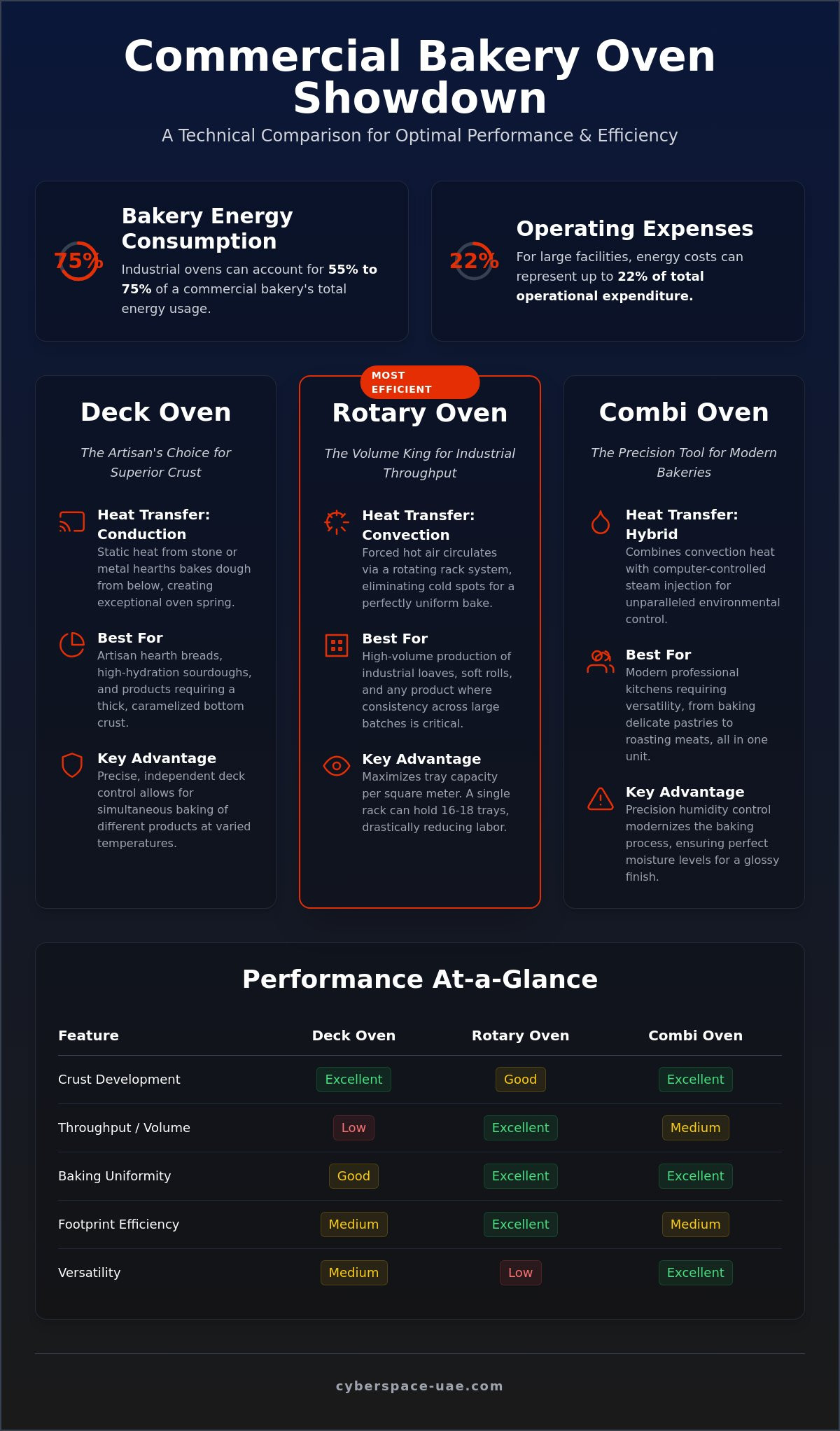
Industrial ovens account for 55% to 75% of total energy consumption in a commercial bakery. With energy costs reaching up to 22% of total operating expenses for large facilities, hardware selection is a critical financial decision. When evaluating a deck oven vs rotary oven for bread, the choice depends on your specific dough hydration levels and required throughput. Selecting the wrong technology results in inconsistent bake quality across large batches and unnecessary floor space consumption.
You need a setup that balances artisan quality with industrial efficiency. This technical comparison examines the performance of stone deck ovens, high-capacity rotary racks, and Rational iCombi Pro systems. This guide provides the data required to optimize crust development and maximize tray capacity per square meter. This analysis covers heat transfer mechanics, ANSI safety standards, and energy efficiency ratings to ensure your facility remains competitive through 2026. You will learn how to identify the most efficient oven for your specific dough types while maintaining precise control over crumb results.
Key Takeaways
- Analyze the performance trade-offs between a deck oven vs rotary oven for bread to determine the optimal balance of crust development and high-volume throughput.
- Evaluate heat transfer mechanics, including conduction and convection, to align machinery with specific dough hydration and crumb structure requirements.
- Examine the Rational iCombi Pro for precision humidity control and its role in modernizing professional bakery environments.
- Review operational factors including energy consumption, ventilation standards, and tray capacity per square meter to optimize facility footprint.
- Establish technical criteria for integrating new ovens with existing industrial dough processing equipment for maximum operational reliability.
Technical Overview of Commercial Baking Technologies
Industrial baking relies on three primary equipment categories: Deck, Rotary, and Combi ovens. These Industrial Oven Technologies represent the core infrastructure of any professional facility. Each type utilizes distinct thermodynamic principles to transform dough into finished product. The selection process begins with understanding heat transfer mechanics: conduction, convection, and steam-assisted radiation. These forces dictate the rate of moisture evaporation and the speed of crust formation.
Thermal mass determines how an oven reacts to cold dough entry. High-density refractory stone hearths in deck ovens act as heat reservoirs. They prevent sharp temperature drops when doors open; this is vital for the initial oven spring in high-hydration doughs. Equipment selection directly impacts crumb structure. The rapid heat transfer of a stone deck creates larger internal air pockets compared to the gradual heating found in standard convection air systems. Choosing between a deck oven vs rotary oven for bread involves weighing these thermal characteristics against production requirements.
The Mechanics of Deck Ovens
Deck ovens utilize static heat distribution. Stone or metal hearths provide the conduction necessary for traditional artisan bread types. Direct contact between the dough and the heated surface ensures a crisp, well-developed bottom crust. Independent deck control allows operators to manage different temperatures and steam levels for multiple products simultaneously. Integrated steam injection systems are essential; they gelatinize the surface starch to produce a glossy, professional finish.
Rotary Rack Oven Fundamentals
Rotary ovens operate via forced convection. A rotating rack system ensures every tray receives uniform airflow, which eliminates cold spots and promotes even browning. This technology supports high-capacity tray loading, making it the standard for industrial throughput. Built-in steam generators provide the rapid moisture recovery needed for high-volume roll production. The mechanical rotation allows for a consistent bake across the entire rack without the need for manual tray rotation mid-cycle.
The final product consistency depends on matching these mechanics to your dough profile. While deck ovens prioritize crust thickness and bottom heat, rotary ovens focus on uniformity and volume. Understanding these technical pillars ensures that your machinery supports your specific production goals and operational reliability requirements.
Deck Oven vs Rotary Oven for Bread Production
Choosing between a deck oven vs rotary oven for bread production requires a technical assessment of crumb elasticity and crust thickness. Deck ovens favor conduction. Rotary ovens utilize convection. This fundamental thermodynamic distinction determines the final market positioning of the bakery product. Artisan bakeries prioritizing crust character often select deck units. Industrial facilities focusing on throughput and uniformity typically invest in rotary rack systems.
Crust and Quality Benchmarks
Stone deck ovens remain essential for artisan hearth breads. The refractory stone surface transfers heat directly to the dough base. This conduction results in superior oven spring and a thick, caramelized bottom crust. Managing bottom heat is precise in a deck configuration because each level operates independently. Rotary ovens present limitations for heavy, high-hydration sourdoughs. Forced airflow can prematurely set the crust, which restricts the expansion of the loaf and leads to a tighter crumb structure. For products requiring a rustic, bold-baked appearance, the static heat of a deck oven is the industry standard.
Operational Efficiency and Volume
Throughput analysis reveals a significant advantage for rotary systems in high-volume environments. A standard rotary rack holds 16 to 18 trays. This configuration maximizes tray capacity per square meter of floor space. Batch baking in rotary ovens reduces labor requirements; operators load an entire rack in seconds rather than peel-loading individual loaves. For detailed specifications on rack systems, consult the Industrial Rotary Baking Oven: Professional Procurement Guide 2026.
Energy consumption patterns vary based on production cycles. Deck ovens require longer pre-heating times due to the high thermal mass of the stone hearths. They are most efficient for continuous, multi-product runs where the oven remains at temperature for 8 to 12 hours. Rotary ovens excel in single-product batches. Industrial loaves and soft rolls benefit from the uniform browning achieved through constant rotation. Manual loading in deck ovens demands skilled labor and more time per batch. Rack systems automate the movement of goods, which streamlines the transition from the prover to the baking chamber. If your facility requires rapid scaling, reviewing the latest Rotary Ovens in our inventory provides a clear path to increased output.
The choice ultimately aligns with your product mix. Sourdough and heavy rye breads demand the conduction of a deck. Sandwich loaves and high-volume rolls favor the convection of a rotary rack. Operational success depends on matching these technical capabilities to your specific dough hydration levels and volume targets.
Evaluating the Rational Combi Oven for Bakery Applications
The integration of combi technology into the industrial bakery sector represents a shift toward multi-functional precision. While traditional debates focus on the deck oven vs rotary oven for bread, the Rational iCombi Pro offers a third path characterized by algorithmic climate management. Modern combi units aren't merely convection ovens with steam; they are intelligent systems capable of managing the entire baking cycle from proofing to crust finishing. This evolution allows bakeries to move beyond specialized single-use equipment toward versatile workstations.
Precision humidity control is the primary differentiator. Unlike the static steam injection of a deck oven or the high-volume generators in rotary racks, a combi oven maintains specific moisture percentages throughout the bake. This level of control is vital for sensitive products like brioche or laminated pastries where excess moisture can ruin the structure. Digital recipe management ensures that results remain identical across multiple shifts. It removes the variability often associated with manual adjustments. Operators can switch between high-hydration sourdough, delicate pastry, and roasted goods by selecting a pre-programmed profile on the interface.
Intelligent Baking with Rational iCombi Pro
The Rational iCombi Pro utilizes advanced sensors to monitor the internal climate of the chamber. These sensors detect load size and product condition; they automatically adjust temperature and airflow to compensate for variations. This eliminates the need for constant monitoring by an operator. Standardized results are achieved through programmed baking paths that manage energy and moisture with high efficiency. For a deeper technical analysis, refer to the Rational Combi Oven for Bakery: Industrial Procurement Guide 2026.
Space Optimization for Smaller Commercial Kitchens
Urban bakery startups often face limited floor space that cannot accommodate both a multi-deck system and a rotary rack. A single Rational unit can replace multiple specialized machines by switching between bread, pastry, and even roasted goods. This footprint reduction is critical for operations adhering to professional baking equipment Dubai standards, where real estate costs are high. Integration with other dough processing tools, such as spiral mixers and provers, creates a streamlined workflow in a compact environment. The ability to execute a diverse menu from one high-performance station maximizes capital efficiency for new enterprises.
Operational Considerations: Capacity, Footprint, and Energy
Industrial baking infrastructure requires a technical evaluation of utility configurations. Electric and gas models serve different operational scales. Electric units provide precise temperature modulation but require high-amperage 3-phase power. Gas configurations often deliver lower long-term fuel costs for continuous production cycles. Ventilation and extraction systems are non-negotiable; they must handle the high-temperature output and steam release of industrial machinery. Failure to align extraction capacity with oven output leads to hazardous working conditions and equipment degradation.
Maintenance cycles impact the total cost of ownership. Beyond the initial purchase price, operators must account for component longevity and energy consumption. Energy represents up to 15% of a bakery's operating costs. High-efficiency models use 20% to 40% less energy than standard units. Regular inspection of door seals and heating elements prevents efficiency loss. Rotary rack systems require specific attention to the rotation motor and rack lift mechanisms. Deck ovens need periodic hearth cleaning to maintain heat transfer quality. Component longevity depends on adhering to manufacturer-specified service intervals.
Energy Efficiency and Heat Retention
Insulation standards in modern rotary rack ovens utilize multi-layer mineral wool to minimize radiant heat loss. This keeps the exterior cool and the interior stable. When comparing a deck oven vs rotary oven for bread, heat retention during loading is a key metric. Deck ovens lose significant temperature during manual loading of individual loaves. The stone hearth acts as a thermal battery to mitigate this, but recovery time is necessary. Digital combi systems manage this through smart energy software that scales power usage based on current chamber temperature and load size.
Workflow and Ergonomics
Kitchen workflow depends on loading heights and maneuverability. Rotary systems use roll-in racks that streamline the transition from provers to the oven. This reduces physical strain on staff. Ease of cleaning varies by technology. Rational combi units feature automated cleaning cycles that remove grease and scale. Deck ovens require manual maintenance of the stone hearths to prevent carbon buildup. Training requirements are higher for specialized industrial machinery; staff must understand digital controllers and safety protocols for high-capacity units. For professional setups, you can view high-performance industrial ovens in our current inventory.
Industrial Procurement: Selecting High-Performance Machinery
Selecting a deck oven vs rotary oven for bread production is only one component of a functional industrial line. Technical compatibility between your oven and dough processing equipment is essential for operational flow. A high-output spiral mixer must be paired with an oven capable of handling large-batch throughput to prevent production bottlenecks. Brand-new, high-performance machinery is mandatory for reliability in 24/7 environments. Refurbished units often lack the thermal consistency required for precise crust and crumb results. Modern industrial units feature digital controllers that integrate with standardized recipes across the facility.
Integrating provers and blast chillers into the production line completes the thermal cycle. Provers manage the final fermentation stage under controlled humidity. Blast chillers rapidly reduce product temperature to meet food safety standards for par-baked or frozen distribution. Sourcing these specialized solutions through national suppliers ensures that technical specifications match local utility requirements and safety regulations. A unified procurement strategy reduces installation complexity and ensures long-term part availability.
The Cyberspace Advantage for Commercial Bakeries
Cyberspace provides direct access to premium deck and rotary oven inventory. We facilitate the procurement of specialized industrial machinery for high-volume operations. Our technical team supports Rational iCombi Pro installations, ensuring precise calibration for specific bakery applications. For detailed information on sourcing specific hardware, refer to our guide on Professional Baking Deck Oven Suppliers: Industrial Procurement Guide 2026.
Next Steps for Facility Upgrades
Facility upgrades begin with site surveys and technical specification matching. We evaluate your current floor space and utility capacity to identify the most efficient equipment configuration. Procuring essential dough processing equipment ensures your line remains balanced from mixing to baking. Ensuring HACCP compliance is critical for industrial food safety; this requires the integration of a commercial blast chiller Dubai standard system. Our logistics team manages the delivery and technical setup of high-performance machinery across the UAE to ensure immediate operational readiness.
Final equipment selection must align with your long-term production volume and product variety. Whether your facility prioritizes the artisan conduction of a deck oven or the industrial convection of a rotary rack, technical precision remains the priority. Professional-grade tools are the gateway to consistent quality and operational excellence in the competitive commercial bakery sector.
Optimizing Your Industrial Baking Infrastructure for 2026
Hardware selection dictates production outcomes. A technical comparison of deck oven vs rotary oven for bread confirms that conduction and convection serve distinct market segments. Stone deck ovens provide the thermal mass essential for artisan loaves. Rotary rack systems deliver the volume and uniformity required for high-throughput industrial production. Matching oven technology to dough hydration levels ensures consistent crust and crumb quality across every batch.
Operational profitability depends on selecting high-performance machinery with documented heat retention and smart energy management features. Cyberspace is a specialized provider of high-capacity rotary and deck ovens. As an authorized Rational iCombi Pro supplier, we manage UAE-wide industrial equipment distribution for facilities requiring technical precision. Our inventory supports every stage of the dough processing cycle from mixing to blast chilling. Reliability in the baking chamber reduces downtime and minimizes energy waste.
View Our Professional Range of Industrial Baking Ovens and secure the hardware reliability your facility requires. Strategic equipment investment ensures your bakery remains competitive and productive in the evolving commercial landscape.
Frequently Asked Questions
Is a deck oven better than a rotary oven for artisan sourdough bread?
Yes, a deck oven is superior for artisan sourdough. The refractory stone hearth provides direct conduction. This creates the bold oven spring and thick bottom crust characteristic of sourdough. When comparing a deck oven vs rotary oven for bread with high hydration, the static heat of the deck prevents the crust from setting too early. This allows for maximum loaf expansion.
Can a Rational combi oven replace a traditional deck oven for baking?
A Rational combi oven can replace a deck oven for many applications, but not all. It offers superior humidity control and precision for pastries and rolls. However, it lacks the stone hearth contact required for traditional hearth breads. It's an ideal solution for facilities with limited floor space that prioritize versatility over specific artisan crust characteristics.
What is the tray capacity difference between a single rack rotary oven and a 4-deck oven?
A single rack rotary oven typically holds 16 to 18 trays. A standard 4-deck oven usually accommodates 8 to 12 trays depending on the depth of the hearth. Rotary ovens provide significantly higher tray capacity per square meter. This makes them the standard choice for industrial facilities focusing on high-volume throughput and rack-based workflows.
How does steam injection differ between rotary and deck ovens?
Deck ovens use static steam injection that settles on the dough surface to create a glossy finish. Rotary ovens utilize integrated steam generators that distribute moisture via forced convection. The rotary system ensures even coverage across all trays simultaneously. This is highly effective for high-volume roll production where uniformity is the primary requirement.
Which oven type is most energy-efficient for continuous high-volume production?
Rotary ovens are the most energy-efficient choice for continuous high-volume production. They utilize forced convection to cook large batches quickly with minimal heat loss between cycles. Energy costs can reach 22% of operating expenses; high-efficiency rack systems mitigate this. Deck ovens are more efficient for long, continuous runs of diverse products that require specific temperature zones.
What are the ventilation requirements for industrial rotary ovens in the UAE?
Industrial rotary ovens in the UAE require high-capacity extraction hoods and dedicated ducting. These systems must clear the significant heat and steam released during rack removal. Ventilation must comply with local safety standards for commercial kitchens. Failure to install adequate extraction can lead to equipment overheating and hazardous working conditions for staff.
Can I bake pastries and bread simultaneously in a multi-deck oven?
Yes, you can bake pastries and bread simultaneously in a multi-deck oven. Each deck features independent temperature and steam controls. This allows operators to set the top deck for high-heat bread while the bottom deck manages delicate pastry temperatures. This flexibility is a primary advantage of deck technology in multi-product bakery environments.
Do rotary ovens require specialized training for kitchen staff?
Rotary ovens require specific training for safe rack maneuvering and digital control operation. Staff must learn how to load and lock the rotating rack system correctly. Training also covers the programming of multi-stage baking cycles. Proper instruction ensures operational safety and prevents mechanical damage to the rotation motor or rack lift mechanisms.