
HACCP Blast Chiller Requirements: An Industrial Compliance Checklist
A blast chiller is not merely a fast refrigerator; it is a critical control point where thermodynamic precision meets regulatory record-keeping. If your cooling process lacks verifiable data, your kitchen remains vulnerable to both bacterial growth and audit failure. Mastery of HACCP blast chiller requirements is a prerequisite for maintaining industrial safety standards and operational efficiency.
Professional kitchens often struggle with the manual burden of temperature logs and the technical distinction between blast chilling and standard freezing. Inconsistent results don't just risk food quality; they create significant compliance gaps. This guide outlines the technical standards and documentation protocols required for a compliant cooling workflow. We provide an industrial checklist covering the mandatory two-stage cooling windows, FSMA Rule 204 traceability standards, and the specific data logging methods required to ensure your process is both safe and auditable. You will learn how to transition from 135°F to 41°F within the strict six-hour window while maintaining the necessary records for regulatory inspections.
Key Takeaways
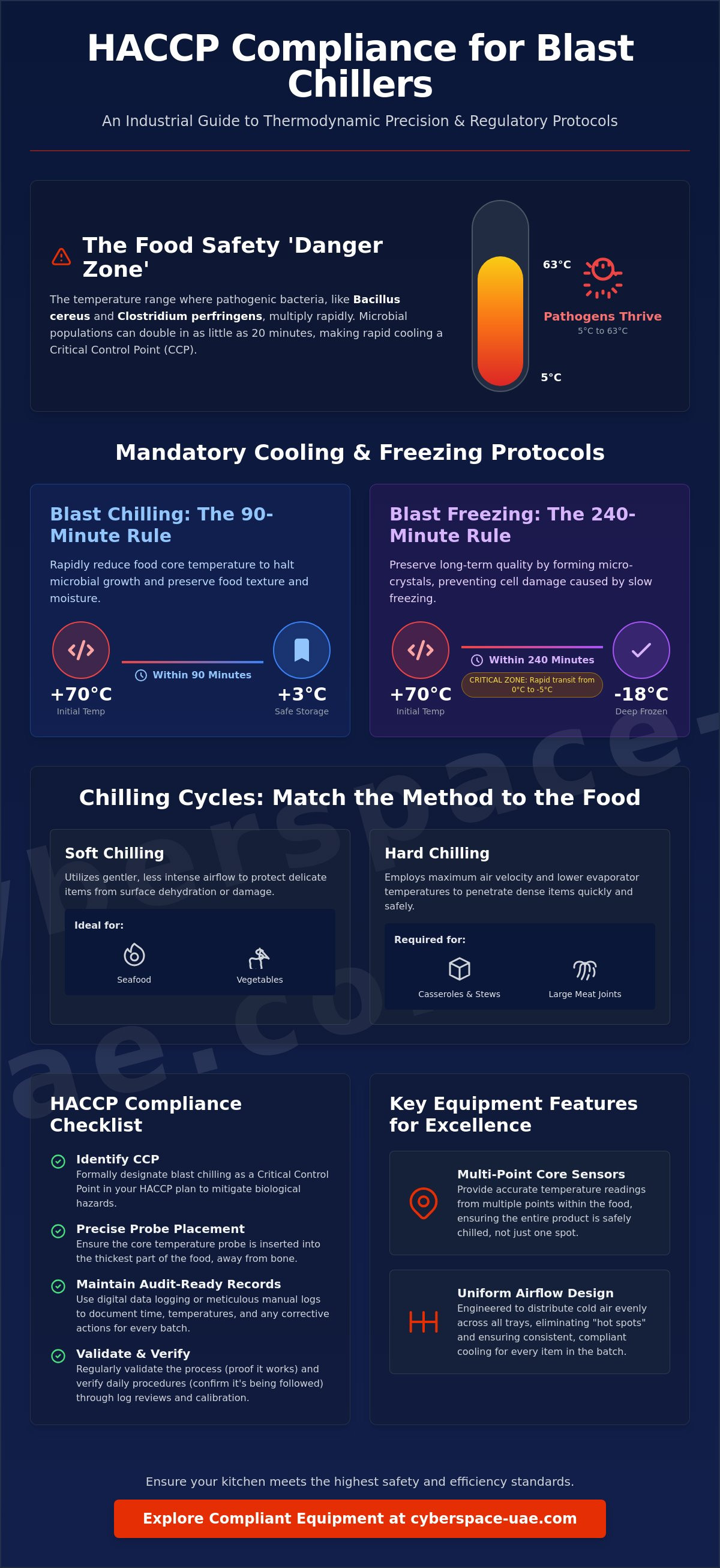
- Identify blast chilling as a Critical Control Point (CCP) to effectively mitigate biological hazards within the 5°C to 63°C danger zone.
- Apply technical time and temperature standards; specifically the 90-minute cooling rule and 240-minute blast freezing protocol.
- Execute an industrial checklist that integrates HACCP blast chiller requirements into daily operations through mandatory pre-cooling and precise probe placement.
- Develop robust documentation systems using specific log fields or automated digital reporting to maintain audit-ready records.
- Prioritize equipment features like multi-point core sensors and uniform airflow design to ensure consistent compliance across all tray levels.
Fundamental HACCP Principles for Rapid Cooling Systems
A Hazard Analysis and Critical Control Point (HACCP) plan identifies blast chilling as a primary Critical Control Point (CCP) in the food production flow. This stage represents the final opportunity to mitigate biological hazards before storage. Unlike standard refrigeration, which lacks the airflow velocity to manage high heat loads, industrial blast chilling is engineered to transition food through the danger zone at a rate that halts bacterial multiplication. Compliance with HACCP blast chiller requirements ensures that every batch meets these non-negotiable safety thresholds.
The danger zone, defined as the temperature range between 5°C and 63°C, is where pathogenic bacteria thrive. Within this window, microbial populations can double in as little as 20 minutes. Rapid cooling isn't just about speed; it's about thermodynamics. By removing heat from the product's core, a blast chiller prevents the conditions required for cellular division. This process is essential for maintaining both the safety and the structural integrity of the food.
Critical Control Points (CCPs) in the Cooling Cycle
The CCP begins the moment cooked food enters the cabinet. Operators must establish clear critical limits for temperature reduction. These limits usually involve a two-stage process: dropping from 63°C to below 10°C within a strictly defined timeframe. If these parameters aren't met, corrective actions are mandatory. This might include reheating the product to 75°C to eliminate pathogens or discarding the batch entirely if the deviation occurs late in the cycle. Precision at this stage is the difference between a safe product and a liability.
The Science of Pathogen Suppression
The primary objective of Blast chilling is the inhibition of spore-forming bacteria. Pathogens like Bacillus cereus and Clostridium perfringens produce spores that survive the initial cooking process. These spores germinate and produce toxins if the food stays in the danger zone for too long. Rapid cooling prevents this germination phase. It also protects the food's quality. Standard slow cooling allows moisture to escape as steam, leading to dehydration and cell wall collapse. Blast chilling locks in moisture and preserves the original texture of the ingredients.
Effective HACCP blast chiller requirements rely on two pillars: validation and verification. Validation is the scientific proof that your cooling process works under maximum load. Verification is the daily confirmation that you're following that process. This includes regular equipment calibration and the review of temperature logs. You don't just need a fast machine; you need a verifiable system that proves compliance during every shift.
Technical Time and Temperature Standards for Compliance
Industrial compliance hinges on two primary time-based benchmarks. The first is the 90-minute rule. This requires reducing the core temperature of food from +70°C to +3°C. Meeting these HACCP blast chiller requirements prevents microbial growth. It's a non-negotiable standard for professional food safety. Failure to hit this window usually indicates over-loading or equipment inefficiency.
Some industrial processes involve products entering the cabinet at +90°C. While standard refrigeration units would fail under this thermal load, a blast chiller uses high-velocity airflow to strip heat away immediately. This protects the equipment's compressor and ensures the product doesn't linger in the danger zone. These standards align with the FDA Food Code cooling guidelines, which mandate specific cooling stages to prevent pathogen proliferation.
Standard Chilling Cycles vs. Hard Chilling
Soft chill cycles protect delicate items. Seafood and vegetables require gentler airflow to prevent surface dehydration or accidental freezing. Hard chilling is the requirement for high-density items. Casseroles, stews, and large meat joints need maximum air velocity. Evaporator temperatures are significantly lower in hard chill modes to penetrate the product core faster. Selecting the correct cycle is essential for both safety and product quality.
Blast Freezing Parameters
For long-term storage, the 240-minute rule applies. This involves reducing core temperature from +70°C to -18°C. The goal is to pass through the "Critical Zone" of 0°C to -5°C as quickly as possible. Rapid transit through this range facilitates micro-crystallization. It prevents the formation of large ice crystals that damage cellular structure. You can read more about the blast chiller vs regular freezer technical differences to understand how dedicated hardware achieves these results.
External factors impact these cycles. High ambient kitchen temperatures or poor ventilation can extend cycle times. Industrial-grade blast chillers are designed to maintain performance even in high-heat environments. Ensure your equipment is rated for the specific climate and load demands of your facility to maintain verifiable compliance.
The HACCP Blast Chiller Compliance Checklist
Compliance is an active operational state rather than a static equipment setting. Every cooling cycle must adhere to a specific sequence to satisfy HACCP blast chiller requirements and ensure data integrity. Failure to follow these procedural steps often results in cooling durations that exceed the 90-minute limit, even with high-performance hardware. Use this checklist to standardise your kitchen's rapid cooling workflow.
- Pre-cooling Protocol: Never load hot food into an ambient cabinet. Initiate a pre-chill cycle to reach an internal air temperature of 0°C or lower before introducing product. This prevents the initial heat spike from compromising the cooling rate and protects the compressor from unnecessary thermal shock.
- Probe Placement: Accurate data depends on sensor positioning. Insert the core probe into the geometric centre of the thickest portion of the food. Avoid contact with bones, tray surfaces, or fat deposits. These materials have different thermal properties and provide inaccurate readings that could invalidate your safety logs.
- Loading Density: Airflow is the primary cooling medium. Maintain a minimum gap of 25mm to 40mm between gastronorm trays. Overloading the cabinet creates dead zones where air cannot circulate. This leads to non-compliant core temperatures in the centre of the stack while the edges may begin to freeze.
- Sanitisation and Calibration: Core probes are high-risk contact points. Clean and sanitise the probe before and after every use to prevent cross-contamination. Inspect door gaskets daily for tears or debris that could allow cold air leakage. Monthly calibration is mandatory. Verify thermometer accuracy using the ice-point method to ensure your audit data remains legally defensible.
Operational Best Practices
Limit food thickness to 50mm for dense products like stews or mashed vegetables. Thicker portions extend the cooling window beyond the 90-minute standard. Remove all lids and covers before starting the cycle. Lids trap steam and act as insulation, significantly slowing the heat extraction process. Position trays to allow unobstructed cross-flow air exchange across the evaporator coils. This ensures that every tray receives the same velocity of chilled air for uniform results.
Equipment Hygiene Standards
Manage defrost cycles to prevent ice accumulation on evaporator coils. Excessive ice reduces heat exchange efficiency and increases energy consumption. Clean stainless steel interiors daily with non-abrasive, food-safe detergents. Focus on high-touch surfaces like door handles and control panels to reduce bio-burden. Regular maintenance of these areas is a core component of meeting HACCP blast chiller requirements and maintaining a professional-grade production environment.
Documentation and Data Logging Protocols
Documentation serves as the verifiable evidence of food safety. Without accurate records, a compliant cooling cycle does not exist in the eyes of an auditor. Meeting HACCP blast chiller requirements necessitates a rigorous data logging protocol that captures every variable of the thermal reduction process. These logs provide the data integrity required to prove that pathogens remained suppressed throughout the production flow.
Every log must contain specific mandatory fields to be considered legally defensible. These include the product name and batch identification number, the initial core temperature at the start of the cycle, and the exact start and end times. The final core temperature achieved must also be recorded alongside the signature or digital ID of the operator. Manual logs are prone to transcription errors; therefore, many industrial facilities are transitioning to automated reporting to ensure accuracy.
Corrective action logs are equally critical. If a product fails to reach the target temperature within the 90-minute window, the deviation must be documented. The record must specify whether the food was reheated to a safe internal temperature or discarded entirely. Under FSMA Rule 204, which became effective on January 20, 2026, enhanced traceability is required for high-risk foods. This makes precise record-keeping for items like fresh-cut produce and specific cheeses mandatory. Retention periods for these logs typically span one to two years, depending on local jurisdiction and product shelf life.
Digital Logging Advantages
Digital systems offer significant operational benefits over manual entry. Automated reporting eliminates human error, a common failure point in high-volume industrial bakeries. USB data transfer or real-time Wi-Fi monitoring allows for the immediate generation of temperature graphs. These visual representations provide rapid audit verification. They also highlight equipment performance trends, allowing for proactive maintenance before a hardware failure occurs.
Verification Procedures
Verification is the secondary layer of compliance. Supervisors must perform regular review cycles of all temperature logs to identify recurring issues or technical deviations. Internal audits of cooling CCPs should occur at least quarterly. This process mirrors the precision required for other thermal equipment. For example, maintaining accurate prover temperature for bread requires similar calibration and documentation standards to ensure consistent product safety and quality.
Select equipment with integrated data logging to streamline your compliance workflow and reduce manual labor. View our range of industrial blast chillers to find models with automated reporting and multi-probe monitoring capabilities.
Selecting Industrial Equipment for HACCP Excellence
Equipment selection directly impacts your ability to meet HACCP blast chiller requirements. High-performance hardware eliminates the technical bottlenecks that lead to batch failure. Focus on specifications that ensure data accuracy and thermal consistency. Your choice of machinery dictates the reliability of your entire safety protocol.
Core probe technology is the foundation of verifiable safety. Multi-point sensors provide a more accurate thermal profile than single-point alternatives. These probes detect the coldest and warmest spots within the product core simultaneously. This ensures the controller only signals cycle completion when the entire mass has reached the safety threshold. It removes the guesswork associated with manual temperature checks.
Airflow design determines temperature uniformity across the cabinet. Industrial units must ensure consistent air velocity across all tray levels. Look for models with high-efficiency evaporator fans and directional baffles. This engineering prevents dead spots where food might remain in the danger zone while adjacent trays begin to freeze. Uniformity is essential for maintaining consistent quality and safety standards in high-volume environments.
Controller functionality simplifies daily operations and audit preparation. Modern interfaces include pre-programmed HACCP cycles for specific food groups such as meats, poultry, or delicate pastries. These presets automatically adjust fan speed and evaporator temperature to match the product density. 304-grade stainless steel construction is the industrial standard for durability. It resists corrosion from frequent sanitisation and withstands the high-moisture environment of a professional kitchen.
High-Capacity Features
Evaluate pull-down capacity based on your peak production volume. Compressor efficiency and thermal recovery times are critical for back-to-back cycles. High-capacity units often allow for seamless integration with a Rational combi oven for bakery. This facilitates a streamlined cook-chill workflow where mobile oven racks transition directly from the heat source to the chiller. This eliminates manual tray handling and reduces the time food spends at ambient temperatures.
Procurement Considerations
Standardise your tray capacity to match existing equipment. Ensure the chiller accommodates GN 1/1 or GN 2/1 racks to maintain a modular production line. Serviceability and local part availability in the UAE are essential for minimizing downtime. For a deeper analysis of industrial specifications, consult our commercial blast chiller Dubai guide. Selecting hardware that meets these HACCP blast chiller requirements ensures long-term operational excellence and regulatory compliance.
Achieving Verifiable Compliance in Industrial Cooling
Operational safety in industrial kitchens requires a transition from manual estimation to technical precision. Mastering HACCP blast chiller requirements ensures that your production flow consistently meets the 90-minute cooling standard and the 240-minute blast freezing benchmark. Success depends on the synergy between rigid operational checklists, multi-point probe accuracy, and automated data logging. By standardising these technical protocols, you eliminate biological risks and protect your facility from audit failures while extending product shelf life without quality loss.
Maintaining this level of operational excellence requires high-performance hardware designed for rigorous commercial use. We provide comprehensive national UAE coverage for industrial kitchen solutions and serve as an authorized distributor of Rational and other premium industrial brands. Our specialization in high-performance commercial bakery machinery ensures your facility remains at the forefront of industrial food safety and thermodynamic efficiency. Reliable equipment is the foundation of a defensible HACCP plan.
View our range of HACCP-compliant industrial blast chillers to upgrade your cooling capabilities. Implement a robust, auditable safety system for your professional kitchen today.
Frequently Asked Questions
How long must food stay in a blast chiller to meet HACCP standards?
Food must reach a core temperature of +3°C within 90 minutes for chilling or -18°C within 240 minutes for freezing to satisfy industrial safety standards. These timeframes are critical for meeting HACCP blast chiller requirements and preventing the germination of spore-forming bacteria. The FDA Food Code also specifies a two-stage cooling process: reducing food from 57°C to 21°C within two hours, then to 5°C or below within the following four hours.
Can I use a regular freezer as a blast chiller if I monitor the time?
No, a standard freezer is not a substitute for a blast chiller. Regular freezers lack the high-velocity airflow and compressor capacity needed to extract heat rapidly from hot products. Introducing hot food into a standard freezer raises the internal cabinet temperature, which endangers existing stock and fails to meet mandatory pull-down windows. Dedicated blast chilling equipment is necessary to ensure the core temperature drops fast enough to inhibit pathogen growth.
What is the maximum entry temperature for a blast chiller cycle?
Industrial blast chillers are designed to handle entry temperatures as high as +90°C. Most HACCP protocols begin the critical cooling measurement once the food reaches +70°C or +63°C. High-performance units use powerful evaporators to manage this thermal load immediately, ensuring the product does not linger in the danger zone where bacteria multiply fastest.
How often should I calibrate my blast chiller core probe?
Monthly calibration is the industrial standard for core probes. Use the ice-point method at 0°C to verify sensor accuracy. Meticulous calibration records are essential for demonstrating that your equipment provides valid data during regulatory audits and health inspections.
Is a blast chiller required by law for all commercial kitchens?
While specific equipment is not always named in legislation, the cooling results are strictly regulated. Meeting the FDA Food Code or USDA time and temperature standards in high-volume environments is practically impossible without specialized hardware. Blast chillers are the primary tool used by professional kitchens to ensure legal compliance and food safety.
What happens to food safety if the blast chiller fails mid-cycle?
Mid-cycle failure requires immediate corrective action and documentation. If the food has been in the danger zone for less than two hours, it may be reheated to 75°C and the cooling cycle restarted. If the duration is unknown or exceeds two hours, the product must be discarded to eliminate the risk of toxin production from pathogens like Bacillus cereus.
Does blast chilling affect the texture of delicate bakery products?
Blast chilling preserves the texture of bakery products by preventing moisture loss. Rapid cooling stops the evaporation process that leads to dehydration and leathery crusts. It also prevents the formation of large ice crystals during freezing, which protects the cellular structure of the crumb and maintains original quality after thawing.
What is the difference between a blast chiller and a shock freezer?
The difference is the target core temperature. A blast chiller pulls food down to +3°C for refrigerated storage. A shock freezer, or blast freezer, reduces the core temperature to -18°C for long-term preservation. Shock freezing uses lower evaporator temperatures to achieve micro-crystallization, which is a key component of many HACCP blast chiller requirements for frozen goods.