
Planetary Mixer Bowl Capacity: A Commercial Selection Guide
Selecting a planetary mixer based solely on its volume is a primary cause of premature motor failure in commercial kitchens. Many operators assume a 60-liter model handles 60 liters of any substance, but ingredient density dictates the actual technical limit. Miscalculating your planetary mixer bowl capacity leads to inconsistent textures and expensive repairs that halt production. In the competitive UAE food service sector, equipment longevity depends on matching motor torque to specific batch requirements.
You understand that heavy pizza dough and light creams place different stresses on a transmission system. This guide provides the technical framework to determine the exact planetary mixer size required for your commercial production. We use specific load limits and ingredient density calculations to ensure your procurement is accurate and efficient. You'll learn to evaluate absorption ratios and attachment specifications to optimize throughput. This analysis covers models ranging from 10L units to 80L floor models to ensure your facility maintains operational excellence without the risk of overloading or under-utilizing your machinery.
Key Takeaways
- Distinguish between nominal bowl volume and functional working load to prevent motor strain and equipment failure.
- Calculate the required planetary mixer bowl capacity by evaluating the Absorption Ratio (AR) of your specific dough or batter.
- Assess how mechanical resistance from dough hooks, paddles, or whisks dictates the maximum permissible batch weight.
- Align equipment specifications with peak production throughput and high-ambient temperature operational demands in the UAE market.
Planetary Mixer Bowl Capacity: Liters vs. Working Load
Industrial planetary mixers are classified by their total bowl volume, yet this number rarely reflects actual production output. Nominal capacity identifies the total liquid volume the bowl can hold when filled to the brim. In a commercial environment, operating at 100% volume is impossible. Ingredients require physical space for the agitator to move, and many mixtures expand during aeration. Overloading the bowl leads to immediate mechanical consequences. Gears strip. Motors burn. Production stops. For UAE commercial kitchens, where high ambient temperatures already stress electrical components, understanding the limits of your planetary mixer bowl capacity is vital for equipment longevity.
Working capacity is a dynamic value that shifts based on ingredient density and viscosity. A mixer might handle a full batch of egg whites but struggle with half that volume of heavy pizza dough. Heavy doughs exert massive resistance against the planetary gears, requiring the motor to draw more current. If the resistance exceeds the torque limit, the internal transmission will fail. Conversely, light creams and batters require high-speed aeration. If the bowl is too full, the ingredients cannot expand, resulting in a dense, poor-quality product. Accurate production planning requires looking past the liter rating and calculating the maximum weight the motor can safely rotate.
Understanding Bowl Volume (L)
Standard industrial sizes for planetary units typically range from 10L to 80L. This liter rating indicates the physical displacement available within the stainless steel vessel. Smaller 10L or 20L units serve well for specialty sauces or small pastry batches. Large-scale operations in Dubai or Abu Dhabi often utilize 60L or 80L floor models to meet high-volume demand. When mixing purely liquid applications, such as thin syrups or washes, you can utilize up to 80% of the nominal volume. However, as soon as solids or thickening agents are added, this percentage must drop to protect the drive system.
Calculating Working Capacity (kg)
Working capacity is measured in kilograms rather than liters. It represents the maximum mass the agitator can move through without causing the motor to overheat or the thermal overload to trip. Viscosity is the primary factor here; thicker substances create more friction and resistance. Working capacity represents the specific intersection where motor torque meets available bowl volume without exceeding mechanical tolerances. To maintain efficiency, practitioners should calculate batch sizes based on the weight of the heaviest ingredient, typically flour, to ensure the planetary gears operate within their designed safety margins.
Ingredient-Specific Capacity Limits: Dough, Batters, and Creams
Ingredient density determines the mechanical limits of your equipment. While a 40L unit might look spacious, its effective planetary mixer bowl capacity fluctuates based on the viscosity of the load. Dense mixtures create high resistance. Light mixtures require volume for expansion. Ignoring these distinctions leads to motor burnout and inconsistent product quality. Operators must calculate batch sizes based on the specific physical properties of the ingredients rather than the nominal liter rating of the stainless steel vessel.
Heavy Dough and Bread Production
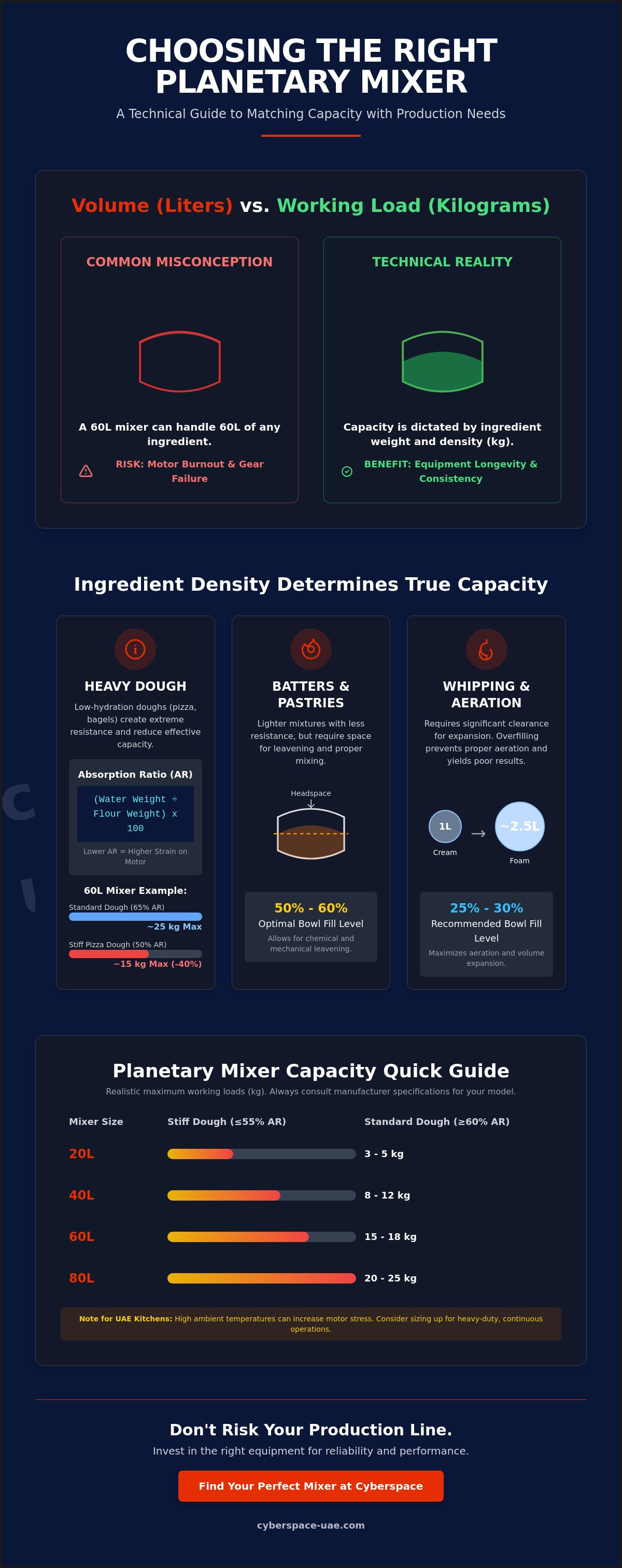
Dough capacity is strictly dictated by the Absorption Ratio (AR). AR is calculated by dividing the total water weight by the total flour weight. A low AR, such as 50% for stiff pizza or bagel dough, creates extreme torque requirements that stress the motor. For these heavy-duty applications, the effective capacity of the mixer is reduced by nearly 40% compared to standard bread dough. A 60L mixer rated for 25kg of standard bread dough may only safely handle 15kg of low-hydration pizza dough. Using a planetary unit for high-gluten stiff doughs carries significant technical risks. Unlike high-performance spiral mixers, planetary transmissions are geared for versatility. Sustained high-torque loads can shear internal pins or strip the drive gears, especially when the motor is forced to maintain speed against high resistance.
Pastry, Creams, and Light Mixtures
Batters and sponge cakes allow for higher volume utilization because they offer less resistance to the agitator. Optimal fill levels for sponge cakes shouldn't exceed 50% to 60% of the nominal bowl volume. This headspace is essential for the chemical and mechanical leavening processes that occur during mixing. Whipping applications require even greater clearance for aeration. For instance, 1L of heavy cream typically expands into 2.5L of foam. Filling the bowl beyond its working capacity prevents the wire whisk from incorporating sufficient air. This results in a flat, dense product and uneven distribution of ingredients.
Efficiency is maximized when the batch size matches the bowl diameter and agitator reach. A batch that's too small for a large bowl won't be reached by the attachment, leading to unmixed pockets at the base. Conversely, overloading causes the motor to run hot. In the high-ambient temperatures of UAE commercial kitchens, this heat buildup is accelerated. Maintaining a 20% safety margin below the manufacturer's maximum working load extends the lifespan of the transmission and ensures repeatable batch results.
Selecting Mixer Size Based on Commercial Production Volume
Operational efficiency depends on matching batch throughput to peak production hours. A mixer that is too small creates bottlenecks, forcing staff to run multiple cycles and increasing labor costs. Conversely, an oversized unit wastes floor space and electrical resources. Determining the optimal planetary mixer bowl capacity requires a precise audit of your hourly output requirements. You must account for the time taken for loading, mixing, and bowl sanitation between batches to calculate true throughput.
Electrical infrastructure is a critical constraint during selection. Most 10L to 30L planetary mixers operate on single-phase power, making them compatible with standard commercial outlets in the UAE. However, high-capacity 60L and 80L industrial units typically require three-phase 380-415V connections. Verify your facility's power supply before procurement to avoid expensive retrofitting. Furthermore, units exceeding 40L capacity require integrated bowl-lifting mechanisms. Manual handling of 40kg+ batches is a safety risk and slows down production transitions.
Small Cafes and Specialty Pastry Shops
Specialty shops with high-variety, low-volume menus prioritize flexibility over sheer scale. Standard 10L to 20L tabletop models are the industry benchmark for these environments. These units offer a compact footprint, allowing them to sit on existing stainless steel worktables. A common mistake in small-scale production is using a large bowl for small batches. This creates a "dead zone" where the agitator cannot reach the bottom of the bowl, leaving unmixed dry ingredients. For recipes requiring less than 2kg of product, a 10L unit ensures better consistency than an under-utilized 40L model.
Industrial Bakeries and Large-Scale Catering
Central kitchens and industrial bakeries require 60L or 80L floor-standing planetary mixers to maintain high-volume output. These machines are designed for continuous operation and feature heavy-duty gear-driven transmissions. In these high-output environments, workflow efficiency is enhanced through the use of interchangeable bowls. While one batch mixes, the next is prepped in a secondary bowl. This reduces downtime to the seconds required to swap vessels.
- 60L Units: Ideal for medium-scale bread production and large catering batches.
- 80L Units: Necessary for industrial-scale confectionery and high-volume batter production.
- Three-Phase Power: Standard for units 60L and above to provide the necessary torque for heavy loads.
- Footprint: Floor-standing units require dedicated floor space and clearance for bowl trolleys.
Redundancy is another factor to consider. In some UAE facilities, two 40L mixers may be preferable to a single 80L unit. This configuration provides a backup if one machine requires maintenance, ensuring production never fully ceases. It also allows for the simultaneous preparation of different products, such as a cake batter and a frosting, without cross-contamination or cleaning delays.
Attachment Impact: How Hooks, Paddles, and Whisks Affect Capacity
Mechanical resistance varies by tool geometry. The choice of attachment dictates the maximum permissible load and the effective planetary mixer bowl capacity. Each tool interacts with ingredients differently, creating varying levels of friction and torque demand on the transmission. Selecting the wrong attachment for a specific load leads to mechanical failure or poor product consistency. Transmission systems are engineered to handle specific resistance profiles. Dough hooks require the highest torque, while wire whisks operate at high speeds with minimal resistance. Overloading a whisk results in physical breakage. Overloading a hook results in gear stripping. Proactive load management involves adjusting batch sizes based on the specific mechanical profile of the tool in use.
The Mechanics of the Spiral Hook
Spiral hooks exert significant lateral force. The hook pushes the dough mass against the bowl wall, creating intense friction. This action generates heat and increases the current draw of the motor. Planetary mixers are less efficient than specialized spiral mixers for heavy dough because the agitator must move through the entire mass while rotating on its axis. This dual motion consumes more power. To protect the gears, operators should maintain a 40% safety margin when using hooks for low-hydration doughs. Exceeding these limits causes the planetary head to wobble, leading to long-term alignment issues. This mechanical stress is particularly dangerous in high-volume UAE bakeries where equipment runs continuously.
Optimizing the Beater and Whisk
Flat beaters, or paddles, are the standard for medium-viscosity mixtures. They provide enough surface area for creaming butter and sugar but offer less resistance than a hook. When mixing cookie dough or heavy cake batters, the bowl can typically be filled to 50% capacity. Scraper attachments further enhance efficiency by removing unmixed ingredients from the bowl walls. This reduces the total mixing time and prevents motor strain from uneven weight distribution.
Wire whisks are designed for maximum aeration. They require high RPM settings to incorporate air into egg whites or cream. Because these ingredients expand significantly, the working capacity is limited by volume rather than weight. Industrial whisks should be constructed from stainless steel to withstand the centrifugal forces of high-speed operation. Aluminum attachments are lighter but less durable in high-volume UAE catering environments. If you require equipment capable of handling these diverse mechanical loads, browse our selection of heavy-duty planetary mixers to find the right fit for your facility.
- Dough Hooks: Highest torque demand; use 40% safety margin for stiff doughs.
- Flat Beaters: Medium resistance; ideal for creaming at 50% bowl volume.
- Wire Whisks: High speed, low resistance; requires maximum headspace for foam expansion.
- Scrapers: Essential for reducing mixing cycles and protecting the motor from localized resistance.
Industrial Planetary Mixers for UAE Commercial Kitchens
Cyberspace Kitchen & Bakery Equipment supplies industrial-grade planetary mixers engineered for the rigorous demands of UAE food service operations. Kitchen equipment in this region must withstand high-ambient temperatures that stress electrical and mechanical components. Our inventory covers the full spectrum of commercial needs. We offer compact 10L units for specialty pastry work and 80L floor models for high-output industrial bakeries. Selecting the correct planetary mixer bowl capacity is the first step toward operational excellence and long-term equipment longevity.
Transmission integrity is the core of our machinery. Cyberspace Kitchen & Bakery Equipment units feature reinforced gearboxes designed for consistent torque delivery under maximum working loads. This heavy-duty construction prevents speed fluctuations when processing high-viscosity doughs or dense batters. Gear-driven systems in our larger units offer superior durability compared to belt-driven alternatives, which is critical for bakeries operating extended shifts. The housing is designed for optimal heat dissipation, a necessary feature for maintaining motor efficiency in the UAE climate.
Technical Specifications of Cyberspace Kitchen & Bakery Equipment Mixers
Precise texture management is achieved through integrated variable speed control. This allows operators to transition from low-torque kneading to high-speed aeration without straining the drive system. Safety remains a non-negotiable standard across our entire range. All models include emergency stop buttons and stainless steel bowl guards as standard equipment. These features ensure compliance with industrial safety regulations and protect operators during high-speed cycles. The reinforced base of our floor models minimizes vibration, reducing wear on internal pins and bearings during heavy-duty cycles.
Procurement and Support
Procurement involves more than a simple transaction; it requires technical alignment with your specific production menu. Cyberspace Kitchen & Bakery Equipment provides professional consultations to match equipment specifications to your batch requirements. We analyze your intended throughput to recommend the ideal planetary mixer bowl capacity for your facility. This process prevents the common errors of motor burnout from overloading or the inefficiency caused by under-utilizing large bowls. We focus on the intersection of your recipe density and the machine's torque limits.
Operational reliability is supported through standardized maintenance protocols. Direct access to spare parts within the UAE ensures that wear-and-tear items are replaced quickly. This localized support minimizes downtime and protects your investment. Our team understands the logistical realities of food service in Dubai, Abu Dhabi, and the Northern Emirates. We provide the technical expertise needed to keep your production lines moving without interruption.
View our professional planetary mixer range to identify the specific model that fits your commercial requirements.
Optimizing Your Commercial Mixing Infrastructure
Accurate equipment selection prevents mechanical downtime and ensures consistent batch quality. You must distinguish between nominal bowl volume and the actual working load dictated by ingredient viscosity. Calculating the planetary mixer bowl capacity based on your specific absorption ratios and attachment types is necessary for motor longevity. This technical approach eliminates the risks of overloading and transmission failure in high-demand UAE kitchens. It's the most reliable way to maintain peak production without compromising your machinery's lifespan.
Cyberspace provides specialized industrial-grade machinery equipped with high-performance gear systems. These units are engineered for operational excellence in heavy-duty professional environments. Our team offers professional B2B technical support to help you scale your production throughput effectively and accurately. Request a technical quote for industrial planetary mixers to secure high-performance tools for your facility. Implementing these technical standards will stabilize your production workflow and protect your long-term capital investment. You'll ensure your kitchen remains efficient and productive.
Frequently Asked Questions
What is the difference between a 20L and 30L planetary mixer?
A 30L mixer provides 50% more physical volume than a 20L model, but the primary technical difference lies in the motor's power rating and gear strength. Higher capacity models are engineered to handle the increased resistance of larger batches. You should select based on your heaviest recipe weight to ensure the transmission isn't consistently operating at its peak thermal limit during peak hours.
Can I mix bread dough in a planetary mixer?
Planetary mixers process bread dough using a dough hook attachment, though they're less efficient than specialized spiral mixers for high-volume production. The planetary motion creates higher friction and heat in the dough mass. For stiff doughs with low hydration, you must reduce the planetary mixer bowl capacity utilization to 40% or 50% to prevent internal gear damage.
How do I know if I am overloading my mixer bowl?
Overloading is indicated by audible motor straining, excessive vibration, or the planetary head moving vertically during the mix. If the machine's thermal overload switch trips frequently, your batch weight exceeds the mechanical torque limit. Operating in high-ambient UAE temperatures accelerates this heat buildup, making batch weight precision critical for the survival of the transmission system.
Does the motor power affect the bowl capacity?
Motor wattage directly determines the maximum weight the mixer can rotate regardless of the physical bowl size. A large bowl with an underpowered motor will fail when processing dense ingredients like cookie dough or heavy batters. Reliable industrial units match high-torque motors with specific bowl volumes to ensure the transmission maintains consistent RPM even when the vessel is near its working limit.
What is the "Absorption Ratio" and why does it matter for capacity?
Absorption Ratio (AR) is the percentage of water weight relative to flour weight in a dough recipe. It's the most critical factor for determining planetary mixer bowl capacity because lower AR values create higher mechanical resistance. For example, a 50% AR pizza dough requires significantly more motor torque than a 65% AR bread dough, necessitating smaller batch sizes to protect the motor.
Are bowl guards mandatory for commercial planetary mixers in the UAE?
Commercial planetary mixers in the UAE must comply with industrial safety standards, which typically require integrated bowl guards. These guards prevent operator contact with moving agitators and include safety interlocks that stop the motor if the guard is opened. Facility managers should verify that all equipment meets local occupational health and safety regulations to ensure full workplace compliance and operator protection.
Can I use a smaller bowl on a large planetary mixer?
Many industrial planetary mixers allow for the use of smaller downsize bowls through the installation of specific adapter kits and matching attachments. This configuration is useful for processing small specialty batches without the dead zone issues common in oversized vessels. It provides operational flexibility, allowing a single 60L machine to function as a 30L unit when production variety increases.