
Professional Baking Equipment in Dubai: Industrial Procurement Guide 2026
The UAE bakery processing equipment market reached a valuation of USD 220 million, signaling a rapid transition toward industrial automation and high-output facilities. Securing the right professional baking equipment Dubai requires a precise focus on the technical synergy between thermal processing and automated dough handling. Most commercial operators recognize that inconsistent bake quality and high labor costs from manual processing are the primary barriers to scaling production. This article provides a technical analysis of high-capacity machinery designed to optimize throughput and operational efficiency in industrial environments. You'll learn how to standardize product quality and increase hourly production capacity through specific equipment configurations. We examine high-performance deck ovens, spiral mixers, and dough sheeters that comply with the 2026 Dubai Municipality Food Code and HACCP standards. This guide details the specifications necessary for long-term reliability and 304/316 stainless steel compliance within the regional regulatory framework.
Key Takeaways
- Understand technical requirements for continuous duty cycles and industrial-grade construction to ensure operational durability.
- Compare thermal processing efficiency between deck and rotary systems to optimize energy consumption when selecting professional baking equipment Dubai.
- Evaluate the mechanical impact of spiral mixers and automated sheeters on gluten development and production throughput.
- Analyze the role of industrial blast chillers in maintaining cold chain integrity and meeting Dubai Municipality food safety standards.
- Identify critical procurement factors, including Total Cost of Ownership (TCO) and regional technical support availability for long-term reliability.
Industrial-Grade vs. Retail Baking Equipment: Defining Professional Standards
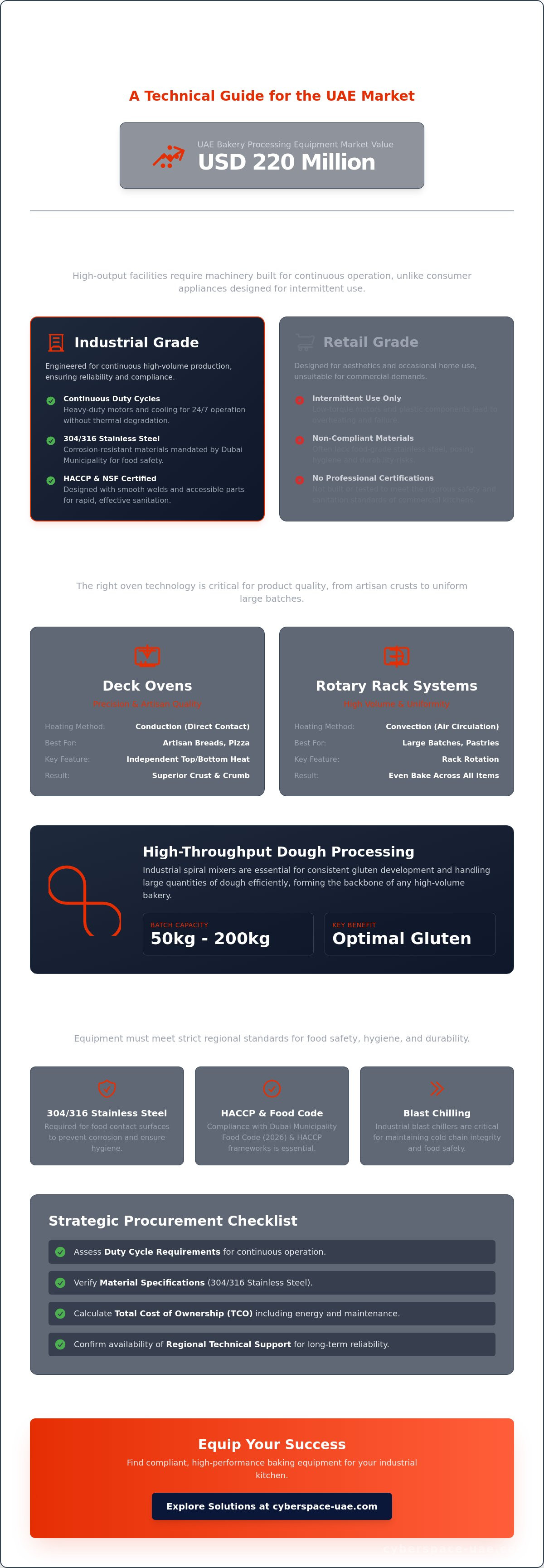
Procuring industrial-grade machinery involves a fundamental shift in engineering requirements. Domestic appliances prioritize aesthetic appeal and intermittent use. In contrast, professional baking equipment Dubai focuses on high-capacity output and structural resilience. Industrial-grade systems must withstand continuous operation cycles without thermal degradation or mechanical fatigue. Retail units often fail under these conditions because they rely on lightweight plastic components and low-torque motors. Commercial success depends on the technical synergy between thermal processing and automated handling.
Commercial-grade Industrial Ovens and dough processors are built for heavy-duty applications. These machines provide the thermal mass and mechanical power needed for high-volume production. Investing in professional-grade tools ensures product consistency across thousands of units. This reliability protects brand reputation by eliminating variability in bake quality. High-end machinery facilitates a predictable workflow, allowing operators to meet strict delivery schedules in the competitive Dubai market. Choosing equipment with industrial classifications is the only way to sustain a high-output commercial kitchen.
Duty Cycles and Production Throughput
Industrial motors utilize heavy-duty copper windings and advanced cooling systems to maintain torque during continuous mixing or sheeting operations. While consumer mixers overheat after brief usage, industrial spiral mixers handle 50kg to 200kg batches repeatedly. High-volume commercial bakeries define success through hourly output metrics. Equipment downtime directly impacts daily revenue and labor costs. Durable machinery minimizes these risks by ensuring the production line remains active during peak demand periods. Reliable components prevent the mechanical failures that often plague lower-end retail appliances.
Material Specifications and Hygiene Standards
Dubai Municipality regulations mandate the use of 304 or 316-grade stainless steel for all food contact surfaces. This specification prevents corrosion and resists chemical reactions from acidic doughs or high-moisture environments. Industrial components are engineered for rapid sanitation to comply with HACCP-based frameworks. NSF or ISO certified machinery features smooth welds and accessible internal parts to eliminate bacterial accumulation zones. These standards ensure the longevity of components even under the extreme high-heat conditions of industrial baking environments. Standardized materials simplify the cleaning process and reduce the time required for daily maintenance protocols.
Thermal Processing Efficiency: Deck Ovens vs. Rotary Rack Systems
Selecting the correct thermal processing system is a primary factor when investing in professional baking equipment Dubai. The choice between conduction-based deck ovens and convection-based rotary rack systems depends on specific product variety and total volume requirements. Deck ovens utilize stone or ceramic hearths to transfer heat through direct contact. This method is essential for developing the crust and crumb structure of artisan breads. Rotary systems rely on high-velocity air circulation and continuous rack rotation to ensure uniform heat distribution across large batches.
Energy consumption patterns differ between electric and gas-fired industrial ovens. Electric units provide precise temperature control and simplified installation. Gas-fired systems often yield lower operational costs in high-volume settings where continuous heating is required. Modern industrial ovens incorporate advanced steam injection systems to manage humidity levels during the initial baking phase. This technical feature is vital for achieving starch gelatinization on the dough surface. These specifications align with FDA food safety regulations regarding consistent thermal processing and manufacturing practices.
Precision Baking with Professional Deck Ovens
Deck ovens offer independent temperature controls for the top and bottom of each level. This allows operators to bake diverse products with varying heat requirements simultaneously. This modularity is a significant advantage for bakeries producing both delicate pastries and heavy loaves. For specialized applications, engaging with baking deck oven suppliers helps in selecting hearths with high thermal mass. Ceramic and natural stone surfaces act as thermal batteries. They maintain stable temperatures despite frequent door openings. This thermal stability is critical for high-hydration sourdoughs that require an immediate heat transfer to achieve maximum oven spring.
High-Volume Output with Industrial Rotary Baking Ovens
Rotary rack ovens maximize production throughput by utilizing vertical space efficiently. The rack rotation mechanism eliminates cold spots by moving the product through the heat source. This ensures every tray receives identical airflow and temperature exposure. This configuration is particularly effective for pastries, buns, and cookies where color uniformity is a primary quality indicator. Modern rotary systems feature programmable bake cycles that automate temperature adjustments and steam intervals. These units provide a superior footprint-to-capacity ratio. They are the standard choice for professional baking equipment Dubai in facilities with limited floor space but high hourly production targets. For those optimizing facility layout, exploring high-capacity oven configurations can provide significant operational advantages.
High-Throughput Dough Processing: Spiral Mixers and Automated Sheeters
Mechanical preparation determines the final crumb structure and volume of baked goods. Effective dough handling requires machinery that manages gluten development while minimizing friction-induced heat. In high-volume environments, selecting the right professional baking equipment Dubai ensures that dough remains within optimal temperature ranges during intensive mixing. Spiral mixers provide the mechanical torque necessary for heavy bread doughs, while automated sheeters deliver the precision required for consistent lamination. These systems are engineered to meet global safety benchmarks, including OSHA bakery equipment standards, which dictate specific design requirements for industrial mixers and dough handling units.
Bowl capacity requirements must be calculated based on daily flour consumption and hydration levels. Using an undersized mixer leads to motor strain and inconsistent gluten networks. Conversely, oversized bowls may fail to engage the dough hook properly for smaller batches. Variable speed controls are essential for planetary mixing to manage diverse textures, from stiff cookie doughs to light meringues. These technical specifications allow operators to standardize their processes, ensuring that every batch meets the same quality metrics regardless of the shift or operator.
Spiral vs. Planetary Mixers for Commercial Use
Spiral mixers utilize a rotating bowl and a synchronized spiral hook to knead dough. This action focuses on a specific portion of the dough mass at a time, preventing over-oxidation and thermal degradation. They're the industry standard for high-hydration bread doughs and heavy sourdoughs. Planetary mixers serve a different function, utilizing an offset agitator that rotates around a stationary bowl. They're essential for patisseries and confectionery where aeration and creaming are required. Removable bowl systems in both mixer types enhance workflow by allowing for continuous production cycles while previous batches undergo fermentation or further processing.
Industrial Dough Sheeters for Laminated Pastry
Automated dough sheeters eliminate the variability of manual rolling. These machines use precision rollers to achieve specific thickness settings, often adjustable in 0.1mm increments. This level of accuracy is vital for puff pastry and croissant production where uniform fat-to-dough layers define the final product quality. High-volume sheeters incorporate variable conveyor belt speeds to synchronize with downstream cutting stations. Maintenance focuses on the integrity of industrial rollers and the effectiveness of scrapers. Regular inspection of these components prevents dough buildup and ensures the machine meets hygiene standards. Investing in high-throughput sheeting technology significantly reduces labor costs while increasing the hourly output of laminated products.
Cold Chain Integrity: Industrial Blast Chillers and Controlled Proving
Cold chain management is a technical requirement for high-capacity bakeries. Integrating a commercial blast chiller Dubai ensures compliance with Dubai Municipality temperature mandates. These units facilitate rapid core temperature reduction. They move products through the bacterial growth zone at high velocity. This process stabilizes par-baked goods and delicate pastries immediately. It also prevents moisture migration, which can ruin the texture of multi-layered products. Beyond safety, controlled proving systems manage yeast activity and dough structure. High-quality professional baking equipment Dubai must provide precise synchronization of humidity and temperature. This ensures consistent results across multiple shifts. Modern retarder-provers allow for precise fermentation scheduling. This optimizes labor allocation and improves production flow.
HACCP Compliance with Industrial Blast Chillers
The "Danger Zone" is where pathogens proliferate. Blast chillers bypass this range using high-power refrigeration systems. They reduce core temperatures from +70°C to +3°C in under 90 minutes. This rapid cooling prevents large ice crystal formation. It preserves the cellular structure of the dough or finished product. Regulatory compliance requires strict temperature logging. These data points are often integrated into the Food Watch digital platform. Modern blast chillers automate data collection. This reduces manual labor. It ensures audit-readiness for food safety inspections. Stainless steel construction (grade 304 or 316) ensures the equipment withstands high-moisture environments without corrosion. The Certified Person in Charge (PIC) must monitor these logs to ensure food safety standards are met during all operational hours.
Controlled Proving Systems for Consistency
Commercial provers utilize advanced sensors to maintain specific humidity levels, usually between 70% and 85%. This prevents dough skinning. It ensures uniform expansion during the final proof. Retarding dough at lower temperatures (around 2°C to 4°C) allows for extended fermentation. This process enhances flavor profiles through enzymatic activity. It improves crumb texture significantly. Retarder-provers integrate these functions into a single unit. Bakers can schedule proofing cycles for early morning shifts. Uniform airflow patterns within the cabinet eliminate hot spots. This leads to standardized product volume and quality. Airflow must be gentle and multidirectional to avoid drying out the dough surface. Consistent proving is essential for maintaining the high standards expected in the Dubai hospitality sector.
Review our technical guide on commercial blast chiller technology to upgrade your cold chain infrastructure.
Strategic Procurement: Selecting Professional Baking Equipment in the UAE
Strategic procurement of professional baking equipment Dubai requires a comprehensive analysis of the Total Cost of Ownership (TCO). This metric extends beyond the initial purchase price to include energy consumption, maintenance expenses, and potential downtime costs. Successful industrial operators prioritize modularity. This allows for future production scaling without requiring a complete kitchen redesign. Local technical support and immediate spare parts availability are non-negotiable criteria for high-volume facilities. Equipment failure in a commercial bakery leads to immediate revenue loss and disrupts supply chain commitments. Don't overlook the long-term impact of choosing machinery that lacks a regional service footprint.
Selecting a reliable industrial equipment partner involves evaluating their technical literacy and focus on operational excellence. A partner must provide machinery that meets the 5% import duty and 5% VAT requirements while ensuring compliance with Dubai Municipality standards. High-performance components reduce the frequency of emergency repairs. Choosing brand-new, industrial-grade tools ensures operational stability. It protects the business against the risks associated with unverified or refurbished units. Precision in equipment selection is the foundation of a predictable and profitable production cycle.
Maximizing ROI through Energy Efficiency
Rational combi ovens and high-efficiency burners offer significant long-term savings. These systems optimize heat transfer and reduce gas or electricity waste during peak operational hours. Insulation quality is a critical technical specification. High-density insulation maintains internal temperatures and reduces the heat load on the kitchen's HVAC system. This synergy lowers utility costs and improves the working environment for staff. Automated systems provide a clear ROI by reducing the headcount required for repetitive tasks like dough sheeting or mixing. While initial capital expenditure is higher, the reduction in manual labor costs typically offsets the investment within a predictable timeframe.
Workflow Optimization and Kitchen Layout
Kitchen layout must minimize cross-traffic to maximize safety and hygiene. Placing spiral mixers near ingredient storage and deck ovens near cooling racks streamlines the production flow. The integration of Rational iCombi Pro systems allows for multi-functional cooking within a compact footprint. These units handle diverse tasks, from steaming to roasting, reducing the need for separate appliances. Operational stability depends on brand-new equipment that functions within specified tolerances. High-performance machinery ensures that the kitchen remains a streamlined gateway to professional-grade output. Proper placement and technical integration are the final steps in optimizing commercial kitchen throughput and maintaining a competitive edge in the Dubai market.
Optimizing Industrial Bakery Performance
Operational excellence in commercial baking depends on the technical synergy between high-capacity thermal processing and automated dough handling. Standardizing product quality requires machinery that meets strict industrial duty cycles and regional regulatory standards. Effective procurement strategies prioritize total cost of ownership; this includes evaluating energy efficiency and the availability of local technical support. Selecting professional baking equipment Dubai ensures that your facility maintains consistent throughput while adhering to the 2026 Dubai Municipality Food Code and HACCP frameworks.
As an authorized dealer for Rational iCombi Pro, we provide specialized industrial-grade machinery designed for operational stability. our focus on professional B2B technical support ensures that your equipment remains reliable under high-volume production demands. Transitioning to advanced automation reduces manual labor costs and increases hourly output. View our full catalog of professional baking machinery to identify the right technical specifications for your facility. Implementing these high-performance solutions establishes a foundation for long-term commercial success.
Frequently Asked Questions
What is the difference between a spiral mixer and a planetary mixer?
Spiral mixers utilize a rotating bowl and a synchronized hook to knead dough with minimal friction. This mechanism is essential for heavy bread doughs to prevent over-oxidation and thermal degradation. Planetary mixers feature an offset agitator that rotates around a stationary bowl. They're designed for multi-functional tasks like aeration, creaming, and mixing lighter batters in patisseries and confectionery environments.
Why should I invest in a deck oven instead of a convection oven for bread?
Deck ovens provide conduction heat through stone or ceramic hearths, which is critical for developing the crust and crumb structure of artisan breads. This direct heat transfer ensures a significant oven spring that convection systems cannot replicate. Convection ovens rely on high-velocity air circulation for uniform coloring. While efficient for pastries and cookies, they lack the thermal mass required for high-hydration sourdough and heavy loaves.
How does a blast chiller improve food safety in a commercial bakery?
Blast chillers rapidly reduce the core temperature of baked or par-baked goods to bypass the bacterial growth zone of 5°C to 60°C. This process ensures compliance with Dubai Municipality food safety standards and the mandatory Food Watch digital platform. Rapid cooling also prevents large ice crystal formation. This preserves the cellular structure and moisture content of the product, ensuring high quality after regeneration or final baking.
What technical specifications are critical for an industrial dough sheeter?
Critical specifications include precision thickness adjustments in 0.1mm increments and variable conveyor belt speeds for synchronized production. The unit must feature 304-grade stainless steel rollers and scrapers to meet regional hygiene requirements. High-performance professional baking equipment Dubai should also include safety guards and emergency stop mechanisms. These features ensure operational stability and protect staff during high-volume lamination processes for puff pastry and croissants.
Can Rational combi ovens be used for high-volume baking applications?
Rational iCombi Pro systems are engineered for high-volume, multi-functional baking applications. They utilize advanced sensors to manage high-density humidity and precise temperature levels across every rack. This technology allows for consistent results even when loading diverse products simultaneously. These units offer a superior footprint-to-capacity ratio, making them a primary choice for facilities requiring maximum versatility without sacrificing industrial-grade throughput.
What are the electrical requirements for a 3-deck industrial oven in the UAE?
A 3-deck industrial oven typically requires a 3-phase 400V or 415V power supply to handle the cumulative thermal load. The specific kilowatt rating depends on the deck size and the number of heating elements per level. Operators must verify that the facility's electrical infrastructure can support the peak load of the professional baking equipment Dubai. Consulting with a technical partner ensures that the installation meets local DEWA standards and operational safety protocols.
How often should commercial rotary ovens undergo professional maintenance?
Professional maintenance for commercial rotary ovens should occur on a quarterly basis in high-output facilities. Regular inspections focus on the rack rotation mechanism, drive motors, and door seals to prevent energy loss. Lubrication of high-temperature bearings and calibration of digital thermostats are essential for maintaining uniform heat distribution. Preventative maintenance reduces the risk of equipment downtime and extends the operational lifespan of the machinery.
Is it better to buy gas or electric baking equipment for a new startup?
Electric baking equipment offers lower initial installation costs and precise temperature control for delicate products. Gas-fired systems often provide lower operational costs in high-volume settings where ovens run continuously. The choice depends on the facility's utility infrastructure and long-term production targets. Startups should evaluate the total cost of ownership, including ventilation requirements and local gas connection availability, before finalizing their procurement strategy.