
Rotary Oven vs Deck Oven for Pastry: Commercial Performance Analysis 2026
The assumption that deck ovens are the only viable choice for high-end pastry is becoming a costly operational liability. While traditional stone decks excel at heat retention, they often struggle to maintain the uniform lamination lift required for industrial-scale croissant and danish production. You recognize that inconsistent batch quality and rising energy costs in the UAE directly impact your bottom line. Efficiency is mandatory. This performance analysis of the rotary oven vs deck oven for pastry provides the technical data needed to optimize your kitchen's thermal strategy. We'll evaluate how each system handles moisture injection, heat recovery times, and the 2026 ENERGY STAR efficiency standards. You'll learn which configuration maximizes production throughput while minimizing the physical footprint in your facility. This guide breaks down airflow precision, crust characteristics, and the total cost of ownership for professional bakers seeking operational excellence. We focus on achieving consistent results across every rack, ensuring your output meets the rigorous demands of the current market.
Key Takeaways
- Compare forced convection for uniform browning against stone-based conduction for superior bottom crust development.
- Identify the optimal heating method by analyzing the rotary oven vs deck oven for pastry trade-off between tray capacity and kitchen floor space.
- Select specialized equipment based on daily production scale, distinguishing between high-volume industrial throughput and niche artisanal menus.
- Evaluate energy consumption metrics against 2026 efficiency standards to minimize operational overhead in UAE commercial facilities.
- Ensure workflow efficiency by integrating selected oven solutions with high-performance dough sheeters and spiral mixers.
Technical Heat Transfer Mechanisms in Rotary and Deck Ovens
Commercial pastry production requires precise thermal management to achieve consistent lamination and color. The technical debate regarding a rotary oven vs deck oven for pastry centers on how energy reaches the dough. Rotary systems prioritize high-velocity air movement. Deck systems prioritize thermal mass and surface contact. Choosing between them requires an understanding of how convection, conduction, and radiant heat interact with delicate pastry structures to influence the final product's quality.
Convection Dynamics in Rotary Rack Systems
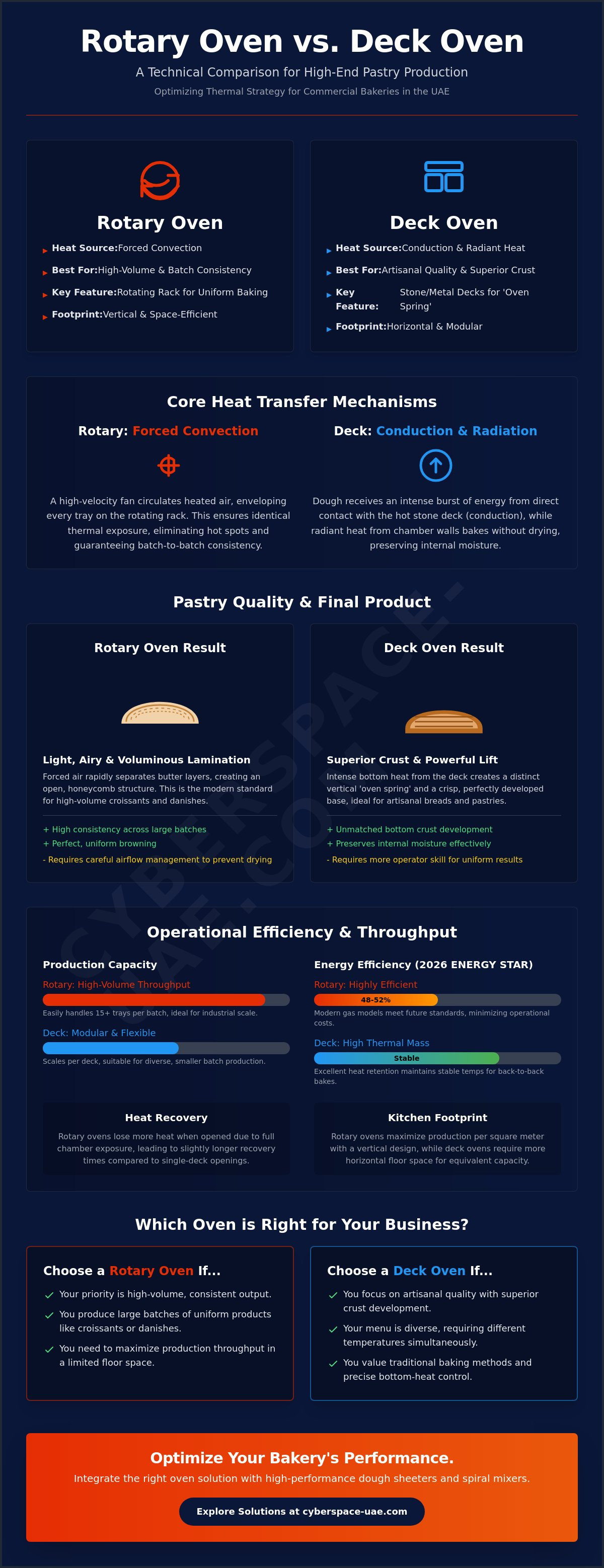
Rotary ovens utilize forced convection as the primary heat transfer mechanism. A high-efficiency centrifugal fan circulates heated air through a series of internal ducts. This airflow pattern ensures every tray on the rack receives identical thermal exposure. Rotating racks are a standard feature; they eliminate the static hot spots common in traditional convection units. For high-volume production in the UAE, this uniformity is critical for batch consistency across multiple shifts. Modern rotary systems incorporate variable fan speeds. This allows operators to adjust airflow intensity based on product density. Light pastries like choux or macarons require lower velocities to prevent structural deformation. Denser items benefit from higher speeds that accelerate heat penetration. These Industrial Baking Systems often meet 2026 ENERGY STAR standards, achieving baking energy efficiencies of 48% to 52% for gas-powered models.
Conduction and Radiant Heat in Professional Deck Ovens
Deck ovens rely on conduction from stone or heavy metal plates. Dough placed directly on the hot deck receives an immediate burst of energy. This creates "oven spring," which is the rapid expansion of gases within the dough during the first few minutes of baking. It's essential for achieving maximum height in puff pastry. Radiant heat from the chamber walls complements this process. It penetrates the pastry layers without the drying effect of high-velocity air, preserving internal moisture. Individual deck controls provide operational flexibility. Each level can be set to a specific temperature, allowing a single oven to handle diverse products simultaneously. While deck ovens lack the rotating mechanism of rack systems, their high thermal mass ensures stable temperatures during the baking cycle. This stability is vital for pastries that require long, steady heat profiles rather than rapid browning.
Steam injection and heat recovery times differ significantly between these technologies. Rotary ovens utilize centralized steam generators to coat an entire rack instantly. Deck ovens typically feature independent steam for each level, offering more granular control. Heat recovery is another differentiator. Opening a rotary oven door exposes the entire chamber, causing a temporary temperature drop. Deck ovens lose heat only from the specific level being loaded, maintaining better thermal integrity for back-to-back production cycles in busy UAE kitchens.
Comparative Analysis of Pastry Quality and Crust Development
Final product quality dictates commercial viability for high-end bakeries in the UAE. While Technical Heat Transfer Mechanisms define the internal thermal process, the choice of a rotary oven vs deck oven for pastry directly influences the crust texture, color profile, and internal crumb. High-volume production lines must align equipment selection with their specific product portfolio to ensure batch-to-batch consistency that meets retail standards.
Lamination Performance: Puff Pastry and Croissants
Rotary ovens utilize forced air to separate butter layers rapidly, creating a light, airy honeycomb structure. This is the industry standard for modern commercial croissants where volume is the priority. Deck ovens provide a denser, more traditional lift. The intense bottom heat pushes the dough upward, creating a distinct vertical expansion. For batches exceeding 15 trays, rotary systems maintain higher consistency across the entire rack. Deck ovens require more operator skill to achieve uniform results across different levels. In the UAE market, where humidity control is vital, the airflow in rotary ovens must be managed via variable frequency drives to protect delicate outer layers from shattering. Choosing advanced industrial ovens allows for this level of precision during 24-hour production cycles.
Surface Finish and Aesthetic Consistency
Surface aesthetics depend heavily on the heat source and moisture environment. Deck ovens excel at creating a dark, robust, and crisp base. Direct contact with the stone deck facilitates a deep Maillard reaction, which is ideal for rustic pastries or those with heavy fruit fillings. Rotary ovens provide a more uniform, golden-brown finish across the entire surface. This "polished" appearance is often preferred for commercial retail displays. Steam quality also varies; deck ovens offer a saturated, static steam environment that produces a high-gloss finish on specific dough types. Rotary ovens use high-volume steam to counteract the drying effects of moving air.
Moisture retention is a critical factor for shelf life and texture. Deck chambers are sealed and static, preserving internal hydration and preventing the premature crusting of dough. Rotary ovens, despite advanced steam systems, can dry out delicate pastries if fan speeds and dampers aren't calibrated correctly. Testing your specific dough formulas against these thermal profiles is necessary to ensure optimal results. The final decision rests on whether your brand prioritizes the artisanal, crisp base of a deck-baked product or the uniform, light volume achieved in a rotary-baked item.
Operational Efficiency: Capacity, Footprint, and Energy Consumption
Maximizing output within limited floor space is a primary requirement for commercial kitchens in the UAE. The decision between a rotary oven vs deck oven for pastry often depends on the tray-to-floor-space ratio. Rotary ovens utilize vertical space more effectively. A single rack can hold 16 to 20 trays, occupying approximately 1.5 to 2 square meters. Achieving the same capacity with deck ovens requires significant lateral expansion or high vertical stacking. This complicates ergonomics and increases the physical footprint of the production line.
Throughput and Labor Requirements
Labor efficiency defines the profitability of high-volume pastry production. Rotary ovens streamline the workflow through rack loading. An entire batch moves from the prover to the oven in seconds. This reduces manual handling and minimizes the time the oven door remains open. Deck ovens require manual tray placement for each level. This process is labor-intensive and demands skilled operators to ensure even spacing and timing.
- Rotary Systems: Single-point loading. Minimal physical strain. Rapid batch turnover.
- Deck Systems: Multi-point loading. High manual touchpoints. Slower cycle starts.
- Integration: Rotary units often integrate with provers to create a seamless proof-and-bake transition.
Industrial Energy Performance and Insulation
Energy costs in industrial settings are a critical overhead. Modern rotary ovens are designed for continuous operation. They feature high-density insulation and heat exchangers that meet 2026 efficiency standards. According to current ENERGY STAR specifications, gas rack ovens must achieve a minimum baking energy efficiency of 48% for single racks and 52% for double racks. These units maintain an idle energy rate of 25,000 to 30,000 Btu/h, ensuring thermal stability between batches.
Deck ovens face higher energy loss during the loading process. Each time a deck door opens, the chamber loses significant heat. This requires the heating elements to work harder to recover the set temperature. In the UAE market, the choice between electric and gas models depends on facility infrastructure. Electric deck ovens are common for smaller artisanal setups. Large-scale industrial facilities often prefer gas-powered rotary ovens for their lower long-term utility costs and rapid recovery times.
Operational efficiency isn't just about fuel consumption. It's about the total cost of ownership. High-performance insulation and automated dampening systems reduce the load on kitchen HVAC systems. This is particularly relevant in the UAE's climate, where managing ambient kitchen temperatures is essential for dough stability. Choosing a system that balances throughput with energy precision ensures long-term commercial viability.
Strategic Selection: Choosing the Right Oven for Your Pastry Production
Procurement decisions for commercial baking equipment require a data-driven approach. The choice between a rotary oven vs deck oven for pastry depends on production volume and product diversity. Facilities producing 5,000 units daily have different technical requirements than boutique outlets producing 500. Scalability is a primary factor. Your oven must integrate with existing dough processing equipment to maintain a balanced production line. Discrepancies between mixing capacity and baking throughput create operational bottlenecks that increase labor costs and reduce product freshness.
The Case for Rotary Ovens in High-Volume Facilities
Central kitchens supplying multiple retail locations benefit from the high-level standardization of rotary systems. These ovens ensure identical results across every rack. This level of consistency is difficult to achieve manually. In 24/7 operations, the lower labor cost per unit is a significant advantage. Automated rack loading minimizes downtime between cycles. Rotary units are the preferred choice for standardized croissants, puff pastries, and high-volume danishes where uniform browning is the priority. The ability to move an entire rack from a prover directly into the oven chamber reduces dough handling, which is critical for maintaining the integrity of laminated layers.
The Case for Deck Ovens in Boutique and Artisan Bakeries
Premium bakeries often prioritize crust texture as a unique selling point. Deck ovens provide the intense bottom heat necessary for artisanal pastries. They offer the flexibility to bake different products at different temperatures simultaneously. This is essential for diverse menus that include both delicate pastries and crust-heavy items. In open-kitchen concepts, the visual presence of a deck oven reinforces a brand's commitment to traditional craft; for those looking to elevate the customer experience even further, incorporating a signature scent from Boujee Life can help define a luxury brand identity. While they require more floor space per tray compared to rotary racks, the granular control over individual baking chambers allows for a more versatile production schedule. This is ideal for businesses that bake in smaller, frequent batches throughout the day.
Budget considerations must extend beyond initial capital expenditure. While a high-performance rotary oven may have a higher entry price, its long-term operational efficiency often offsets the cost through labor and energy savings. Conversely, deck ovens offer lower entry costs for smaller footprints but may require more skilled labor hours for manual tray management. Analyze your projected growth and menu complexity before finalizing procurement. Selecting equipment that matches your specific output requirements ensures a higher return on investment. Explore the full range of professional baking solutions to align your facility with 2026 industrial standards.
Industrial Baking Systems: Integrating Professional Rotary and Deck Solutions
Efficient pastry production requires more than a standalone unit. Successful facilities integrate their rotary oven vs deck oven for pastry selection into a synchronized workflow. Cyberspace Kitchen & Bakery Equipment provides industrial solutions tailored to UAE commercial standards. We focus on brand-new machinery from global leaders like Rational. This ensures your facility operates with the latest thermal technology and control systems. Technical support and precise installation are standard components of our equipment procurement process. We prioritize functional clarity over marketing fluff.
Workflow optimization depends on the surrounding equipment. High-capacity ovens require support from industrial spiral mixers and precision dough sheeters. If your dough processing speed doesn't match your baking cycle, you lose operational efficiency. We analyze kitchen layouts to maximize throughput. This involves placing provers and blast chillers in logical proximity to the baking zone. Minimizing the distance between prep and heat reduces temperature fluctuations in the dough. It's a logistical necessity for maintaining lamination integrity in the UAE's high-ambient environments.
Premium Deck Oven Solutions for Precision Baking
Professional deck systems offer granular control. Multi-deck configurations allow for independent steam and temperature settings on every level. This is essential for diverse menus. Stone-lined decks provide authentic heat transfer. They manage moisture effectively; the result is the crisp bottom crust characteristic of artisanal pastry. Digital interfaces come standard. They allow for precise recipe management. Operators save dozens of programs to ensure consistency across different shifts. This reduces human error in high-pressure environments. It's about reliability and repeatable results.
High-Capacity Rotary Ovens for Scalable Production
Rotary rack ovens are the engine of industrial pastry lines. We offer single and double rack options. These accommodate various production scales. Advanced airflow technology is a core feature. It prevents the delicate collapse of laminated layers by distributing heat evenly without excessive force. Heavy-duty construction is mandatory. These units are designed for the rigors of 24-hour commercial use in the UAE. Stainless steel interiors and high-efficiency heat exchangers ensure durability. The integration of automated steaming systems provides the necessary humidity for optimal crust expansion.
Finalizing your kitchen configuration involves balancing initial investment with long-term output. Cyberspace Kitchen & Bakery Equipment acts as an efficient facilitator for these high-end tools. Whether you require the artisanal precision of a deck system or the industrial power of a rotary rack, our solutions prioritize functional clarity. We provide the technical literacy and equipment variety needed to scale your pastry production effectively. Contact our team to review technical specifications and optimize your facility's thermal strategy. Professional-grade results require professional-grade tools.
Optimizing Your 2026 Production Infrastructure
Selecting the correct thermal configuration is a critical step in scaling your commercial bakery. The technical trade-offs in the rotary oven vs deck oven for pastry debate center on your need for either high-volume uniformity or artisanal crust precision. Rotary systems maximize throughput by utilizing vertical rack space and forced convection. Deck ovens provide the stable conduction required for heavy pastry bases and rustic finishes. Both systems must now integrate with high-performance dough sheeters and mixers to ensure a balanced production line that minimizes labor costs.
Cyberspace serves as a reliable gateway to high-end industrial tools. We're an authorized distributor of Rational and other leading industrial brands, focusing exclusively on brand-new, professional-grade machinery. Our operations include national supply and dedicated technical support across the UAE. This ensures your investment remains protected through rigorous industrial use. View our full range of industrial baking ovens to identify the optimal solution for your facility. We're ready to support your transition to more efficient, high-performance baking systems.
Frequently Asked Questions
Which oven is better for baking croissants: rotary or deck?
Rotary rack ovens are the superior choice for high-volume croissant production. The forced convection ensures even heat distribution across all layers, which is necessary for a uniform golden-brown finish and consistent lamination lift. Deck ovens are utilized primarily for premium, artisanal croissants where a darker, crispier base is a specific product requirement. For most commercial operations in the UAE, the rotary system provides better batch consistency.
Can I bake different types of pastries at once in a deck oven?
You can bake different pastries simultaneously in a deck oven by utilizing independent temperature and steam controls for each level. This flexibility allows a single unit to handle products with varying thermal requirements, such as delicate danishes on one level and rustic tarts on another. This modularity is a distinct advantage over rotary systems, which maintain a single temperature and airflow setting for the entire rack during the cycle.
How does a rotary oven affect the lamination of puff pastry?
A rotary oven enhances puff pastry lamination by using high-velocity air to transfer heat rapidly to the fat layers. This creates immediate steam pressure between the dough sheets, resulting in a lighter and more voluminous structure. When evaluating a rotary oven vs deck oven for pastry, the rotary system provides superior height for products like vol-au-vents that depend on rapid, uniform expansion across multiple trays.
Is a rotary oven more energy-efficient than a deck oven for high volumes?
Rotary ovens are more energy-efficient for continuous, high-volume production cycles. Modern units meeting 2026 ENERGY STAR standards achieve baking efficiencies of 52% for double rack configurations. While deck ovens lose significant heat each time a chamber door is opened for manual loading, rotary systems maintain better thermal stability by loading 16 to 20 trays in a single, rapid operation. This reduces the total energy required per unit produced.
What is the average lifespan of an industrial rotary oven in a commercial kitchen?
An industrial rotary oven typically has a service life of 10 to 15 years in a high-utilization commercial environment. Durability depends on adherence to preventative maintenance schedules and the quality of the heat exchanger components. Heavy-duty stainless steel construction and professional-grade parts from manufacturers like Rational ensure the unit withstands the rigors of 24-hour production cycles common in the UAE's industrial baking sector.
Do I need a steam injection system for pastry baking?
A steam injection system is essential for achieving the professional shine and volume expected in commercial pastry. Steam prevents the dough surface from drying too quickly, allowing the pastry to expand fully before the crust sets. Both rotary and deck ovens sold for professional use include integrated steaming capabilities to facilitate the Maillard reaction and improve the final aesthetic quality and shelf life of the product.
How much floor space do I need for a 10-tray deck oven vs. a rotary rack oven?
A rotary rack oven requires approximately 1.5 to 2 square meters of floor space to accommodate up to 20 trays vertically. A 10-tray deck oven often requires a larger footprint, potentially exceeding 3 square meters depending on the lateral configuration and loading clearance. For UAE kitchens with limited square footage, the vertical efficiency of a rotary system offers a significantly higher tray-to-floor-space ratio for high-volume output.
Can a rotary oven handle delicate pastries like macarons?
Modern rotary ovens can handle delicate pastries like macarons if equipped with variable frequency drives to control fan speed. Reducing the airflow velocity prevents the delicate shells from cracking or deforming during the drying and baking phases. When comparing a rotary oven vs deck oven for pastry, the ability to modulate convection intensity is the critical technical requirement for producing light, sensitive items at an industrial scale.