
Blast Chiller vs Regular Freezer: Technical Comparison for Industrial Kitchens
Why treat a storage unit like a production tool? Many industrial kitchens rely on standard cooling for high-volume output, unaware that slow temperature drops facilitate large ice crystal formation and increased bacterial risk. When analyzing a blast chiller vs regular freezer, the distinction isn't just about speed; it's about thermodynamics. You understand that maintaining 0°C to 5°C in chiller rooms is essential, yet the specific method used to reach those temperatures dictates your final product integrity and waste levels.
This technical comparison details the operational differences between rapid cooling and static freezing to help you optimize food safety. You'll learn how to achieve full compliance with UAE food safety regulations, including Federal Law No. 10 of 2015 and mandatory HACCP standards. We'll examine cooling stages, shelf-life extension, and the specific equipment specifications required to improve kitchen workflow efficiency and eliminate quality degradation. This guide provides the data necessary to make an informed procurement decision for your facility.
Key Takeaways
- Analyze the fundamental thermodynamic distinctions of a blast chiller vs regular freezer to prevent cellular damage caused by macro-crystallization.
- Ensure full compliance with UAE food safety regulations by mastering mandatory two-stage cooling timelines and HACCP temperature standards.
- Improve industrial bakery and kitchen workflow efficiency through specialized par-baking and dough management strategies that halt fermentation precisely.
- Evaluate technical specifications including tray capacity and refrigeration types to match equipment performance with specific industrial output requirements.
Defining the Functional Parameters of Blast Chillers and Freezers
Understanding the mechanical intent behind kitchen equipment is vital for operational efficiency. A standard commercial freezer serves as a static storage environment. It's designed to hold products that have already reached their target preservation temperature. In contrast, an industrial blast chiller is a thermal processing machine. It's engineered for rapid heat extraction from hot or room-temperature goods. The primary objective is to move food through the bacterial growth zone at maximum velocity. When comparing a blast chiller vs regular freezer, the choice depends on whether you're storing inventory or preparing it for the next stage of production.
The Role of the Commercial Freezer
Standard freezers prioritize temperature stability for long-term inventory management. These units utilize low-velocity airflow to maintain a consistent sub-zero climate, typically -18°C or lower. This design is ideal for preserving frozen goods but fails during the initial cooling phase. Commercial freezers lack the evaporative capacity to handle the steam and heat loads of cooked food. Adding hot items to a static freezer causes thermal shock. This localized temperature spike warms neighboring products, potentially compromising their safety and texture. It's a storage solution, not a cooling one.
The Role of the Industrial Blast Chiller
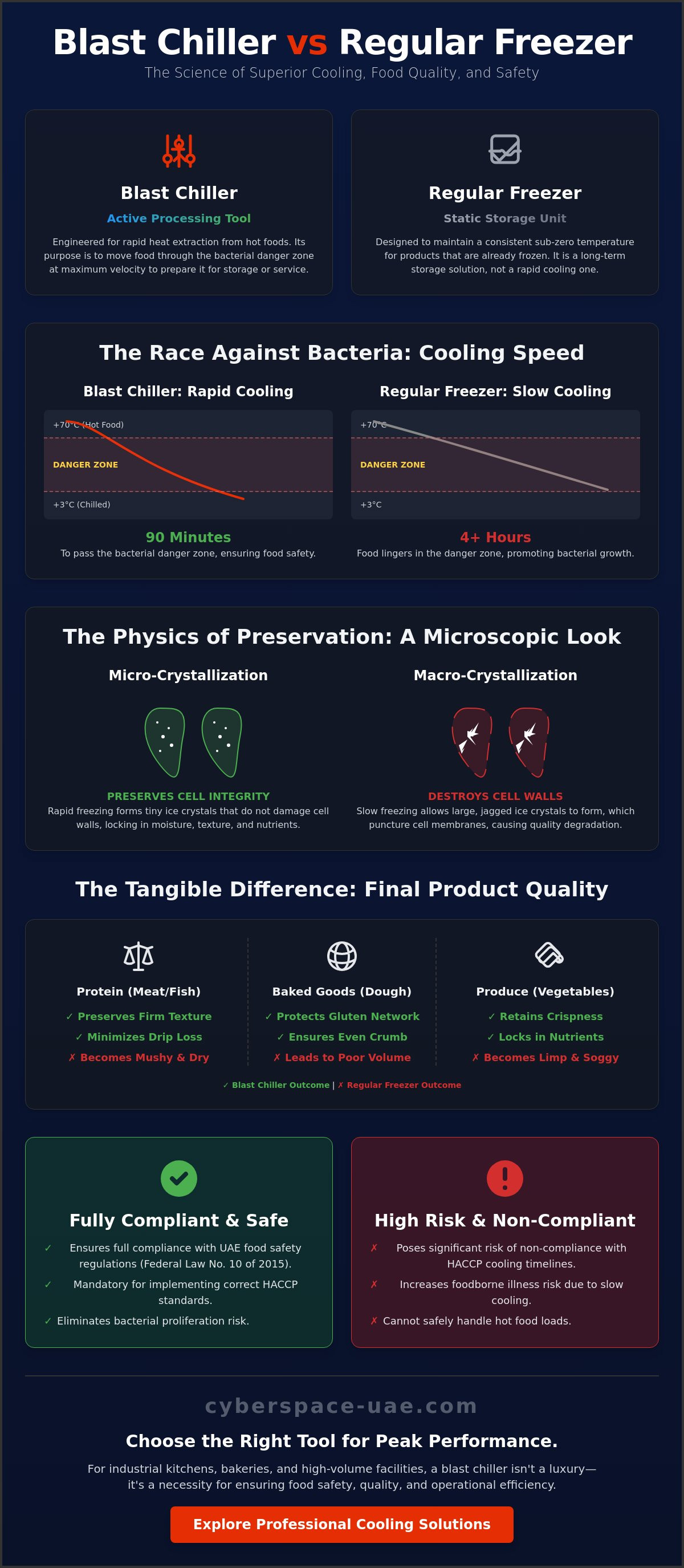
Industrial blast chillers are built for high-stress thermal reduction. Blast chilling protocols require reducing the core temperature of food from +70°C to +3°C within 90 minutes. This rapid transition is achieved through high-powered fans and heavy-duty refrigeration systems. These components facilitate constant, aggressive air circulation across every tray. Most professional units feature programmable cycles tailored to specific food densities. Hard chilling cycles use lower air temperatures for thick cuts of meat. Soft chilling cycles protect delicate items like pastries or seafood from surface freezing. Shock freezing modes can further reduce temperatures to -18°C in approximately 240 minutes, ensuring the formation of micro-crystals rather than cell-damaging macro-crystals.
The mechanical specifications of these units reflect their intense workload. Blast chillers feature oversized evaporators and high-CFM (cubic feet per minute) fans that are absent in standard storage freezers. This hardware allows the equipment to overcome the latent heat of hot food without straining the compressor. For high-volume kitchens, this processing power is the only way to ensure compliance with international food safety standards while maintaining product quality. It's a critical tool for any facility moving from batch cooking to a cook-chill workflow. Without this dedicated thermal processing, kitchens risk bacterial proliferation and inconsistent product results.
The Physics of Preservation: Micro-Crystallization vs. Macro-Crystallization
Preservation quality depends entirely on the speed of the transition from liquid to solid. In a standard commercial freezer, the cooling process is slow. This allows water molecules to bond into large, jagged structures known as macro-crystals. These crystals are physically larger than the food cells they inhabit. As they grow, they puncture and tear the delicate cell walls. This mechanical destruction is the primary cause of quality loss in frozen goods. The science of freezing dictates that reducing the time spent in the crystallization zone is the only way to maintain product integrity.
A blast chiller utilizes high-velocity forced convection to bypass this danger zone. By extracting heat rapidly, the water molecules freeze into tiny, uniform micro-crystals. These crystals remain within the cellular boundaries without causing structural damage. When comparing a blast chiller vs regular freezer, the difference in the final product is measurable through drip loss. Macro-crystals cause significant purge or liquid leakage during thawing, resulting in dry proteins and limp vegetables. Micro-crystallization ensures that moisture remains locked within the fibers, preserving the original bite, weight, and nutritional profile of the ingredients.
Understanding Cellular Integrity
Mechanical damage is particularly evident in high-hydration products. In artisan bread doughs, large ice crystals disrupt the gluten network, leading to poor volume and uneven crumb structure. In proteins, macro-crystallization causes the mushy texture often associated with frozen seafood or steak. Rapid freezing prevents this degradation. By keeping the cellular matrix intact, blast chilling allows for long-term storage without the tell-tale signs of industrial processing. Operators can achieve a fresh-to-table experience even after weeks of preservation. For those looking to upgrade their production line, exploring technical specifications for professional blast chillers is a logical next step.
Comparison of Cooling Velocities
The most critical phase of the freezing process is crossing the latent heat of fusion. This is the stage where liquid water turns into ice at 0°C. A standard freezer lingers in this phase, allowing macro-crystals to expand. An industrial blast chiller uses aggressive forced convection to minimize this duration. This mechanical speed prevents the aggregation of water molecules into large clusters. Speed is the fundamental metric for molecular preservation.
- Slow Freezing: 10 to 20 hours to reach core temperature; results in structural collapse.
- Blast Chilling: 90 to 240 minutes to reach core temperature; results in cellular stability.
- Drip Loss: Standard freezing often results in 5% to 10% weight loss; blast chilling reduces this to near zero.
Food Safety Compliance and UAE HACCP Standards
Regulatory compliance in the UAE is stringent. The primary risk in industrial food production is the temperature danger zone. This range, between 5°C and 57°C, allows for rapid bacterial proliferation. In high-volume operations, the technical distinction of a blast chiller vs regular freezer is settled by safety mandates. A regular freezer cannot cool hot food fast enough to meet legal requirements. Under Federal Law No. 10 of 2015, HACCP compliance is mandatory for commercial catering. Failure to adhere to these standards can result in penalties as high as AED 2,000,000. Using a blast chiller ensures that food passes through the danger zone at a speed that prevents pathogen growth.
Bacterial Growth Mitigation
Pathogens like Salmonella and Listeria thrive in warm, moist environments. UAE food safety standards require a specific two-stage cooling process. Cooked food must drop from 57°C to 21°C within two hours. It must then reach 5°C or below within an additional four hours. A standard freezer is designed for storage, not active thermal reduction. It lacks the forced convection needed to ensure uniform cooling from the core to the surface. Blast chillers utilize high-velocity fans to achieve these targets consistently. The 90-minute chilling rule and 240-minute freezing rule are industry benchmarks for total compliance.
HACCP Documentation and Reporting
Health inspections require verifiable proof of safety protocols. Modern industrial chillers feature integrated data logging and digital probes. These systems record every cooling cycle, creating a permanent audit trail. This technology simplifies the management of Commercial Blast Chiller Technology by providing precise cooling curve reports. Instead of manual temperature logs, operators can export digital files for inspectors. This level of automation reduces human error and ensures that every batch meets the required safety thresholds.
Eliminating steam in storage areas is another critical safety factor. Placing hot food directly into a walk-in freezer creates condensation and localized temperature increases. This environment facilitates cross-contamination and mold growth. Blast chillers contain the cooling process within a specialized chamber. This isolation protects the rest of your inventory from humidity and thermal fluctuations. It's a proactive approach to maintaining a sterile and compliant kitchen environment. Professional equipment selection is the only way to guarantee these results in a commercial setting.
Industrial Applications: Optimizing Bakery and Kitchen Workflows
Operational efficiency in industrial settings requires a shift from storage-focused thinking to process-driven workflows. When comparing a blast chiller vs regular freezer, the primary advantage is the ability to decouple production from service hours. Par-baking strategies utilize this by halting the baking process at 80% completion. Rapid cooling stabilizes the crumb structure immediately. This allows for final finishing just before service, ensuring product freshness without requiring 24-hour staffing. It's a method that maintains consistent quality during peak demand periods.
Bakery Specific Workflows
Laminated doughs, such as croissants and puff pastry, require precise thermal management to protect fat layers. Standard freezers often cause the layers to merge due to slow heat extraction. Utilizing Professional Baking Equipment in Dubai allows for the precise retardation of fermentation. This enables centralized production hubs to distribute stabilized doughs to multiple satellite locations. It also ensures that delicate mousses and high-moisture desserts maintain their structural integrity during transit and display, reducing the risk of collapse or weeping.
The "Cook and Chill" Methodology
Scaling a commercial operation requires a move away from traditional "order-to-plate" preparation. The cook and chill method integrates high-performance Rational combi ovens with rapid cooling technology. Kitchens can prepare large batches of proteins and sauces during off-peak hours and chill them to safe storage levels instantly. This improves kitchen ergonomics and reduces the intense pressure of "rush hour" service. It's a strategic approach that maximizes the ROI of your machinery while stabilizing labor costs. To optimize your production line, view our range of professional blast chillers designed for high-volume industrial environments.
Selecting Professional Cooling Equipment for Industrial Environments
Procurement for industrial facilities requires a technical assessment of current production capacity. When evaluating a blast chiller vs regular freezer, the primary metric is throughput. A blast chiller must match the output of your primary heating equipment, such as Deck Ovens or Rotary Ovens. If your oven processes 10 trays per cycle, your cooling unit requires an equivalent tray capacity to prevent production bottlenecks. This synchronization ensures a continuous workflow without idle time for staff or machinery. Selecting the wrong capacity leads to either energy waste or dangerous delays in the cooling cycle.
Technical Specifications to Monitor
High-performance refrigeration in the UAE must account for extreme ambient temperatures. Industrial units require compressors with high horsepower (HP) and British Thermal Unit (BTU) ratings to maintain efficiency when external temperatures exceed 40°C. Air-cooled systems are common; however, water-cooled units may offer superior performance in enclosed spaces with limited ventilation. Build quality is equally critical. 304-grade stainless steel is the industry standard for durability and hygiene in humid environments. It resists corrosion and withstands the aggressive cleaning protocols required in high-volume kitchens. Look for high-density polyurethane insulation and reinforced door seals to minimize energy loss and maintain precise internal climates.
The user interface is a vital operational consideration. Programmable controls allow for standardized cycles, ensuring consistency regardless of staff skill levels. Automation reduces the risk of human error in temperature management during busy shifts. Footprint and ventilation requirements must also be analyzed. Compact vertical units maximize floor space, but they require adequate clearance for heat dissipation. Poor ventilation leads to compressor strain and premature mechanical failure, increasing long-term maintenance costs.
- Compressor Rating: Heavy-duty compressors engineered for tropical climates.
- Material: 304-grade stainless steel interior and exterior.
- Control Systems: Programmable interfaces for precise cycle management.
- Insulation: High-density, CFC-free polyurethane for thermal retention.
Investment and Long-Term Value
Calculating the return on investment involves more than the initial purchase price. Industrial equipment should be evaluated based on its ability to reduce food waste and optimize labor. By automating the cooling process, staff can focus on preparation rather than manual temperature monitoring. Local service support and warranty coverage are vital for minimizing downtime in the UAE market. Investing in premium machinery facilitates operational excellence and ensures that your facility remains compliant with evolving safety standards. High-quality industrial equipment reduces the total cost of ownership by extending service life and lowering energy consumption.
Optimizing Industrial Thermal Processing Standards
A technical comparison of a blast chiller vs regular freezer reveals that standard storage units aren't designed for production-level heat extraction. Micro-crystallization is the only method to prevent cellular damage and drip loss in high-volume catering. Compliance with UAE food safety regulations requires the rapid cooling speeds that only dedicated industrial chillers provide. These systems ensure consistent product quality while maintaining full HACCP audit trails through automated logging.
We serve as an authorized distributor of high-performance industrial machinery tailored for the UAE commercial food sector. Our inventory includes specialized solutions designed to withstand high ambient temperatures. Every purchase includes expert technical support for brand-new equipment to ensure seamless integration into your facility. View Our Range of Industrial Blast Chillers to upgrade your production capabilities.
Achieving operational excellence begins with selecting the correct technical tools for your specific workflow requirements.
Frequently Asked Questions
Can I use a regular freezer as a blast chiller if I leave the door open?
No, this practice is mechanically ineffective and poses a significant food safety risk. Standard commercial freezers lack the high-velocity fans required for rapid heat extraction from hot products. Leaving the door open forces the compressor to run continuously, leading to mechanical failure and excessive energy consumption. It also introduces ambient humidity into the unit, causing frost buildup and preventing the food from bypassing the bacterial danger zone within the required timeframe.
How long can food be stored in a blast chiller?
Blast chillers are designed for thermal processing, not long-term storage. Once food reaches its target core temperature of +3°C for chilling or -18°C for freezing, it should be moved to a dedicated storage unit. While many professional units have a "hold" mode for short-term preservation, using them as primary storage is energy-inefficient. This practice also prevents the equipment from being used for new production batches, reducing overall kitchen throughput.
What is the difference between blast chilling and shock freezing?
The distinction lies in the target core temperature and the intended storage state. Blast chilling reduces food temperature from +70°C to +3°C for short-term refrigerated use. Shock freezing, also known as blast freezing, drops the core temperature to -18°C or lower. This rapid transition facilitates micro-crystallization, which preserves the cellular structure of the food. Both functions are essential when comparing the utility of a blast chiller vs regular freezer in industrial settings.
Does blast chilling change the taste of the food?
Blast chilling preserves the original flavor and nutritional profile more effectively than any other cooling method. By preventing large ice crystals from puncturing cell walls, the ingredients retain their natural juices and aromatics. Standard freezing methods often result in significant drip loss during the thawing process, which removes essential moisture and flavor. Rapid cooling locks in the peak quality of the ingredients at the moment of processing, ensuring a fresh-to-table experience.
Are blast chillers energy-efficient for small bakeries?
Yes, blast chillers provide long-term energy efficiency by protecting other refrigeration assets from thermal shock. Placing hot trays directly into a standard freezer forces that unit to consume excessive power to maintain its internal climate. A blast chiller handles the high-heat load specifically and rapidly. For small bakeries, this equipment reduces ingredient waste and allows for more efficient batch production, which lowers total operational costs and improves labor utilization.
Can you put hot food directly into a blast chiller?
Yes, industrial blast chillers are specifically engineered to accept food directly from the oven at temperatures of +70°C or higher. These machines utilize high-powered evaporators and aggressive forced convection to handle steam and heat without straining the compressor. This capability is the primary technical advantage of a blast chiller vs regular freezer in a professional environment. It ensures an immediate transition into the cooling phase to meet mandatory safety standards.
How often do industrial blast chillers require professional maintenance?
Professional maintenance should be scheduled at least twice per year for industrial units operating in the UAE. Technicians must inspect the compressor, clean the condenser coils, and verify door seal integrity to ensure optimal heat extraction. Kitchen staff should also perform monthly filter cleanings to prevent dust accumulation. Regular servicing prevents unexpected mechanical failure and maintains the energy efficiency of the refrigeration system in high-ambient temperature environments.
Is a blast chiller mandatory for HACCP compliance in the UAE?
While UAE regulations don't explicitly name the machine, meeting the mandatory cooling timelines is nearly impossible without one. Food safety standards require cooked food to drop from 57°C to 21°C within two hours, a target that standard refrigeration cannot achieve for large batches. A blast chiller is the primary tool used by commercial kitchens to guarantee compliance with these two-stage cooling protocols. It provides the necessary documentation to pass health inspections consistently.