
Combi Oven vs Convection Oven: Industrial Technical Comparison 2026
Did you know that the hidden cost of a three-phase electrical installation for a single industrial unit can reach $15,000 before the first batch is even baked? Large-scale food production requires a rigorous balance between energy consumption and output quality. You're likely managing the dual pressures of rising utility rates and the need for absolute thermal consistency across high-volume batches. Choosing between a combi oven vs convection oven is no longer just about the cooking method. It's a critical financial decision centered on long-term operational viability and footprint optimization.
This technical comparison provides a data-driven analysis of heat transfer physics, moisture control, and total cost of ownership for 2026. You'll learn how to maximize ROI while maintaining compliance with the latest NSF/ANSI 4-2025 sanitation standards. We examine the specific performance benchmarks of ENERGY STAR v3.0 requirements, such as the 76% cooking energy efficiency mandate for electric convection models. This guide serves as a procurement roadmap to help you select the precise thermal solution for your industrial facility.
Key Takeaways
- Understand the mechanical differences between dry heat circulation and saturated steam injection for precise humidity control.
- Compare heat transfer coefficients to ensure consistent thermal performance across 10-tray and 20-tray industrial configurations.
- Identify the optimal equipment for specific production needs, from specialized pastry baking to high-volume catering and roasting.
- Analyze long-term operational ROI by evaluating the maintenance needs of a combi oven vs convection oven, including water filtration and descaling.
- Establish procurement criteria for identifying certified suppliers with robust technical support and spare parts inventory in the UAE.
Technical Definitions: Understanding Convection and Combi Mechanisms
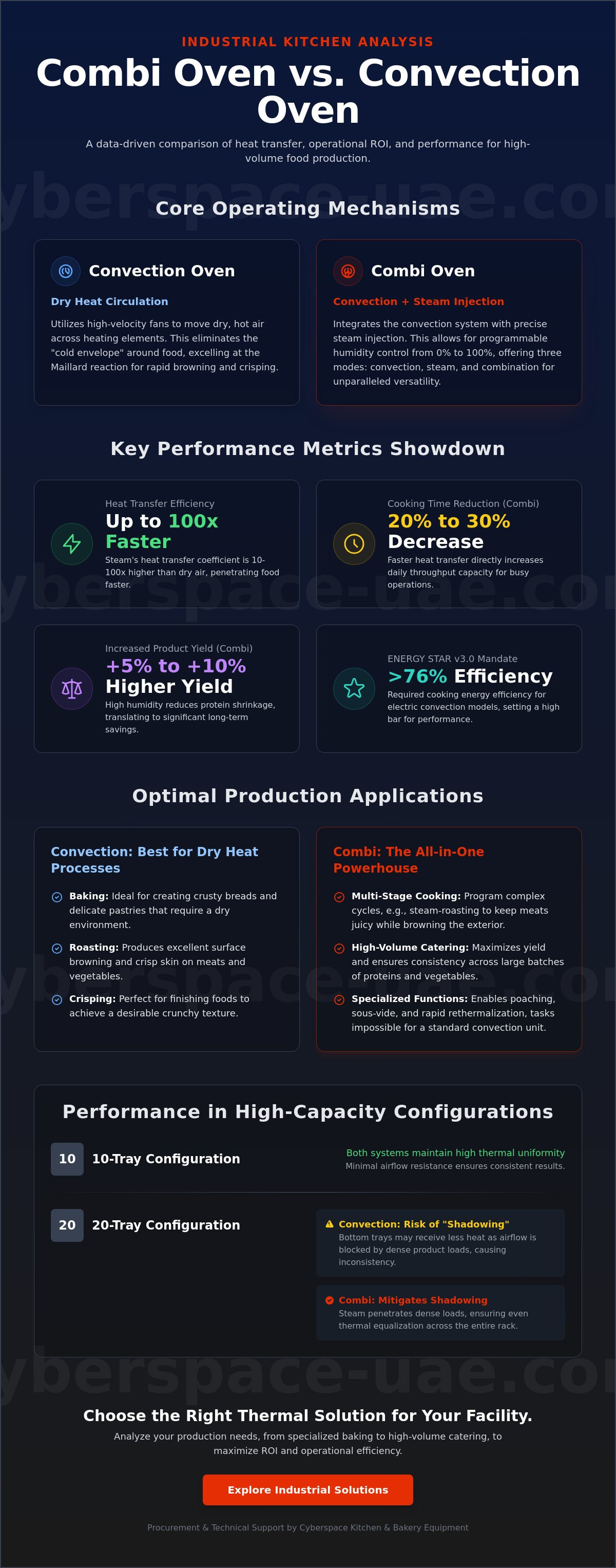
Industrial kitchen operations require high-performance thermal equipment to maintain consistent output across high-volume batches. The operational baseline for any commercial oven is thermal consistency. This ensures that every product, whether placed on the top or bottom tray, receives identical heat exposure. While both systems aim for this uniformity, their mechanical approaches to heat transfer differ significantly. A convection oven utilizes high-velocity fans and exhaust systems to circulate dry, hot air throughout the chamber. In contrast, a combi oven integrates this convection mechanism with precise steam injection.
The primary technical differentiator between these units is the steam generation system. Most high-capacity combi ovens feature either a dedicated steam generator (boiler) or a boilerless injection system. Boiler-based units maintain a reservoir of hot water to produce immediate, high-volume steam. Boilerless systems flash-freeze water onto the heating elements or fan blades. When comparing a combi oven vs convection oven, the choice often hinges on this ability to manipulate the atmospheric moisture content within the cooking cavity.
The Mechanics of Forced Air Convection
Convection ovens rely on mechanical fans to move air across heating elements. This forced air movement eliminates the "cold envelope" that typically surrounds food items in static ovens. High-velocity fans ensure rapid heat transfer by continuously replacing cooler air with heated air. This process is highly effective for the Maillard reaction. It produces the rapid surface browning and crisping required for traditional baking and roasting.
Dry heat has specific limitations in industrial applications. Without humidity control, moisture evaporates quickly from the product surface. This can lead to excessive dehydration and product shrinkage in moisture-sensitive applications. While convection remains the standard for crusty breads and pastries, it lacks the versatility required for complex, multi-stage cooking cycles.
The Combi Steamer Advantage
Modern Combi steamer technology provides three distinct operational modes: steam, convection, and combination. This allows for precision control of saturation percentages from 0% to 100% humidity. Operators can program specific humidity levels to match the requirements of different food groups. For example, a 30% humidity setting can prevent lean proteins from drying out while still allowing the convection heat to brown the exterior.
This versatility directly impacts operational yield. Maintaining high humidity levels during the roasting process significantly reduces protein shrinkage. In a high-volume catering environment, a 5% to 10% increase in yield per batch translates to substantial long-term savings. The integration of steam also enables specialized functions like poaching, sous-vide, and rapid rethermalization, which are impossible in a standard convection unit.
Comparative Performance: Dry Heat vs. Saturated Steam
Steam transfers heat significantly faster than dry air. In industrial thermal processing, the heat transfer coefficient of steam is roughly 10 to 100 times higher than that of circulating air. This physical property allows combi ovens to reduce cooking times by 20% to 30% compared to standard convection units. For high-volume operations, this time reduction directly increases daily throughput capacity. It's a vital metric for facilities managing tight production schedules.
Energy consumption patterns vary between the two systems. Convection ovens typically require less energy during the pre-heat phase. They don't have water heating requirements. However, combi ovens often demonstrate superior efficiency during sustained operation. According to ENERGY STAR v3.0 data, high-performance gas convection ovens must meet a 49% cooking energy efficiency. Combi ovens achieve similar or better results by utilizing the latent heat of steam to maintain internal temperatures with less burner activity.
Consistency Benchmarks:
- 10-tray configurations: Both systems maintain high uniformity. Airflow resistance is minimal at this scale.
- 20-tray configurations: Convection units may experience "shadowing." This happens when bottom trays receive less heat because the air path is blocked by the product.
- Thermal Equalization: Combi units mitigate shadowing by using steam to penetrate dense product loads, ensuring even cooking across the entire rack.
Thermal Consistency and Airflow Patterns
Precision fan speed control is vital in professional convection systems. Advanced convection systems now feature bi-directional fans. These fans reverse direction at set intervals to break up laminar airflow patterns. This prevents hot spots on the edges of trays. In a combi oven vs convection oven comparison, the combi's ability to inject moisture provides a secondary layer of thermal stability. Steam acts as a heat buffer. It fills the gaps between trays that air alone cannot reach effectively. This is particularly effective for heavy roasted proteins where core temperature consistency is critical for food safety compliance.
Moisture Management and Food Quality
The technical difference lies in the exhaust flap control. Standard convection ovens use a passive vent. Modern combi systems utilize motorized dampers. These dampers allow for precise humidity extraction at specific stages of the cooking cycle. This is essential for products like roast chicken where a moist interior must be followed by a high-heat, low-humidity skin-crisping phase. Combi ovens also prevent flavor transfer in multi-product loads through active dehumidification and rapid air exchange. You can cook fish and dessert simultaneously without cross-contamination. Precision moisture control in a Rational combi oven for bakery ensures consistent crust development for artisan breads.
Evaluate our current range of high-performance cooking systems to determine the best fit for your production line.
Operational Applications for Commercial Food Service
Operational efficiency is dictated by the specific output requirements of the facility. Industrial baking lines often prioritize specialized equipment over multi-functional units. In contrast, full-service kitchens require high versatility to manage diverse menu items within a limited footprint. Calculating throughput capacity in terms of trays per hour is essential for procurement. For instance, a 20-tray unit with a 30-minute cycle provides a gross capacity of 40 trays per hour, assuming optimized loading protocols. If a combi oven vs convection oven comparison shows a 20% reduction in cooking time, the total daily throughput increases proportionally, allowing for higher volume without expanding the kitchen footprint.
Convection Ovens in Specialized Baking
Convection remains the industrial standard for specialized pastry production. Consistent dry airflow is necessary for items like cookies, muffins, and macarons that require uniform surface dehydration. While deck ovens provide the bottom heat required for specific artisan breads, convection units offer cost-effective scaling for single-product lines. These systems are optimized for simple, high-frequency cycles where moisture injection is unnecessary or detrimental to final product texture. Deciding on a combi oven vs convection oven for a dedicated bakery often leads to convection due to lower capital costs for dry-heat-only products. These units are also preferred for large-scale dehydration of vegetables or proteins where moisture removal is the primary objective.
Combi Ovens in Diverse Menu Operations
Combi ovens offer a strategic advantage in diverse menu operations. A single unit can execute steaming, poaching, roasting, and baking, effectively replacing multiple pieces of equipment. This versatility is critical during peak-hour demands where kitchen staff must pivot between different cooking techniques rapidly. Modern systems allow for sous-vide applications, providing precise temperature control for vacuum-sealed proteins. Utilizing advanced combi oven cooking programs ensures standardized output across different shifts, regardless of operator skill level.
High-performance units, such as a Rational combi oven, facilitate complex multi-stage recipes through automated humidity adjustments. This level of automation is absent in standard convection systems. When evaluating equipment for catering, the ability to rethermalize plated meals without dehydration is a primary differentiator. This multi-mode functionality maximizes kitchen real estate and reduces the need for secondary appliances like standalone steamers or specialized proofing cabinets. The ability to switch from high-heat roasting to low-temperature steaming in a single cavity streamlines the production workflow for complex, multi-component menus.
Industrial Selection Criteria: ROI and Maintenance
Industrial procurement requires a shift from evaluating initial capital expenditure (CAPEX) to analyzing total cost of ownership (TCO). While the upfront cost of a high-performance combi unit is higher, the operational savings often justify the investment. Energy efficiency is a primary driver. ENERGY STAR certified gas convection ovens can save approximately $2,000 annually on utility bills. However, a combi oven vs convection oven comparison must also account for facility infrastructure. Upgrading to three-phase power for a combi unit can range from $5,000 to $15,000 depending on existing site conditions. These are critical procurement costs separate from the unit price.
Calculating the Total Cost of Ownership (TCO)
TCO models must include water consumption and specialized chemical costs. Combi ovens require consistent water usage for steam generation and automated cleaning cycles. When comparing the 10 tray combi oven price against multiple convection units, factor in the reduction in labor hours. Automated cooking programs reduce the need for specialized staff, lowering long-term payroll expenses. Energy consumption under ENERGY STAR v3.0 standards ensures that modern units meet strict idle energy rates, such as 1.4 kW for full-size electric convection models.
Durability and Maintenance Protocols
The UAE's high water hardness necessitates rigorous filtration and descaling protocols. Steam generators are susceptible to scale buildup, which can lead to component failure and increased energy consumption. Utilizing Rational combi oven self cleaning systems is essential for maintaining operational longevity. These systems use targeted chemicals to remove mineral deposits and grease without manual scrubbing. This automation ensures the unit remains compliant with NSF/ANSI 4-2025 sanitation standards with minimal staff intervention.
Maintenance for industrial convection ovens focuses on mechanical components. Routine inspections should target:
- Fan motor bearings and drive belts.
- Door gaskets and hydraulic seals.
- Exhaust flap calibration and airflow sensors.
High-end brands like Rational are engineered for a service life exceeding 10 years in high-volume environments, provided maintenance schedules are followed. View our full inventory of industrial cooking solutions to optimize your facility's ROI.
Procurement of High-Performance Cooking Systems
Selecting an industrial thermal solution requires rigorous verification of supplier credentials and local technical infrastructure. In the UAE, high-volume production facilities must prioritize vendors who maintain a comprehensive inventory of local spare parts. Downtime in a high-capacity bakery or catering facility results in immediate revenue loss. Evaluating the combi oven vs convection oven choice at this stage involves verifying that the selected unit integrates seamlessly with existing professional baking equipment. This includes ensuring that your electrical load, ventilation capacity, and drainage systems can support the specific requirements of the new machinery.
Final procurement must include a verification of HACCP (Hazard Analysis and Critical Control Points) compliance. Modern combi units often feature internal data logging. This simplifies food safety audits by recording core temperatures and cooking durations automatically. Before finalizing any purchase, verify that the equipment meets national electrical safety standards and the latest NSF/ANSI 4-2025 sanitation requirements. These certifications are mandatory for legal operation in commercial environments.
Brand Selection and Industrial Standards
Rational remains the global benchmark for combi technology due to its consistent thermal accuracy and robust construction. Industrial-grade units should utilize high-grade stainless steel, typically 304 or 316, for the cooking chamber to resist corrosion from steam and cleaning chemicals. High-density insulation is also critical. It minimizes heat radiation into the kitchen environment and maintains the 76% cooking energy efficiency required for ENERGY STAR v3.0 electric models. Compliance with these standards ensures long-term operational reliability and safety. Verification of build quality prevents premature equipment failure in high-demand environments.
Next Steps for Commercial Kitchen Integration
A kitchen footprint audit is mandatory before commissioning. Combi ovens require dedicated drainage for hot condensate and specific ventilation protocols. Type I hoods are generally required if the oven is used for high-fat proteins to manage grease-laden vapors. Professional installation by certified technicians ensures that technical commissioning meets manufacturer specifications. This includes verifying water pressure for steam generation and calibrating fan speeds. Requesting a technical demonstration using your specific menu items is the final step. This confirms that the equipment delivers the required texture, yield, and consistency for your unique production needs. Direct coordination with suppliers ensures a streamlined transition from procurement to full-scale operation.
Optimizing Industrial Kitchen Performance for 2026
Selecting the correct thermal solution requires a balance between initial capital expenditure and long-term operational efficiency. Convection ovens remain a reliable standard for specialized dry-heat baking. Combi ovens provide the technical versatility needed for complex, high-volume menus. Determining the ideal combi oven vs convection oven configuration depends on your specific production volume and menu diversity. Prioritize units that meet ENERGY STAR v3.0 efficiency ratings and NSF/ANSI 4-2025 sanitation standards to ensure regulatory compliance and lower utility costs. Factor in the total cost of ownership, including the necessity of robust water filtration for steam-based systems in the UAE climate.
Operational success relies on choosing a partner that provides more than just hardware. We're an authorized supplier of Rational high-performance ovens and specialized industrial baking machinery. Our team ensures nationwide technical support and professional installation across the UAE to maximize your equipment's service life. Secure your facility's output quality with precision-engineered tools designed for modern industrial requirements. We look forward to facilitating your next phase of operational growth.
View Professional Rational Combi Oven Solutions
Frequently Asked Questions
Which oven is better for high-volume bread baking?
Convection or rotary ovens are typically superior for specialized high-volume bread production. These units provide the consistent dry heat and airflow needed for specific crust development. While a combi oven offers versatility, specialized industrial bakeries often prioritize the dedicated thermal profiles and tray capacities of rotary or deck systems for standardized bread output.
Do combi ovens require a water connection and drainage?
Yes, all combi ovens require a dedicated water inlet and a high-temperature drainage connection. The water supply is necessary for steam generation and automated cleaning cycles. The drainage system manages hot condensate and wastewater safely. In the UAE, professional installation must include high-quality water filtration to prevent mineral buildup within the steam generator.
Can a convection oven perform steaming functions?
A standard convection oven cannot perform true steaming functions. It's designed strictly for dry heat circulation via mechanical fans. Some specialized convection models feature moisture injection for bread crusting, but they lack the precision saturation control of a combi unit. They cannot maintain the 100% humidity levels required for poaching or rapid steaming.
What is the average lifespan of an industrial combi oven?
High-performance industrial combi ovens, such as Rational models, have an expected service life exceeding 10 years. This longevity is strictly dependent on adherence to manufacturer maintenance protocols and water filtration standards. Regular descaling and routine inspections of door seals and fan motors are the primary factors in extending the unit's operational life.
Is a combi oven worth the extra investment for a small cafe?
A combi oven is worth the investment if the cafe menu requires diverse cooking techniques within a limited footprint. The ability to roast, steam, and bake in one unit replaces multiple appliances. When comparing a combi oven vs convection oven for small spaces, the combi's multi-functionality often justifies the higher CAPEX through increased menu flexibility and labor savings.
How often do industrial ovens require professional servicing in the UAE?
Industrial ovens in the UAE should receive professional servicing at least every six months. High local water hardness and elevated ambient temperatures increase the mechanical strain on steam and cooling systems. Facilities with 24/7 production cycles may require quarterly inspections to ensure components like steam generators and convection fans remain within operational specifications.
What are the cleaning requirements for convection vs. combi ovens?
Convection ovens generally require manual cleaning of the internal chamber, racks, and fan guards. Combi ovens feature advanced automated self-cleaning cycles that utilize specialized chemicals to dissolve grease and mineral scale. This automation reduces daily labor hours and ensures the unit consistently meets the latest NSF/ANSI 4-2025 sanitation standards with minimal staff intervention.
Can I use a combi oven for sous-vide cooking?
Yes, modern combi ovens are highly effective for high-volume sous-vide cooking. They provide precise temperature control in steam mode, often maintaining accuracy within one-degree increments. This allows kitchen staff to cook vacuum-sealed proteins at low temperatures for extended periods. It eliminates the need for standalone water baths and circulators in a professional production environment.