
Deck Oven Installation Requirements UAE: A Technical Procurement Guide
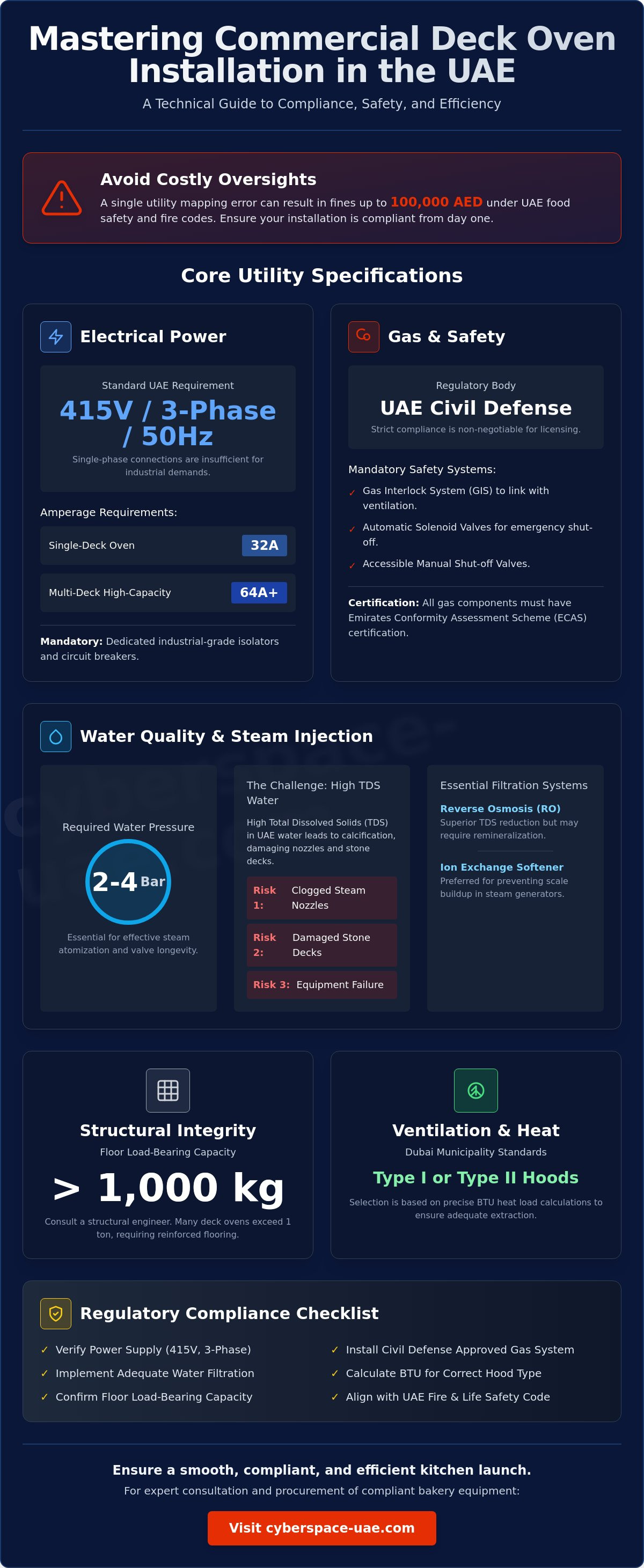
A single technical oversight during utility mapping can trigger fines up to 100,000 AED under current UAE food safety and fire codes. You're likely aware that securing a commercial kitchen license across the Emirates is a high-stakes process; the March 2026 amendments to the UAE Fire and Life Safety Code of Practice have standardized previously variable requirements. Mastering the specific deck oven installation requirements UAE authorities demand is essential for any bakery looking to avoid costly utility delays or premature equipment failure.
Professional kitchen managers must balance 3-phase power availability with the high ambient heat challenges inherent to the Gulf climate. This procurement guide delivers a precise, technical breakdown of the electrical, gas, and spatial parameters required for industrial deck ovens. We'll examine mandatory specifications for Grade 304 stainless steel surfaces, Civil Defense gas line protocols, and the latest relevant food safety authority ventilation standards to ensure your facility remains compliant, efficient, and inspection-ready.
Key Takeaways
- Verify power supply compatibility with standard 415V, 3-phase, 50Hz requirements to prevent utility delays during commissioning.
- Implement high-performance filtration systems to manage water TDS levels, ensuring steam nozzle longevity and stone deck integrity.
- Calculate precise BTU heat loads to select appropriate Type I or Type II extraction hoods as per Dubai Municipality standards.
- Evaluate site-specific deck oven installation requirements UAE authorities mandate, including floor load-bearing capacities often exceeding 1,000kg.
- Streamline the licensing process by aligning equipment specifications with the latest UAE Fire and Life Safety Code of Practice.
Core Infrastructure: Electrical and Gas Supply Standards
Industrial baking equipment requires a robust utility interface to maintain consistent thermal output and operational safety. In the UAE, the baseline electrical specification for industrial deck ovens is 415V, 3-phase, 50Hz. Standard single-phase connections are generally insufficient for the rapid recovery times and high-temperature demands of professional machinery. Meeting the specific deck oven installation requirements UAE authorities mandate starts with ensuring your facility's power distribution board can handle the load. Amperage requirements vary significantly based on configuration. A single-deck unit may require 32A, while high-capacity multi-deck setups often exceed 64A per phase. Dedicated industrial-grade isolators and circuit breakers are mandatory to prevent localized overloads from affecting the entire kitchen grid.
3-Phase Power vs. Single Phase for Industrial Baking
High-capacity deck ovens utilize 3-phase power for its inherent voltage stability and balanced load distribution. This is critical for protecting sensitive digital control boards and preventing the premature burnout of heating elements. Fluctuations in power can lead to uneven baking results or hardware failure. For a deeper look at energy consumption and operational costs, consult our Electric Deck Oven vs Gas: A Technical Performance Analysis. While modern electric units offer precision, they rely on a steady, heavy-duty electrical feed. These systems often incorporate stone decks that mirror Masonry oven principles of heat retention to ensure consistent bottom heat across long production cycles.
Gas Connection and Safety Interlocks
Gas-fired units introduce additional regulatory layers, specifically regarding UAE Civil Defense compliance. Installations must feature a Gas Interlock System (GIS) and automatic solenoid valves. These safety mechanisms cut off the gas supply if the extraction system fails or if a leak is detected. Gas line pressure must be calibrated for either LPG or Natural Gas, depending on the specific commercial zone's infrastructure. Precise deck oven installation requirements UAE inspectors look for include the presence of accessible manual shut-off valves and certified pressure regulators. While flexible connections allow for easier maintenance and cleaning, rigid piping is often required for high-pressure lines to ensure long-term structural integrity. Verify that all gas components carry the necessary Emirates Conformity Assessment Scheme (ECAS) certifications before commissioning.
Water Quality and Steam Injection Requirements
Effective steam injection is a technical necessity for professional crust development in industrial baking. In the UAE, achieving consistent steam quality requires precise management of incoming water pressure and mineral content. Standard deck oven installation requirements UAE operators must follow dictate a water pressure range of 2 to 4 bar. If pressure falls below this threshold, the steam generator cannot atomize water effectively. If it exceeds it, the solenoid valves may suffer mechanical stress or failure. High Total Dissolved Solids (TDS) levels, typical in regional water supplies, present a significant risk to internal components. Minerals like calcium and magnesium precipitate out of solution at high temperatures, leading to rapid calcification of steam nozzles and the porous surfaces of stone decks.
Filtration Systems for UAE Water Conditions
Selecting the correct filtration technology is a prerequisite for equipment longevity. While basic carbon filters remove chlorine, they don't address the high mineral load found in local municipal water. Bakery managers must choose between reverse osmosis (RO) systems and ion exchange softeners. RO systems provide superior TDS reduction but require careful remineralization to prevent the water from becoming corrosive to copper fittings. Ion exchange is often the preferred choice for preventing scale buildup in the steam generator. A strict maintenance schedule is essential; filters in high-volume industrial environments typically require inspection every three to six months to prevent breakthrough calcification. Monitoring the conductivity of the filtered water ensures the system operates within manufacturer specifications.
Plumbing and Drainage Layout
Drainage systems must handle both excess moisture and high-temperature steam condensation. Hygiene regulations in Dubai and Abu Dhabi often require air-gap drainage to prevent backflow contamination from the main sewer line. All drainage piping must be constructed from high-temperature resistant materials, such as CPVC or specialized stainless steel, to withstand the thermal shock of steam exhaust. Positioning the water inlets and drainage points is a critical part of the spatial plan. These connections must remain accessible for routine descaling and service without requiring the disassembly of the oven stack. While the UAE Fire and Life Safety Code of Practice primarily focuses on fire prevention, its standards for pressurized systems and thermal discharge also inform the safe routing of steam lines. If you're planning a new facility, reviewing our range of professional deck ovens can help you align your plumbing layout with high-performance equipment requirements.
Ventilation, Heat Load, and Extraction Systems
Managing the thermal output of a multi-deck oven is a core component of deck oven installation requirements UAE facilities must address. In a region where ambient summer temperatures frequently reach 45°C, the heat load from industrial baking can quickly overwhelm standard HVAC systems. Engineers must calculate the precise British Thermal Units (BTU) or kW output per deck to size extraction systems correctly. A triple-deck configuration generates significant radiant heat that requires a high-capacity extraction canopy. Proper sizing prevents the kitchen from becoming an inhospitable workspace and protects sensitive electronics on adjacent equipment.
UAE municipal regulations distinguish between Type I and Type II hoods. Type I hoods are mandatory if the oven produces grease or smoke, while Type II hoods are standard for heat and steam removal. Minimum extraction rates (CFM) are determined by the oven's aperture size and total deck count. To maintain air balance, these systems must integrate with the building's Fresh Air Handling Unit (FAHU). This ensures that the air removed by the exhaust is replaced by tempered, filtered air, preventing negative pressure issues that can hinder door operation and suction efficiency. Referencing technical Commercial Kitchen Electrical and Gas Standards helps in aligning ventilation with utility capacities.
Thermal Management in High-Volume Bakeries
Radiant heat from stone decks can affect the performance of nearby refrigeration and prep stations. Effective insulation is required to minimize heat transfer to the kitchen floor and surrounding equipment. In high-volume environments, managing the thermal transition of products is also critical. Integrating Commercial Blast Chiller Technology is a common strategy to stabilize product temperatures quickly after baking, reducing the overall heat load on the facility’s climate control and maintaining food safety standards.
Exhaust Ducting and Fire Suppression
UAE Civil Defense mandates the use of fire-rated ducting for all commercial kitchen exhaust systems. These ducts must withstand high temperatures and prevent the spread of flame between zones. Most industrial deck oven installation requirements UAE inspectors enforce include a pre-installed fire suppression system, such as Ansul, within the extraction hood. Clearance is another vital metric; maintain a minimum gap between the oven top and the canopy to ensure optimal capture velocity without creating a fire hazard. Regular cleaning of grease filters and ductwork is a legal requirement to maintain the facility's fire safety certificate and operational license.
Spatial Planning and Structural Integrity
Industrial deck ovens are among the heaviest assets in a commercial bakery. A standard three-deck configuration with stone soles often exceeds 1,000kg in total weight. This concentrated load requires a floor with high structural integrity and load-bearing capacity. Before delivery, verify that the kitchen floor is reinforced to handle these specifications without risk of subsidence or cracking. Specific deck oven installation requirements UAE engineers prioritize include the assessment of floor finishes; non-slip, heat-resistant tiles are mandatory for safety and hygiene compliance. If your facility is located on an upper floor of a commercial building or mall, structural sign-off from the building's facilities management is a prerequisite.
Clearance zones are vital for both operational flow and technical maintenance. Front-of-oven space must accommodate the full extension of loading peels and the movement of mobile racks, typically requiring at least 1,500mm of unobstructed floor space. For side and rear access, a minimum gap of 500mm is necessary to allow technicians to reach burner assemblies, steam generators, and electrical panels. Modular units offer a distinct advantage for facilities with limited access. These ovens can be transported in sections through standard door widths and assembled on-site, whereas pre-assembled units may require specialized rigging or the removal of storefront glass.
Leveling is a non-negotiable step during the final positioning phase. An uneven oven causes inconsistent heat distribution across the stone decks, leading to "hot spots" and uneven bread bottoms. Technicians use precision spirit levels on each deck to adjust the heavy-duty feet or stand. This ensures that the steam injection system distributes moisture evenly and that the oil or gas burners operate at peak efficiency.
Workflow Optimization and Accessibility
Positioning the oven correctly within the production line reduces labor costs and minimizes temperature fluctuations in the dough. The oven should be located within close proximity to dough processing equipment to ensure a seamless transition from final proofing to baking. Ergonomic height is another factor; the bottom deck should be high enough to prevent excessive bending, while the top deck must remain accessible for safe loading. Ensure that the placement does not obstruct the path to emergency exits or fire suppression controls as per UAE Civil Defense protocols.
Multi-Deck Stacking and Stand Requirements
Stacking kits must be rated for the specific weight of additional decks to ensure long-term stability. Many UAE bakeries utilize integrated prover bases to maximize their vertical footprint. These bases require their own utility connections for water and power, which must be factored into the initial spatial mapping. When comparing footprint requirements, the static nature of a deck oven often allows for tighter placement than an Industrial Rotary Baking Oven, which requires additional clearance for rack rotation and door swing. Explore our full range of industrial deck ovens to find the configuration that fits your spatial constraints.
UAE Regulatory Compliance and Commissioning
Finalizing a bakery project requires strict adherence to local mandates. Dubai Municipality and the Abu Dhabi Agriculture and Food Safety Authority (ADAFSA) require detailed technical submittals before a final trade license is issued. Meeting the deck oven installation requirements UAE inspectors demand involves a documented verification of all safety interlocks and utility connections. Civil Defense approvals are mandatory for gas-fired units. These inspections focus on the gas interlock system and solenoid valve functionality. Purchasing brand-new equipment simplifies this process. Used machinery often lacks the necessary ECAS certification or updated fire-safety features required for modern UAE commercial zones. Non-compliance can lead to severe penalties; fines for food safety and fire code violations range from 50,000 to 100,000 AED.
A comprehensive pre-commissioning checklist ensures the facility is ready for operation:
- Verify 3-phase voltage stability and phase rotation at the isolator.
- Confirm gas line pressure is within the manufacturer's specified mbar range.
- Check water TDS levels post-filtration to protect steam nozzles from calcification.
- Inspect exhaust fan CFM against the building’s Fresh Air Handling Unit (FAHU) balance.
- Test emergency stop buttons and automatic gas shut-off valves.
Commissioning and Initial Burn-Off
The commissioning phase begins with a controlled burn-off. This process cures the stone decks by removing residual moisture from the manufacturing phase. It's essential to start at 100°C and increase in 50°C increments every hour until reaching the maximum operating temperature. This prevents the stone from cracking due to rapid thermal expansion. During this time, technicians verify temperature calibration across all levels using external thermal probes to ensure the digital interface is accurate. Steam injection uniformity is tested next. High-performance units must demonstrate rapid recovery times and consistent moisture distribution to maintain production speed in high-volume environments.
Authorized Procurement and Warranty Security
Sourcing equipment from authorized UAE distributors ensures a reliable supply chain for spare parts. This is critical for minimizing downtime in 24-hour industrial bakeries. Documenting the entire setup process, including utility test results, is a requirement for manufacturer warranty validation. A final handover includes rigorous staff training on safety protocols and emergency shut-off procedures. Operators must know the location of the manual gas reset and the electrical isolator. Ensure all operational manuals and maintenance logs are available on-site. In Dubai, these records must be integrated into the "Food Watch" digital platform for real-time regulatory tracking. Following these deck oven installation requirements UAE authorities mandate ensures a seamless transition to full production; to find the right team to manage your new facility, click here.
Finalizing Your Industrial Bakery Infrastructure
Successful facility commissioning depends on the precise integration of 415V 3-phase power, high-capacity extraction systems, and specialized water filtration to manage regional mineral levels. Adhering to the specific deck oven installation requirements UAE authorities mandate protects your investment from utility-related downtime and regulatory penalties. Ensuring your floor load-bearing capacity and gas interlock systems meet Civil Defense standards is essential for a smooth facility handover and long-term operational safety.
We operate as an authorized UAE distributor, providing only brand new industrial machinery backed by full technical support and installation guidance. Our specialists ensure your equipment is commissioned according to exact manufacturer specifications and local safety codes. This methodical approach guarantees that your production line remains efficient and compliant from day one. Request a Technical Quote for Industrial Deck Ovens today to secure high-performance tools for your commercial kitchen. We look forward to facilitating your facility’s operational success through reliable, professional-grade solutions.
Frequently Asked Questions
Does a deck oven require a dedicated exhaust hood in the UAE?
Yes, a dedicated extraction system is mandatory for all industrial baking units. Dubai Municipality and ADAFSA require a Type II hood for heat and steam removal or a Type I hood if the oven produces smoke or grease. The system must integrate with the building's FAHU to maintain air balance and prevent negative pressure issues.
What is the standard electrical phase for commercial bakery ovens in the UAE?
The standard specification is 415V, 3-phase, 50Hz. Most industrial deck ovens require this configuration to handle high amperage loads, typically ranging from 32A to 64A per phase. Single-phase connections are generally insufficient for the thermal recovery speeds required in professional baking environments.
Can I install a gas deck oven in a shopping mall in the UAE?
Installation depends on mall management and Civil Defense approval. Many UAE malls prioritize electric units for safety; however, gas is permitted if the facility has a centralized gas line and a certified Gas Interlock System. You must ensure all components meet the latest deck oven installation requirements UAE fire codes.
How much clearance do I need around a 3-deck stone oven?
Plan for 1,500mm of frontal clearance for loading and unloading operations. Side and rear clearances should be at least 500mm to allow for technical service and airflow. These zones ensure that burners and electrical panels remain accessible for routine maintenance and emergency repairs.
Is water filtration mandatory for deck ovens with steam injection?
Yes, specialized filtration is essential due to high mineral content in local water supplies. High TDS levels lead to rapid calcification of steam nozzles and stone decks. Using reverse osmosis or ion exchange systems prevents scale buildup and protects your equipment's manufacturer warranty.
What are the UAE Civil Defense requirements for bakery oven gas lines?
Gas lines must feature automatic solenoid shut-off valves and a Gas Interlock System (GIS). All piping and connections must be fire-rated and installed by a Civil Defense-approved contractor. ECAS certification for the oven itself is a prerequisite for final commissioning and licensing.
How do I calculate the floor load for a multi-deck industrial oven?
Calculate the total weight by summing the oven modules, stone decks, and the maximum product load. This often exceeds 1,000kg for a 3-deck unit. Ensure the kitchen floor's structural integrity can support this concentrated weight by obtaining a technical sign-off from the building's facilities management.
Why is 3-phase power preferred over single-phase for industrial baking?
3-phase power provides superior voltage stability and balanced electrical load distribution. It protects sensitive digital controllers and heating elements from fluctuations common in high-amperage machinery. This stability is a core part of the deck oven installation requirements UAE operators must meet for consistent performance.