
How to Start a Bakery Business in UAE: Industrial Startup Equipment List 2026
The UAE bakery and cereals market reached a valuation of AED 5.4 billion in 2023, yet high initial capital expenditure on the wrong machinery often stalls growth before production begins. Building a profitable facility requires more than a trade license. It demands a strictly calibrated startup bakery equipment list UAE that aligns with high-volume production needs and municipality codes.
You understand that navigating Dubai Municipality food safety regulations and HACCP requirements is a complex hurdle. This guide provides a technical framework for selecting industrial machinery, including deck ovens and high-capacity spiral mixers, to ensure operational efficiency. We'll detail the specific equipment requirements for 2026, the licensing flow for foreign ownership, and the thermal management solutions necessary for commercial success in the Gulf region.
Key Takeaways
- Navigate licensing requirements from the Department of Economy and Tourism and necessary municipality food safety approvals.
- Distinguish between spiral and planetary mixers to optimize dough processing for specific commercial production outputs.
- Evaluate industrial thermal systems, including deck ovens and blast chillers, to ensure consistent quality and safety.
- Implement a strategic startup bakery equipment list UAE to maximize long-term ROI and operational reliability.
- Prioritize high-performance machinery to maintain full compliance with HACCP frameworks and UAE food safety standards.
Navigating UAE Bakery Licensing and Facility Requirements
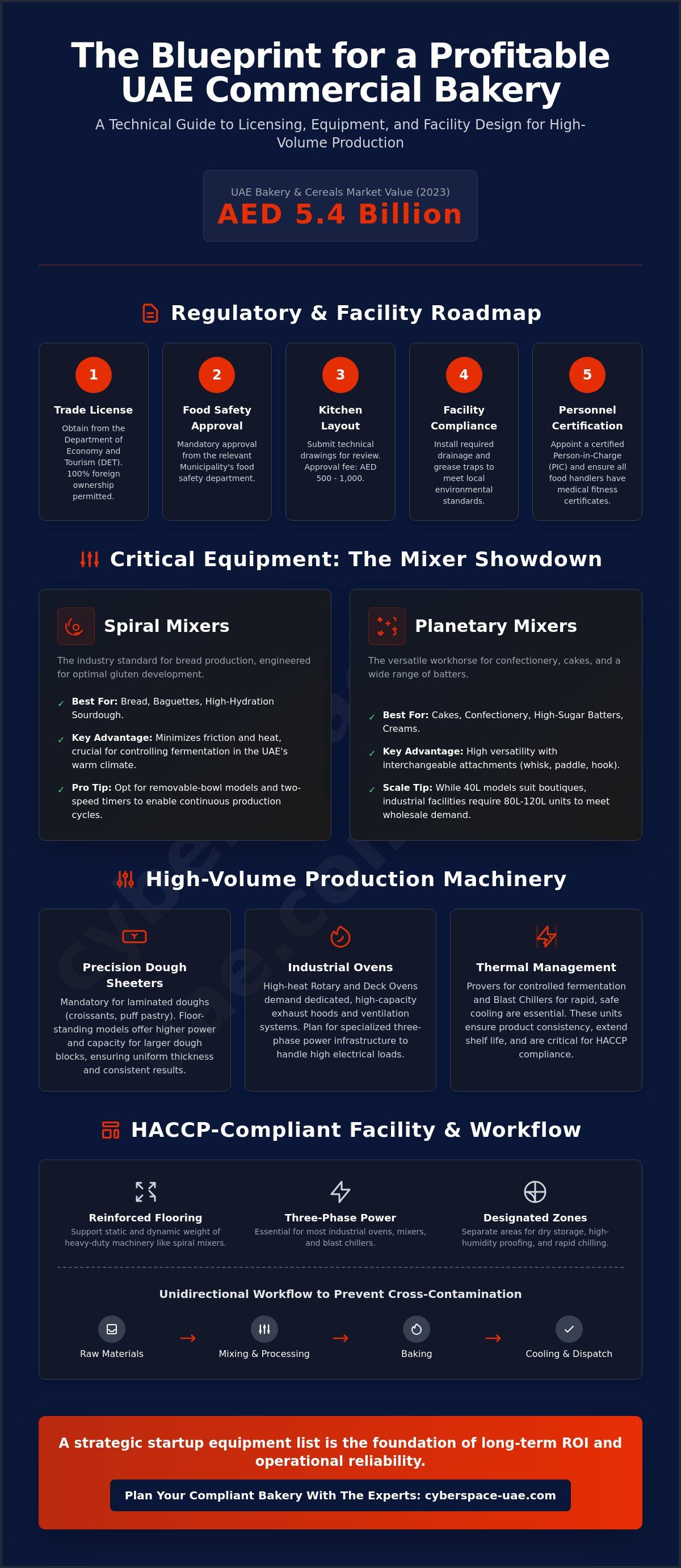
Launching a commercial bakery in the UAE requires a Trade License from the Department of Economy and Tourism (DET). Current regulations permit 100% foreign ownership for mainland activities. Beyond the license, food safety department approvals are mandatory. This process involves submitting a technical kitchen layout for municipality review, which typically costs between AED 500 and AED 1,000 for approval. Commercial baking at an industrial scale necessitates specific drainage and grease trap installations to meet local environmental standards. Failure to align facility design with these codes results in costly retrofitting later.
Legal Steps for National Bakery Operations
Choose between a Limited Liability Company (LLC) or a Free Zone entity. Free zones suit export-oriented production or cloud kitchens. Mainland licenses allow direct retail storefronts. You must designate a Person-in-Charge (PIC) who holds a food safety certification. Every food handler requires an annual medical fitness certificate. These legal foundations ensure your startup bakery equipment list UAE remains compliant during municipality inspections. Documentation must be current to avoid operational pauses or fines. To stay ahead of these regulatory and financial obligations, partnering with CTC Tax & Accounting ensures your bookkeeping and tax compliance are handled by experts.
Facility Specifications for Industrial Equipment
Industrial machinery requires specialized facility infrastructure. High-heat Rotary Ovens and Deck Ovens demand high-capacity exhaust systems and dedicated ventilation hoods. These units generate significant thermal loads that impact ambient temperature. Plan for reinforced flooring to support the static and dynamic weight of heavy-duty Spiral Mixers. These mixers exert high torque during the processing of dense doughs. Allocate specific floor space for Dough Sheeters to ensure unobstructed movement during laminating processes.
Utility planning must account for high-voltage electrical loads. Most industrial ovens and Blast Chillers operate on three-phase power. Zoning is critical for food safety and efficiency. Allocate separate areas for dry storage, high-humidity proofing, and rapid chilling. Implementing HACCP-compliant workflows means designing a unidirectional flow from raw material intake to final dispatch. This prevents cross-contamination between raw ingredients and finished products. Correct placement of Provers and Rational combi ovens reduces labor movement and increases output per square meter.
Essential Dough Processing Machinery: Spiral and Planetary Mixers
Industrial dough processing is the technical foundation of commercial baking. Your startup bakery equipment list UAE must differentiate between mixing technologies to ensure production efficiency. Spiral mixers are the industry standard for bread production. They utilize a rotating bowl and a spiral hook that stays in a fixed position. This configuration minimizes friction and heat transfer. It's essential for maintaining dough temperature in the UAE's climate, where ambient heat can accelerate fermentation prematurely.
Planetary mixers serve a different functional purpose. These machines use a stationary bowl with an agitator that moves in a planetary motion. This versatility makes them ideal for confectionery, cakes, and high-sugar batters. When calculating bowl capacity, consider your hourly production targets. A 40-liter planetary mixer might suffice for boutique pastry shops, but industrial facilities often require 80-liter or 120-liter units to meet wholesale demand. Efficiency depends on matching motor torque to the specific density of your ingredients.
Spiral Mixers for Bread Production
Selecting between fixed-bowl and removable-bowl spiral mixers depends on your operational scale. Fixed-bowl models are cost-effective for medium-sized batches. Removable-bowl mixers allow for continuous production cycles. While one batch mixes, the previous one moves to the proofing stage. Integrating professional baking equipment ensures consistent gluten development across all batches. High-performance spiral mixers also feature two-speed timers. This allows for an initial slow-speed blend followed by high-speed development, which is critical for high-hydration sourdough and baguette doughs.
Precision Dough Sheeting and Lamination
Dough sheeters are mandatory for producing puff pastry, croissants, and laminated doughs. Floor-standing models offer longer conveyor belts and higher motor power compared to table-top versions. These units facilitate larger dough blocks, reducing labor time per kilogram of product. Precision is managed through adjustable roller gaps. Accurate calibration ensures uniform thickness, which is vital for even baking and consistent product weight. Look for stainless steel construction. It provides the durability needed for heavy-duty commercial use and simplifies sanitation protocols required by Dubai Municipality.
Calculating the ROI on these machines involves assessing labor savings. A manual rolling process cannot match the speed or precision of an industrial sheeter. For high-volume facilities, automated sheeting lines further reduce human error. If you're refining your startup bakery equipment list UAE, prioritize mixers and sheeters with high-grade safety guards and emergency stop buttons. These features prevent workplace injuries and ensure compliance with local occupational health standards. You can explore high-capacity dough processing units to determine the best fit for your facility layout.
Industrial Baking Technology: Rotary, Deck, and Combi Ovens
Industrial baking requires precise thermal management to ensure product consistency and profitability. When finalizing a startup bakery equipment list UAE, the choice of oven technology directly dictates your production capacity and product variety. Rotary ovens are engineered for high-volume operations. They utilize a rotating rack system and convection airflow to ensure uniform browning across hundreds of units simultaneously. This technology is essential for standardizing bread rolls, buns, and cookies where high throughput is the primary objective.
Artisan bakeries require a different approach. Deck ovens provide conductive heat through stone or ceramic hearths, which is vital for crust development. Integrating these systems with versatile Rational combi ovens allows a facility to handle everything from delicate pastries to roasted fillings within a compact footprint. Analyzing heat retention and fuel efficiency in these multi-deck systems is critical for managing overhead costs in the UAE's competitive food sector.
High-Capacity Rotary Baking Systems
Consistent browning depends on sophisticated airflow management. Modern units allow for programmable fan speeds to accommodate different product densities. Reviewing industrial rotary baking oven specs for 2026 highlights the importance of heat exchanger efficiency. Standardizing tray sizes within these rack systems maximizes the internal volume usage. This reduces energy consumption per unit and streamlines the loading process for high-output commercial lines.
Artisan Quality with Professional Deck Ovens
Artisan products like sourdough and baguettes require the conductive heat of a stone-baked surface. Deck ovens provide this through independent heating elements for the top and bottom of each chamber. Steam injection systems are a critical technical specification. They allow for the rapid introduction of moisture, which is necessary for proper crust expansion and shine. Sourcing from reputable baking deck oven suppliers ensures access to units with high-density insulation. This insulation maintains stable temperatures even during frequent door openings.
Rational Combi Oven Integration
Integrating Rational combi oven for bakery technology provides a versatile solution for diverse production needs. These units combine convection heat with precise steam control, allowing for complex baking profiles to be automated via digital interfaces. This versatility reduces the total kitchen footprint by replacing the need for separate specialized steamers. Technical maintenance is a primary consideration for these systems. Automated cleaning cycles and high-grade water filtration are necessary to prevent scale buildup and ensure long-term operational reliability within your startup bakery equipment list UAE.
Thermal Management Systems: Provers and Blast Chillers
Thermal management represents the final technical pillar in a professional startup bakery equipment list UAE. It bridges the gap between high-speed dough processing and final distribution. Precision control over fermentation and cooling prevents product waste and ensures strict food safety compliance. Provers and blast chillers aren't optional for industrial operations; they're required for stabilizing biological reactions and meeting HACCP standards. Without these systems, ambient temperature fluctuations in the UAE can compromise batch consistency and safety.
Industrial Dough Proving and Retarding
Calibrating humidity levels between 75% and 85% is essential to prevent dough surfaces from drying during the rise. Standard provers focus on maintaining heat and moisture to accelerate yeast activity. Retarder provers add refrigeration capabilities, which allows bakers to slow down fermentation cycles. This provides essential flexibility in labor schedules and improves flavor development through long, cold fermentation. Uniform airflow remains mandatory to ensure every tray on a rack reaches the same temperature at the same time, preventing uneven proofing across large batches.
Blast Chilling for Food Safety and Quality
Rapidly reducing core temperatures of baked goods is essential for preserving moisture and texture. Standard refrigeration systems lack the power to do this and allow large ice crystals to form, which destroys the cell structure of frozen dough. Implementing commercial blast chiller technology protocols ensures products pass through the "danger zone" of 5°C to 60°C quickly. This minimizes bacterial growth risks and locks in the quality of the finished product immediately after the bake cycle.
Industrial units require 304-grade stainless steel construction for long-term durability in high-humidity environments. Easy-clean evaporators are necessary to meet Dubai Municipality sanitation standards and prevent cross-contamination. Automated temperature logging is a critical technical feature that provides the digital records required for HACCP audits. You can view industrial blast chiller specifications to select a unit that matches your oven output capacity. This ensures your thermal management system doesn't become a bottleneck in your production line while maintaining the highest food safety standards.
Optimizing Your Startup Bakery Equipment List for ROI
Achieving profitability in the UAE bakery sector requires a strategic balance between initial capital expenditure and long-term operational costs. Selecting machinery solely based on price often leads to higher energy bills and frequent downtime. Your startup bakery equipment list UAE should prioritize high-performance machinery that offers measurable energy efficiency. New equipment provides the reliability necessary for commercial scaling. Used machinery often lacks a verifiable service history and modern thermal insulation. This increases the total cost of ownership over time.
A phased procurement plan allows for scalable growth without overextending initial cash flow. Start with core industrial assets: a high-torque spiral mixer, a multi-deck or rotary oven, and essential thermal management units. Expand into specialized machinery like planetary mixers or automated sheeting lines as market demand stabilizes. This approach preserves capital while ensuring the facility meets immediate production targets.
Calculating Production Efficiency
Operational bottlenecks occur when equipment capacities are mismatched. Calculate your hourly output requirements precisely. If a spiral mixer produces 120kg of dough per hour, but your rotary oven capacity is limited to 60kg, you're paying for idle machine time. Synchronizing these units ensures a smooth production flow. Precision temperature and humidity control in provers and blast chillers also reduces raw material waste. Automated dough sheeters provide significant labor-saving benefits. They replace manual rolling tasks, allowing staff to focus on finishing and packaging. This increases your output per labor hour.
Finalizing the Equipment Procurement Strategy
Selecting a single-source supplier for integrated kitchen solutions simplifies technical coordination. It ensures that all components of your startup bakery equipment list UAE work together seamlessly. This integration is vital for maintaining consistent electrical loads and utility connections across the production line. Single-source procurement also streamlines communication for technical support and spare parts acquisition.
Verify warranty terms and the availability of national technical support before purchase. Industrial baking systems require regular calibration to maintain performance. Establishing maintenance contracts with professional providers prevents unexpected operational pauses. Conduct comprehensive pre-commissioning tests for all systems. This includes verifying electrical loads, gas pressure for ovens, and drainage flow for sanitation units. These steps ensure the facility is fully operational and compliant with municipality standards before the first commercial batch.
Scaling Commercial Bakery Operations in the UAE
Success in the national bakery sector depends on technical precision and strict regulatory alignment. You've identified how municipality approvals and HACCP compliance dictate facility design and workflow. High-performance machinery, specifically spiral mixers and blast chillers, remains mandatory for maintaining batch consistency in high-volume environments. Finalizing your startup bakery equipment list UAE requires a methodical approach to machinery specifications and facility layout to ensure long-term ROI and operational reliability.
We serve as an official Rational dealer and specialists in high-capacity Deck and Rotary ovens. Our organization provides comprehensive national technical support for all industrial machinery to ensure your production line maintains maximum uptime. View our full catalog of professional bakery equipment to select tools engineered for rigorous commercial output. Precise equipment selection is the gateway to professional-grade results. We're ready to facilitate your facility's technical requirements for the 2026 market.
Frequently Asked Questions
What are the basic trade license requirements for a bakery in the UAE?
Bakery operations require a trade license from the Department of Economy and Tourism (DET), with costs typically ranging from AED 12,000 to AED 35,000. Current regulations permit 100% foreign ownership for both mainland and free zone entities. You must also obtain a food permit from the local municipality and ensure all food handlers possess valid occupational health cards and Person-in-Charge (PIC) certifications.
Which is better for a startup bakery: a rotary oven or a deck oven?
The choice depends on your specific production volume and product variety. Rotary ovens are engineered for high-volume, uniform baking of bread rolls and buns using rack rotation. Deck ovens are superior for artisan products that require conductive heat for stone-baked crust development. Many facilities include both in their startup bakery equipment list UAE to balance high throughput with premium product quality.
Why is a blast chiller necessary for a commercial bakery operation?
Blast chillers are essential for rapidly reducing the core temperature of baked goods to bypass the bacterial danger zone of 5°C to 60°C. This rapid cooling process preserves internal moisture and prevents the formation of large ice crystals in frozen dough. It's a critical technical requirement for maintaining HACCP compliance and extending the shelf life of par-baked industrial products.
What is the difference between a spiral mixer and a planetary mixer?
Spiral mixers utilize a rotating bowl and a fixed spiral hook to develop gluten in heavy bread doughs with minimal heat friction. Planetary mixers feature a stationary bowl and an agitator that moves in a circular motion. While spiral mixers are specialized for bread, planetary mixers are multi-functional tools used for whipping creams, mixing batters, and various confectionery applications.
Do I need a special permit for industrial gas ovens in the UAE?
Yes, all industrial gas installations require specific approvals from Civil Defence and the local gas utility provider. The facility must meet strict ventilation, piping, and emergency shut-off standards to operate legally. Many startup operators select high-efficiency electric deck or rotary ovens to simplify the initial permitting process and reduce the complexity of the facility's utility infrastructure.
How much power supply is typically required for a commercial bakery setup?
Commercial bakeries typically require a three-phase power supply to support heavy-duty motors and heating elements. Total load requirements vary, but a single industrial rotary oven can demand between 30kW and 50kW. It's vital to verify that your facility's electrical allocation from DEWA or FEWA matches the cumulative load of your startup bakery equipment list UAE to avoid operational interruptions.
Can a Rational combi oven replace a traditional bakery oven?
A Rational combi oven is a versatile supplement but typically doesn't replace the high-volume capacity of a rotary oven or the hearth of a deck oven. These units excel at precision steaming, roasting fillings, and baking delicate pastries. They're ideal for diversifying a product range within a small footprint, though wholesale bread production still requires specialized industrial baking technology.
What are the HACCP requirements for bakery equipment in the UAE?
HACCP standards require all equipment to be constructed from non-porous, corrosion-resistant materials, specifically 304-grade stainless steel. Machinery must feature smooth, easy-clean surfaces to prevent ingredient buildup and cross-contamination. Automated temperature logging is often required for thermal management systems, such as provers and blast chillers, to provide the digital records necessary for municipality food safety audits.