
Industrial Blast Chiller Capacity Guide: Technical Selection for UAE Food Service
Physical cabinet volume is a secondary metric for calculating professional kitchen throughput. For UAE food service operators, an undersized unit creates immediate production bottlenecks and compromises HACCP compliance. This blast chiller capacity guide provides a technical framework for calculating requirements based on food density and cycle times. It's the most effective way to ensure your facility moves food from 60°C to 5°C within the strict safety windows mandated by Dubai Municipality.
You require equipment that manages peak loads without risking food quality or mechanical failure. This article details how to evaluate Irinox MultiFresh® Next and EasyFresh® Next models against specific operational demands. We'll examine technical selection criteria, UAE Federal Decree-Law No. 11 of 2024 compliance, and the impact of local ambient temperatures on performance. You'll gain a precise methodology for selecting a system that ensures food safety and long-term durability.
Key Takeaways
- Differentiate between chilling weight and tray count to ensure accurate equipment sizing for your facility.
- Calculate peak batch sizes and daily volumes to determine your specific production throughput requirements.
- Analyze the impact of food density and airflow on cooling efficiency to maintain uniform temperatures.
- Utilize this blast chiller capacity guide to choose the optimal Irinox MultiFresh Next or EasyFresh Next model.
- Implement precise sizing strategies to maximize energy efficiency and ensure consistent HACCP compliance.
Understanding Blast Chiller Capacity: Kg vs. Tray Ratings
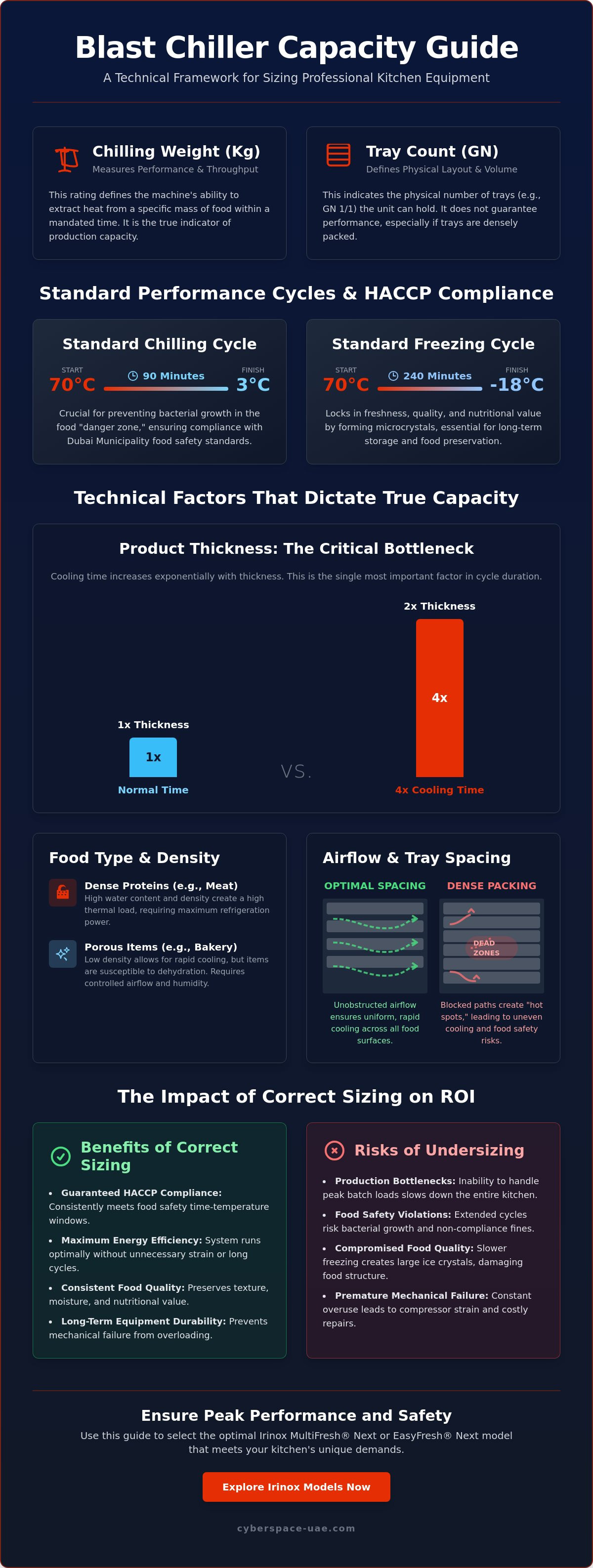
Operational efficiency in a professional kitchen depends on precise equipment sizing. This blast chiller capacity guide focuses on the two primary metrics: chilling weight (kg) and tray count (GN). Capacity isn't a static volume measurement. It represents the machine's ability to extract heat within specific timeframes. A standard chilling cycle reduces food temperature from +70°C to +3°C within 90 minutes. For freezing, the benchmark is reaching -18°C at the core within 240 minutes. Understanding what is blast chilling involves recognizing these time-to-temperature ratios as the true indicators of performance.
Irinox units frequently exceed these industrial minimums. Their high-performance cycles are engineered for maximum heat extraction even under heavy loads. While tray count (5, 10, or 20 trays) determines physical layout, the kg rating dictates actual production throughput. Mismatching these metrics leads to equipment strain and food safety risks.
The Relationship Between Weight and Time
Kg ratings are cycle-dependent. They don't indicate static storage volume. An industrial-grade unit rated for 50kg means it can process that specific weight within the 90-minute window. Entry-level units often provide weight ratings based on lower initial temperatures or extended cycles. Professional-grade Irinox models maintain performance even when food enters at peak cooking temperatures. High initial temperatures require greater refrigeration power. If the unit is undersized, the cycle time extends. This delay risks bacterial growth and violates HACCP standards. Always verify if a kg rating refers to a standard 90-minute cycle or a slower, non-compliant process.
GN Tray Standards and Spacing
Tray capacity dictates the internal architecture. Most units utilize GN 1/1 or GN 2/1 configurations. The physical count is only half the equation. Vertical pitch, or the distance between trays, is critical for high-velocity airflow. Dense packing blocks the air path. This creates "dead zones" where food stays in the danger zone too long. Optimal spacing allows air to circulate over every surface area. High tray density requires more powerful fans to maintain velocity. When selecting a unit, consider the food height. Thick products require more vertical space; this effectively reduces the usable tray count. Consistent core temperature reduction depends on this balance between physical tray load and unobstructed airflow.
Technical Factors Influencing Capacity Requirements
Nominal ratings provide a baseline. Actual performance depends on product characteristics. This blast chiller capacity guide emphasizes that food density and thickness dictate the rate of core heat extraction. A tray of dense protein requires more energy to cool than a tray of puffed pastry. Thermal conductivity varies by ingredient. Liquids like soups transfer heat through convection within the container. Solids rely on conduction. Both require different airflow strategies to meet safety standards.
Product thickness is the most significant bottleneck. Doubling the thickness of a product quadruples the cooling time. This is a physical law of thermodynamics. Operators must adjust tray loading based on product height to maintain the 90-minute window. Research regarding rapid cooling with a blast chiller highlights how critical these variables are for pathogen control. If the product is too thick, the core temperature remains in the danger zone despite the surface being chilled.
Food Type and Thermal Conductivity
Menu variety changes the thermal load. Cooked meats have high water content and density. They represent a high thermal load for the refrigeration system. Bakery items are air-filled and porous. They cool rapidly but are susceptible to dehydration. Effective capacity isn't just about weight. It's about how the unit manages moisture. Dense loads require maximum extraction power. Delicate items need controlled humidity to prevent surface cracking. For professional operations, selecting Irinox blast chillers ensures the technology can adapt to these specific ingredient requirements.
Airflow and Evaporator Efficiency
Evaporators are the heart of heat exchange. A larger surface area allows for faster heat transfer without the coils icing over. High-power fans must push air through every gap between trays. Uniformity is the goal. If airflow is obstructed, "hot spots" occur. This leads to uneven cooling and potential spoilage. Using a technical blast chiller capacity guide helps identify units with sufficient fan power. Irinox MultiFresh technology uses variable fan speeds. It optimizes airflow for the specific product type. This prevents the "skinning" of sauces while ensuring dense proteins reach +3°C at the core on schedule. Evaporator efficiency directly impacts the unit's ability to handle back-to-back cycles in a busy UAE kitchen.
Calculating Your Kitchen’s Production Throughput
Determining the correct equipment size requires analyzing peak production loads rather than average daily output. A blast chiller capacity guide must prioritize the largest batch size generated by your primary cooking equipment, such as a 10-tray combi oven or a high-capacity rotary oven. If your oven produces 40kg of product per cycle, your blast chiller must match or exceed this chilling weight. This prevents production bottlenecks where cooked food sits at ambient temperatures waiting for a vacant chilling slot.
Operational tempo depends on the synchronization of cooking and cooling cycles. Most industrial chilling cycles require 90 minutes. If your kitchen operates on a continuous flow, the blast chiller becomes the pace-setter for the entire line. You must also account for recovery time between cycles. This includes the period needed for the evaporator to defrost and the cabinet to return to the optimal starting temperature. In high-volume UAE environments, this typically requires 10 to 15 minutes between heavy cycles. Ignoring this window leads to a cumulative delay that can shift an entire production schedule by several hours by the end of a shift.
The Throughput Formula
To calculate the required capacity for your facility, use this industrial formula: (Total Daily Production Volume / Total Operating Hours) x Cycle Duration (1.5 hours for standard chilling). This provides the baseline kg capacity needed per cycle to maintain a steady workflow.
Always apply a 20% safety margin to the final result. This buffer accounts for variations in food density and the higher ambient temperatures common in UAE kitchens. For example, a medium-scale commercial bakery producing 480kg of product over an 8-hour shift requires 60kg of throughput per hour. Multiplying by a 1.5-hour cycle results in a 90kg requirement. Adding the 20% safety margin brings the optimal unit capacity to 108kg. This ensures the compressor operates within efficient parameters and doesn't run constantly at 100% load, which extends the lifespan of the equipment.
Tray Loading Protocols
Effective capacity is limited by tray density. Overloading a single GN 1/1 tray beyond 3.5kg to 5kg usually obstructs the horizontal airflow paths. This creates uneven cooling and extends cycle times, potentially pushing the food into the danger zone. For dense proteins or thick sauces, lower tray weights and increased spacing are necessary to ensure core temperature reduction on schedule.
Staggered loading improves airflow velocity but reduces the total batch weight per cycle. Full-load efficiency is only achievable in units with high-static pressure fans, such as those found in Irinox models. Refer to our guide on Commercial Blast Chiller Technology for specific safety protocols regarding tray spacing and probe placement. Proper loading ensures that the physical tray count aligns with the technical chilling capacity of the machine, maintaining both safety and quality.
Selecting the Right Irinox Model for Your Operation
Selecting a unit based on the blast chiller capacity guide metrics ensures operational continuity. Irinox MultiFresh Next represents the current industry standard for multi-functional capacity. These systems provide verified performance data for both chilling and freezing cycles under heavy industrial loads. Unlike entry-level units, Irinox maintains temperature precision regardless of food density or kitchen ambient heat. You can review the technical specifications for the entire Irinox Collection to match specific kg ratings to your production volume. These ratings aren't theoretical; they reflect actual performance in high-ambient UAE environments.
The Irinox range is divided into reach-in and roll-in configurations. Reach-in models are best for restaurants and bakeries with limited floor space. Roll-in models serve industrial kitchens where trolleys move directly from the oven to the chiller. Both configurations utilize the MultiFresh® Next and EasyFresh® Next technology platforms. These platforms prioritize food freshness through rapid heat extraction and precise humidity management. Correct model selection prevents the common error of buying for tray count while ignoring the kg-per-cycle limitations of the refrigeration circuit.
MultiFresh Next 5-15 Tray Units
Reach-in models are engineered for boutique bakeries and high-end restaurants. These units handle frequent, smaller batch cycles without excessive energy consumption. A 5-tray unit provides a compact footprint while delivering high-velocity airflow for rapid core temperature reduction. Technical specifications for these models focus on kg per cycle efficiency. They're ideal for operations that produce diverse menu items throughout the day. The MultiFresh® Next platform includes cycles for proofing, low-temperature cooking, and regeneration. This versatility maximizes the utility of the floor space. Variable fan speeds allow for delicate handling of pastry items while maintaining the power needed for dense protein blocks.
High-Capacity 20-80 Tray Roll-In Systems
Industrial food production facilities require seamless integration between cooking and cooling phases. Roll-in models accommodate standard trolley systems, eliminating manual tray handling. These high-capacity systems are designed for integration with Industrial Rotary Baking Ovens to create a high-throughput workflow. Capacity ratings for these units range up to 80 trays, supporting massive daily volumes. Advanced humidity and temperature control prevents product weight loss during the chilling process. This preserves food quality and maximizes ROI in large-scale operations. The construction uses high-density insulation to maintain thermal efficiency in extreme climates. For expert assistance in sizing your facility, view our full range of industrial blast chillers to ensure your equipment meets all UAE food safety requirements.
Optimising ROI through Correct Sizing and Maintenance
Return on investment for high-end refrigeration depends on operational precision. This blast chiller capacity guide emphasizes that correct sizing is the primary factor in preventing premature compressor failure. An undersized unit runs continuously to meet temperature targets. This leads to excessive energy consumption and mechanical strain. Conversely, a correctly sized Irinox unit utilizes its power to move food through the danger zone quickly and then enters a low-energy holding mode. This balance reduces utility costs and extends the equipment's service life in the demanding UAE climate.
Superior moisture retention is a hallmark of Irinox technology. By chilling food rapidly, the unit prevents the evaporation of natural moisture. This results in higher product yield and better food quality after regeneration. Reduced food waste directly impacts the bottom line. Large-scale operations benefit from batch cooking enabled by high-capacity chilling. This optimizes kitchen staff hours and ensures a consistent supply of product during peak service times.
HACCP and Documentation
Food safety compliance is a legal requirement in the UAE. Irinox MultiFresh systems feature automated data logging. This technology records every cycle, ensuring you have a digital audit trail for HACCP inspections. You must ensure your unit's capacity meets the 90-minute safety window for every load. If the unit is overloaded, the cycle time extends. This invalidates your safety logs and risks regulatory non-compliance. Precise probe placement and automated logging provide the technical evidence required to meet national food safety standards consistently.
Long-term Performance Retention
Maintaining the rated chilling capacity requires strict maintenance protocols. Dust and grease accumulation on condensers reduces heat exchange efficiency. This forces the system to work harder and longer to achieve the same results. Regular cleaning is mandatory. Probe calibration is equally critical. Inaccurate core temperature readings lead to either unsafe food or excessive chilling times that waste energy. For comprehensive facility planning, consult the Professional Baking Equipment Guide to understand how your blast chiller integrates with other industrial assets. Proper maintenance ensures that your initial investment continues to deliver peak performance for its entire lifecycle.
Optimizing Industrial Production Throughput
Precise equipment selection is the foundation of operational excellence in UAE commercial kitchens. This blast chiller capacity guide has detailed the technical necessity of matching kg ratings to actual batch weights rather than physical tray counts. Successful implementation requires a thorough analysis of food density and thermal load to ensure core temperatures reach safety targets within the 90-minute window. Irinox MultiFresh technology provides the technical precision needed to maintain these standards while preserving product moisture and quality.
Maintaining HACCP-compliant data logging is a critical regulatory requirement for all local food service providers. Selecting a unit with integrated documentation features ensures your facility remains compliant during municipal inspections. With national UAE industrial support, you can integrate high-performance chilling systems into your existing workflow with technical confidence. Achieving long-term durability and ROI depends on this alignment between production demand and machine capability. Browse the high-performance Irinox Blast Chiller collection to identify the specific model that meets your facility's technical requirements. Professional-grade equipment ensures your kitchen remains safe and efficient.
Frequently Asked Questions
How do I calculate the kg capacity needed for my bakery?
Calculate your required capacity by dividing total daily production by operating hours, then multiplying by the 1.5-hour cycle duration. Add a 20% safety margin to account for peak demand and high ambient temperatures. This ensures your unit handles the largest batch size produced by your oven without bottlenecking the workflow.
Is tray count or kg rating more important when buying a blast chiller?
The kg rating is the critical technical metric for production throughput. Tray count determines physical layout, but the chilling weight defines the machine's ability to extract heat within safety windows. This blast chiller capacity guide recommends prioritizing the 90-minute chilling weight to ensure HACCP compliance under full loads.
Can I overload a blast chiller if I increase the cycle time?
Overloading is not a viable operational strategy. Extending the cycle time violates food safety standards that require cooling from 60°C to 5°C within 90 minutes. Excessive loading blocks the high-velocity airflow paths, leading to uneven core temperatures and potential bacterial growth in the center of the product.
What is the difference between chilling capacity and freezing capacity?
Chilling capacity refers to reducing food temperature from +70°C to +3°C within 90 minutes. Freezing capacity measures the weight reduced to a core temperature of -18°C within 240 minutes. Freezing requires significantly higher refrigeration power and longer cycles to prevent the formation of large ice crystals that damage food texture.
Are Irinox blast chillers compatible with GN 1/1 and 2/1 trays?
Irinox MultiFresh Next and EasyFresh Next models are fully compatible with standard GN 1/1 and GN 2/1 tray configurations. The internal racking systems allow for adjustable vertical pitch. This flexibility is essential for maintaining unobstructed airflow when processing products of varying heights or densities.
How does food density affect the blast chilling cycle?
Higher food density increases the thermal load and slows core heat extraction. Dense proteins like beef joints require more time and energy than porous items like croissants. Using a blast chiller capacity guide helps operators adjust tray loading weights to ensure dense products reach safe temperatures within the mandated timeframe.
What happens if the blast chiller capacity is too small for my oven output?
An undersized unit creates immediate production delays and safety risks. Cooked food must wait at ambient temperatures for an available cycle, which encourages bacterial multiplication. The mismatch also causes the compressor to run at 100% load constantly, leading to high utility costs and premature mechanical failure.
Do Irinox units provide HACCP-compliant temperature logs?
Irinox MultiFresh systems include integrated data logging technology for automated record-keeping. These units track core temperatures via multi-point probes and record cycle durations. The resulting digital audit trail meets the strict documentation requirements of Dubai Municipality and federal UAE food safety regulations.