
Industrial Rotary Baking Oven: Professional Procurement Guide 2026
Industrial baking success depends on matching heat exchange efficiency with rack rotation precision, not just tray count. High-volume operations often struggle with uneven heat distribution across large batches and escalating energy costs. Selecting the right industrial rotary baking oven is a critical capital investment. It dictates long-term operational durability and performance.
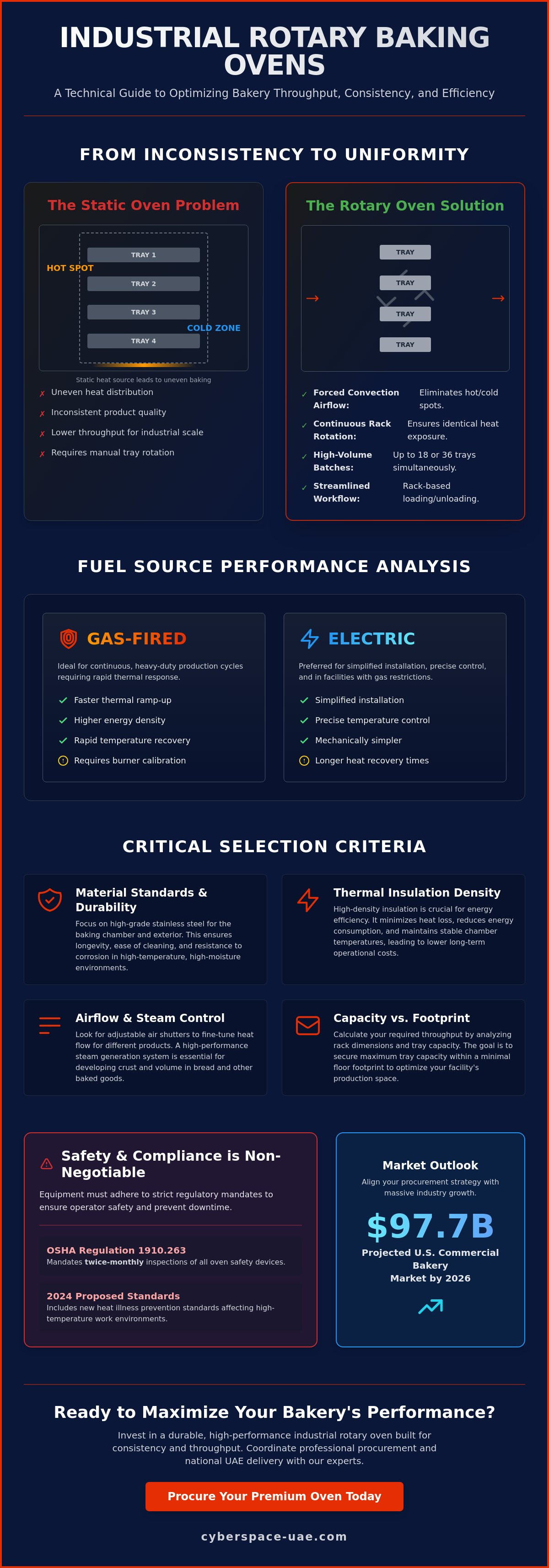
You likely recognize that equipment downtime and burner failure are unacceptable risks in continuous production. This guide provides a technical framework for evaluating high-capacity rotary rack ovens to optimize bakery throughput and consistency. We'll analyze essential specifications including airflow dynamics, precise steam control, and current regulatory mandates. This includes the mandatory OSHA safety device inspections required twice monthly under regulation 1910.263 and the implications of the 2024 proposed heat illness prevention standards. Gain the technical clarity needed to secure maximum tray capacity within a minimal floor footprint. This evaluation ensures your procurement strategy aligns with the projected $97.7 billion U.S. commercial bakery market of 2026.
Key Takeaways
- Understand how convection-based heat distribution and continuous rack rotation ensure product uniformity across high-volume batches.
- Evaluate technical specifications for gas and electric fuel sources alongside high-performance steam generation systems.
- Calculate production throughput requirements by analyzing rack dimensions and tray capacities relative to facility floor space.
- Identify essential material standards for an industrial rotary baking oven, focusing on high-grade stainless steel and thermal insulation density.
- Coordinate professional procurement and national UAE delivery for brand-new, industrial-grade equipment.
The Role of Industrial Rotary Baking Ovens in High-Volume Production
The industrial rotary baking oven is the primary thermal processing unit for high-capacity commercial bakeries. These systems function through forced convection heat distribution. Unlike a standard static Oven, a rotary system utilizes a mechanical drive to rotate the entire product rack within the baking chamber. This continuous motion ensures that every tray receives identical exposure to the heated air streams. It's the standard solution for industrial bread, pastry, and biscuit lines where consistency across thousands of units is the priority.
Static deck ovens remain useful for artisanal products requiring high floor heat. However, they lack the throughput required for industrial-scale operations. An industrial rotary baking oven allows for the simultaneous processing of up to 18 or 36 trays depending on the rack configuration. This batch-processing capability shifts the labor focus from manual tray loading to bulk rack management. The result is a significant increase in hourly output and a more predictable production schedule. It's a transition from individual product handling to a streamlined, automated workflow.
Uniformity and Airflow Dynamics
Precision in a rotary system depends on the interaction between forced convection and mechanical rotation. High-velocity fans push heated air through a series of adjustable air shutters located on the side walls. These shutters allow operators to fine-tune the heat flow to match specific product requirements. As the rack rotates, the product passes through these air streams at a constant rate. This movement eliminates cold spots and "dead zones" often found in static environments. It ensures even browning and consistent internal temperatures even in high-density tray configurations. Precise airflow management also helps maintain the required moisture levels for different dough types.
Industrial Scale and Operational Efficiency
Operational efficiency is achieved by integrating the oven into a rack-based production cycle. Personnel move entire racks directly from the prover into the baking chamber. This minimizes the time the oven door remains open, which reduces heat loss and energy consumption. For facilities running continuous shifts, this streamlined process is vital. It reduces the physical strain on staff and minimizes the number of touchpoints in the production line. By maximizing the vertical baking surface area, facilities can achieve higher throughput without expanding their physical floor footprint. This makes the rotary oven a superior choice for urban or space-constrained industrial kitchens requiring maximum output.
Technical Specifications: Fuel Sources and Steam Generation Systems
Choosing the correct fuel source for an industrial rotary baking oven directly impacts long-term operational costs and thermal performance. In the UAE market, facilities must weigh the benefits of gas combustion against electric heating elements. Gas-fired units generally provide faster thermal ramp-up and higher energy density. This makes them suitable for continuous, heavy-duty production cycles. Conversely, electric models offer simplified installation. They're often preferred in multi-story developments or facilities where gas piping is restricted. Each choice dictates the infrastructure requirements of the commercial kitchen.
Safety and compliance are non-negotiable technical requirements. Burner assemblies and electrical configurations must adhere to international safety standards, such as OSHA bakery equipment regulations, which mandate specific inspection protocols for oven safety devices. High-quality burners improve heat exchange efficiency. This reduces fuel consumption while maintaining stable ambient temperatures within the baking chamber. Selecting a burner with poor reliability leads to inconsistent heat and increased equipment downtime.
Gas vs. Electric Performance Analysis
Gas burners deliver heat via a high-efficiency heat exchanger. This allows for a rapid response to temperature set-point changes. This speed is critical for reducing downtime between batches. Electric ovens utilize high-density heating coils. These coils offer precise control but may require longer recovery times during high-volume throughput. From a maintenance perspective, gas systems require periodic burner calibration and combustion chamber inspections. Electric systems are mechanically simpler but rely on the integrity of the heating elements. For businesses evaluating these options, reviewing a catalog of professional rotary ovens helps determine the best fit for specific utility capacities.
Advanced Steam Injection Technology
Steam volume is the primary factor in crust development and volume expansion. Oversized steam generators are essential for industrial bakeries producing crusty breads or baguettes. These systems must provide rapid steam recovery. If the steamer can't regenerate heat quickly enough, subsequent batches suffer from poor crust shine and restricted oven spring. Automated steam discharge valves ensure precise humidity levels throughout the initial baking phase. This automation eliminates human error and maintains consistency across varied product lines. High-performance steamers utilize cast iron or steel spheres to maximize the surface area for water vaporization. This design ensures a high-density steam cloud that penetrates the entire rack evenly.
Capacity Planning: Evaluating Rack Dimensions and Production Throughput
Calculating the baking surface area is the first step in capacity planning. An industrial rotary baking oven typically utilizes standard tray dimensions like 60x80 cm or 45x75 cm. Total output depends on the number of levels per rack. A 20-tray rack with 60x80 cm trays provides roughly 9.6 square meters of baking surface. Standardizing these dimensions across the facility ensures seamless workflow integration. It prevents bottlenecks during the transfer from prep stations to the oven. Maximizing vertical space requires careful consideration of tray spacing. If trays are too close, airflow is restricted. This leads to uneven baking despite the rotation. Maintain at least 80-100 mm of clearance between trays for optimal convection efficiency.
Operational safety remains a priority during capacity expansion. Mechanical rack rotation systems must comply with OSHA safety standards for bakery equipment. These regulations specify requirements for fuel shutoff valves and electrical heating equipment safety. Ensuring trolleys are locked securely during rotation prevents mechanical failure and maintains production uptime. It's essential to verify that the oven's drive motor can handle the weight of a fully loaded double rack without losing rotational speed.
Rack Configurations and Trolley Compatibility
Selecting a rack configuration requires balancing product height with tray count. Standard 15, 18, or 20-tray racks are common. Higher tray counts maximize throughput for low-profile items like cookies or biscuits. Removable trolleys facilitate rapid batch turnover. These units must maintain full compatibility with existing provers and retarders to avoid manual tray transfers. Standardization reduces labor costs and minimizes the risk of product damage during handling.
Footprint vs. Output Optimization
Kitchen floor space is a premium asset. Facilities must calculate production output per square meter. A single-rack oven offers a compact footprint. Double-rack models double the output with only a marginal increase in width. For high-volume pastry production, deciding between a rotary oven vs deck oven for pastry involves analyzing vertical space utilization. Rotary systems prioritize volume; deck ovens focus on floor-contact heat. Strategic placement near exhaust hoods and maintaining required clearance for maintenance is essential for operational longevity.
Critical Selection Criteria for Commercial Bakery Operations
High-grade material selection is the foundation of equipment longevity. An industrial rotary baking oven must feature internal and external panels constructed from high-grade stainless steel, typically AISI 304. This material resists corrosion from high-humidity steam injection and withstands the mechanical stress of daily rack loading. Insulation density is equally critical. High-density mineral wool layers prevent heat dissipation into the production area. This maintains internal thermal stability while reducing the load on facility HVAC systems. Proper insulation ensures the exterior surface remains safe for operators during peak production hours. It's a standard requirement for maintaining energy efficiency in high-volume environments.
Control interfaces dictate the precision of the baking cycle. Electromechanical controls offer durability and simplified repair in environments with fluctuating power quality. Digital programmable systems provide higher accuracy for complex product lines. These interfaces allow for multi-stage baking profiles, adjusting temperature and steam injection at specific intervals. Safety components must include double-tempered glass doors. This design provides a thermal barrier while allowing full visibility of the product. Motorized extractor hoods are necessary to clear steam and heat immediately upon door opening. They don't just protect the operator; they maintain the kitchen's air quality by preventing sudden temperature spikes.
Control Systems and Recipe Management
Modern industrial units feature computerized control panels capable of storing 99 or more distinct baking programs. This recipe management ensures consistency across different shifts, regardless of operator experience. Integration with Software 4.0 allows for remote monitoring of energy consumption and cycle times. These systems can alert maintenance teams to performance deviations before a total failure occurs. A simplified user interface with intuitive icons reduces training time for high-turnover kitchen staff. It ensures that complex baking parameters are executed correctly every time, minimizing product waste.
Durability and Maintenance Access
Long-term operational costs are tied to maintenance accessibility. Removable combustion chambers allow technicians to service the burner and heat exchanger without dismantling the entire oven structure. The heat exchanger design must account for thermal expansion. High-quality alloys prevent cracking under the stress of rapid heating and cooling cycles. Door seal integrity is vital for preventing energy loss. Heavy-duty hinges with adjustable tension ensure a hermetic seal over years of constant use. For facilities prioritizing long-term reliability, selecting a professional rotary oven with accessible components is a strategic requirement.
Procuring Premium Rotary Ovens from Cyberspace Kitchen & Bakery Equipment
Cyberspace Kitchen & Bakery Equipment maintains a specialized inventory of brand-new industrial rotary baking ovens. We prioritize high-performance machinery designed for continuous, multi-shift operation. Our selection process focuses on technical precision. We help facilities match specific oven capabilities to their production volume and fuel availability. National UAE delivery ensures that equipment reaches industrial sites across the Emirates efficiently. Professional equipment support provides technical guidance during the initial configuration phase. This ensures your investment meets the rigorous demands of the 2026 commercial bakery market, where U.S. market size alone is projected to reach $97.7 billion.
As authoritative baking deck oven suppliers, we facilitate complete production line integration. This includes technical consultation for sizing and fuel source selection. We analyze your facility's power capacity and floor space. This ensures the chosen equipment fits the operational environment without compromising safety or throughput. Our inventory consists strictly of brand-new units to guarantee maximum thermal efficiency and structural integrity from day one.
The Cyberspace Advantage: Industrial Grade Solutions
We focus exclusively on premium, new machinery. This strategy maximizes operational uptime and ensures compliance with current safety regulations. It eliminates the risks associated with refurbished units, such as hidden burner wear or insulation degradation. Our technical expertise aligns oven specifications with specific bakery production goals. We maintain a streamlined procurement process. This allows commercial food service entities to move from technical discovery to operational action rapidly. Our role is to act as an efficient facilitator for high-end industrial tools.
Strategic Equipment Integration
Maximum efficiency involves pairing the industrial rotary baking oven with compatible upstream equipment. We coordinate integrated packages designed to maintain production momentum. Key components for synchronization include:
- High-capacity spiral mixers for consistent dough development.
- Industrial provers with precise temperature and humidity control.
- Planetary mixers for high-volume pastry and confectionery lines.
- Dough sheeters for standardized thickness in laminated products.
This synchronization ensures a consistent dough flow from the initial mix to the final bake. For new bakery startups or industrial expansions, we customize equipment packages based on projected hourly throughput. This modular approach allows for future scaling as production requirements grow. Next steps involve requesting technical data sheets and specific pricing for UAE facilities. Contact our technical team to finalize your professional procurement strategy and secure high-performance equipment.
Optimizing Your 2026 Production Strategy
Selecting an industrial rotary baking oven is a decision that dictates your facility's throughput and consistency for years. Success requires a focus on precise airflow dynamics and robust steam generation. These technical factors ensure uniform browning across every rack level. High-capacity operations must prioritize equipment with accessible maintenance points and digital control systems to maintain a competitive edge. Aligning these specifications with your production goals reduces energy waste and minimizes downtime.
Cyberspace Kitchen & Bakery Equipment specializes in brand-new industrial machinery designed for high-performance commercial environments. We provide comprehensive technical support and national UAE delivery for all our rotary systems. Our team ensures that your equipment package integrates seamlessly with existing mixers and provers for a streamlined workflow. Secure the reliability your professional bakery requires with our specialized solutions.
View our high-capacity Industrial Rotary Ovens to begin your procurement process. We look forward to facilitating your operational excellence.
Frequently Asked Questions
What is the primary difference between a rotary oven and a convection oven?
The main distinction is the mechanical rotation of the entire product rack. While both systems utilize fans to circulate heated air, an industrial rotary baking oven rotates the rack to ensure every tray passes through the same heat zones. This eliminates the need for manual tray rotation and ensures higher uniformity in large batches. Convection ovens typically feature static trays and rely solely on airflow for heat distribution.
Which fuel source is more efficient for high-volume baking in the UAE?
Gas-fired ovens generally offer higher energy efficiency and lower operational costs for high-volume production in industrial zones. They provide faster temperature recovery times between batches compared to electric models. However, electric ovens are a viable alternative for facilities with restricted gas access or specific ventilation limitations. The choice depends on local utility rates and the facility's existing infrastructure.
How many trays can a standard industrial rotary rack oven hold?
Standard single-rack configurations typically accommodate 15, 18, or 20 trays. The tray capacity is determined by the vertical spacing required for specific products. For example, a 20-tray rack is suitable for low-profile items like biscuits, while 15-tray racks provide the clearance needed for larger bread loaves. Double-rack models can double these capacities within a single baking cycle.
What maintenance is required for a commercial rotary oven burner?
Routine maintenance includes cleaning the burner head and inspecting the ignition system for carbon buildup. Safety devices must be checked at least twice monthly by a trained employee to comply with industrial safety standards. Periodic calibration of the air-to-fuel ratio ensures optimal combustion efficiency and prevents soot accumulation in the heat exchanger. Regular inspections extend the burner's lifespan and prevent unexpected production stoppages.
Can a rotary oven handle delicate pastries as well as heavy bread?
Yes, these ovens are versatile enough for varied product lines. Operators can adjust the rotation speed and airflow volume to suit delicate pastries that require gentle heat. Precise steam control and programmable baking phases allow for the high humidity needed for bread crusts and the dry heat required for crisp pastry layers. This flexibility makes them a standard choice for diversified commercial kitchens.
What are the electrical requirements for a 3-phase industrial rotary oven?
Most industrial models require a 3-phase power supply, typically 380V to 415V at 50Hz or 60Hz. The amperage requirement depends on the oven's total kilowatt rating, which varies between gas and electric models. Electric ovens have significantly higher power draws due to the heating elements. It's essential to verify your facility's circuit breaker capacity before installation to ensure stable operation under full load.
How does steam injection improve the quality of bread in a rotary oven?
Steam injection creates a thin layer of moisture on the dough surface during the initial baking stage. This moisture delays crust formation, which allows the bread to expand fully. It also gelatinizes the surface starches to produce a characteristic shine and a crisp texture. Without adequate steam, the crust becomes dull and the loaf volume is restricted. High-performance steamers ensure this moisture reaches every tray on the rack.
Is it better to invest in a single or double rack rotary oven?
The decision depends on your production volume and available floor space. A double-rack industrial rotary baking oven maximizes throughput by processing two trolleys simultaneously, making it ideal for large-scale distribution. If your facility has space constraints or requires smaller, more frequent batches, a single-rack oven offers better operational flexibility. Evaluate your daily output requirements to determine the most cost-effective configuration.