
Professional Kitchen Equipment Price List: Industrial Procurement Guide 2026
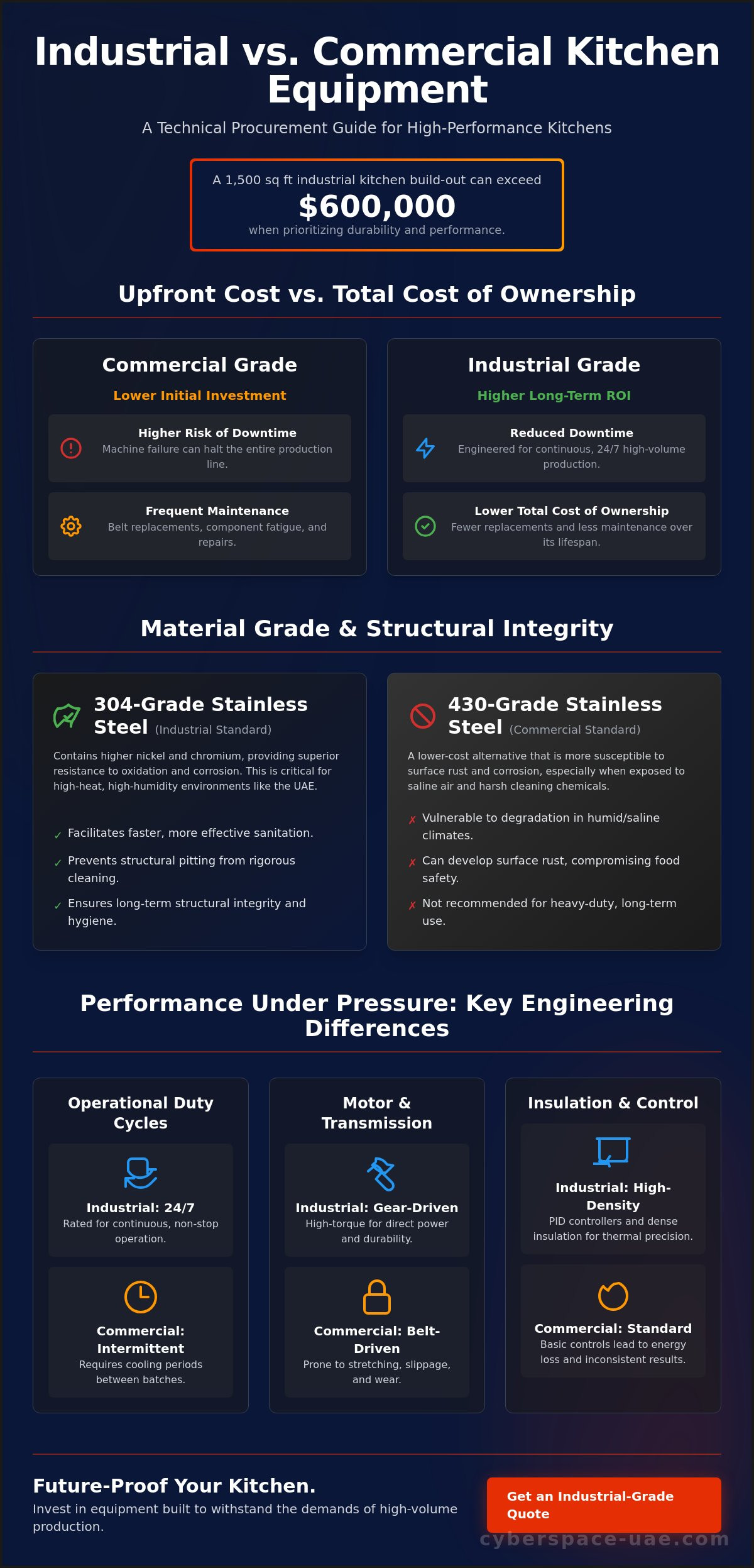
A 1,500-square-foot commercial kitchen build-out in 2026 can exceed $600,000 when prioritizing industrial-grade durability over entry-level hardware. Most operators recognize that a standard professional kitchen equipment price list often obscures the true cost of ownership, especially when accounting for the extreme thermal demands of the UAE. High initial capital expenditure is a significant hurdle. However, the gap between a low-cost unit and a high-performance asset is measured in downtime and maintenance frequency.
This guide provides a technical framework to evaluate machinery costs against long-term ROI and industrial specifications. You'll learn to identify the price drivers for high-performance assets like blast chillers, rotary ovens, and spiral mixers. We also address the 2026 transition to A2L-compliant refrigerants and thermal precision requirements to ensure your procurement remains future-proof and operationally efficient.
Key Takeaways
- Identify the material grade standards, specifically 304 stainless steel, that justify industrial pricing and long-term durability.
- Learn to navigate a professional kitchen equipment price list by focusing on duty-cycle capacity and technical specifications rather than surface-level costs.
- Evaluate high-performance thermal systems, including Rational combi ovens and industrial rotary units, based on thermal precision and operational ROI.
- Understand the impact of UAE-specific power requirements and environmental factors on industrial machinery lifespan and procurement strategy.
- Distinguish between commercial-grade and industrial-grade machinery to ensure equipment can handle high-volume production without premature failure.
Decoding Industrial Kitchen Equipment Pricing Structures
Industrial kitchen equipment pricing is determined by engineering tolerances and material durability. Unlike light-duty commercial units, industrial-grade machinery is designed for continuous duty cycles. A professional kitchen equipment price list reflects these technical distinctions through component specifications and build quality. High-end procurement requires an analysis of thermal precision, mechanical torque, and structural longevity. Industrial pricing is a reflection of metallurgical and electrical standards rather than just hardware volume.
Foundational standards for a Commercial Kitchen Overview emphasize hygiene and workflow; therefore, material choice is the primary cost driver. Professional equipment prioritizes 304-grade stainless steel over 430-grade alternatives to prevent corrosion in high-heat, high-humidity environments. Additionally, the integration of PID (Proportional-Integral-Derivative) controllers ensures thermal stability. This is essential for consistent batch production in large-scale bakery operations.
Material Grade and Structural Integrity
The choice between 430 and 304 stainless steel significantly impacts the initial investment. 304-grade steel contains higher nickel and chromium levels, providing superior resistance to oxidation. This is a critical requirement for UAE operations where ambient humidity and saline air accelerate equipment degradation. 430-grade steel is more susceptible to surface rust and structural pitting under rigorous cleaning protocols.
- Reinforced Frames: Industrial mixers and ovens utilize heavy-gauge internal frames to manage vibration and weight.
- Insulation Density: High-performance ovens feature high-density rock wool or ceramic fiber insulation. Thicker insulation reduces energy consumption and maintains external surface safety.
- Sanitation Standards: 304-grade surfaces facilitate faster cleaning cycles and comply with stringent food safety regulations.
Operational Duty Cycles and Motor Ratings
Motor engineering dictates the reliability of prep-heavy equipment. Procurement managers analyzing a professional kitchen equipment price list must evaluate motor horsepower alongside torque ratings. Industrial spiral mixers require high-torque motors capable of handling low-hydration doughs without overheating. The transmission system is a secondary price driver. Gear-driven systems offer direct power transfer and higher durability than belt-driven alternatives, which are prone to stretching and slippage under heavy loads.
Choosing high-duty cycle equipment ensures a lower total cost of ownership. While the upfront price is higher, the ROI is realized through reduced downtime and fewer component replacements. Industrial motors are rated for 24/7 operation, whereas standard commercial motors may require cooling periods between batches. This distinction is vital for high-volume production facilities where machine failure halts the entire supply chain.
Core Bakery Equipment Price Drivers: Mixers and Sheeters
Bakery operations impose the highest mechanical stress on kitchen machinery. When evaluating a professional kitchen equipment price list, the distinction between prep-level and industrial-level mixers is critical for operational uptime. Industrial-grade equipment utilizes reinforced drive systems and high-torque motors to manage the resistance of dense dough. Selecting brand-new machinery over refurbished units eliminates the risks associated with fatigued transmissions and worn bearings. Reliability in high-volume environments depends on these mechanical tolerances.
A Spiral Mixer is the standard for high-volume bread and pizza production. Unlike planetary mixers, spiral units rotate both the bowl and the hook. This dual-rotation system minimizes friction and prevents dough temperature spikes. Precise temperature control is a core metric for Energy Efficiency in Commercial Kitchens, as it reduces the need for climate-controlled proofing adjustments. Procurement managers should look beyond the professional kitchen equipment price list to analyze motor duty cycles and transmission reliability.
Spiral and Planetary Mixer Capacity Analysis
Price tiers for mixers scale with volume and mechanical complexity. A 50L spiral mixer serves boutique bakeries, while 200L units are required for industrial wholesale production. Price increases between these tiers aren't linear; they reflect the increased material density of the frame and the cooling requirements of the motor. Dual-speed motors and programmable timers increase the initial cost but provide essential consistency. Planetary mixers offer versatility through interchangeable attachments, yet their vertical drive systems are less efficient for heavy dough hydration. Industrial planetary units require heavy-duty gearboxes to handle the torque of mixing dense batters at scale without thermal failure.
Dough Sheeters: Precision and Lamination Costs
Industrial dough sheeters are priced based on lamination precision and throughput speed. Manual sheeters are cost-effective for low-volume pastry work. However, automatic models utilize programmable logic controllers to ensure uniform thickness across thousands of cycles. Roller width and conveyor length are the primary physical price drivers. Wider rollers allow for larger dough blocks, increasing production speed. Synthetic belts are often standard, but stainless steel belts command a premium for their superior sanitation and resistance to mechanical wear. For precise dough processing, review industrial dough sheeters designed for high-performance lamination and consistent output.
High-Performance Thermal Systems: Ovens and Blast Chillers
Thermal processing units represent the most significant capital expenditure on any professional kitchen equipment price list. High-performance systems are defined by their ability to maintain precise temperature windows under heavy load. Industrial bakery operations require thermal stability to ensure product consistency and minimize waste. Strategic thermal system acquisition aligns with the USDA procurement and inventory management guide principles regarding cost-effectiveness and menu-driven purchasing. Operators must choose between the versatility of combi systems and the throughput of specialized rotary units.
The industrial rotary baking oven is the primary driver for high-volume bread production. These units utilize rack rotation and high-volume steam injection to produce uniform results. Conversely, baking deck oven suppliers prioritize thermal mass. Stone-sole decks command a higher price than metal alternatives because they provide superior heat retention. This is essential for achieving the specific crust characteristics required in artisan baking. The price reflects the weight and durability of the refractory materials used in construction.
Rational iCombi Pro: Evaluating the Premium Price
The Rational combi oven for bakery applications justifies its price through advanced sensor technology. iDensityControl and iCookingSuite systems adjust moisture and airflow in real-time. This reduces the need for manual monitoring and lowers labor costs. Automatic cleaning and descaling systems are standard in premium models. These features prevent lime-scale buildup, which is a common failure point in UAE water systems. Energy efficiency ratings for Rational systems remain high, ensuring lower long-term operational costs compared to entry-level combi units.
Industrial Blast Chiller and Prover Technology
HACCP compliance requires rapid reduction of core food temperatures. Standard refrigeration cannot achieve the cooling speeds necessary for industrial food safety. Commercial blast chiller technology utilizes high-velocity airflow to bypass the bacterial danger zone. The price gap between standard chillers and industrial blast units reflects the power of the evaporator and compressor systems. For large-scale bakeries, retarder provers provide essential humidity control. These systems allow for precise fermentation schedules, enabling operators to manage production cycles across 24-hour shifts without quality degradation.
Strategic Procurement: Evaluating Manufacturer Price Lists
Procurement managers often treat a professional kitchen equipment price list as a static document. This approach ignores the variables of industrial integration and operational longevity. A list price doesn't account for site-specific requirements or the long-term costs of utility consumption. In the UAE market, infrastructure compatibility is the most common point of failure for new kitchen projects. Industrial machinery must be evaluated against the facility's electrical capacity and HVAC capabilities. Strategic procurement prioritizes technical alignment over the lowest initial quote.
Analyzing manufacturer specifications requires a deep understanding of electrical and mechanical engineering. For instance, a high-capacity rotary oven requires a dedicated 3-phase power supply and specific gas pressure levels. If the facility isn't pre-configured for these loads, the cost of electrical upgrades can exceed the savings found on a cheaper equipment model. The price list also frequently excludes the cost of commissioning. This process ensures the machinery operates within manufacturer parameters to maintain warranty validity.
Technical Specification Checklist for Buyers
Infrastructure requirements are the primary "hidden" costs in any procurement project. High-capacity deck ovens and mixers almost universally require 3-phase power for stable operation. Single-phase alternatives often struggle with recovery times or torque requirements, leading to inconsistent product quality. Buyers must also verify Ingress Protection (IP) ratings for all control systems. Industrial kitchens are high-moisture and high-heat environments. Electrical components without adequate IP ratings fail prematurely due to steam penetration or grease buildup.
- Power Requirements: Contrast 3-phase vs. single-phase to avoid site modification costs.
- IP Ratings: Ensure electrical enclosures are rated for industrial kitchen humidity levels.
- Control Interfaces: Evaluate the durability of touch-screens against manual dials for high-use environments.
- Ventilation Loads: Calculate the additional HVAC requirements for high-BTU output equipment.
Total Cost of Ownership (TCO) Calculations
A machine's purchase price is just a fraction of its lifetime cost. Total Cost of Ownership (TCO) includes energy, water, labor, and maintenance. High-reliability brands command a premium because they optimize these variables. For example, a Rational combi oven reduces labor costs through automated cooking programs and self-cleaning cycles. These features allow operators to reallocate staff to other high-value tasks, providing a direct ROI. Water filtration is another critical UAE-specific factor. The high mineral content in local water supplies can destroy steam-based equipment within months. Integrating high-quality filtration is a mandatory procurement step to protect the investment.
Local spare parts availability and technical support are essential for minimizing downtime. A machine that's out of service for two weeks due to a missing sensor is more expensive than a premium unit with local backing. Professional installation ensures that the equipment is leveled, calibrated, and connected according to safety standards. To ensure operational excellence with brand-new industrial tools, review our professional kitchen equipment solutions.
Commercial Solutions from Cyberspace Kitchen & Bakery Equipment
Cyberspace Kitchen & Bakery Equipment specializes in brand-new industrial machinery for high-volume food service operations. We don't supply used, refurbished, or residential-grade appliances. This strict focus ensures that every item on a professional kitchen equipment price list provides the reliability required for 24/7 production environments. Industrial procurement isn't just about hardware acquisition; it's about securing assets that maintain operational uptime under extreme thermal and mechanical stress. Our inventory is curated for professionals who prioritize long-term ROI over low-cost, short-term fixes.
National support across the UAE allows for streamlined logistics and technical facilitation. We provide the technical documentation necessary for facility integration, ensuring that power requirements and ventilation loads are addressed before delivery. Our commitment to operational excellence means we only offer machinery that meets current industrial standards for durability and efficiency. We act as a streamlined gateway to professional-grade solutions, ensuring your facility is equipped for industrial-scale performance.
Industrial Grade Deck and Rotary Ovens
Our oven selection focuses on thermal mass and precision. Stone-sole Deck Ovens are essential for artisan bread production, providing the heat retention needed for superior crust formation. These units utilize heavy-duty refractory tiles to ensure even heat distribution across all decks. For industrial-scale throughput, our Rotary Ovens utilize rack rotation systems to eliminate cold spots. These ovens feature integrated steam injection systems and high-density insulation. This combination reduces energy loss and ensures consistent batch results regardless of ambient kitchen temperatures.
Advanced Dough Processing Solutions
Processing dense doughs requires high-torque transmissions and reinforced frames. Our Spiral Mixers are engineered for heavy-duty cycles, featuring dual-speed motors and programmable timers for batch consistency. These mixers reduce friction during the kneading process, preventing premature yeast activation. For lamination and pastry work, our precision Dough Sheeters offer adjustable roller gaps for exact thickness control. These machines are built with stainless steel components to withstand rigorous cleaning protocols. Consistency in dough thickness is mandatory for industrial lamination quality.
Planetary Mixers in our inventory offer high-capacity bowl sizes and heavy-duty attachments for versatile prep work. These units utilize gear-driven transmissions to provide consistent power for thick batters and fillings. Additionally, our Blast Chillers and Provers ensure HACCP compliance and fermentation control. A tailored professional kitchen equipment price list for your facility can be requested to align these assets with your specific production goals. We provide the technical framework necessary for high-performance procurement and streamlined facility setup.
Optimizing Your Industrial Procurement Strategy
Procurement decisions in 2026 require a shift from price-point comparison to technical evaluation. Industrial-grade machinery is defined by its material standards and duty-cycle capacity. This guide has detailed how 304-grade stainless steel, high-torque motors, and advanced thermal sensors justify premium investments. Prioritizing Total Cost of Ownership (TCO) over initial capital expenditure reduces long-term operational costs and equipment downtime. Reliable UAE-wide supply and technical support remain essential for maintaining high-volume production schedules. Proper commissioning and local spare parts availability are the final steps in securing a resilient supply chain.
Cyberspace Kitchen & Bakery Equipment serves as a specialized partner for high-end food service operations. As an Authorized Rational Dealer and Specialist in Industrial Bakery Machinery, we provide the technical framework for successful facility integration. We offer National UAE Supply & Support for all brand-new installations. To receive a tailored breakdown of costs and specifications for your project, Request a Professional Kitchen Equipment Price List. Equip your facility for operational excellence with tools built for industrial performance.
Frequently Asked Questions
Why is a professional kitchen equipment price list higher than residential appliances?
Industrial equipment is engineered for continuous 24/7 duty cycles and high-volume production. Unlike residential units designed for occasional use, these machines feature heavy-gauge materials, high-torque motors, and superior thermal mass. These specifications ensure the machinery withstands the rigorous demands of a commercial environment without mechanical failure.
What are the main price drivers for a Rational iCombi Pro in the UAE?
Intelligent sensors and automated control systems are the primary cost factors for Rational units. These systems adjust humidity and temperature in real-time to optimize cooking results and reduce labor requirements. In the UAE, the inclusion of robust self-cleaning cycles and descaling technology is essential to protect internal components from local water mineral content.
How does the capacity of a spiral mixer affect its industrial price?
Price scales with the bowl volume and the mechanical strength required to rotate larger dough batches. A higher capacity necessitates a reinforced frame and a motor with higher torque ratings to manage the increased resistance of dense dough. Larger units also require more complex cooling systems to maintain motor efficiency during extended mixing cycles.
Is it better to invest in a deck oven or a rotary oven for high-volume baking?
The choice depends on the specific product requirements and throughput goals. Rotary ovens offer superior throughput for high-volume, uniform production by rotating entire racks through a consistent heat field. Deck ovens provide higher thermal mass and are preferred for artisan products requiring stone-sole contact for specific crust characteristics.
What technical specifications should I look for in a commercial blast chiller?
Focus on pull-down capacity and compressor power to ensure HACCP compliance. The unit must be capable of reducing core food temperatures from 70°C to 3°C within 90 minutes. High-velocity airflow systems and A2L-compliant refrigerants are standard technical requirements for modern industrial procurement in 2026.
Do industrial price lists typically include installation and commissioning costs?
Most manufacturer lists exclude these costs, focusing solely on the hardware. Professional installation and commissioning are separate but mandatory expenses to ensure the equipment is calibrated and the warranty remains valid. These services verify that electrical and water connections meet the specific technical requirements of the machinery.
What is the importance of 304 stainless steel in commercial kitchen pricing?
304 stainless steel provides superior corrosion resistance due to its high chromium and nickel content. It's more expensive than 430-grade steel but is essential for hygiene and durability in high-humidity UAE kitchens. Investing in 304-grade surfaces prevents oxidation and structural pitting during intensive daily cleaning cycles.
How do I calculate the ROI of upgrading to high-efficiency baking equipment?
ROI is calculated by comparing initial capital expenditure against long-term savings in labor, energy, and waste reduction. A professional kitchen equipment price list should be analyzed alongside projected utility costs and maintenance intervals. High-efficiency units often pay for themselves through reduced downtime and lower consumption rates over a three to five-year period.