
Prover Temperature for Bread: Industrial Calibration and Settings Guide
A single degree of deviation in your prover temperature for bread is often the difference between a high-yield batch and a total production loss. In high-volume commercial kitchens, minor environmental fluctuations lead to sluggish fermentation or the crust skinning that ruins crumb quality. You understand that guesswork has no place in a professional bakery where consistency dictates your daily profit margins.
This guide provides the technical calibration data and relative humidity parameters required to standardize your proofing protocols. By implementing these precise settings, you can eliminate over-proofed dough and increase your kitchen throughput without sacrificing the final flavor profile. Our technical breakdown covers the standard 90 to 100 degree Fahrenheit range for bread and the 80 to 90 percent humidity levels needed for optimal yeast activity. We also detail the latest 2026 NSF standards for equipment safety and the mandatory shift toward low-GWP refrigerants in modern retarder-prover systems.
Key Takeaways
- Identify the correlation between thermal settings and yeast CO2 production to maintain precise control over fermentation rates.
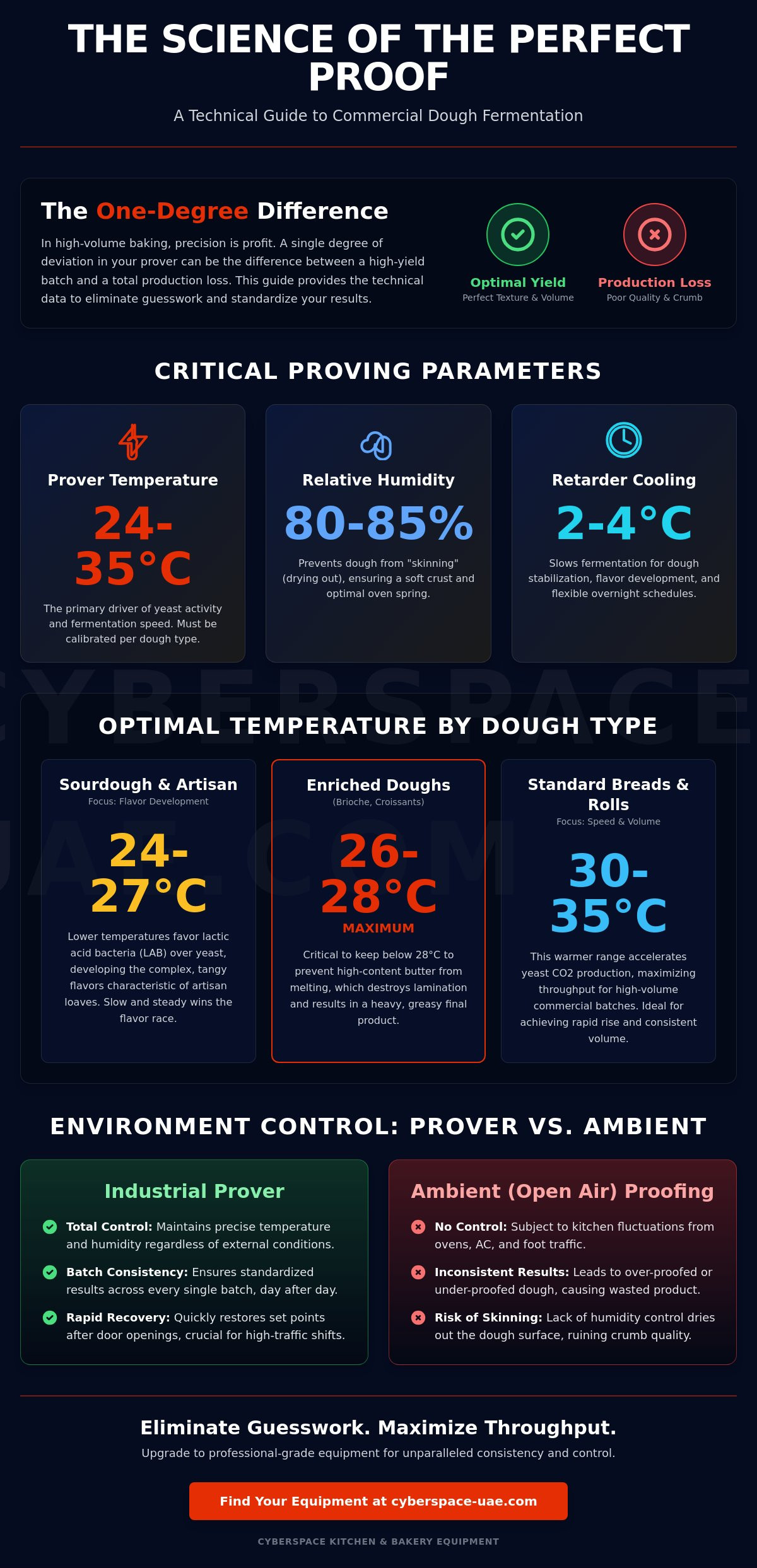
- Calibrate the optimal prover temperature for bread based on variety, utilizing 24°C–27°C for artisan flavor development or 30°C–35°C for high-volume production.
- Maintain relative humidity targets of 80% to 85% to prevent surface evaporation and eliminate dough skinning during the final proof.
- Configure automated retarder-prover cycles with 2°C–4°C cooling phases to stabilize dough and facilitate efficient overnight fermentation schedules.
- Scale equipment procurement by matching prover tray capacity with rotary oven throughput to ensure a continuous and streamlined production workflow.
The Science of Prover Temperature and Fermentation
Proving represents the final fermentation stage before the baking process begins. This phase is critical for determining the finished loaf's volume, crumb structure, and flavor profile. In a professional bakery, managing the prover temperature for bread is a technical requirement for batch consistency. Yeast metabolism is thermally sensitive. As temperatures rise, yeast cells consume sugars more rapidly, increasing carbon dioxide production. This gas expands the developed gluten network, creating the aeration necessary for a professional crumb.
Industrial production requires careful management of thermal mass. High-capacity dough batches possess significant thermal inertia. Cold dough entering a prover requires a specific duration to reach the internal set point. Industrial provers must compensate for this load to ensure the core of the dough ferments at the same rate as the exterior. In UAE commercial kitchens, ambient temperatures often exceed 30°C. Without a dedicated, climate-controlled prover, fermentation becomes erratic. This lack of control leads to inconsistent throughput and wasted product.
Enzymatic Activity vs. Yeast Growth
Temperature dictates the balance between enzymatic activity and yeast growth. Lower temperatures favor enzyme-driven flavor development, while higher temperatures prioritize rapid CO2 production. Standard white breads typically utilize a prover temperature for bread between 30°C and 35°C for maximum throughput. However, exceeding 35°C introduces production risks. Rapid fermentation at high heat often results in "off-flavors" and weakened gluten structures. Maintaining structural integrity requires a precise thermal environment to prevent dough collapse. Understanding The Science of Proving and Fermentation is essential for calibrating these biological variables.
Industrial Prover vs. Ambient Proofing
Open-air proofing lacks the control required for high-volume shifts. Ambient kitchen conditions fluctuate based on oven proximity and ventilation cycles. A closed-loop prover cabinet provides a stabilized, insulated environment. These units maintain internal set points regardless of external kitchen heat or humidity levels. Recovery time is a key performance metric for industrial equipment. Professional provers are engineered to restore programmed temperatures within minutes of door openings. This rapid recovery prevents sluggish fermentation during high-traffic shifts where racks are constantly moved. Consistent thermal stability is the only way to ensure standardized results across every batch.
Optimal Temperature Ranges for Professional Dough Types
Precise thermal control is the foundation of a standardized bakery workflow. Different dough formulations react uniquely to heat. A lean white dough requires a different environment than a high-fat laminated pastry. Calibrating your prover temperature for bread based on specific dough chemistry ensures that every batch meets quality benchmarks. Standard white bread and commercial rolls typically perform best between 30°C and 35°C. This range maximizes throughput by accelerating yeast activity without compromising the structural integrity of the gluten. For frozen dough products, the process requires gradual temperature ramping. Moving frozen units directly into high-heat environments causes condensation and uneven expansion.
Managing Enriched Dough Stability
Enriched doughs, such as brioche and croissants, are thermally sensitive. The primary risk is fat leakage. If the internal temperature exceeds 28°C, the butter layers in laminated doughs begin to melt. This destroys the lamination and results in a greasy, heavy final product. Maintaining a ceiling of 26°C to 28°C is critical for protecting the fat-layer integrity. Before proofing, using high-precision industrial dough sheeters ensures uniform thickness, which promotes even heat penetration. Referencing technical Optimal Temperature and Humidity Ranges helps operators set specific safety margins for high-fat recipes.
Sourdough and Long-Fermentation Parameters
Artisan sourdough and lean doughs prioritize flavor development over speed. These products require lower temperatures, typically between 24°C and 27°C. Lower heat favors lactic acid bacteria (LAB) growth, which produces the characteristic acidity of artisan loaves. Consistent prover stability directly impacts the final aesthetics. It influences crust coloration and the formation of surface blisters during the bake. Bakeries that utilize stone-hearth deck ovens must ensure that the proofing stage prepares the dough to withstand intense radiant heat. Inconsistent proofing leads to blowouts or poor oven spring, regardless of oven quality.
Achieving these specific thermal targets requires professional-grade equipment. It's essential to verify that your hardware can maintain tight tolerances during continuous operation. You can explore a range of high-performance provers designed for industrial precision. Reliable equipment eliminates the variables that cause production waste and ensures that your prover temperature for bread remains constant throughout every shift. This technical accuracy is what separates industrial-scale success from inconsistent manual results.
The Critical Role of Humidity in Proving Cabinets
Humidity control is as vital as the prover temperature for bread. Temperature settings alone cannot prevent dough surface dehydration. When air moisture levels drop, the surface of the dough evaporates, creating a rigid "skin." This skinning effect is detrimental to the final product. It restricts expansion during the bake and significantly reduces oven spring. Professional standards require a Relative Humidity (RH) range of 80% to 85% for most bread varieties. Maintaining this balance ensures the dough surface remains elastic and capable of maximum expansion.
Precise humidity management also prevents excessive condensation. If RH levels exceed 90%, moisture accumulates on the dough surface. These "wet tops" cause sticky handling and uneven crust coloration. Industrial provers must balance these extremes to ensure a supple, elastic dough surface ready for the oven. This technical equilibrium is necessary for high-volume batches where consistency is the primary objective. Achieving this requires specialized equipment capable of fine-tuning the atmospheric moisture content independently of the heat settings.
Calculating Relative Humidity (RH)
The relationship between air temperature and moisture-carrying capacity is a fundamental law of thermodynamics. Warmer air has a higher capacity for water vapor. Consequently, increasing the prover temperature for bread necessitates a proportional increase in steam injection. Without this adjustment, the relative humidity will drop, even if the absolute moisture remains the same. Industrial proving cabinets utilize digital hygrometers and precision probes to monitor these shifts. These sensors trigger automated steam generators to maintain the programmed RH set point. In high-output environments, these systems must react instantly to the moisture loss that occurs when cabinet doors are frequently opened.
Airflow and Heat Distribution
Uniform proofing across multiple racks requires engineered airflow. Stagnant pockets of air, or "dead zones," lead to hot spots and erratic fermentation rates. High-performance provers utilize laminar airflow systems to circulate conditioned air. Laminar flow moves air in parallel layers with minimal disruption. This method is superior to turbulent airflow, which can strip moisture from the dough too aggressively. Strategic ducting and variable-speed fans ensure that every rack receives identical heat and moisture. This level of environmental homogeneity is essential for bakeries operating high-capacity rotary ovens, where entire racks must be ready for the bake simultaneously. Professional grade provers are designed to eliminate these variables, ensuring predictable throughput and reduced product waste.
How to Calibrate and Program Industrial Retarder Provers
Retarder provers automate the transition from cold storage to active fermentation. This technology eliminates the need for manual intervention during early morning shifts. Programming these units requires a four-step calibration process to ensure dough stability and consistent results. Most professional equipment currently available in the UAE market features smart touch-screen controls to manage these multi-phase cycles.
- Step 1: Retarding Phase. Set the temperature between 2°C and 4°C. This range stalls yeast activity and allows for extended cold fermentation.
- Step 2: Recovery Phase. Program a gradual temperature ramp. A slow increase prevents thermal shock and condensation buildup on the dough surface.
- Step 3: Final Proofing. Input the target prover temperature for bread, typically between 33°C and 38°C (90°F–100°F). Set relative humidity to 80%–90%.
- Step 4: Hold Phase. Define a "hold" temperature of 15°C. This phase provides production flexibility if oven throughput is delayed, preventing over-proofing.
Benefits of Retarder Prover Technology
Implementing automated cycles improves labor efficiency. It allows staff to prep dough during daylight hours for early morning bakes. Extended cold fermentation also enhances the flavor profile by allowing organic acids to develop. Precision control reduces product waste by ensuring the dough reaches peak proof exactly when the oven is ready. This synchronization is vital for high-volume commercial environments where timing dictates profit margins.
Maintenance and Troubleshooting
Operational efficiency depends on routine maintenance. As of January 2026, new commercial systems must use low-GWP refrigerants to comply with the AIM Act. Ensure your retarder component meets these updated environmental standards. Routine sensor calibration is mandatory. Dust or moisture on temperature and humidity probes leads to inaccurate readings, compromising the prover temperature for bread. Sanitization protocols are also essential. High-humidity environments are prone to mold growth. Use NSF-certified cleaning agents to maintain food safety standards. Inspect door gaskets and seals monthly. Brittle or cracked seals allow heat to escape, forcing the system to overwork and increasing energy consumption.
Precise calibration is the only way to guarantee a standardized product. If your current equipment cannot maintain these tight tolerances, it may be time to upgrade your hardware. Browse our catalog of professional retarder provers to find a system that matches your production requirements.
Selecting Professional Proving Equipment for UAE Bakeries
Operational efficiency in a commercial bakery depends on the synchronization of equipment. Selecting a prover requires more than checking temperature ranges. You must calculate capacity based on your rotary oven throughput. A prover that is too small creates a production bottleneck, while an oversized unit leads to over-proofing as dough waits for oven space. Full-size industrial cabinets typically accommodate 17 to 20 sheet pans measuring 18-by-26 inches. Matching these volumes ensures a continuous, streamlined workflow from fermentation to bake.
Material specifications dictate long-term durability. High-grade stainless steel construction is mandatory to resist corrosion in 85% relative humidity environments. Modern control systems now feature touchscreen interfaces with multi-program memory. these systems allow operators to store specific profiles for different dough types, ensuring the prover temperature for bread remains identical across every shift. For advanced dough management, integrating provers with blast chillers enables par-baked or frozen dough cycles. This combination provides the flexibility needed to manage fluctuating daily demands without sacrificing product freshness.
Modular vs. Reach-in Prover Systems
Space optimization is a primary concern in urban UAE kitchens. Reach-in provers offer a compact footprint for boutique bakeries. In contrast, high-volume industrial facilities require modular roll-in systems. These units allow staff to move entire racks directly from the prover to the oven, reducing manual handling. Energy efficiency is a critical 2026 industry trend. High-performance insulation is necessary to maintain internal set points against the high ambient temperatures common in Middle Eastern commercial kitchens. Look for units with high-density polyurethane insulation to minimize thermal loss and reduce operating costs.
Procurement and Installation
Industrial provers have specific site requirements that you must address before delivery. Steam-based systems require a dedicated water connection and a floor drain for condensation management. Electrical specifications are equally vital. High-wattage heating elements often require three-phase power to maintain the prover temperature for bread during continuous operation. Verify that your equipment meets the latest April 2026 NSF standards for electrical safety and sanitation. Proper installation ensures that sensors and probes remain calibrated for maximum accuracy from day one.
Selecting the right hardware is a strategic investment in your bakery's consistency. If you're scaling production or upgrading an existing facility, professional guidance is essential. Contact Cyberspace for specialized professional baking equipment and technical procurement support tailored to the UAE market.
Standardizing Industrial Proofing Protocols
Achieving consistency in high-volume baking requires strict adherence to environmental parameters. Precise control over the prover temperature for bread, typically maintained between 33°C and 38°C, ensures predictable fermentation rates across every batch. When paired with relative humidity levels of 80% to 85%, these settings prevent surface dehydration and optimize oven spring. Transitioning to automated retarder-prover technology further stabilizes your workflow by allowing for programmable recovery phases and extended cold fermentation.
Cyberspace is an authorized distributor of Rational and other high-end industrial brands. We specialize in equipment tailored to UAE commercial kitchen specifications, providing full technical support and installation services to guarantee operational excellence. View our range of industrial provers and retarders to secure the precision your production demands. Professional-grade results are the direct outcome of eliminating environmental variables.
Frequently Asked Questions
What is the ideal prover temperature for sourdough bread?
Sourdough requires a range of 24°C to 27°C for optimal results. This lower temperature favors lactic acid bacteria growth, which is necessary for flavor development. While higher settings accelerate the process, they often compromise the complex acidity and structural integrity characteristic of artisan loaves. Maintaining this stability ensures consistent crust coloration and aeration in the final bake.
How much humidity should a commercial prover have?
Professional standards require relative humidity (RH) levels between 80% and 90%. This moisture prevents the dough surface from drying out and keeps the exterior elastic for maximum expansion. Specific products like viennoiserie often require the higher end of this range, typically 85% to 90%, to protect high fat content during the expansion phase.
Can I proof bread at 40 degrees Celsius to save time?
Proofing at 40°C is generally discouraged for professional applications. While it speeds up CO2 production, it risks gluten collapse and the development of sour off-flavors. Excessive heat also causes butter leakage in enriched doughs, destroying the lamination. It's better to stick to the standard 30°C to 35°C range to ensure a high-quality crumb structure.
What happens if the prover temperature for bread is too low?
Sluggish fermentation occurs when the prover temperature for bread falls below 20°C. This delay disrupts production schedules and leads to dense, under-proofed loaves with poor oven spring. Consistent thermal stability is required to ensure predictable results and standardized throughput in high-volume commercial kitchens. Low temperatures fail to activate yeast at the rate needed for industrial efficiency.
Why is my dough developing a hard skin inside the prover?
Hard skinning indicates insufficient relative humidity or aggressive airflow within the cabinet. When the air is too dry, moisture evaporates from the dough surface, creating a crust that inhibits expansion in the oven. You should verify that your humidity sensors are calibrated and that the steam injection system is providing the target 80% to 85% RH consistently.
What is the difference between a prover and a retarder prover?
A standard prover only provides heat and humidity for active fermentation. A retarder prover includes an integrated refrigeration system to stall yeast activity at 2°C to 4°C. This technology allows for overnight cold fermentation and automated transitions to the proofing phase. It provides greater production flexibility and improves labor efficiency by shifting baking schedules.
How long does bread take to proof in an industrial prover?
Most standard bread varieties require 45 to 90 minutes in a controlled environment. The exact duration depends on the dough's initial temperature, yeast concentration, and the specific prover temperature for bread settings. High-volume operations use these precise parameters to synchronize proofing cycles with oven availability, ensuring a continuous production flow without bottlenecks.
Do I need a water connection for my commercial proving cabinet?
Yes, industrial provers require a dedicated water connection to generate the steam necessary for humidity control. Most units also need a floor drain to manage condensation buildup during the cycle. Proper plumbing is essential for the automated moisture systems to operate correctly, preventing the need for manual water tray refills and ensuring atmospheric consistency.