
Rotary Oven Price in UAE: Industrial Procurement Guide 2026
In the UAE industrial market, the price of a rotary oven is a direct reflection of its thermal recovery speed and mechanical duty cycle, not just its tray capacity. Many bakery operators focus on initial capital expenditure but overlook the operational costs associated with high energy consumption and inconsistent baking quality across large batches. It's a common challenge to find machinery that balances high throughput with the precision required for uniform crust and crumb quality in every bake.
You likely recognize that older models or lower-tier equipment often lead to excessive maintenance downtime and technical support hurdles that disrupt production schedules. This article provides a technical breakdown of the factors influencing the rotary oven price in UAE and how performance specifications impact your long-term ROI. We'll analyze energy efficiency standards, mechanical duty cycles, and the essential technical support structures required for the 2026 commercial baking sector. This guide ensures your procurement strategy prioritizes maximum throughput with minimal labor while meeting strict national operational and safety regulations.
Key Takeaways
- Identify market price ranges for industrial rotary rack ovens, contrasting entry-level units with premium European models.
- Examine how heat exchanger construction and insulation density influence the rotary oven price in UAE and overall thermal recovery.
- Compare the technical performance and installation requirements of electric, gas, and diesel fuel sources for commercial kitchens.
- Determine essential selection criteria, including rack capacity matching and facility floor load-bearing specifications.
- Explore professional-grade procurement options for new rotary and deck oven systems with dedicated technical support.
The Economics of Rotary Oven Procurement in the UAE
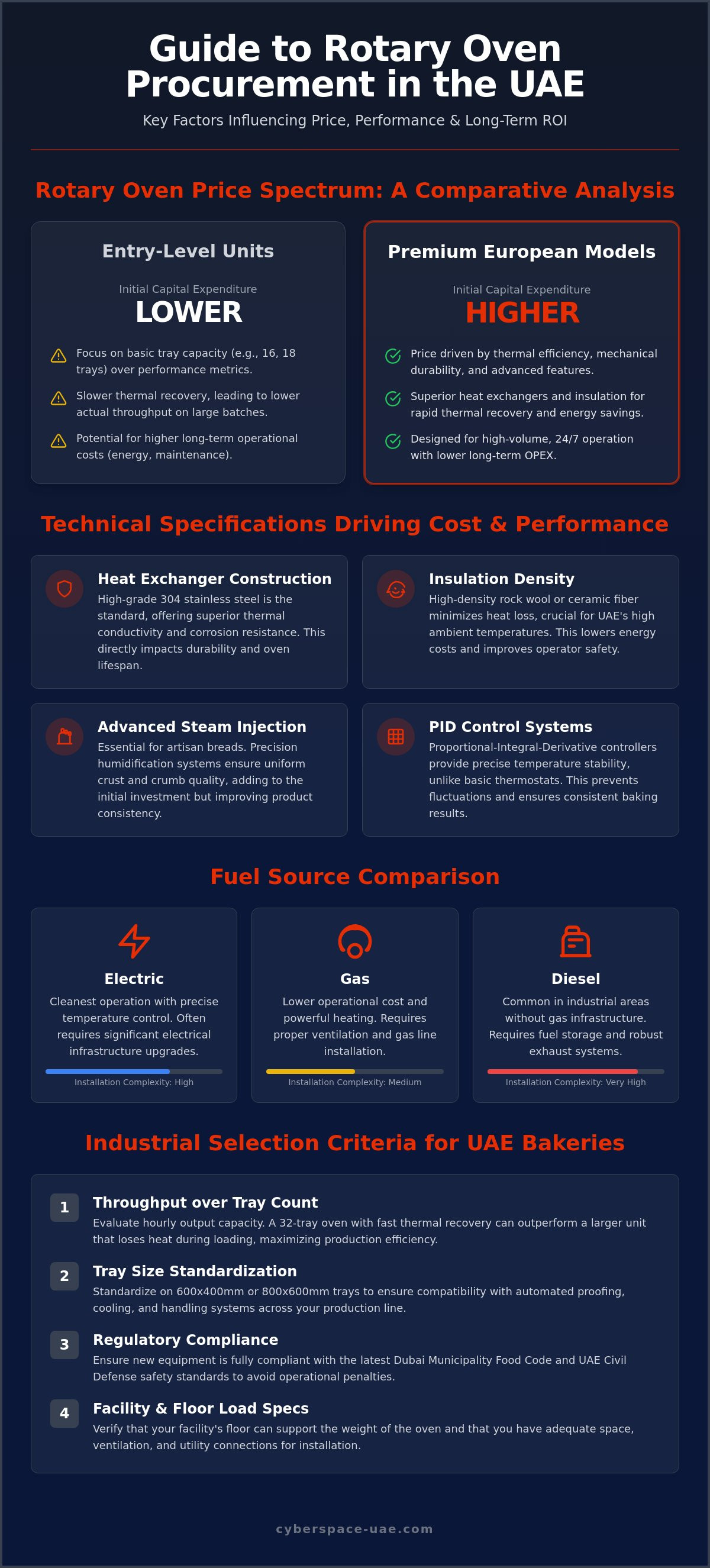
Industrial rotary rack ovens represent the primary heating solution for high-volume UAE bakeries. These systems utilize a rotating rack mechanism and forced convection to ensure uniform heat distribution across every tray. When evaluating the rotary oven price in UAE, procurement teams must look beyond simple tray counts like 16, 18, or 32. The actual cost is driven by the technical specifications of industrial ovens, specifically thermal recovery speed and mechanical durability. Entry-level models often prioritize lower initial capital expenditure but may lack the heavy-duty insulation required for the UAE's high-ambient operating temperatures. Premium European models command a higher price due to superior heat exchanger construction and advanced steam generation systems.
Brand-new equipment is the standard for serious industrial operations. While the market contains various options, investing in new machinery ensures compliance with the latest Dubai Municipality Food Code and Civil Defense safety standards. Refurbished units often carry hidden operational expenses, including higher energy consumption and frequent mechanical failures. New systems provide a predictable OPEX through manufacturer warranties and modern energy-saving technologies. This reliability is essential for maintaining consistent production schedules in a competitive market like Dubai or Abu Dhabi.
Throughput vs. Capital Expenditure
Production capacity is measured by hourly output, not just rack size. A 32-tray oven with a fast thermal recovery cycle can outperform larger units that lose temperature during loading. High-performance ovens minimize the time required to return to the set baking temperature after the door is closed. Automation features, such as programmable baking cycles and automatic steam venting, increase the initial purchase price but significantly reduce labor requirements. These systems allow a single operator to manage multiple units, justifying the higher investment through long-term payroll savings and reduced human error.
Industrial Market Trends 2026
The 2026 UAE food sector shows a clear shift toward high-efficiency burners and precision control systems. Modern rotary ovens now feature multi-functional touchscreens with cloud-based recipe pre-sets, ensuring product consistency across multiple facility locations. Standardization is also critical. Most industrial operations in the region have moved toward 600x400mm or 800x600mm tray sizes to maintain compatibility with automated proofing and cooling systems. These trends reflect a broader industry focus on digitalization and operational efficiency to counter rising utility and labor costs.
Technical Specifications Influencing Rotary Oven Price
Equipment cost is fundamentally linked to material quality and engineering precision. The rotary oven price in UAE varies significantly based on the heat exchanger's construction. High-grade stainless steel, specifically Grade 304, is the industry standard for durability and hygiene. It offers superior thermal conductivity compared to lower-tier alloys. This material choice prevents corrosion from high-moisture steam cycles, extending the operational lifespan of the machinery in demanding commercial environments.
Insulation density is another critical cost factor. In the UAE, where ambient kitchen temperatures can be high, high-density rock wool or ceramic fiber insulation is necessary to minimize heat loss. This reduces the load on the heating elements and lowers long-term utility expenses. Effective insulation maintains a cool exterior, improving operator safety and reducing the overall HVAC load of the facility. Cheaper models often compromise on insulation thickness, leading to higher energy waste and inconsistent internal temperatures.
Advanced steam injection systems are essential for artisan bread production. Precision humidification ensures a uniform crust and crumb quality across every batch. These systems require complex plumbing and high-quality solenoid valves, which contribute to the total investment. Control systems also dictate price. PID (Proportional-Integral-Derivative) controllers offer precise temperature stability, whereas basic thermostats often result in temperature fluctuations that compromise consistency. All such systems must align with UAE industrial equipment standards to ensure legal compliance and operational safety.
Airflow Dynamics and Heat Distribution
Uniform baking depends on sophisticated airflow patterns. Vertical airflow systems distribute heat evenly across every level of the rack, preventing hot spots. High-velocity fans facilitate rapid thermal recovery after door openings, which is vital for maintaining high throughput. Adjustable shutters allow technicians to fine-tune heat flow, accommodating delicate pastries that require gentler convection than heavy doughs.
Mechanical Build Quality
The rotation mechanism is a primary indicator of mechanical longevity. Top-hook systems are generally preferred for industrial 24/7 operations as they reduce floor-level debris interference. Turntable systems are common in smaller units but may require more frequent maintenance of the base bearings. Motor duty cycles must be rated for continuous use. High-quality door sealing technology and double-glazed viewing panels prevent energy leakage, ensuring the oven remains efficient throughout its lifecycle. For businesses scaling production, selecting new rotary ovens with these technical advantages is a prerequisite for operational excellence.
Fuel Source Comparison: Electric vs. Gas vs. Diesel
Selecting a fuel source is a primary decision that dictates both the initial rotary oven price in UAE and the long-term operational expenditure of a bakery. Industrial facilities must evaluate their existing infrastructure before procurement. Electric models are frequently chosen for their precision and simplified installation. Gas and diesel variants, however, remain the standard for high-volume plants due to their superior thermal recovery speeds. The choice between these sources involves a trade-off between upfront installation complexity and monthly utility billing cycles in the 2026 market.
Gas-fired ovens generally offer faster heat-up times. This efficiency is critical in facilities where the oven door opens frequently for rack swaps. While gas burners provide intense heat, they require rigorous installation protocols. In the UAE, gas line installations must comply with strict Civil Defense safety regulations, including the integration of emergency shut-off valves and fire-rated extraction hoods. These requirements increase the initial setup cost but often result in lower energy expenses per kilogram of product compared to purely electric heating elements.
Electric Rotary Ovens: Precision and Cleanliness
Electric units utilize high-output heating elements to maintain temperature stability. These ovens are easier to install as they don't require complex gas plumbing or specialized fuel storage. They're ideal for smaller industrial units or facilities with limited ventilation. Modern electric rotary systems often integrate with smart grid technology and energy monitoring software. This allows operators to track DEWA consumption in real-time, optimizing baking schedules to take advantage of off-peak industrial rates. Maintenance is typically lower since there are no burner assemblies to clean or calibrate.
Gas and Diesel Solutions: Power for High-Volume
High-capacity bakeries often prioritize gas or diesel burners for their raw power. Modern burner technology has evolved to maximize combustion efficiency, reducing fuel waste and emissions. For multi-oven facilities, the ROI of investing in centralized gas infrastructure is reached quickly through significant savings on the energy bill. Diesel remains a viable alternative in remote locations or industrial zones where gas piping isn't yet available. These systems require a dedicated maintenance protocol for burner assemblies and fuel lines to ensure consistent flame quality and prevent soot buildup in the heat exchanger.
Industrial Selection Criteria for UAE Bakeries
Selecting an industrial oven requires a precise calculation of hourly throughput. A mismatch between rack capacity and actual production volume leads to wasted energy or production bottlenecks. Buyers must evaluate the industrial rotary baking oven based on its ability to handle peak demand without compromising quality. Standard rack configurations usually accommodate 16 to 32 trays. This selection directly affects the rotary oven price in UAE; however, the cost of an oversized unit is compounded by the energy required to heat unused space during off-peak hours.
Facility dimensions often dictate the equipment model. Industrial rotary ovens require significant vertical clearance for the rotation motor and extraction hood. Ceiling height must accommodate the oven's external dimensions, which often exceed 2.5 meters. Floor load-bearing capacity is equally critical. A fully loaded 32-tray oven can weigh over 1,300 kg. All equipment must adhere to the Dubai Municipality Food Code or ADAFSA standards. This includes ensuring surfaces are Grade 304 stainless steel for HACCP compliance. Verifying these technical constraints before purchase prevents costly facility modifications later.
Operational Integration
Production efficiency depends on the synchronization of machinery. It's essential to match oven capacity to spiral mixer batch sizes. If a mixer produces 100kg of dough, the oven rack must be able to accommodate that volume immediately to prevent over-proofing. Workflow planning should create a linear path from the prover to the rotary oven and then to the cooling zone. Digital control interfaces now feature programmable recipes. While these systems simplify operations, they require specific staff training to ensure correct parameter settings for different product types. This reduces human error and maintains brand consistency.
Maintenance and After-Sales Support
Reliability is non-negotiable for 24/7 industrial bakeries. Premium European brands are often preferred due to the widespread availability of genuine spare parts in the local market. Modern industrial ovens include predictive maintenance features that alert operators to potential motor or burner issues before a failure occurs. Technical support must be national. Accessing locally based technicians ensures that downtime is minimized. A lower initial rotary oven price in UAE for a brand without local support often leads to catastrophic losses during peak seasons. To ensure your facility operates with maximum efficiency, you can view our professional rotary oven specifications and consult with our technical team for a tailored procurement plan.
Industrial Solutions from Cyberspace Kitchen & Bakery Equipment
Cyberspace Kitchen & Bakery Equipment serves as a specialized B2B supplier for the commercial food service sector. The firm provides high-performance professional baking equipment designed for heavy-duty industrial use. Unlike generalist suppliers, Cyberspace focuses on machinery that meets the thermal recovery and mechanical duty cycles required for high-volume production. This specialization is vital when calculating the rotary oven price in UAE. The investment covers more than hardware; it includes national technical support and guaranteed compliance with Dubai Municipality and ADAFSA standards.
The portfolio features advanced systems from leading baking deck oven suppliers and rotary oven manufacturers. For industrial expansions or new facility startups, Cyberspace provides technical consultation. This service aligns equipment specifications with production targets. It ensures every component, from spiral mixers to rotary racks, operates as a synchronized system. National logistical support ensures rapid procurement and installation across all emirates. This methodical approach reduces the path from discovery to operational status.
High-Performance Product Range
The inventory includes the Rational combi oven for bakery production. These systems offer precision for specialty bakes requiring controlled humidity. To maintain food safety standards, Cyberspace supplies commercial blast chiller Dubai systems. These units are necessary for rapid temperature reduction in industrial cycles. Every machine is brand-new. This policy eliminates the mechanical risks and high OPEX associated with refurbished equipment. It's the most reliable way to ensure full adherence to the latest UAE Civil Defense fire safety regulations.
Professional Procurement Services
Efficiency begins with technical site analysis. Cyberspace experts evaluate facility constraints, including utility loads and floor load-bearing capacities. This assessment ensures the rotary oven price in UAE matches a solution that fits the physical environment. The procurement process is streamlined for professional operators. It moves from technical verification to logistical deployment without delays. Direct communication with Cyberspace allows for specialized machinery quotes and custom configurations. It's a gateway to professional-grade solutions that prioritize long-term ROI and operational excellence in the UAE market.
Optimizing Industrial Baking ROI for 2026
Successful industrial procurement in the UAE requires a shift from viewing equipment as a capital cost to evaluating it as an operational asset. The rotary oven price in UAE is fundamentally determined by mechanical duty cycles, insulation density, and thermal recovery efficiency rather than tray capacity alone. Prioritizing brand-new, professional-grade industrial machinery ensures your facility remains compliant with MoIAT and Civil Defense standards while minimizing energy waste.
Selecting between electric, gas, or diesel models depends on your specific infrastructure and production volume requirements. Ensuring that your rack capacity aligns with your spiral mixer output prevents bottlenecks and maintains consistent product quality. Cyberspace Kitchen & Bakery Equipment facilitates this process by providing brand-new high-performance equipment backed by national UAE distribution and support.
Request a technical specification and quote for industrial rotary ovens to secure a high-performance solution for your bakery expansion or startup. Our technical team is ready to assist with detailed site requirements and precise machinery configurations. Achieve operational excellence with equipment built for the practical realities of the 2026 industrial market.
Frequently Asked Questions
What is the average price of a 32-tray rotary oven in the UAE?
Market data for 2026 indicates that a 32-tray rotary oven price in UAE typically starts around AED 27,318 for electric models and can exceed AED 46,800 for high-specification gas units. These figures depend on the inclusion of steam systems, burner technology, and the specific heat exchanger materials used. Premium models with advanced digital controls represent the higher end of this pricing spectrum.
Is a gas-fired rotary oven cheaper to operate than an electric one in the UAE?
Gas-fired ovens generally offer lower operational costs for high-volume industrial bakeries. While the initial setup for gas lines and Civil Defense compliance involves higher capital expenditure, the cost per thermal unit for gas is typically lower than electricity. This makes gas models more cost-effective for facilities running continuous 24/7 production cycles where thermal recovery speed is critical.
What are the main differences between rotary and deck ovens for high-volume baking?
Rotary ovens use forced convection and a rotating rack to bake large batches rapidly and uniformly. Deck ovens rely on conduction and radiant heat from stone or steel plates, which is better for artisan products requiring a specific bottom crust. Rotary systems prioritize maximum throughput and minimal labor, whereas deck ovens are preferred for specialized textures in smaller batches.
Do I need a special permit for gas-fired industrial ovens in the UAE?
Yes, all gas-fired industrial equipment must be approved by the UAE Civil Defense. Installation requires a permit and must be conducted by certified technicians to ensure compliance with safety protocols. This includes the integration of fire-rated hoods, gas suppression systems, and emergency shut-off valves. Compliance with Dubai Municipality or ADAFSA food safety codes is also mandatory for all installations.
How long does a professional-grade rotary oven typically last?
A professional-grade rotary oven has an expected operational lifespan of 10 to 15 years with a consistent maintenance schedule. Durability is largely determined by the grade of stainless steel in the heat exchanger and the duty cycle of the rotation motor. Investing in new, high-performance equipment ensures the longest possible service life and reduces the risk of early mechanical failure.
What are the ventilation requirements for installing a rotary rack oven?
Installation requires a high-capacity extraction system with a fire-rated hood and dedicated ducting. The ventilation must be capable of removing both intense heat and steam to maintain a safe working environment. Requirements include specific airflow rates defined by the Dubai Municipality Food Code to prevent heat accumulation and ensure the efficient operation of the oven's burner or elements.
Can a rotary oven be used for both bread and delicate pastries?
Yes, modern rotary ovens are highly versatile when equipped with adjustable airflow shutters and precision steam injection. By controlling the convection speed, operators can bake delicate items like croissants without damage. The same unit can then be adjusted for the high-intensity heat and steam required for heavy bread loaves, making it a flexible asset for diverse production lines.
Does Cyberspace Kitchen & Bakery Equipment provide technical support for installation?
Cyberspace Kitchen & Bakery Equipment provides national technical support and procurement assistance across the UAE. This service includes analyzing site requirements, such as floor load-bearing capacity and utility connections, to ensure a seamless installation process. Providing technical expertise for new machinery is a core part of the company's commitment to supporting the commercial food service sector.