
Unox vs Rational Combi Oven: Technical Comparison and Procurement Guide 2026
The industry standard for professional kitchens is shifting; the oven with the highest market share may no longer be the most efficient choice for your specific operational costs. You likely recognize that high energy consumption and equipment downtime during peak service are the primary drivers of shrinking margins. Selecting between a unox vs rational combi oven requires a deep dive into technical specifications rather than brand recognition alone. Reliability in high-ambient temperatures and the ability to simplify complex programming for unskilled staff are now baseline requirements for industrial procurement.
This guide provides a rigorous technical evaluation of the Rational iCombi Pro and the Unox CHEFTOP-X to assist facilities in selecting high-performance equipment. You'll learn how these systems mitigate labor shortages by reducing dependency by up to 23% and which models meet strict UAE ESMA registration standards for 2026. We'll compare AI-driven programming, energy efficiency ratings, and maintenance requirements to ensure your procurement decision minimizes lifecycle costs. Our analysis focuses on 304 and 316 stainless steel compliance and 400V three-phase power needs to guarantee operational excellence in demanding commercial environments.
Key Takeaways
- Technical differentiation between boiler-based steam generation and direct injection systems for precise moisture control.
- Analysis of energy consumption patterns and insulation performance under high UAE ambient temperatures to minimize lifecycle costs.
- A two-step procurement framework to audit menu complexity and determine optimal tray capacity for industrial throughput.
- Comparative data on the unox vs rational combi oven regarding labor dependency reduction and AI-integrated operational efficiency.
- Application-specific selection criteria for the Unox Cheftop and Bakertop series tailored to diverse culinary and pastry requirements.
The Evolution of Combi Oven Technology: Unox vs. Rational
Modern industrial kitchens rely on combi oven technology as their primary thermal engine. These units integrate convection and steam to maximize throughput while maintaining food quality. The decision between a unox vs rational combi oven often defines a facility's operational workflow for over a decade. Rational established the category's foundation through mechanical precision. Unox transitioned the industry toward digital integration and lean manufacturing. By 2026, the market has bifurcated into legacy reliability and data-centric performance. Selecting the correct brand requires a technical understanding of how these systems manage heat, moisture, and energy.
Rational: The Legacy of Precision
Rational AG remains the industry benchmark. German engineering is the core of the iCombi Pro series. These units utilize boiler-based steam systems to ensure high-density saturation. Chefs in high-end establishments prefer the haptic feedback and intuitive manual overrides of the interface. This brand holds approximately 50% of the global combi oven market share as of May 2026. Its systems prioritize standardization across large-scale operations. The build quality focuses on 304 and 316 stainless steel. This ensures compliance with international food safety standards and UAE hygiene regulations. It's a system built for longevity and consistent output under heavy service loads.
Unox: The Rise of Data-Driven Cooking
Unox represents the shift toward automated climate control and AI integration. The CHEFTOP-X series utilizes advanced sensors to monitor food progress in real-time. This reduces the need for skilled labor. Unox employs a vertical manufacturing model and produces most components in-house. This strategy allows for a more competitive initial investment compared to legacy brands. Their Data Driven Cooking (DDC) ecosystem allows operators to monitor multi-unit energy consumption and HACCP data remotely. In 2026, 34% of new product developments in this sector involve smart technology. Unox leads this trend through its MIND.Maps technology and automated washing cycles. Their equipment is designed for performance-focused kitchens that prioritize creative flexibility and low energy consumption.
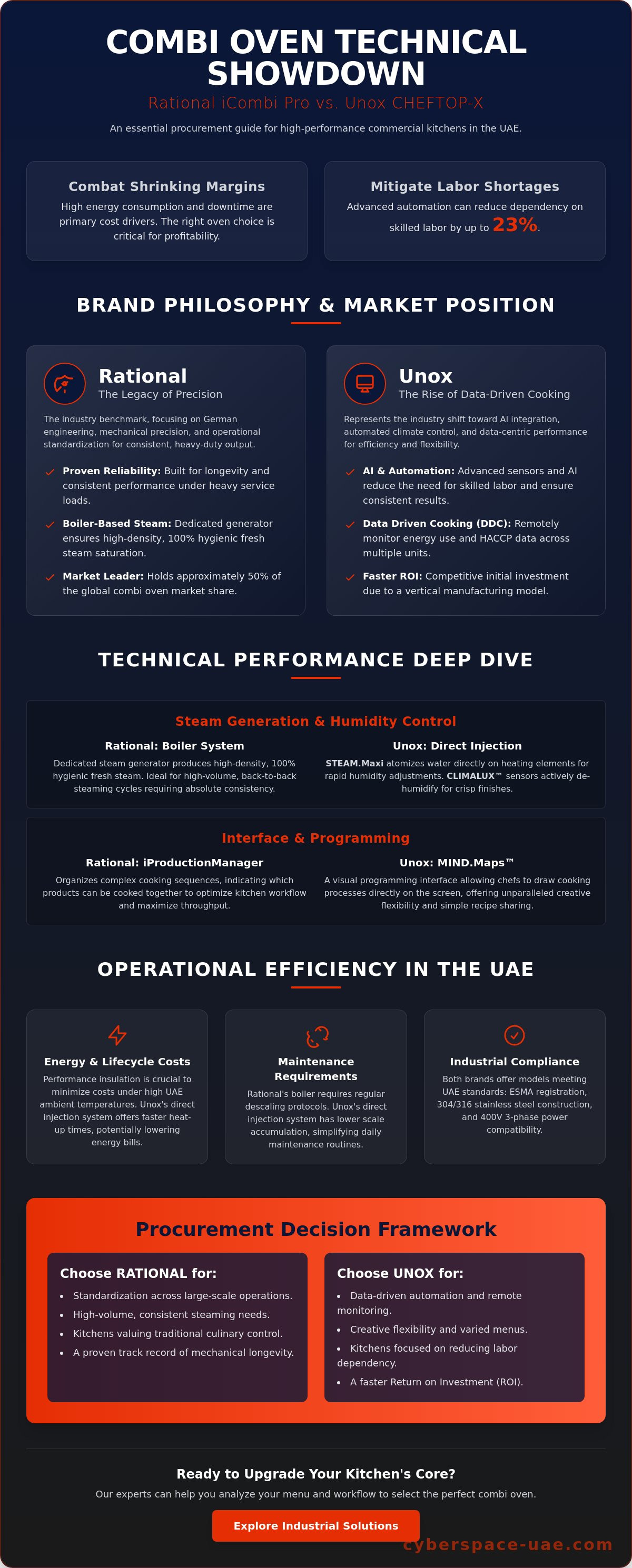
Choosing between these brands requires an audit of your kitchen's technical requirements. Rational offers a proven track record of standardization and robust steam production. Unox provides a faster ROI through AI-integrated efficiency and lower upfront costs. Both manufacturers now provide units with ESMA registration for the UAE market. This ensures they meet 400V/50Hz electrical requirements for industrial use. Your choice will ultimately depend on whether your kitchen values traditional culinary control or data-driven automation.
Technical Performance: iCombi Pro vs. Cheftop Mind.Maps
Technical performance in the unox vs rational combi oven debate centers on engineering philosophy. Rational utilizes a traditional boiler-based steam generator to produce high-density saturation. Unox employs direct injection technology via their STEAM.Maxi system. Boiler systems offer superior consistency for back-to-back steaming cycles. Direct injection provides faster heat-up times and lower scale accumulation. Each system requires specific maintenance protocols to ensure longevity in industrial settings.
Steam Generation and Humidity Control
Rational's iCombi Pro features a dedicated steam generator that delivers 100% hygienic fresh steam. This is critical for high-volume steaming where saturation levels must remain constant. In contrast, Unox uses STEAM.Maxi to atomize water directly onto the heating elements. This method is highly efficient for rapid humidity adjustments. While an industrial rotary baking oven is the standard for mass-scale bread production, these combi units provide the necessary versatility for varied menus. Unox's CLIMALUX sensors provide active de-humidification by extracting excess moisture through a dedicated vent. This ensures a crisp finish on proteins and pastries that boiler-only systems may struggle to replicate without precise manual intervention.
Interface and Programming Capabilities
Operational efficiency depends on interface responsiveness. Rational's iProductionManager organizes complex cooking sequences by indicating which products can be cooked together. It optimizes the workflow for maximum throughput. Unox utilizes Mind.Maps, a visual programming interface where chefs draw the cooking process. This visual approach simplifies training for unskilled staff. Both brands use high-durability capacitive touchscreens designed for industrial environments. These screens resist grease and heat, ensuring long-term reliability. For multi-site operations, recipe replication is achieved through USB or cloud-based synchronization. This maintains product consistency regardless of the operator's skill level. If you're managing a high-volume facility, you can explore the latest Rational combi oven options for integrated automation.
Heat distribution is managed through variable fan speeds. Rational units feature multiple fans that reverse direction to eliminate cold spots. Unox's AIR.Maxi system provides up to four fan speeds to protect delicate products like meringues or light sponges. Build materials for both manufacturers consist of high-grade 304 or 316 stainless steel. Rational emphasizes heavy-duty construction for the cooking cabinet. Unox integrates more composite materials in non-critical areas to reduce weight and cost. Both configurations meet the 2026 UAE standards for food contact surfaces and heat insulation. Choosing between a unox vs rational combi oven requires balancing these specific engineering advantages against your daily menu requirements.
Operational Efficiency and Lifecycle Costs in the UAE
Ambient conditions in the UAE require equipment with superior thermal management. High external temperatures increase the cooling load on internal electronics. When evaluating a unox vs rational combi oven, energy consumption patterns for 10-tray and 20-tray units vary based on insulation quality. Unox claims up to 30% less energy consumption compared to traditional brands through their high-efficiency heating elements. Rational focuses on high-performance heat exchangers to maintain cabinet temperatures during frequent door openings. Both brands require 400V/50Hz three-phase power for industrial-scale operations in the region. Legal compliance requires mandatory ESMA registration for all units sold and installed locally.
Energy Consumption and Insulation Standards
Thermal retention is achieved through advanced glazing and cabinet density. Rational utilizes triple-pane glass in the iCombi Pro to minimize heat radiation into the kitchen environment. This reduces the load on your facility's HVAC system. Unox employs high-performance insulation and double-pane glass to achieve significant energy savings at a lower unit weight. High-efficiency motors in these units support continuous industrial operation by adjusting power based on the specific load. This is a critical factor for professional baking equipment in Dubai where electrical costs directly impact monthly margins. Maintaining an airtight seal via high-grade silicone gaskets is mandatory to prevent energy loss in 45°C+ ambient environments.
Automated Cleaning and Maintenance Protocols
Scale accumulation from local water hardness is the primary cause of equipment downtime. Rational's iCareSystem uses phosphate-free cleaner tabs that descale the boiler automatically. This eliminates the need for external descaling pumps. Unox's Rotor.KLEAN system uses liquid detergents and features sensors to monitor water quality and chemical usage. While Rational's proprietary chemicals are often priced higher, they offer integrated descaling that protects the internal boiler. Unox systems are compatible with a wider range of chemicals but require strict adherence to filtration schedules to prevent nozzle clogging. Technical support and spare parts for both brands are widely available across the UAE.
Ambient temperatures frequently exceed 40°C in local kitchens. This places immense stress on the cooling fans of the oven's control boards. Rational's design includes robust ventilation for electronic components to prevent thermal shutdown. Unox utilizes forced-air cooling to maintain sensor accuracy in high-heat zones. Water filtration is not optional. UAE water typically contains high levels of dissolved solids. Failure to install a resin-based softener or reverse osmosis system will void warranties for both manufacturers. Rational's boiler-based system is particularly sensitive to calcium buildup; Unox's injection nozzles can clog if water is not treated. You must factor in the cost of high-capacity filters when calculating the total cost of ownership.
Procurement Framework: Selecting the Right Unit for Your Kitchen
Procuring industrial equipment requires a structured evaluation to ensure long-term ROI. A unox vs rational combi oven selection shouldn't be based solely on upfront cost. Instead, follow a five-step framework to align the unit with your operational reality. Start by auditing your menu complexity. If your kitchen requires high-volume steaming and rapid roasting, a boiler-based system may be preferable. Conversely, a menu focused on diverse, small-batch baking might benefit from the precision of direct injection. Step two involves calculating throughput. Daily tray capacity (6, 10, or 20 GN) must match peak service demand to prevent bottlenecks.
Tray Capacity and Volume Requirements
Selecting the correct size is essential for energy efficiency. Countertop models (6 or 10 GN) are ideal for boutique operations or specialized stations. Floor models (20 GN) are designed for mass-production environments. Over-sizing your equipment leads to significant energy waste during non-peak hours. While baking deck oven suppliers often cater to high-density bread production, a combi oven provides the versatility needed for varied cooking modes. Ensure your kitchen footprint allows for the required door clearance and exhaust hood placement as per UAE regulations. Floor models require a larger drainage capacity and dedicated water lines.
Assessing Staff Technical Literacy
Equipment damage often results from improper manual operation. Evaluate whether your staff requires 'One-Touch' cooking interfaces to maintain consistency. Rational's iProductionManager and Unox's Mind.Maps both offer automated sequences that reduce the risk of user error. These systems also include automated HACCP logging. This digital documentation removes the administrative burden from managers and ensures food safety compliance. A 3-year Total Cost of Ownership (TCO) analysis must include chemical costs, water filter replacements, and anticipated energy consumption. For a detailed technical consultation on your next procurement, view our full range of Rational and Unox solutions.
Step four requires an evaluation of your kitchen's ventilation capacity. Combi ovens produce significant steam and grease during roasting cycles. This necessitates a high-performance exhaust hood that meets local fire safety codes. Finally, perform a 3-year TCO analysis. This calculation should weigh the lower initial investment of a Unox unit against the potential labor savings offered by Rational's advanced automation. Factor in the frequency of service intervals and the local availability of certified technicians. A well-planned procurement strategy ensures your equipment remains a productive asset rather than a maintenance liability.
Industrial Solutions: The Unox Collection at Cyberspace
Cyberspace facilitates the procurement of high-performance Unox equipment for the UAE market. While the technical comparison of a unox vs rational combi oven reveals distinct engineering paths, Unox provides high-precision data integration for modern facilities. We supply brand-new machinery to ensure operational reliability and full compliance with industrial standards. Our logistical framework supports national delivery and technical assistance for seamless integration into your kitchen workflow. Sourcing new equipment through our platform guarantees access to the latest AI-driven features and manufacturer warranties.
Standout Models: From Convection to Speed Ovens
The Unox Cheftop Mind.Maps series is the primary choice for high-precision protein cooking. It utilizes CLIMALUX sensors to monitor and adjust humidity levels in real-time. For industrial pastry and bread production, the Unox Bakertop series provides uniform heat distribution across all tray levels. This ensures consistent browning and texture for high-volume baking. The Unox Bakerlux Shop.Pro serves retail environments requiring fast throughput for frozen dough products. Operations prioritizing service speed utilize the Unox Speed-X. This model is the first self-washing speed oven to combine convection, steam, and microwave performance for rapid industrial output.
Why Professionals Choose Unox for Modern Operations
ROI benefits are driven by Unox's vertical manufacturing model and advanced sensor technology. These systems reduce waste by preventing overcooking and optimizing energy usage during non-peak hours. The 304 and 316 stainless steel construction ensures the equipment withstands the corrosive effects of high-volume steaming and industrial cleaning chemicals. Cyberspace provides a transparent procurement path for brand-new units. We do not sell used or refurbished machinery. This commitment to quality ensures your facility operates with the most efficient tools available in 2026. Our technical support team assists with the initial setup to ensure your unit meets local 400V/50Hz electrical requirements.
Selecting Unox through Cyberspace allows for a streamlined upgrade to your kitchen's thermal capacity. We focus on providing industrial-grade solutions that minimize downtime and maximize labor efficiency. Our inventory is managed to support the immediate needs of growing foodservice operations. You can evaluate specific model technical sheets to match your menu requirements exactly. Precision, durability, and data-centric performance define the current Unox lineup. To secure high-performance equipment for your facility, browse the full Unox Combi Oven collection at Cyberspace.
Optimizing Industrial Kitchen Throughput and Efficiency
Selecting between a unox vs rational combi oven requires balancing legacy reliability with modern AI-driven efficiency. Technical evaluations confirm that while Rational offers superior steam saturation for high-volume operations, Unox provides significant ROI through lower energy consumption and streamlined digital interfaces. Both brands meet 2026 UAE ESMA standards and require robust water filtration to prevent scale accumulation in high-ambient temperatures. Your procurement strategy must prioritize a 3-year Total Cost of Ownership analysis to ensure long-term profitability and operational uptime.
Cyberspace facilitates your transition to advanced thermal technology with a comprehensive collection of brand-new industrial-grade machinery. We provide technical support available nationally to ensure your equipment maintains peak performance in demanding commercial environments. Our inventory includes specialized Unox ovens designed for diverse culinary and pastry applications. Explore the Unox Industrial Oven Collection to secure a high-performance solution for your facility. Achieving operational excellence starts with the right technical foundation.
Frequently Asked Questions
Which is better for baking, Unox or Rational?
Unox Bakertop models are specifically engineered for industrial pastry and bread production with specialized fan control for delicate items. Rational iCombi Pro offers superior standardization for large-scale bakery operations requiring consistent results across multiple units. Your choice depends on whether you prioritize the specialized humidity curves of a dedicated bakery unit or the multi-purpose versatility of a standard combi.
What is the price difference between a 10-tray Rational and Unox oven?
Rational ovens typically carry a 20% to 30% higher upfront cost than comparable Unox models as of May 2026. This price gap is attributed to Rational's boiler-based technology and extensive global service network. You should evaluate the unox vs rational combi oven based on long-term ROI and labor savings rather than the initial purchase price alone.
Do Unox ovens require a boiler for steam generation?
Unox ovens don't utilize a boiler for steam generation. They employ direct injection technology where water is atomized directly onto the heating elements. This design reduces scale buildup within a central tank and allows for rapid humidity adjustments. Rational utilizes a high-density steam generator to ensure 100% steam saturation during heavy-duty steaming cycles.
How often should a commercial combi oven be serviced?
Commercial kitchens should schedule technical maintenance at least twice per year. High-volume operations in the UAE often require quarterly inspections to monitor cooling fans and gasket integrity due to extreme ambient heat. Frequent servicing prevents equipment downtime during peak service and ensures that automated cleaning systems are functioning correctly to maintain manufacturer warranties.
Can Unox ovens be integrated with HACCP monitoring software?
Unox ovens integrate fully with HACCP monitoring through the Data Driven Cooking (DDC) ecosystem. This platform automatically logs cooking temperatures and cleaning cycles to ensure food safety compliance. Managers can access this data remotely to generate reports for health inspections. This digital documentation removes the need for manual record-keeping and reduces administrative errors in busy kitchens.
What are the power requirements for a 20-tray industrial combi oven?
A 20-tray industrial combi oven requires a 400V/50Hz three-phase electrical connection. This equipment must be installed on a dedicated MCB circuit breaker to handle the high current draw safely. You must verify that your kitchen's electrical infrastructure can support the specific kilowatt rating of the unit before procurement. Improper wiring leads to frequent component failure and potential fire hazards.
Is it worth upgrading from a convection oven to a combi oven?
Upgrading to a combi oven increases kitchen throughput by combining steam and convection modes in a single footprint. This technology reduces product shrinkage by up to 15% compared to traditional convection ovens. It also allows for a wider range of cooking techniques, including sous-vide and rapid roasting. The investment is justified through increased food yield and reduced labor dependency.
How does the UAE climate affect combi oven performance?
The UAE climate impacts performance through extreme ambient heat and high water mineral content. External temperatures exceeding 40°C place additional stress on internal cooling fans and control boards. High water hardness leads to rapid scale accumulation in steam nozzles and boilers. You must install high-capacity resin softeners and ensure adequate ventilation to prevent thermal shutdown during summer months.