
Blast Chiller HACCP Compliance: Industrial Food Safety Standards 2026
A standard refrigerator is a storage unit, not a safety tool. Using one to cool hot food batches is a primary cause of rapid bacterial growth and a guaranteed way to fail a food safety audit. Achieving blast chiller HACCP compliance requires more than just owning the machinery; it demands a technical system of precision airflow and automated data logging.
You know that manual temperature checks are often inconsistent and that slow cooling times compromise both food quality and shelf life. This guide provides a technical roadmap for implementing HACCP-compliant blast chilling cycles to ensure full regulatory compliance and operational efficiency. We will detail the mandatory two-stage cooling process, the implications of FSMA Rule 204 traceability, and how to systematize your production workflow for 2026.
Key Takeaways
- Identify critical control points within the 5°C to 60°C "Danger Zone" to prevent rapid bacterial multiplication in cooked batches.
- Implement the 90-minute cooling rule to achieve blast chiller HACCP compliance by reducing core temperatures from +70°C to +3°C.
- Evaluate the thermal capacity differences between storage refrigeration and industrial blast chillers to eliminate the risk of thermal shock to existing stock.
- Automate regulatory documentation using digital temperature logging via USB or Wi-Fi for consistent, audit-ready records.
- Optimize production efficiency by integrating blast chilling cycles with Rational combi oven workflows and appropriate GN tray capacities.
Understanding Blast Chiller HACCP Compliance and Food Safety
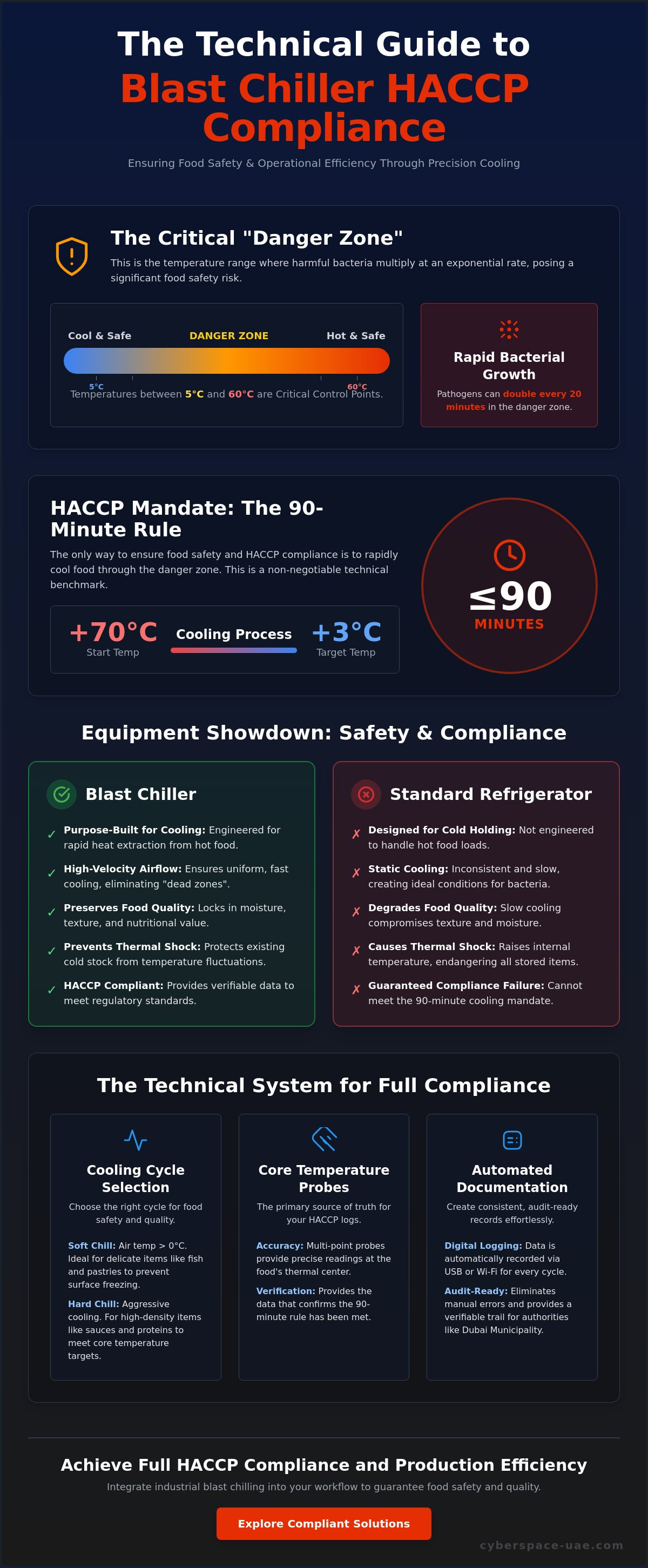
HACCP (Hazard Analysis and Critical Control Points) is a preventative system designed to identify and mitigate biological, chemical, and physical hazards in food production. In professional catering and industrial food processing, the cooling phase represents a primary Critical Control Point (CCP). Blast Chilling is the technical process of rapidly reducing the temperature of cooked food to bypass the "Danger Zone." This zone, ranging from 5°C to 60°C, is where bacterial multiplication occurs at an exponential rate.
At these temperatures, pathogens such as Bacillus cereus and Staphylococcus aureus can double every 20 minutes. Relying on standard refrigeration for cooling is a common compliance failure. Conventional units are engineered for cold holding, not heat extraction. Introducing hot batches into a static refrigerator raises the internal cavity temperature, causing "thermal shock" to stored inventory and inviting condensation. Achieving blast chiller HACCP compliance is the only way to verify that food has moved through the danger zone fast enough to remain safe for later consumption.
The Role of Blast Chillers in a Food Safety Management System
A blast chiller serves as a specialized tool for managing the transition between the cooking and storage stages. It prevents cross-contamination by sealing the food in a controlled, high-velocity airflow environment. This process maintains the "cold chain" for prepared batches, ensuring that the core temperature drops from +70°C to +3°C in under 90 minutes. It's about operational logic. Rapid thermal reduction stops the cooking process immediately, preserving the moisture, texture, and nutritional value of the product while meeting strict HACCP benchmarks. You don't have to guess if the food is safe; the machine provides the data.
Regulatory Standards for Rapid Cooling in the UAE
For commercial kitchens in the UAE, compliance with national food safety guidelines is a legal mandate. Dubai Municipality and other regional authorities require documented proof that high-risk foods are cooled according to specific time-temperature parameters. Verification of commercial blast chiller Dubai standards often involves digital logging that can be audited via platforms like Food Watch. Given the high ambient temperatures in regional kitchens, which often exceed 30°C, the cooling efficiency of the equipment is critical. Standard units can't compete with the dedicated evaporator power of an industrial blast chiller in these environments. Without this equipment, a kitchen won't provide the verifiable audit trail required for modern food safety certification.
Technical Requirements for HACCP-Compliant Cooling Cycles
To maintain blast chiller HACCP compliance, operators must adhere to the 90-minute rule. This technical benchmark requires food core temperatures to drop from +70°C to +3°C within a 90-minute window. Achieving this is impossible with static cooling. It requires high-velocity chilled air and specialized evaporator design to strip heat from the product surface at a rate that prevents bacterial growth. This process is a foundational element of the monitoring and corrective action steps outlined in the HACCP Principles & Application Guidelines.
Uniform heat extraction depends on airflow mechanics. Industrial units use powerful fans to circulate air across every tray level simultaneously. This eliminates "dead zones" where air might stagnate and allow temperatures to rise. Evaporator design plays a vital role here. Large-surface-area evaporators maintain consistent internal temperatures even when the unit is fully loaded with hot GN 1/1 pans. This mechanical efficiency ensures that every batch, regardless of its position in the cabinet, meets the safety standard.
Hard Chill vs. Soft Chill Parameters
Selecting the correct cycle is essential for both food safety and quality. Soft chill cycles maintain air temperatures just above 0°C. This is ideal for delicate items like pastries, fish, or thin vegetables, as it prevents surface freezing and cellular damage. Hard chill cycles use much lower air temperatures for high-density proteins and large-batch sauces. These items have a higher thermal mass and require aggressive cooling to reach the core. Automating these cycle selections via pre-programmed settings reduces human error and ensures repeatable blast chiller HACCP compliance.
Probe Technology and Core Temperature Monitoring
Verification requires accurate data. Multi-point food probes measure the temperature at the center of the thickest part of the food. These probes are the primary source of truth for your HACCP logs.
- Accuracy: Multi-sensor probes provide a more precise reading than single-point needles.
- Hygiene: Probes must be sanitized before and after every batch to prevent cross-contamination.
- Calibration: Annual calibration is mandatory to ensure the data used in your safety audits is valid.
Integrating these rapid cooling cycles with a Rational combi oven for bakery or industrial kitchen ensures a seamless, safe transition from the heat of the oven to the cold chain.
Blast Chiller vs. Standard Refrigeration: A Food Safety Analysis
The primary function of a storage chiller is to maintain a static environment for already-cooled products. It is not a cooling tool. Standard refrigeration lacks the evaporator surface area and fan velocity required to extract heat from hot food at a rate that satisfies safety protocols. Relying on these units for cooling is a common obstacle to achieving blast chiller HACCP compliance. When hot batches are placed in a walk-in, the compressor cannot compensate for the sudden thermal load, leading to a dangerous rise in internal air temperature.
This rise in ambient temperature causes "thermal shock" to existing stock. If you place a steaming pan of sauce next to chilled dairy or raw proteins, the surface temperature of the surrounding items can quickly enter the danger zone. This violates the cold holding Critical Control Point (CCP) for your entire inventory. Beyond safety, slow cooling in a standard unit promotes excessive evaporation. This leads to moisture loss and a reduction in final product weight. Industrial blast chillers use high-velocity air to "skin" the food surface quickly, locking in moisture and preserving the cellular structure.
Operational cost-efficiency is another factor. Overloading a standard storage chiller forces the compressor to run continuously at maximum capacity. This increases energy consumption and accelerates mechanical wear. A dedicated blast chiller is engineered for these high-heat events, completing the cycle efficiently before entering a low-energy holding mode.
Why Walk-In Chillers Cannot Meet HACCP Cooling CCPs
Walk-in chillers are engineered for passive cold storage. They fail the cooling CCP for several technical reasons:
- Insufficient Airflow: Standard fans move air at low speeds to prevent drying out stored goods, which is inadequate for rapid heat removal.
- Ambient Temperature Spikes: Hot food loads can raise the cavity temperature above 10°C for hours, compromising all stored ingredients.
- Condensation Risks: Steam from hot food creates moisture on walls and ceilings, providing a breeding ground for mould and Listeria.
HACCP Differences: Blast Chilling vs. Blast Freezing
While both processes use rapid airflow, their HACCP parameters differ. Blast chilling focuses on reaching a +3°C core within 90 minutes. Blast freezing requires the core to drop from +70°C to -18°C, typically within 240 minutes. The speed of freezing is vital for quality. Rapid freezing creates micro-crystals within the food's cell structures. Slow freezing in a standard freezer creates large macro-crystals that rupture cell walls, leading to "drip loss" and mushy textures upon thawing. Documentation for frozen stock must verify that the -18°C threshold was reached within the required timeframe to remain compliant for long-term storage.
Implementing HACCP Temperature Logging and Documentation
Documentation serves as the legal verification of safety protocols. In a professional kitchen, an unrecorded cooling cycle is considered a non-compliant cycle. Achieving blast chiller HACCP compliance requires a structured approach to data collection. Every cooling event must generate a record that includes the batch identification number, the date, and the specific operator responsible for the load. Technical precision is mandatory. You must log the starting core temperature, the exact time the cycle began, the final temperature achieved, and the total duration of the process.
Digital data cycles have replaced manual paper logs in modern industrial settings. Units equipped with USB ports or Wi-Fi connectivity allow for the automated extraction of cycle data. This transition to digital reporting ensures that information is unalterable and easily searchable during a surprise inspection. Automated systems eliminate the "guesstimation" often found in handwritten logs, providing a precise thermal graph of the entire cooling curve. This data is essential for identifying mechanical drift or operator errors before they result in a failed audit.
Corrective actions are a required component of a valid HACCP plan. If a cooling cycle fails to reach the +3°C target within the 90-minute window, the failure must be documented. The log should state the reason for the deviation and the action taken, such as discarding the product or immediately re-cooking it to a safe internal temperature. Demonstrating that your facility identifies and manages these failures is a key indicator of a high-functioning safety management system.
Automated Data Logging Systems
Integrated software provides real-time monitoring of all active cycles. These systems alert supervisors immediately if a unit loses power or if a probe detects a temperature spike. In high-volume industrial kitchens, this automation reduces the labor hours spent on manual entry and significantly lowers the risk of human error. For businesses with multiple sites, cloud-based storage allows for centralized management of HACCP data, ensuring consistent standards across all locations.
Audit Preparation and Compliance Verification
Organization is the foundation of a successful food safety audit. Logs should be archived by production date and batch number for immediate retrieval. Inspectors will also look for evidence of probe calibration. You must maintain a separate log showing that all food probes are tested for accuracy at regular intervals. Staff must be trained to follow the industrial food safety guide protocols to ensure every batch meets 2026 regulatory requirements.
Maintain your operational standards by implementing industrial blast chillers with automated logging and audit-ready reporting features.
Industrial Blast Chillers for UAE Professional Kitchens
Selecting the correct machinery is the final step in securing blast chiller HACCP compliance. Equipment capacity must align with peak production loads to prevent system overloading. Most industrial units utilize GN 1/1 or GN 2/1 tray configurations. For medium-sized operations, a 5-to-10 tray GN 1/1 unit provides the necessary throughput. Large-scale catering facilities or industrial bakeries require GN 2/1 roll-in models. These high-capacity units handle the output of multiple ovens simultaneously without compromising cooling speed.
In the UAE, the configuration of the condensing unit is a critical technical choice. Internal condensing units offer a compact footprint and simplified installation. However, they vent heat directly into the kitchen environment. For high-volume facilities, remote condensing units are the superior choice. By moving the heat rejection process outside the building, you reduce the load on the kitchen's HVAC system. This ensures the chiller maintains its thermal extraction performance even when ambient kitchen temperatures exceed 40°C during peak summer months.
Maintenance protocols are mandatory for sustained performance. High-performance industrial blast chiller freezers require monthly condenser coil cleaning to prevent airflow blockages. Quarterly calibration of the internal food probes is also necessary to ensure the data logged for safety audits remains accurate. Neglecting these mechanical requirements leads to longer cooling cycles and increased energy consumption.
Cook-and-Chill Workflow Integration
Operational efficiency depends on the compatibility of your thermal equipment. A Rational combi oven for bakery allows for precise cooking cycles that transition immediately into the chilling phase. This "cook-and-chill" method maximizes product yield by reducing moisture shrinkage. It also enables scheduled production, allowing kitchens to prepare large batches in advance and chill them safely for later service. Utilizing professional baking equipment designed for rapid batch processing ensures there is no bottleneck between the oven and the cold chain.
Procurement Criteria for High-Capacity Units
Durability and hygiene are the primary procurement benchmarks. Specify 304 stainless steel for all internal and external surfaces to ensure resistance to corrosion and ease of sanitization. High-density, CFC-free polyurethane insulation is essential for maintaining thermal stability in high-ambient environments. When evaluating units, check the insulation thickness; 60mm to 80mm is the industrial standard for energy efficiency. For technical specifications and industrial solutions tailored to your specific production volume, contact Cyberspace Kitchen & Bakery Equipment to review our range of blast chiller HACCP compliance tools.
Securing Operational Excellence in UAE Commercial Kitchens
Adhering to 2026 food safety standards requires a transition from passive storage to active thermal management. Standard refrigerators cannot extract heat fast enough to meet regulatory benchmarks. Implementing high-velocity airflow and automated data logging ensures consistent blast chiller HACCP compliance while protecting existing inventory from thermal shock. By integrating these systems into a cook-and-chill workflow, facilities reduce food waste and maintain superior product quality through every production cycle.
Cyberspace Kitchen & Bakery Equipment serves as a specialized industrial kitchen machinery supplier, delivering high-performance brand-new equipment across the region. We provide expert technical support for the UAE commercial sector, ensuring your facility meets all industrial food safety requirements. It's essential to utilize tools engineered for the specific thermal demands of high-volume production to maintain a verifiable audit trail.
View our range of HACCP-compliant industrial blast chillers to finalize your procurement strategy. Professional-grade equipment ensures your kitchen remains audit-ready and operationally efficient through 2026 and beyond.
Frequently Asked Questions
What is the HACCP temperature requirement for blast chilling?
The international HACCP standard requires food to cool from 57°C to 21°C within 2 hours and reach 5°C or below within a total of 6 hours. In industrial settings, the benchmark for blast chiller HACCP compliance is more rigorous, aiming to reduce core temperatures from +70°C to +3°C within 90 minutes. This rapid reduction ensures food bypasses the bacterial danger zone where pathogens multiply most quickly.
How long can food stay in a blast chiller after the cycle ends?
Food can remain in the unit until it's transferred to cold storage, provided the chiller has an automatic "hold" mode. Most professional units switch to a holding temperature between 1°C and 4°C once the chilling cycle completes. However, you shouldn't use the unit for long-term storage because it reduces operational efficiency and delays the next production batch.
Is a blast chiller mandatory for HACCP compliance in the UAE?
Yes, the Dubai Municipality Food Code mandates the use of blast chillers for any establishment that cooks and cools high-risk or perishable foods. Using standard refrigerators for cooling is a violation of local safety regulations. Every facility must demonstrate a verifiable cooling process as a Critical Control Point (CCP) within its documented food safety management system.
What is the difference between a blast chiller and a shock freezer for HACCP?
The primary difference lies in the target core temperature and the time allowed to reach it. A blast chiller targets a core temperature of +3°C within 90 minutes to prevent bacterial growth. A shock freezer must reach -18°C at the core, typically within 240 minutes. Freezing is also used for parasite destruction in raw fish, requiring temperatures as low as -35°C for 15 hours per UK and international standards.
How often should blast chiller temperature probes be calibrated?
Probes require professional calibration at least once per year to ensure the accuracy of your safety logs. Operators should also perform internal "ice-point" verification checks weekly or monthly. Keeping a dedicated calibration log is a mandatory requirement for safety inspectors to verify that your temperature data is accurate and reliable.
Can I put hot food directly into a blast chiller?
Yes, blast chillers are specifically engineered to accept food directly from the oven at temperatures of +70°C or higher. Unlike standard refrigerators, these units have high-capacity evaporators and powerful fans designed to strip heat away instantly. This prevents the thermal shock that occurs when hot items are placed near cold ingredients in a walk-in chiller.
What happens if a blast chilling cycle takes longer than 90 minutes?
If a cycle exceeds the 90-minute benchmark, you must initiate a documented corrective action. If the food has spent too long in the danger zone, it may need to be reheated to +75°C to eliminate pathogens or discarded entirely. You must record the failure in your HACCP log, identifying the cause, such as overloading or mechanical malfunction, to prevent recurrence.
How do I maintain a blast chiller for long-term HACCP compliance?
Maintenance focuses on mechanical efficiency and data integrity. You must clean the condenser coils monthly to ensure maximum heat extraction and inspect door gaskets for a proper thermal seal. Regularly archiving digital temperature logs and ensuring all software is updated are also essential steps for maintaining a compliant and audit-ready food safety system in 2026.