
Blast Chilling vs Shock Freezing: A Technical Comparison for Industrial Kitchens
Relying on standard refrigeration to cool hot food is a direct violation of UAE food safety mandates and a primary cause of texture degradation in industrial bakeries. You likely recognize that rapid temperature reduction is essential for preserving cellular structure and meeting the 90 minute cooling window required by national food safety regulations. Failing to distinguish between chilling and freezing cycles leads to unnecessary food waste and HACCP non-compliance.
This technical comparison clarifies the distinct mechanical processes of blast chilling and shock freezing to help you select the precise equipment for your production line. Understanding these differences is vital when you evaluate the blast chiller price in UAE and its impact on your operational ROI. We'll examine airflow dynamics, ice crystal formation, and how specific T3-rated compressors ensure performance in the local climate. This guide provides the technical data needed to maintain 4°C for chilled goods or -18°C for frozen stock while ensuring your facility meets the latest unified national food safety standards.
Key Takeaways
- Differentiate between blast chilling to +3°C and shock freezing to -18°C to ensure correct thermal application for specific food types.
- Understand the role of micro-crystal formation in preserving cellular integrity and preventing texture loss in industrial baked goods.
- Ensure compliance with UAE food safety mandates by meeting the 90-minute rapid cooling requirement for HACCP-certified operations.
- Evaluate the blast chiller price in UAE relative to operational efficiency gains and the significant reduction in daily food waste.
- Select equipment configurations based on tray capacity and integration requirements with existing professional baking equipment and production workflows.
Defining Blast Chilling and Shock Freezing in Professional Kitchens
Industrial kitchens in the UAE operate under rigorous thermal regulations. Understanding the technical distinction between blast chilling and shock freezing is essential for maintaining compliance and product quality. Both processes utilize high-velocity airflow to extract heat rapidly, but they serve different operational goals. Blast chilling focuses on moving food through the danger zone for short-term refrigeration. Shock freezing extends this process to achieve deep-core solidification for long-term storage.
The mechanical extraction of heat relies on powerful internal fans and specialized evaporators. Standard refrigeration units lack the airflow capacity to lower core temperatures quickly enough to meet safety standards. When researching the blast chiller price in UAE, operators must prioritize units capable of managing these distinct cycles to maximize versatility and ensure a safe production line.
The Purpose of Industrial Blast Chilling
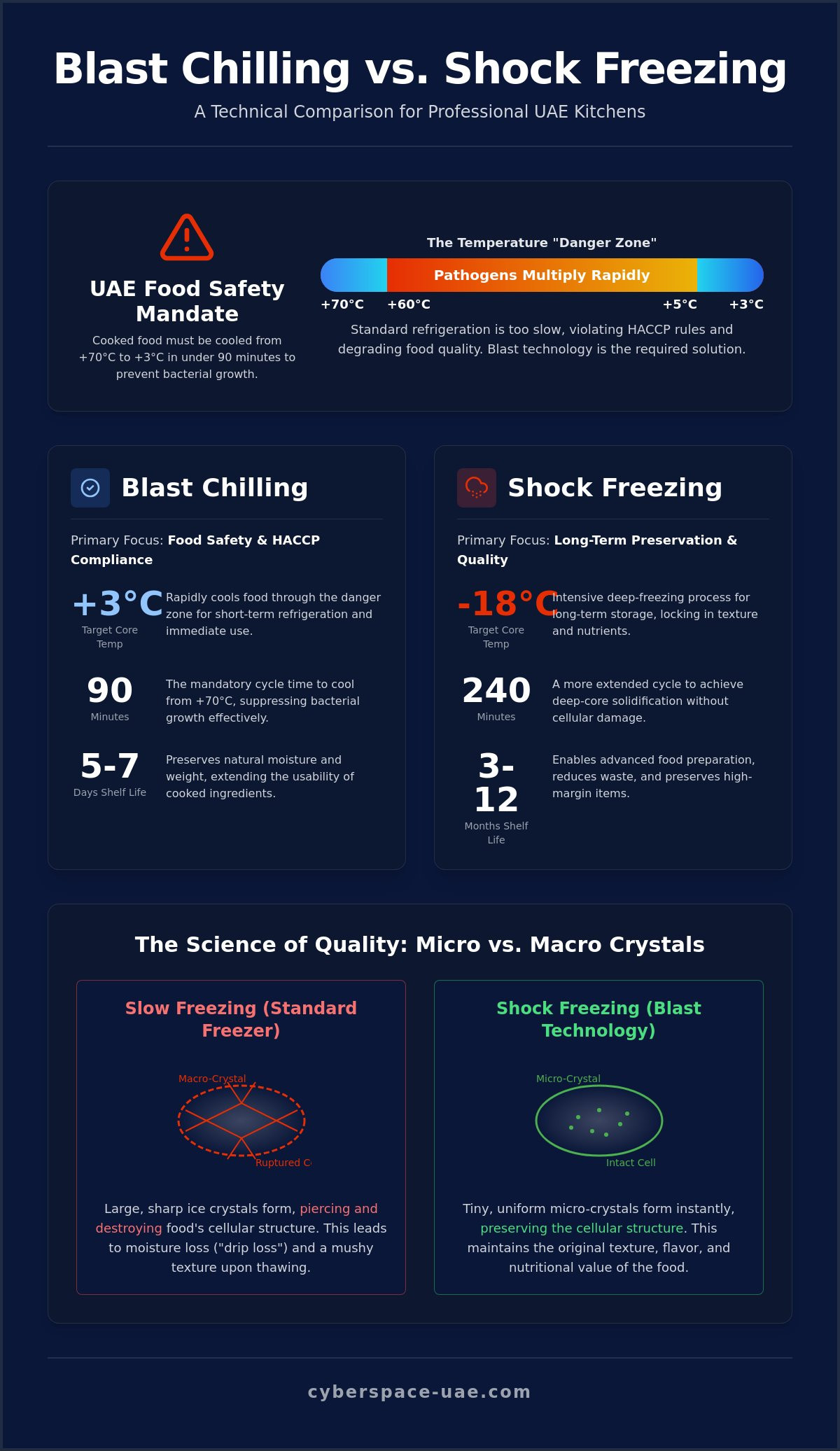
The primary objective of blast chilling is bacterial suppression. Food safety standards, including those enforced by Dubai Municipality, require cooked food to drop from +70°C to +3°C in under 90 minutes. This speed bypasses the "Danger Zone" (5°C to 60°C) where pathogens multiply most rapidly. Beyond safety, rapid chilling preserves the natural moisture and weight of cooked proteins. Slow cooling allows steam to escape, which results in dry, lower-weight products. Blast chilling locks in hydration. It prepares hot components for immediate cold-chain storage or assembly without compromising the temperature of existing stock in your walk-in chiller.
The Purpose of Shock Freezing
Shock freezing is a more intensive process designed for long-term preservation. It accelerates the transition from +70°C to a core temperature of -18°C. The speed of this transition is critical for maintaining food structure. Slow freezing creates large macro-crystals that rupture cellular walls, leading to "drip loss" and mushy textures upon thawing. In contrast, shock freezing creates tiny micro-crystals that leave the food's cellular structure intact. This is particularly vital for delicate pastries and raw dough. While the blast chiller price in UAE for units with shock freezing capabilities may be higher, the ability to preserve the texture of high-margin items like artisanal breads and seafood justifies the technical upgrade. It ensures that products retain their original quality even after months in storage.
Blast Chiller vs Shock Freezer: Technical Comparison Table
Selecting the correct thermal equipment requires a clear understanding of mechanical specifications and performance benchmarks. While many units offer dual-functionality, the internal components must handle significantly different stress loads. Industrial operators evaluating the blast chiller price in UAE should prioritize machines with high-reserve cooling capacities to ensure consistent results in high-ambient temperatures.
| Feature | Blast Chilling | Shock Freezing |
|---|---|---|
| Target Core Temp | +3°C | -18°C |
| Cabinet Air Temp | 0°C to -5°C | -35°C to -40°C |
| Standard Cycle | 90 Minutes | 240 Minutes |
| Shelf Life Impact | 5 to 7 Days | 3 to 12 Months |
| Primary Focus | HACCP Compliance | Structural Integrity |
Temperature and Time Parameters
A standard chilling cycle must bring food from +70°C to +3°C within 90 minutes. This rapid drop is a non-negotiable requirement for HACCP-based safety systems. Shock freezing extends this timeline to 240 minutes to reach a core temperature of -18°C. Standard commercial refrigerators cannot perform these cycles. They lack the evaporator surface area and fan power to remove heat at this velocity. Attempting to use a walk-in chiller for these tasks will raise the ambient temperature of the room, endangering other stored stock. For a reliable cold chain, you can view professional-grade cooling solutions designed for these specific industrial loads.
Mechanical Differences in Equipment
The engineering of a shock freezer is more robust than a dedicated chiller. High-velocity fans must maintain consistent airflow patterns to ensure uniform heat removal across all trays. This prevents "dead spots" where food stays in the danger zone too long. In the UAE, equipment must utilize T3-rated compressors. These are specifically engineered to operate in ambient kitchen temperatures up to 43°C. The science of freezing and food quality dictates that only these high-powered systems can achieve the thermal shock necessary to prevent large ice crystal formation. Insulation is also thicker in shock-capable units, typically using high-density polyurethane to maintain -40°C air temperatures without taxing the motor. When comparing the blast chiller price in UAE, verify the refrigerant type and cooling capacity (BTU/hr) to ensure the unit can handle your peak production volume.
The Science of Micro-Crystals and Food Quality
Thermal management in industrial food production is primarily about controlling the behavior of water molecules. When food freezes slowly in a conventional freezer, water molecules have time to bond into large macro-crystals. These jagged structures pierce the delicate cell membranes of the product. Upon thawing, the damaged cells cannot hold their internal fluids, resulting in significant "drip loss." This fluid leakage carries away essential proteins and salts, leaving the ingredient dry and flavorless. This is a common failure point in kitchens that prioritize a lower initial blast chiller price in UAE over the technical specifications of the evaporator and compressor.
Rapid thermal reduction ensures that water solidifies into millions of tiny micro-crystals. Because these crystals are microscopic and rounded, they remain between the cell walls without causing structural damage. This mechanical preservation is why a high-performance unit is a critical asset. Operators must factor in the direct savings from reduced weight loss and improved ingredient yield when evaluating their equipment investment. Micro-crystals effectively lock in the organoleptic properties of the food, ensuring that taste, color, and aroma remain unchanged after long-term storage.
Preserving Cellular Integrity in Bakery Products
The gluten network in raw or par-baked dough is highly sensitive to thermal shifts. Slow freezing causes starch retrogradation, where water migrates away from the starch granules, making the bread stale before it even reaches the oven. Shock freezing halts this process instantly. It protects the elasticity of the gluten structure and ensures that laminated pastries maintain their crisp, multi-layered texture after regeneration. Maintaining this quality is a primary reason why the blast chiller price in UAE is viewed as a quality-control investment rather than a simple utility cost.
Texture Retention in Gastronomy
In high-end meat and seafood processing, fiber integrity determines the final mouthfeel. Slow freezing turns the firm fibers of a steak or a fish fillet into a mushy, unappealing mass. Micro-crystals prevent flavor leakage by keeping the natural juices locked within the cellular structure. This ensures that the specific taste and smell of the ingredient remain identical to the fresh state. Micro-crystals prevent the leakage of intracellular fluids that carry the primary flavor profile of the ingredient. This level of precision allows central kitchens to prepare high-volume batches without the degradation typical of standard cold storage methods.
Operational Efficiency and HACCP Compliance in the UAE
The 2026 unified national food safety system in the UAE has standardized inspection protocols across all emirates. Manual temperature recording is no longer sufficient for high-risk food sectors. Automated systems are now the baseline for regulatory approval. Industrial kitchens must demonstrate precise control over the cooling curve to maintain their operating licenses. When factoring the blast chiller price in UAE into your capital expenditure, consider the equipment as a primary tool for legal compliance and risk mitigation. These machines provide the data necessary to pass audits by the Dubai Municipality and the Abu Dhabi Agriculture and Food Safety Authority (ADAFSA).
Beyond safety, rapid thermal management transforms kitchen logistics. It allows for a shift from "service-period cooking" to "production-cycle cooking." This change stabilizes labor requirements and reduces the stress of peak hours. You can browse industrial blast chillers designed to integrate into high-volume production schedules.
HACCP Requirements and Temperature Probes
UAE regulations require food to be cooled from 60°C to 3°C within 90 minutes. Verification of this window is mandatory for HACCP-based systems. Modern blast chillers utilize multi-point core probes to monitor the internal temperature of the densest food items. This data is logged automatically. Digital records replace paper logs, which eliminates human error and provides a clear traceability trail for health inspectors. In central kitchens, this level of automation is essential for managing the increased frequency of risk-based inspections under the current national framework.
ROI of Professional Thermal Management
The financial return on a blast chiller extends beyond avoiding fines. Food waste in commercial kitchens often stems from improper cooling that leads to premature spoilage. Extending the shelf life of prepared components from two days to five days significantly reduces ingredient costs. This preservation also allows kitchens to purchase seasonal ingredients in bulk during price troughs. Labor efficiency improves through batch cooking. Staff can prepare complex sauces or proteins during off-peak hours, blast chill them, and regenerate them as needed. This process increases menu variety and total kitchen output without requiring additional headcount. For medium-sized businesses, the savings in food waste alone often offset the initial equipment investment within the first year of operation. Effective thermal management is a prerequisite for scaling industrial food production in the UAE market.
Selecting the Right Industrial Blast Equipment
Determining the correct equipment size requires an analysis of your peak hourly production rather than daily averages. Tray capacity ranges from compact 5-tray counter-top units to massive roll-in tunnels capable of housing multiple trolleys. For facilities utilizing high-output professional baking equipment, the blast chiller must match the rack size of the ovens to eliminate manual tray transfers. This synchronization is critical in cook-chill workflows where speed is the primary variable.
Integrating your cooling units with Rational combi ovens creates a seamless transition from heat to cold. This pairing ensures that food moves directly from the oven to the chiller without environmental exposure. When analyzing the blast chiller price in UAE, operators should also account for electrical load requirements. Industrial-scale machinery often requires three-phase power and dedicated drainage lines to handle the heavy condensation generated during rapid cooling cycles. Failure to plan for these utilities can lead to significant installation delays and cost overruns.
Bakery-Specific Considerations
Industrial bakeries face unique challenges regarding moisture loss. Delicate doughs and pastries are prone to "skinning" if airflow is too aggressive or dry. High-end units offer variable fan speeds and humidity management to protect the surface of the product. Reach-in models are suitable for boutique pastry labs, while high-volume bakeries require roll-in models that accept the same trolleys used in rotary ovens. This modularity reduces labor costs and minimizes the risk of product damage during handling. It's essential to select a unit that offers soft-chilling modes for sensitive items like sponge cakes to prevent surface freezing while the core remains warm.
Technical Support and Brand Selection
Reliability is the most significant factor in the UAE's high-ambient climate. Investing in brand-new equipment is mandatory to ensure the cooling system utilizes T3-rated compressors designed for 43°C environments. Used or refurbished units often fail under these conditions, leading to catastrophic stock loss and HACCP violations. Selecting established brands ensures that spare parts and technical service remain available throughout the machine's lifecycle. Consulting with blast chiller specialists allows for custom configurations tailored to your specific kitchen footprint. A precise match between equipment capacity and production volume is the most effective way to optimize the blast chiller price in UAE and ensure a rapid return on investment.
Optimizing Thermal Infrastructure for Operational Growth
Precision in thermal management is the baseline for industrial food production. Selecting between blast chilling and shock freezing depends entirely on your end-product requirements and storage timelines. Chilling ensures immediate HACCP compliance and moisture retention; shock freezing preserves cellular integrity through micro-crystal formation. Both processes are essential for meeting the unified national food safety standards enforced across the UAE. When assessing the blast chiller price in UAE, prioritize technical specifications like T3-rated compressors and automated data logging to ensure long-term ROI.
As specialists in industrial bakery and kitchen machinery, we provide the tools required for high-performance environments. We are an authorized supplier of Rational Combi Ovens and offer national distribution across the UAE to support your facility's expansion. Our team assists in configuring equipment that integrates directly with your existing production lines to maximize efficiency and eliminate food waste. Proper equipment selection ensures your operation stays ahead of regulatory requirements while maintaining peak ingredient quality.
Maintain your competitive edge through superior food quality and regulatory compliance. Explore our range of industrial blast chillers and shock freezers to upgrade your facility today.
Frequently Asked Questions
Can a standard freezer be used as a shock freezer?
No, standard commercial freezers lack the airflow velocity and refrigeration capacity required for shock freezing. A standard freezer takes between 6 and 12 hours to freeze products, which leads to large ice crystal formation and cellular damage. Shock freezers are engineered to complete this process in under 240 minutes. Using a standard unit for this task will also raise the internal cabinet temperature, potentially compromising the safety of other stored inventory.
How long can food be stored after blast chilling?
Food can typically be stored for 5 to 7 days when maintained at a constant temperature of +3°C or below. This shelf life is only achievable if the core temperature was reduced from +70°C to +3°C within the mandatory 90-minute window. For storage requirements exceeding one week, you must use a shock freezing cycle to bring the product core to -18°C, which can extend usability for several months depending on the ingredient type.
Is blast chilling mandatory for HACCP compliance in the UAE?
Yes, blast chilling is the primary industrial method for meeting UAE rapid cooling mandates. Dubai Municipality and ADAFSA regulations require high-risk cooked foods to drop from 60°C to 3°C in less than 90 minutes. While manual methods like ice baths exist for small volumes, blast chilling is the only verifiable and scalable solution for industrial kitchens. Automated data logging provided by these units is essential for passing official health inspections.
Does shock freezing affect the nutritional value of food?
Shock freezing preserves nutritional value more effectively than any other preservation method. By rapidly lowering the temperature, the equipment halts enzymatic activity and metabolic decay almost instantly. Because the process creates micro-crystals instead of large macro-crystals, the cellular structure remains intact. This prevents the loss of water-soluble vitamins and minerals that usually occur through "drip loss" when food is thawed after being frozen in a conventional freezer.
What is the difference between a blast chiller and a retarder prover?
These machines serve opposite thermal functions in a bakery workflow. A blast chiller is designed to remove heat as quickly as possible to stop biological processes or prepare food for storage. A retarder prover uses refrigeration to slow down yeast fermentation (retarding) and then introduces controlled heat and humidity to wake the yeast and expand the dough (proofing). While both utilize refrigeration, their airflow patterns and humidity controls are technically distinct.
Can I put hot food directly into a blast chiller?
Yes, industrial blast chillers are specifically engineered to accept food at temperatures of +70°C or higher. This is the core purpose of the equipment. High-capacity evaporators and T3-rated compressors are designed to handle these sudden "shock loads" without failing. This specialized engineering is a primary driver of the blast chiller price in UAE. Putting hot food into a standard refrigerator would cause the compressor to fail and endanger the entire cold chain.
What are the power requirements for an industrial shock freezer?
Most industrial-scale shock freezers require a three-phase (400V) electrical connection to power their high-velocity fans and heavy-duty compressors. While smaller 3-tray or 5-tray units may operate on a standard single-phase 230V supply, larger roll-in models demand significant amperage. When evaluating the blast chiller price in UAE, you must also factor in the cost of providing dedicated industrial power lines and appropriate circuit breakers to handle these high-performance machines.
How do I clean and maintain a commercial blast chiller?
Daily sanitation of the Grade 304 stainless steel interior with food-safe, non-abrasive cleaners is mandatory. You must also clean the condenser coils at least once a month to remove dust and grease, which is critical in the UAE's dusty environment. Check door gaskets for cracks or leaks weekly to ensure thermal integrity. Regular maintenance of the defrost system and temperature probes ensures the unit continues to meet HACCP logging requirements without mechanical failure.