
Calibrating a Dough Sheeter: A Professional Industrial Guide
Selecting a thickness setting on a control dial isn't the same as calibrating a dough sheeter. Mechanical drift is a physical reality in high-volume production environments. It results in uneven pastry thickness and frequent product tearing. You're likely experiencing inconsistent bakes because your rollers aren't perfectly parallel.
Ensuring uniform thickness across the entire belt width requires a technical alignment protocol. This guide provides the steps to synchronize industrial rollers for perfect lamination consistency. You'll learn to standardize production settings and reduce ingredient waste. The focus is on mechanical precision rather than simple dial adjustments.
The following sections outline specific synchronization checks and 2026 compliance factors. We'll address the July 1 FDA material safety requirements and protocols to avoid OSHA lockout-tagout fines that exceed $15,000 per incident. This is the professional framework for standardizing your equipment performance.
Key Takeaways
- Identify essential pre-calibration inspection protocols including drive chain tension and scraper blade hygiene. Ensure mechanical readiness before alignment.
- Master the technical sequence for calibrating a dough sheeter using digital calipers and feeler gauges to zero thickness gauges.
- Standardize millimeter settings for high-volume lamination to maintain output uniformity across varying dough temperatures.
- Establish a preventative maintenance schedule to distinguish between routine recalibration and necessary roller replacement.
- Implement synchronization protocols to eliminate product tearing and minimize ingredient waste in industrial production lines.
Understanding Industrial Dough Sheeter Calibration Requirements
Mechanical calibration in industrial dough processing refers to the precise alignment of the upper and lower rollers. This ensures they remain perfectly parallel across their entire length. The process is distinct from standard operational adjustments made during a shift. While a baker changes the dial for different products, calibrating a dough sheeter involves verifying that the physical distance between rollers matches the digital or analog readout. Precise alignment is the technical foundation for Understanding Laminated Dough and its production requirements. Without this synchronization, the internal structure of puff pastry or croissants fails to develop uniform layers.
Defining Calibration in a Commercial Context
Operational thickness adjustment is a routine task. Mechanical zeroing is a maintenance protocol. Zeroing ensures that when the dial indicates 0mm, the rollers are actually in contact or at the manufacturer's specified baseline. Parallelism is critical. If one side of the roller is 0.5mm lower than the other, the dough will "tail" or skew toward the tighter side. This creates curved sheets that are difficult to stack or cut. Industry standards for professional baking typically require a thickness tolerance within 1% of the target setting. High-precision equipment maintains this through rigid chassis design and calibrated tensioning systems.
Consequences of Poor Mechanical Alignment
Inconsistent thickness leads to uneven heat penetration during the bake cycle. Thinner sections of a pastry sheet may overbake or burn while thicker sections remain raw. This variability forces production teams to reject batches, which increases ingredient waste and labor costs. Beyond product quality, poor alignment places uneven stress on the machinery. Mechanical strain on motors, drive chains, and belts increases when rollers are misaligned. This leads to premature component failure and unexpected downtime in high-volume facilities.
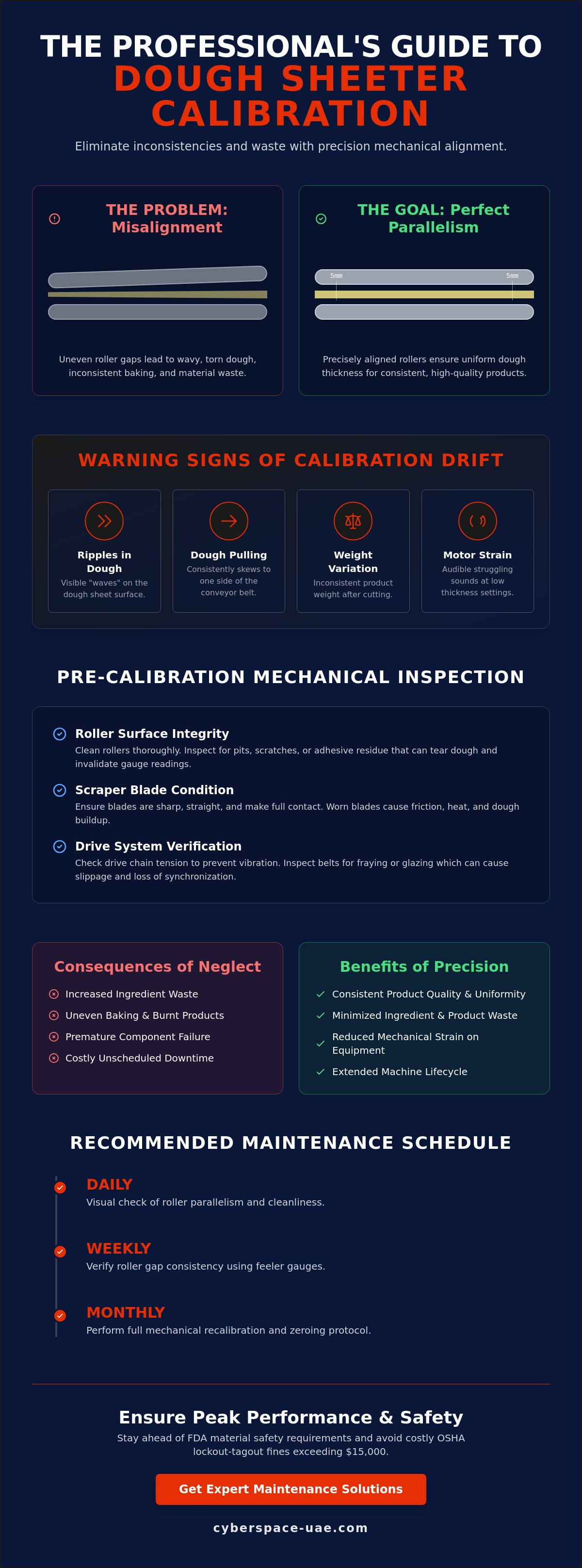
Identifying calibration drift requires monitoring the output. Common indicators include:
- Visible "waves" or ripples in the dough sheet surface.
- Dough consistently pulling to one side of the conveyor belt.
- Variations in final product weight after cutting.
- Audible strain from the motor at low thickness settings.
Professional bakery environments should follow a tiered frequency protocol. Visual checks of roller parallelism should occur daily. Weekly verification using feeler gauges ensures the gap remains consistent across the roller width. Full mechanical recalibration is recommended monthly or after any significant jam. Maintaining this schedule ensures that calibrating a dough sheeter remains a proactive maintenance step rather than a reactive fix for failed batches. This systematic approach preserves the equipment lifecycle and ensures standardized production quality.
Pre-Calibration Mechanical Inspection Protocols
Mechanical calibration is ineffective if the hardware is compromised by debris or component wear. Before calibrating a dough sheeter, technicians must perform a comprehensive mechanical audit. Residual flour or grease on roller surfaces introduces measurement errors. Even a 0.2mm layer of dried dough invalidates precision gauge readings. High-volume industrial environments accelerate component degradation. Scraper blades, drive chains, and thickness levers require verification before any alignment begins.
Roller Surface and Scraper Blade Integrity
Inspect rollers for pits, scratches, or adhesive residue. Surface imperfections cause dough tearing and uneven lamination. Use non-abrasive plastic scrapers and food-grade solvents for cleaning. Avoid metal tools that score the stainless steel or chrome-plated finish. Scraper blades must be sharp and straight. Worn or warped blades fail to clear the roller surface, which causes friction and heat. This localized heat alters dough elasticity during the sheeting process, leading to inconsistent results regardless of dial settings. Replace blades that show visible gaps when pressed against the roller.
Drive System Verification
Industrial machines rely on synchronized belt and chain systems. Check drive chain tension. Loose chains cause vibration, resulting in rippled dough sheets. Inspect belts for fraying or glazing. Glazed belts slip under the heavy load of cold, high-fat doughs, causing the rollers to lose synchronization. Verify gear alignment in electric models to ensure torque is distributed evenly across both rollers. Lubricate all specified points with food-grade grease. Proper lubrication reduces mechanical resistance. This allows for smoother roller movement and more accurate thickness adjustments during the calibration phase.
Verify the thickness adjustment lever for mechanical play. Drift often originates in a loose locking mechanism or a worn cam. If the lever doesn't hold its position under the pressure of the dough, calibration won't survive a production run. Replace worn bushings or tension springs to restore factory-spec rigidity. Facilities seeking peak operational efficiency often upgrade to high-performance dough sheeters designed for continuous industrial use. Ensure all safety guards are functional and that the emergency stop is accessible before proceeding to the technical alignment steps.
Step-by-Step Procedure for Calibrating a Dough Sheeter
The technical process of calibrating a dough sheeter requires precision tools and a methodical approach. You'll need digital calipers, a set of feeler gauges ranging from 0.05mm to 1.00mm, and a standardized sample of production dough. These tools allow for objective measurement rather than visual estimation. Calibration ensures that the physical gap between the rollers matches the numerical value on the equipment interface. This alignment is critical for maintaining the tight tolerances required in industrial pastry production.
Zeroing the Thickness Gauge
Establish a baseline by closing the rollers to their minimum setting. Don't allow the rollers to make physical contact, as metal-to-metal friction damages the surface finish and puts unnecessary strain on the motor. Reset the digital display or manual dial to the zero mark once the minimum safe gap is reached. In older mechanical models, identify the "dead zone" in the adjustment lever. This is the range where the handle moves without engaging the roller assembly. You must eliminate this slack to ensure that every dial movement results in a corresponding change in roller height.
Verifying Parallelism Across the Rollers
A zeroed dial doesn't guarantee a uniform gap across the entire belt width. Use feeler gauges to measure the space at the left, center, and right sections of the rollers. Identify "coning," a condition where the gap is wider on one side than the other. Even sub-millimeter variances cause dough to skew or "tail" as it passes through. Adjust the internal tie-rods or eccentric bushings to bring the rollers into perfect alignment. This mechanical synchronization is the primary goal when calibrating a dough sheeter for high-volume lamination. Repeat the measurements until the gap is identical at all three points.
Synchronizing the Dial with Real-World Output
Theoretical gap measurements often differ from the final dough thickness due to material physics. Sheet a test piece of dough through the rollers at a fixed setting, such as 5.0mm. Measure the resulting sheet with digital calipers immediately after it exits the machine. You must account for dough spring-back. High-protein doughs or those with high yeast activity often expand slightly once the compression force is removed. This elasticity varies based on dough temperature and hydration levels. Document the calibration offset for your production team. For example, if a 5.0mm setting produces a 5.2mm sheet, the offset is +0.2mm. Standardizing this data helps staff achieve consistent results regardless of the specific machine they're operating.
Finalize the procedure by running three consecutive test sheets. Each sheet should display a thickness variance of less than 1% across its surface. If the variance exceeds this threshold, re-check the drive chain tension and roller bearings for excessive play. Consistent output is the only valid confirmation of a successful calibration protocol.
Optimizing Thickness for High-Volume Lamination
Industrial lamination efficiency depends on a rigid reduction sequence. Random thickness adjustments cause layer compression and fat leakage. Maintaining the correct fat-to-dough ratio requires uniform sheeting at every stage. For specific pass-by-pass millimeter targets, refer to the commercial dough sheeter for puff pastry guide. This technical documentation ensures all operators follow identical protocols. Standardizing these settings is the only way to achieve predictable product height and flake density in a commercial bakery.
Standardizing Millimeter Settings for Puff Pastry
Initial breakdown passes should focus on gradual reduction. Forcing a thick dough block through a narrow gap damages the gluten structure. It also causes the fat layers to shatter rather than stretch. Set your baseline for the first pass and reduce the gap by no more than 20% to 30% per pass. This preserves the integrity of the lamination. Calibrating a dough sheeter specifically for these multi-stage passes prevents the "tailing" effect discussed in previous sections. Consistency here ensures that every croissant or pastry sheet has the same weight and dimensions before it enters the oven.
Environmental Adjustments for UAE Kitchens
Environmental factors in the UAE significantly impact dough behavior. High ambient temperatures increase dough relaxation and stickiness. This makes calibrating a dough sheeter more complex because metal rollers undergo thermal expansion during continuous use. A gap calibrated on a cold machine may tighten by 0.1mm to 0.2mm as the rollers reach operating temperature. Perform a secondary verification check after 30 minutes of production. Use industrial provers to stabilize dough temperature before the final sheeting pass. This prevents elasticity shifts that lead to product shrinkage after cutting.
Roller deflection is another critical factor in high-volume lamination. When processing stiff, chilled dough blocks, mechanical resistance can cause rollers to bow slightly. This creates a sheet that's thicker in the center than at the edges. Standardize your reduction steps to avoid overloading the roller assembly. Gradual reduction is more effective than aggressive thickness drops. Ensure operators understand that calibration includes monitoring for this deflection during peak load periods. Humidity also increases dough tackiness, requiring more frequent cleaning of the scraper blades to prevent buildup.
Transitioning between dough types requires specific calibration offsets. Stiff doughs exert higher pressure on the roller assembly, while soft, yeasted doughs are more prone to tearing. Document the required dial settings and belt speeds for each category. Use digital readouts to maintain shift-to-shift consistency. This eliminates the "feel" factor where different operators produce variable results. For reliable performance in high-volume facilities, invest in industrial dough sheeters with reinforced roller housings and digital precision controls to minimize mechanical drift.
Professional Maintenance and Equipment Lifecycle Management
Preventative maintenance is a commercial necessity. It protects the accuracy achieved during calibrating a dough sheeter and extends the operational life of the machinery. High-volume facilities should implement a tiered maintenance schedule. Daily tasks include cleaning rollers and checking scraper blades. Weekly protocols focus on drive chain tensioning and lubrication of pivot points. Monthly audits must include full mechanical verification using the calibration steps outlined previously. Neglecting these intervals leads to mechanical drift and increased ingredient waste.
Staff training is the first line of defense against calibration loss. Operators must avoid aggressive thickness drops that strain the roller assembly. Improper handling, such as using metal tools for cleaning or slamming the adjustment lever, causes immediate misalignment. Standardize handling procedures to ensure the equipment remains within factory tolerances between scheduled service intervals. This discipline reduces the frequency of calibrating a dough sheeter and prevents unexpected downtime during peak production hours.
When to Seek Industrial Technical Support
Calibration has limits. Structural warping or frame misalignment can't be corrected through standard adjustment screws. Bearing failure is a common cause of roller instability. If the rollers show vertical or horizontal play when the machine is locked, internal components require replacement. These issues often stem from years of processing stiff doughs at high speeds. For complex repairs or new facility setups, consult professional baking equipment Dubai specialists. They ensure that all equipment meets the May 2026 FDA material safety requirements and 21 CFR compliance standards. Professional intervention is also required if OSHA lockout-tagout procedures are necessary for internal drive repairs to avoid fines exceeding $15,000 per incident.
Upgrading to High-Precision Industrial Sheeters
Aging machinery often lacks the rigidity required for modern lamination standards. Modern industrial dough sheeters feature digital thickness controls that eliminate the "dead zone" found in manual levers. These systems offer automated calibration protocols that reduce operator error. Evaluating the ROI on a new unit should include labor savings from reduced manual adjustments and lower rejection rates. Modern units also simplify compliance with the July 2026 EU BPA and PFAS restrictions regarding food-contact surfaces. Contact Cyberspace Kitchen & Bakery Equipment for technical specifications on high-performance sheeters designed for the UAE's industrial baking sector. Precision hardware is a prerequisite for consistent, high-volume production and long-term operational excellence.
Standardizing Your Industrial Production Quality
Industrial precision is a prerequisite for high-volume lamination. Moving beyond simple dial adjustments to a technical protocol for calibrating a dough sheeter ensures that every batch meets specific thickness tolerances. By integrating mechanical zeroing and environmental adjustments for the UAE climate, production facilities eliminate product skewing and uneven bakes. These protocols standardize output across multiple shifts and reduce ingredient loss significantly.
Reliable production requires high-performance hardware. Cyberspace Kitchen & Bakery Equipment is an authorized supplier of premium industrial baking machinery, specializing in high-capacity dough processing solutions. We provide national UAE delivery and professional technical support for all industrial equipment. View our range of industrial dough sheeters to secure the precision your facility demands. Operational excellence starts with calibrated accuracy.
Frequently Asked Questions
How often should a commercial dough sheeter be calibrated?
Perform a full mechanical recalibration monthly or immediately following a dough jam. Daily visual inspections of roller parallelism are necessary for high-volume production lines. Weekly verification using feeler gauges ensures the gap remains consistent across the entire belt width. Maintaining this schedule prevents mechanical drift and ensures standardized product thickness.
Why is my dough sheeter producing sheets that are thicker on one side?
Uneven thickness indicates a lack of parallelism between the rollers. This "coning" effect occurs when internal tie-rods or eccentric bushings lose synchronization. Dough consistently pulling or skewing toward the tighter side is a primary indicator of this mechanical imbalance. It requires immediate adjustment of the synchronization screws to restore a uniform gap.
Can I calibrate my dough sheeter without specialized tools?
Industrial precision requires digital calipers and feeler gauges. While visual estimation is possible for basic tasks, calibrating a dough sheeter for professional lamination requires sub-millimeter accuracy. Objective measurements ensure the physical roller gap matches the dial readout across the left, center, and right sections. Specialized tools eliminate the "feel" factor and reduce ingredient waste.
Does the type of flour used affect the calibration of the machine?
Flour type does not change the physical alignment of the rollers. However, high-protein flours increase dough elasticity and "spring-back" after the sheeting pass. Technicians must document a specific operational offset for different dough types. This accounts for how the material expands once the compression force is removed, ensuring the final product meets specifications.
What is the most common cause of calibration drift in industrial sheeters?
Mechanical vibration and component wear are the primary causes of drift. Loose locking mechanisms, worn cams, or slack in the drive chain allow rollers to shift during high-pressure passes. Processing stiff, chilled dough blocks accelerates this wear. Regular maintenance of the thickness adjustment lever and drive system prevents the loss of precision over time.
How do I know if my rollers are no longer parallel?
Monitor for dough "tailing" or curving as it exits the rollers. Use feeler gauges to measure the gap at the left, center, and right sections of the roller assembly while the machine is off. Any variance exceeding 1% of the target thickness confirms that the rollers are no longer parallel. Visible ripples in the dough surface also suggest alignment issues.
Should I calibrate the machine while it is cold or after it has warmed up?
Verify calibration after the machine has reached operating temperature. Metal rollers undergo thermal expansion during continuous use, which can tighten the gap by 0.1mm to 0.2mm. Checking the alignment while the rollers are at production heat ensures accuracy during actual lamination runs. This is especially critical in high-ambient-temperature environments like those found in the UAE.
What is the difference between a manual and an automatic dough sheeter calibration?
Manual calibration involves physical adjustment of tie-rods and mechanical bushings. Automatic systems utilize digital thickness controls and sensors to zero the machine electronically. Calibrating a dough sheeter with automated features reduces operator error and provides higher repeatability. Digital systems allow for stored programs, which ensures consistent results across multiple shifts and different operators.