
Commercial Kitchen Ovens Dubai: Industrial Procurement Guide 2026
In high-volume food production, an industrial oven is a critical failure point that determines your total operational margin. Sourcing the right commercial kitchen ovens available in the UAE requires a technical understanding of thermal efficiency and mechanical durability. Most operators agree that inconsistent heat distribution and frequent equipment downtime during peak production cycles are the fastest ways to erode profitability in the UAE's competitive F&B sector.
This guide provides a technical analysis of industrial-grade ovens and bakery machinery engineered for the specific demands of the 2026 market. You'll learn how to achieve 100% product consistency at scale while reducing utility costs through high-efficiency thermal insulation. We examine the performance specifications of Deck Ovens, Rotary Ovens, and Rational Combi systems to ensure your procurement strategy aligns with national food safety standards. We preview the essential machinery configurations and technical support structures necessary to maintain a high-output industrial kitchen without the risk of expensive mechanical failure.
Key Takeaways
- Understand the engineering requirements for 18-24 hour operational cycles, focusing on Grade 304 and 316 stainless steel for industrial durability.
- Compare Deck Ovens and Rotary Rack systems to identify the most efficient commercial kitchen ovens Dubai provides for your specific production volume.
- Evaluate the performance gap between Spiral and Planetary mixers to optimize dough processing for high-capacity industrial bakeries.
- Integrate Rational Combi technology and Blast Chillers to maintain HACCP compliance and enhance thermal management across all food service cycles.
- Analyze Total Cost of Ownership (TCO) to ensure machinery procurement delivers maximum ROI through reduced energy overheads and minimized waste.
Heavy Duty Kitchen Equipment Standards for UAE Industrial Operations
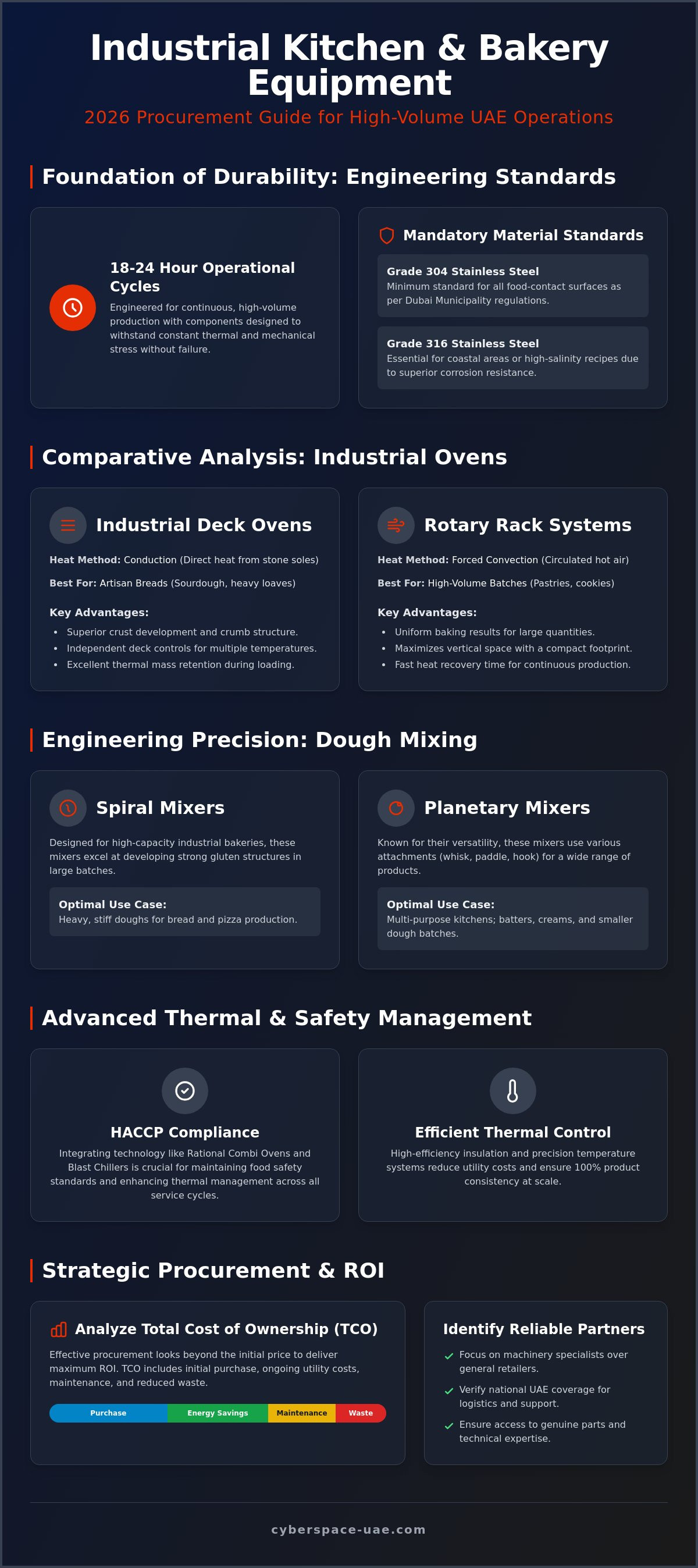
Industrial success depends on machinery endurance. For high-volume facilities, "heavy-duty" describes equipment capable of 18-24 hour continuous operational cycles. These units feature high-cycle components designed to withstand thermal expansion and mechanical stress without failure. Standard commercial kitchen ovens Dubai retailers often stock are often insufficient for industrial-scale production. True industrial machinery prioritizes component longevity over retail price points. This distinction is critical for operators managing centralized kitchens or large-scale bakery plants.
Material selection is non-negotiable. Dubai Municipality standards for food-contact surfaces mandate a minimum of Grade 304 stainless steel. For facilities in coastal areas or those using high-salinity recipes, Grade 316 provides essential corrosion resistance. High-grade steel ensures structural integrity under constant heat cycles. Brand-new equipment is mandatory for maintaining these performance standards. Used machinery often carries hidden fatigue in heating elements or structural welds, risking compliance with UAE food safety protocols and increasing the likelihood of peak-hour downtime.
Criteria for Industrial-Grade Machinery
Technical evaluation of Industrial oven technology requires specific engineering benchmarks. Thermal insulation must be thick enough to maintain external surfaces at safe temperatures while preserving internal heat. This directly impacts energy overheads. Door seals must be rated for thousands of high-heat cycles without losing elasticity. For dough processing, motor torque and gearbox builds are critical. An undersized motor will fail under the resistance of heavy, stiff doughs. Energy efficiency ratings serve as a primary procurement metric, as inefficient commercial kitchen ovens Dubai operations run can significantly increase monthly utility costs.
Identifying Reliable Industrial Partners
Procurement should focus on machinery specialists rather than general kitchenware retailers. Specialists understand the technical nuances of professional baking equipment Dubai facilities require for scale. Reviewing supplier portfolios for high-performance brands like Rational ensures access to genuine parts and technical expertise. National UAE coverage is essential for logistics. A partner with a local presence provides the technical support necessary to minimize downtime during peak production. Specialized partners act as facilitators for operational excellence, ensuring that the machinery matches the specific throughput requirements of the facility.
Comparative Analysis: Industrial Deck Ovens vs. Rotary Rack Systems
Selecting the correct heating method determines both final product quality and operational throughput. In the market for commercial kitchen ovens Dubai, the choice usually falls between Deck Ovens and Rotary Rack Systems. These categories serve distinct culinary purposes based on heat transfer physics. Deck ovens utilize conduction, where heat transfers directly from stone soles to the dough. This is essential for artisan bread requiring specific crust development. Rotary systems use forced convection, circulating hot air around a rotating rack to ensure uniform results for pastries and high-volume batches.
Space utilization is a primary procurement factor. Rotary ovens maximize vertical space, providing high tray capacity within a compact footprint. Modular deck ovens require more horizontal floor area but offer the flexibility of independent baking chambers. Heat recovery time is equally critical. Industrial machinery must return to the set temperature immediately after door closure to maintain production momentum. While rotary ovens recover quickly due to powerful heat exchangers, deck ovens excel in thermal mass retention, preventing temperature drops during loading cycles.
Precision Baking with Industrial Deck Ovens
Industrial deck ovens offer unmatched precision for crust-heavy products. Stone deck soles provide the thermal inertia needed for superior crust development and internal crumb structure in sourdough and heavy loaves. Independent deck control allows operators to manage multiple temperature zones simultaneously. One deck can bake at 240°C while another handles delicate items at 180°C. This modularity is vital for facilities with diverse product lines. For technical specifications on these units, consult specialized baking deck oven suppliers.
High-Volume Efficiency with Rotary Systems
Rotary rack ovens prioritize labor efficiency and output volume. Rack-loading mechanics streamline the production flow, allowing staff to load dozens of trays in a single movement. Consistent airflow technology eliminates the need for manual tray rotation, ensuring every unit on the rack receives identical heat exposure. This is the standard for industrial pastry and biscuit production in the UAE. Integrating an industrial rotary baking oven into a production line maximizes throughput while minimizing human error. Current restaurant industry technology trends indicate that automated rack systems significantly reduce labor costs per unit produced.
Before finalizing your machinery selection, review high-performance oven technical specs to ensure the equipment meets your specific volume requirements.
Engineering Precision in Dough Processing and Mixing Machinery
Industrial dough preparation is the technical precursor to baking. Even the most advanced commercial kitchen ovens Dubai facilities operate cannot compensate for poorly developed gluten structures or inconsistent lamination. Engineering precision in mixing and sheeting ensures that the raw product entering the oven meets the strict requirements for high-volume uniformity. High-torque industrial motors are the foundation of this reliability. These motors must maintain consistent RPM under the high resistance of stiff doughs to prevent overheating and mechanical fatigue.
Selecting Industrial Mixing Technology
Spiral mixers are the standard for heavy, stiff doughs and large-scale bread production. The technical advantage lies in the mixing mechanic; the spiral hook remains stationary while the bowl rotates. This process minimizes friction heat during intensive dough development, preserving yeast integrity. Planetary mixers provide multi-functional versatility for pastry, creams, and culinary applications. They utilize a central shaft that rotates around the bowl, accommodating various attachments for diverse production needs.
Gearbox durability is a critical procurement factor. Gear-driven systems provide direct power transmission, making them superior for heavy-duty industrial cycles compared to belt-driven models. Operators should evaluate bowl capacity based on peak production hours. Industrial batches typically range from 60 to 200 liters. All contact surfaces must adhere to the Grade 304 stainless steel requirement established in previous sections to ensure long-term durability and food safety.
Precision Lamination and Sheeting
Dough sheeters are essential for achieving consistent lamination in puff pastry and croissant production. These machines use adjustable rollers to produce uniform thickness across hundreds of units. This precision directly impacts the final bake quality in high-volume settings. Tabletop models are suitable for limited spaces, but floor-standing units offer the belt length required for industrial throughput. Precision rollers prevent the dough from tearing, maintaining the integrity of the fat layers necessary for proper pastry expansion.
Sanitation remains a priority for high-cycle processing. Industrial sheeters feature quick-release components for efficient cleaning. Design specifications must include scrapers and belts made from non-porous, food-grade materials. This prevents ingredient buildup and ensures compliance with Dubai Municipality safety protocols. Reliability in dough processing reduces waste and ensures that the investment in high-performance ovens yields the expected product quality. Efficient dough preparation is the first step in maintaining a streamlined industrial kitchen workflow.
Advanced Thermal Management: Combi Ovens and Blast Chilling Technology
Modern thermal management extends beyond simple heat application. It requires the precise integration of moisture control and high-velocity convection to maximize yield. For facilities seeking the most versatile commercial kitchen ovens Dubai offers, the Rational iCombi Pro remains the industry benchmark. This technology replaces multiple traditional appliances by combining steam and dry heat. It allows for high-precision roasting, steaming, and baking within a single footprint. Intelligent cooking programs ensure flavor consistency across multiple shifts, regardless of the operator's skill level. This precision reduces food waste by preventing overcooking and ensuring uniform results across every tray.
High-end thermal management directly improves kitchen throughput. By automating climate adjustments, these systems reduce the need for manual monitoring. This allows staff to focus on preparation and assembly rather than technical oven adjustments. In the UAE's high-volume food service sector, the ability to produce consistent results under heavy load is a primary driver of ROI. Integrating intelligent systems minimizes human error and ensures that every batch meets the facility's quality standards.
Rational iCombi Pro Technology
Automated climate control optimizes moisture and temperature for every tray. The iCombi Pro system senses the load size and product condition, adjusting parameters in real-time to maintain the desired finish. Matching 10-tray or 20-tray models to industrial service demands is critical for maintaining production momentum. These units are engineered for 2026 operational standards, providing the connectivity and data logging required for modern kitchen management. Detailed technical data is available for the Rational combi oven for bakery to assist in precise equipment selection.
Industrial Blast Chilling and Proving
Rapid temperature reduction is essential for infrastructure safety. Dubai Municipality mandates that chilled perishable foods must be held at a maximum of 5°C. Blast chillers facilitate this by moving products through the danger zone quickly, meeting strict HACCP requirements. This process also extends shelf life by preserving the cellular structure of the food. Provers and retarder-provers manage fermentation cycles, ensuring bakery output remains consistent regardless of ambient kitchen temperatures. Review the technical specs for a commercial blast chiller Dubai to ensure your facility meets national food safety regulations.
Acquire brand-new Rational iCombi Pro systems and industrial blast chillers to optimize your facility's thermal management and production efficiency.
Strategic Procurement: Optimizing ROI for UAE Commercial Kitchens
Procurement success in the UAE food service sector is measured by Total Cost of Ownership (TCO) rather than initial capital expenditure. For high-capacity facilities, the purchase price of commercial kitchen ovens Dubai suppliers offer represents only a fraction of the long-term operational cost. A technical TCO calculation must include projected energy consumption, preventative maintenance schedules, and labor efficiency gains. Industrial-grade machinery pays for itself by minimizing product waste and reducing the frequency of component replacements. Partnering with a specialized industrial supplier ensures that equipment configurations match specific production volumes, preventing the inefficiencies of under-powered or over-sized systems.
Developing a phased procurement plan allows growing operations to scale without compromising on equipment quality. Start with core high-torque mixing and high-efficiency baking units. As throughput increases, integrate automated sheeting and advanced thermal management systems like Rational iCombi Pro models. This modular approach preserves cash flow while ensuring that every piece of machinery meets the 18-24 hour operational cycles defined in earlier sections. Reliable industrial machinery provides a predictable ROI by maintaining 100% product consistency, which is essential for brand reputation in the competitive Dubai market.
Long-Term Value vs. Initial Capital Expenditure
High-efficiency thermal insulation and intelligent climate control are primary drivers of long-term value. Modern industrial ovens utilize advanced materials to retain heat, directly impacting monthly utility overheads in the UAE. While standard commercial units may have a lower entry price, their shorter lifespan and higher energy requirements often result in a higher TCO within the first 36 months of operation. Industrial-grade builds feature reinforced chassis and heavy-duty heating elements designed for longevity. Technical support availability is equally critical. Access to national UAE-wide service and genuine parts mitigates the extreme cost of equipment downtime during peak production shifts.
Final Checklist for Industrial Procurement
Before finalizing a machinery order, technical facility requirements must be verified. Most high-capacity ovens and large-scale mixers require a three-phase power supply (380-415V, 50Hz). Inadequate electrical infrastructure will lead to motor failure or inconsistent heating. Ventilation and extraction systems must be rated to handle the heavy-duty thermal loads generated by continuous baking cycles. Ensure the facility layout accommodates the airflow requirements for both ovens and blast chillers to maintain operational safety. For specialized industrial quotes and technical consultations, contact Cyberspace Kitchen & Bakery Equipment to secure brand-new, high-performance machinery tailored to your facility's specific throughput requirements.
Securing High-Performance Kitchen Infrastructure
Successful industrial operations require a transition from standard appliances to high-cycle machinery built for 18-24 hour production. Prioritizing Grade 304 stainless steel and high-torque motors ensures long-term reliability in the UAE's demanding climate. Selecting the correct commercial kitchen ovens Dubai provides is a strategic decision that impacts both product consistency and total cost of ownership. Integrating Rational iCombi Pro technology and precision dough processing tools allows facilities to achieve significant energy savings while maintaining 100% product uniformity. Specialist facilitators ensure every component, from spiral mixers to blast chillers, meets the technical requirements of high-capacity bakery lines.
Cyberspace Kitchen & Bakery Equipment provides 100% brand-new industrial machinery backed by national UAE technical expertise. We specialize in Rational iCombi Pro technology and offer expert support for high-capacity bakery lines. Secure your facility's operational future with precision-engineered tools designed for the 2026 market. Request a Technical Quote for Industrial Kitchen Equipment to optimize your production throughput today. Your investment in technical precision is the foundation of long-term commercial success.
Frequently Asked Questions
What is the difference between a standard commercial oven and an industrial deck oven?
An industrial deck oven features reinforced construction and superior thermal mass compared to standard commercial models. These units use high-grade stone soles to facilitate conduction heating for artisan bread. While standard ovens are designed for intermittent use, industrial versions support 18-24 hour operational cycles. This durability is essential when sourcing commercial kitchen ovens Dubai facilities use for high-volume production. Thicker insulation and Grade 304 stainless steel builds ensure these ovens maintain heat during continuous loading.
How do I choose between a spiral mixer and a planetary mixer for my bakery?
Choose a spiral mixer for heavy, stiff doughs used in large-scale bread production. The rotating bowl and stationary hook minimize friction heat, which is critical for yeast health. Select a planetary mixer for tasks requiring versatility, such as whipping creams or mixing cake batters. Planetary models use various attachments like whisks and paddles, making them the preferred choice for pastry kitchens with varied menu requirements. Consider your primary product volume before selecting the motor torque specifications.
Why are Rational combi ovens considered the industry standard for professional kitchens?
Rational systems are the industry standard due to their iCombi Pro technology and automated climate control. These ovens integrate steam and convection to provide precise thermal management for every tray. They replace multiple traditional appliances, saving floor space in expensive Dubai real estate. Intelligent cooking programs ensure that flavor profiles remain identical across different shifts, which is vital for maintaining brand standards in high-capacity industrial kitchens. The system automatically adjusts parameters based on the load size.
What are the HACCP requirements for blast chillers in the UAE food service sector?
Blast chillers must reduce food core temperatures rapidly to meet national safety standards. Dubai Municipality mandates that chilled perishable foods stay at a maximum of 5°C. A blast chiller prevents bacterial growth by moving food through the 60°C to 5°C range within strict time limits. Larger catering and central kitchen operations require these units to maintain HACCP certification. Proper temperature logging is essential for regulatory audits across all seven emirates to ensure food safety compliance.
Is it better to buy new or refurbished heavy-duty kitchen equipment?
Procurement of brand-new machinery is the only way to ensure industrial-grade longevity. Refurbished equipment often carries hidden mechanical fatigue in heating elements and structural welds. New units provide the latest energy-efficient technology and full manufacturer warranties. In the UAE market, brand-new commercial kitchen ovens Dubai specialists supply are essential for maintaining the 100% product consistency required for high-volume food service operations. New equipment also ensures access to the latest national technical support and genuine parts.
What electrical specifications are required for industrial rotary ovens in the UAE?
Heavy-duty rotary ovens in the UAE typically require a three-phase electrical connection (380 to 415V, 50Hz). This power configuration is necessary to drive the high-velocity convection fans and the internal rack rotation mechanism. Standard single-phase connections are insufficient for the thermal loads required in industrial baking. Facility managers must verify that the kitchen's electrical infrastructure supports these specifications before procurement to prevent motor failure or circuit overloads. Proper grounding and dedicated breakers are mandatory for these high-capacity units.
How does a dough sheeter improve the efficiency of a pastry kitchen?
A dough sheeter replaces manual rolling with adjustable precision rollers to achieve uniform lamination. This is essential for high-quality croissants and puff pastries where consistent fat-to-dough layering is required. By producing identical thickness across every batch, sheeters reduce ingredient waste and significantly increase production speed. This efficiency allows pastry kitchens to scale their output without increasing labor costs or compromising on the technical finish of the final product. It ensures the dough remains at a consistent temperature during processing.
Can I use a deck oven for products other than bread, such as pizza or pastries?
Deck ovens are multi-functional tools beyond bread production. The stone-sole heat is ideal for achieving a crisp base on industrial-scale pizza. Since these ovens feature independent temperature controls for each deck, a single unit can bake bread at high heat while simultaneously handling delicate pastries at lower temperatures in a separate chamber. This versatility makes them a valuable asset for facilities with diverse product lines that require precise conduction heating. They provide the thermal inertia needed for consistent results across different food categories.