
Commercial Prover Humidity Control: Precision Management for Industrial Bakeries
Is your production consistency at the mercy of the UAE's fluctuating ambient conditions? In industrial baking, the difference between a premium crust and a batch lost to skinning often comes down to a few percentage points of relative humidity. You likely understand that inconsistent fermentation in high-heat environments leads directly to increased product waste and unpredictable dough expansion. Relying on basic settings is insufficient when local water mineral content threatens to degrade sensitive hardware and sensors.
Mastering commercial prover humidity control requires a precise understanding of technical hardware requirements and specific environmental variables. You'll learn how to calibrate your systems to counter high-ambient heat and prevent common issues like limescale damage to humidity sensors. This article provides the technical framework needed to ensure uniform dough development and superior crust quality. We examine the hardware configurations, ultrasonic humidification trends, and maintenance protocols required to maintain peak operational efficiency in commercial bakeries across the Emirates. This knowledge will help you reduce waste and stabilize your production line despite external climate challenges.
Key Takeaways
- Understand how relative humidity prevents crust skinning and facilitates optimal enzymatic activity for consistent dough expansion.
- Evaluate the technical differences between steam injection and ultrasonic systems to optimize your commercial prover humidity control strategy.
- Address UAE-specific environmental challenges, including high-efficiency insulation requirements and the mitigation of limescale-induced sensor failure.
- Apply specific humidity calibration targets for various dough types, ranging from robust sourdough to temperature-sensitive viennoiserie.
- Identify critical hardware specifications, such as Grade 304 stainless steel and digital PID controllers, to ensure long-term equipment reliability.
The Science of Humidity in Commercial Dough Proofing
Precision in The Science of Humidity in Commercial Dough Proofing dictates the final structural integrity and aesthetic quality of the baked product. In an industrial bakery, moisture management is a technical requirement, not a preference. Without accurate commercial prover humidity control, the dough surface interacts negatively with the surrounding air, leading to irreversible defects. Humidity saturation is the equilibrium between evaporation and condensation on the dough surface.
Maintaining this balance ensures the dough remains extensible. High humidity levels keep the outer layer of the dough hydrated and flexible. This elasticity is critical during the initial stages of baking, known as oven spring, where rapid gas expansion occurs. If the surface is too dry, it loses the ability to stretch. This results in stunted loaves or internal tearing as gases force their way through a hardened exterior. Proper hydration facilitates optimal enzymatic activity and gas retention within the gluten matrix.
Preventing Surface Dehydration and Skinning
Low humidity environments cause the dough surface to lose moisture to the air. This process, known as skinning, creates a premature, leathery crust. Once this skin forms, it acts as a physical barrier. It restricts the natural expansion of the dough during fermentation. Air velocity is a major factor. High-speed air circulation within the prover accelerates evaporation rates, even if the temperature is correct. In UAE industrial kitchens, ambient heat often exceeds 40°C. Prover cooling systems must work harder, which often strips moisture from the air. Technical consequences include "cracked" or dull surfaces on the final product. This diminishes market value and consumer appeal.
Relative Humidity (RH) and Yeast Activity
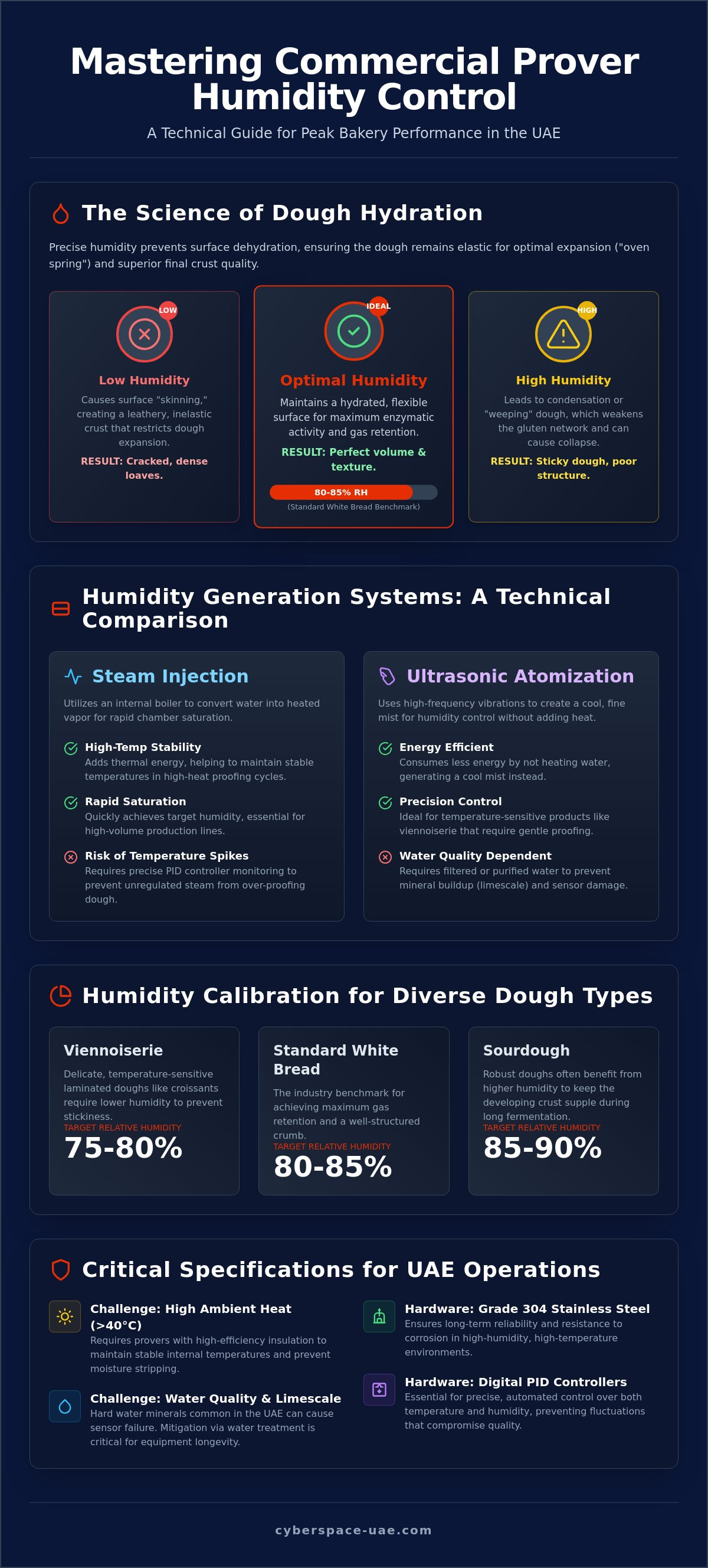
There is a direct correlation between ambient moisture levels and the metabolic rates of commercial yeast. Yeast requires a warm, moist environment to convert sugars into carbon dioxide efficiently. For standard industrial white bread, maintaining a consistent 80-85% RH is the industry benchmark. This specific range maximizes gas retention within the gluten structure. However, excess humidity presents different risks. It leads to "weeping" dough. Water droplets condense and pool on the surface. This weakens the gluten network. It can cause the dough to collapse under its own weight before it reaches the deck oven. Precise commercial prover humidity control prevents these structural failures. It ensures each batch meets weight and volume specifications.
Technical Generation Methods: Steam vs. Ultrasonic Systems
Mechanical precision in commercial prover humidity control is dictated by the method used to introduce moisture into the chamber. Industrial bakeries typically utilize one of three core technologies: steam injection, ultrasonic atomization, or passive evaporative systems. Each method offers distinct advantages in response time, energy consumption, and thermal stability. Choosing the correct system depends on your specific product range and production volume requirements.
Evaporative systems represent the most basic technical approach. These rely on heated water pans and internal fan-driven airflow to distribute moisture. While mechanically simple, their response time is significantly slower than active injection methods. In high-output UAE bakeries, the lag in passive evaporation often leads to environmental fluctuations. Modern industrial provers prioritize active systems that provide instantaneous moisture adjustment to maintain the strict equilibrium required for high-quality dough development.
Steam Injection Mechanics
Steam injection systems utilize an internal boiler or heating element to convert water into heated vapour. This technology is ideal for high-temperature proofing cycles where rapid saturation is essential to maintain production speed. Because steam carries thermal energy, it helps stabilize the internal temperature without overworking the primary heating elements. Many facilities integrate these units with industrial rotary baking ovens to create a synchronized workflow. However, operators must monitor PID controllers closely. Unregulated steam can cause temperature spikes that lead to over-proofing or yeast exhaustion.
Ultrasonic Atomization and Precision
Ultrasonic systems use piezoelectric transducers to generate high-frequency vibrations. These vibrations atomize water into a "cold mist" with a droplet size of approximately 1-5 microns. This method provides superior accuracy for Humidity Calibration for Diverse Baking Applications because it doesn't rely on heat. It's the preferred choice for delicate viennoiserie and laminated doughs where high heat would cause butter leakage. Ultrasonic generators are highly efficient, often requiring 80% to 90% less electrical energy than thermal steam boilers. They offer near-instantaneous moisture delivery, ensuring the proofing environment remains stable even during frequent door openings in a busy kitchen.
Environmental Factors and Water Quality in UAE Industrial Kitchens
Operating industrial bakeries in the UAE presents unique engineering challenges that directly impact commercial prover humidity control. High baseline temperatures and specific regional water characteristics necessitate equipment with specialized configurations. Standard specifications often fail under the thermal loads of the local climate. Maintaining a stable fermentation environment requires a combination of high-efficiency insulation, robust cooling systems, and rigorous water treatment protocols to prevent premature hardware failure.
While the choice between isothermal and adiabatic Technical Generation Methods: Steam vs. Ultrasonic Systems is a primary consideration, local environmental variables often dictate the ultimate success of these technologies. Across the UAE, ambient kitchen temperatures frequently exceed 40°C. This external heat pressure forces prover systems to work harder to maintain internal setpoints, making thermal resistance a critical performance metric for any industrial installation.
Managing High Ambient Temperatures
Baseline heat in the UAE necessitates the use of retarder-prover systems rather than simple proofing cabinets. These units utilize integrated refrigeration to control the fermentation timeline. Managing humidity during the transition from a chilling phase (2°C to 4°C) to a proofing phase (35°C to 38°C) is technically demanding. Without precise calibration, condensation levels spike during this temperature ramp, leading to surface saturation and dough collapse. Insulated cabinet walls are critical for UAE climate stability because they minimize thermal transfer and prevent the external environment from disrupting the internal equilibrium. High-density polyurethane insulation ensures that the cooling and humidification systems operate within their designed efficiency parameters.
Hard Water and Mineral Accumulation
Limescale accumulation from hard water is the leading cause of sensor failure in regional bakeries. UAE water supplies, while strictly regulated, often contain mineral concentrations that precipitate rapidly when heated or atomized. Calcium and magnesium deposits form a physical barrier on humidity probes and sensors. This results in "sensor drift," where the controller receives inaccurate data and either over-saturates or under-humidifies the chamber. Ultrasonic transducers are particularly sensitive to mineral buildup, which can dampen high-frequency vibrations and reduce moisture output.
Maintenance intervals for descaling must be strictly followed to ensure equipment longevity. Industrial facilities should implement reverse osmosis (RO) or dedicated water softening systems to treat water before it enters the prover. Procuring professional baking equipment for UAE industrial kitchens that is specifically designed for regional water specs reduces the risk of unplanned downtime. High-performance commercial prover humidity control systems often feature self-cleaning cycles or accessible boiler tanks to simplify the removal of mineral deposits. Consistent water quality management directly correlates to predictable dough development and reduced replacement costs for sensitive electronic components.
Humidity Calibration for Diverse Baking Applications
Precise commercial prover humidity control requires specific Relative Humidity (RH) setpoints tailored to dough composition. Standardizing settings across different product lines leads to inconsistent results and increased waste. High-hydration artisan doughs require different saturation levels than enriched, high-fat pastries. For standard industrial pan bread, maintain 85% RH. This high saturation level ensures maximum volume and the soft, uniform crumb texture required for commercial slicing.
Pre-frozen dough applications demand a specialized recovery profile. You shouldn't jump to full humidity immediately. Implement a gradual RH increase during the thawing phase. This prevents surface condensation from forming as the dough temperature rises. Sudden moisture spikes on cold dough cause sweating, which degrades the final crust appearance. Managing these transitions is vital for bakeries utilizing centralized production models in the UAE.
Artisan Breads and High Saturation
Artisan sourdough requires 75-80% RH to maintain a robust but flexible exterior. This range prevents premature starch gelatinization. If the dough surface dries out during the proofing stage, it creates a rigid barrier that resists expansion. You must coordinate your prover settings with your baking deck oven suppliers to ensure the dough arrives at the oven with the correct surface moisture. This synergy allows the oven's steam injection to work effectively, resulting in a superior bloom and traditional crust color. Retarder-provers managing 12-24 hour cycles must maintain these levels without fluctuation to avoid leathery skinning.
Viennoiserie and Controlled Fermentation
Precision requirements for high-fat doughs, such as croissants, are narrow. Target 70-75% RH to prevent butter leakage while maintaining hydration. High humidity at elevated temperatures causes the laminated fat layers to melt prematurely, destroying the product's internal structure. There's also the danger of wash-off. Excess humidity dissolves egg wash or sugar coatings before the trays even reach the oven. This leads to a dull, patchy finish. Calibrate your internal airflow to ensure uniform humidity across all trays. Pockets of stagnant air lead to uneven proofing heights. To achieve these results, invest in high-performance provers equipped with digital RH sensors.
Selecting High-Performance Provers for Industrial Production
Industrial procurement of proofing equipment requires a focus on long-term operational reliability and technical precision. You must prioritize Grade 304 stainless steel construction. This material is essential for resisting corrosion in environments with constant moisture exposure. Digital PID controllers are the industry standard for commercial prover humidity control. These controllers use mathematical algorithms to adjust moisture levels dynamically, preventing the over-saturation or drying cycles common in cheaper, analog-based units. Precise management at this stage ensures that your production line maintains the standards set during the mixing and shaping phases.
Before finalizing a purchase, assess the accessibility of the humidity generators. Routine maintenance, particularly descaling in the UAE's hard water environment, is non-negotiable. If the generator is sealed or difficult to reach, your technical team will face increased downtime and higher service costs. You should also ensure the cabinet dimensions and door clearances are compatible with your existing rack systems and tray dimensions. Seamless integration into your current logistics flow prevents bottlenecks during the loading and unloading phases, which is critical for maintaining the tight schedules of high-volume industrial bakeries.
Retarder-Prover Integration
Modern industrial facilities benefit from integrated retarder-prover systems. These units automate the transition from chilling at 2°C to proofing at 38°C with perfectly synced humidity levels. This automation significantly reduces labour costs. You don't need staff on-site for early morning transitions because the system handles the fermentation timeline through overnight programmable cycles. High-capacity industrial units feature high-torque fans and reinforced flooring to handle the weight of multiple heavy-duty racks. This setup ensures that every loaf, from the top rack to the bottom, receives uniform moisture and heat distribution regardless of the batch size.
Durability and Material Specifications
The physical build of the prover impacts its thermal efficiency. High-density polyurethane insulation is necessary to isolate the internal environment from UAE ambient heat. This insulation maintains the setpoint without constant cycling of the compressors or heaters, extending the lifespan of the mechanical components. Use tempered glass doors for product monitoring. This allows your team to check dough progress without opening the doors and venting the humidity. Sensor redundancy is another critical feature. Dual humidity probes are standard in professional industrial units. If one sensor fails or drifts due to mineral buildup, the secondary probe maintains the commercial prover humidity control until maintenance can be performed. High-precision humidity control systems provide a superior return on investment by eliminating the batch-to-batch variability and high labour costs associated with manual proofing methods.
Optimizing Industrial Fermentation Performance
Precision in fermentation is a technical requirement for any high-volume bakery. Effective management of relative humidity prevents surface skinning and ensures dough remains extensible for maximum oven spring. Hardware choice, specifically Grade 304 stainless steel and PID controllers, directly impacts equipment lifespan and batch consistency. These technical components are necessary for maintaining the strict equilibrium required for high-quality dough development across diverse product ranges.
Stabilizing your commercial prover humidity control is essential to counter the UAE's high ambient heat and hard water conditions. Proactive maintenance and water treatment systems protect your investment from sensor drift and mechanical failure. We're an authorized distributor of premium baking brands and provide technical expertise in UAE-compliant kitchen machinery. We're suppliers of high-capacity industrial fermentation systems designed for regional operational realities.
View our range of industrial Provers and professional baking equipment to upgrade your production capabilities. Achieving consistent, professional-grade results is a standard you can maintain in any environment.
Frequently Asked Questions
What is the ideal humidity for commercial bread proofing?
The ideal relative humidity for standard commercial white bread is between 80% and 85% RH. Artisan sourdough typically requires a slightly lower range of 75% to 80% RH to ensure the crust remains robust but flexible. Maintaining these specific levels ensures the dough surface stays moist and extensible throughout the fermentation process.
Why is my dough developing a skin inside the prover?
Dough skinning occurs when the relative humidity is too low or internal air velocity is too high. This causes moisture to evaporate from the dough surface faster than it can be replaced from within the core. Increasing your commercial prover humidity control setpoint or reducing fan speed often resolves this issue by preventing premature surface dehydration.
Do I need a water filter for my commercial prover?
Dedicated water filtration is essential for provers operating in the UAE to prevent rapid mineral accumulation. High calcium and magnesium levels in local water supplies lead to limescale buildup on heating elements and humidity sensors. Using a reverse osmosis (RO) system or a high-capacity water softener extends the lifespan of your electronic components and prevents inaccurate sensor readings.
What is the difference between a prover and a retarder-prover?
A standard prover only provides controlled heat and moisture for active fermentation. A retarder-prover includes an integrated refrigeration system that allows for a chilling phase before the proofing cycle begins. This enables overnight fermentation and reduces the need for early morning labor shifts by automating the transition from cold storage to active proofing.
Can I use a combi oven as a prover for high-volume baking?
While a combi oven can proof dough, it isn't designed for the high-volume rack throughput of a dedicated industrial prover. Combi ovens are excellent for versatile cooking but lack the specialized airflow and large-scale capacity required for continuous industrial production lines. Dedicated provers offer superior climate stability for multiple full-size racks simultaneously.
How does humidity affect the final crust of the bread?
Humidity levels during proofing dictate the thickness, color, and texture of the final crust. High humidity prevents premature starch gelatinization, allowing the dough to expand fully during the initial baking phase. This results in a thinner, crispier crust with a professional sheen rather than a dull, leathery finish that lacks volume.
How often should I clean the humidity generator in an industrial prover?
You should descale the humidity generator at least once a month under typical UAE operating conditions. Industrial units used in high-output environments may require bi-weekly inspections to ensure mineral deposits don't obstruct the transducers or boiler elements. Regular maintenance prevents the system from failing during peak production hours and ensures consistent moisture delivery.
Is ultrasonic humidity better than steam injection for pastry?
Ultrasonic humidification is superior for pastries and viennoiserie because it produces a cold mist that doesn't significantly raise the internal temperature. Steam injection introduces heat that can melt the fat layers in laminated doughs like croissants. Precise commercial prover humidity control via ultrasonic atomization maintains hydration without risking structural collapse or butter leakage.