
Deck Oven for Artisan Bread: Industrial Performance and Specifications
Achieving a professional-grade crust and open crumb is impossible without the specific thermal mass of a stone hearth. While convection units offer versatility, they often fail to provide the consistent heat recovery needed for high-volume production. Selecting a high-performance deck oven for artisan bread is the only way to eliminate inconsistent oven spring and dull, lackluster crusts.
You likely understand that scaling an artisan operation requires more than just increased floor space. With interest in sourdough up 45% year-over-year, the pressure to maintain quality at scale is higher than ever. This technical guide outlines the essential specifications for industrial deck ovens, focusing on the thermal mass and steam injection systems required for professional results. We'll examine critical performance metrics, current NSF/ANSI 4-2025 sanitation standards, and modular configurations designed to maximize capacity. You'll gain the technical insight needed to ensure energy-efficient operations and repeatable, high-quality output for your bakery.
Key Takeaways
- Technical requirements for stone hearth soles and integrated steam injection to ensure superior crust development.
- Heat zone management for a deck oven for artisan bread using independent top, bottom, and front controls.
- Production scaling via modular, stackable configurations to maximize output within limited footprints.
- Process integration of high-torque spiral mixers and controlled provers for high-hydration artisan doughs.
- Procurement standards focusing on manufacturer warranties and technical support availability for industrial longevity.
Defining the Deck Oven for Artisan Bread Production
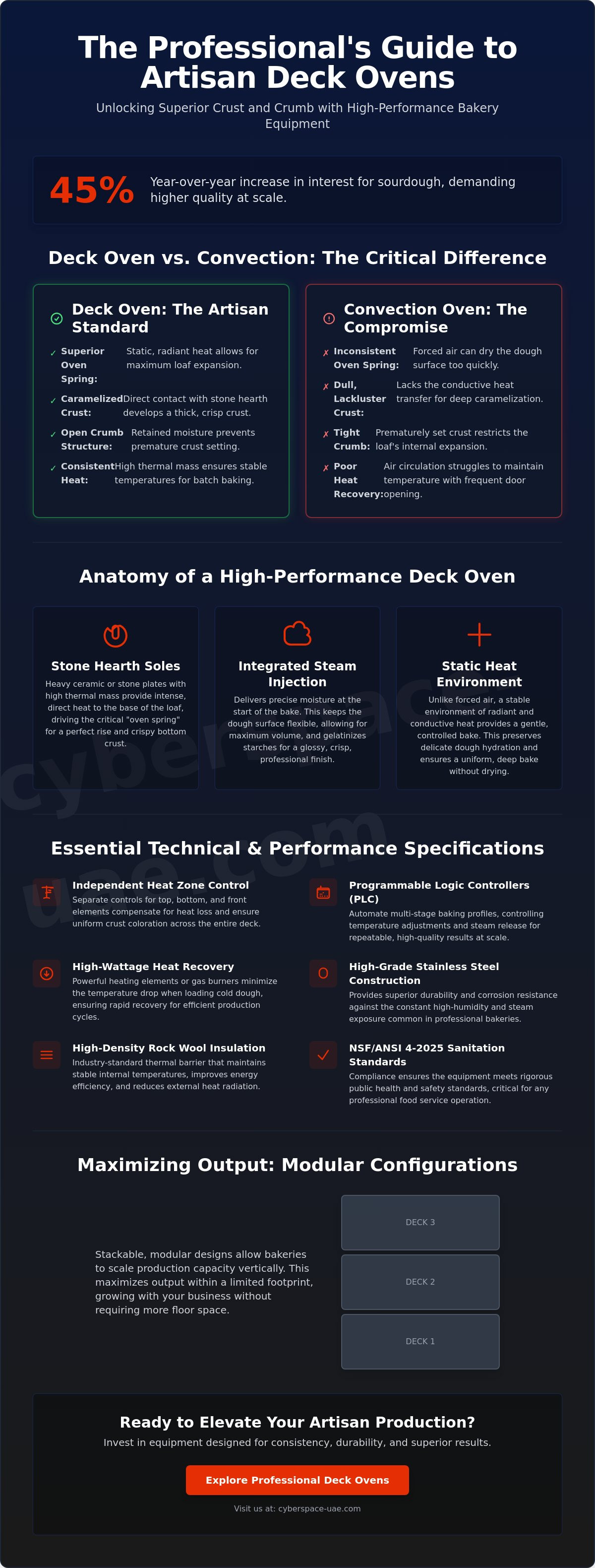
A professional deck oven for artisan bread serves as the primary tool for high-quality bread production. It relies on three critical components: static heat, stone hearth soles, and integrated steam injection. Unlike convection ovens that utilize forced air, a deck oven provides a stable baking environment where heat is transferred through conduction and radiation. This design is a direct technological descendant of the traditional masonry oven, adapted for modern industrial requirements. Industrial applications range from small-scale sourdough bakeries to high-volume commercial facilities requiring precise crust characteristics.
Convection ovens often fail to replicate the artisan profile because they lack the necessary thermal mass. Forced air circulation can lead to premature drying of the dough surface. This prevents the loaf from expanding fully before the crust hardens. In contrast, the static heat of a deck oven allows for a controlled, gradual bake. This stability is essential for achieving the thick, caramelized crust and open crumb structure associated with premium artisan products. The absence of moving air ensures that the delicate hydration levels in the dough are preserved throughout the baking cycle.
The Importance of Stone Hearth Soles
Industrial deck ovens utilize heavy ceramic or stone plates to provide high thermal mass. These materials absorb significant heat energy, maintaining stable temperatures even during frequent loading and unloading cycles. Direct contact between the dough and the heated stone facilitates rapid heat transfer to the base of the loaf. This conductive heat is the primary driver of "oven spring," the final burst of fermentation and expansion that occurs in the first minutes of baking. Without this immediate heat source, the bottom crust remains pale and soft, lacking the traditional artisan texture and structural integrity.
Steam Injection Systems and Crust Development
Effective crust development requires precise moisture management. Modern steam injection systems deliver controlled volumes of high-pressure steam at the start of the bake. This moisture condenses on the cool dough surface, keeping it flexible. By delaying the setting of the crust, steam allows the loaf to reach its maximum volume. This process also triggers starch gelatinisation. The resulting chemical reaction creates the glossy, translucent finish and crisp texture required for professional sourdough and baguettes. Unlike standard injection methods, industrial-grade systems ensure uniform distribution across the entire deck surface, eliminating inconsistent results within a single batch.
Technical Specifications for Crust and Crumb Consistency
Precision control is mandatory for industrial output. A high-performance deck oven for artisan bread features independent temperature management for top, bottom, and front heat zones. This granularity allows bakers to compensate for heat loss near the doors and ensures uniform crust coloration across the entire stone surface. Modern units utilize Programmable Logic Controllers (PLC) to store multi-stage baking profiles. These systems automate temperature adjustments and steam release intervals, which is critical for mastering the science of bread-making at scale. High-density rock wool insulation serves as the industry standard, providing the thermal barrier necessary to maintain internal temperatures while reducing external heat radiation.
Durability remains a primary concern in high-humidity bakery environments. Industrial deck ovens are constructed using high-grade stainless steel to resist corrosion from constant steam exposure. For operations looking to upgrade their facility, selecting professional bakery equipment with these specifications ensures long-term operational reliability. The integration of advanced sensors ensures that the PLC maintains real-time accuracy, preventing the temperature fluctuations that lead to inconsistent crumb structures.
Thermal Management and Heat Recovery
Production efficiency depends on rapid heat recovery. When cold dough enters the chamber, the deck temperature drops immediately. Industrial specifications prioritize high-wattage elements or optimized gas burners to minimize this recovery window. Door design also plays a vital role. Triple-glazed viewing windows and heavy-duty gaskets prevent energy leakage. Balancing thermal mass with energy consumption requires a precise ratio of stone thickness to heating capacity. Thicker stones retain more heat but require longer initial preheating times. Bakers must calculate these cycles to align with tight production schedules.
Steam Generation Technology
Steam quality determines the final aesthetic of the loaf. Professional systems often use integrated steam generators that produce dry, high-pressure vapor. This is superior to external boilers which may lose pressure over long pipe runs. Maintaining these systems is essential for performance. Limescale build-up in nozzles can result in uneven moisture distribution, leading to dull patches on the crust. Regular descaling protocols are non-negotiable. For a deeper analysis of hardware options, consult the latest data on steam injection systems in modern commercial deck ovens. High-output bakeries should prioritize systems with rapid-fire steam recovery to handle back-to-back loading cycles without moisture loss.
Modular Configurations and Scaling Production Capacity
Modularity is the primary solution for bakeries balancing high output with restricted square footage. A deck oven for artisan bread typically allows for vertical stacking of up to four or five independent baking chambers. This verticality ensures that production capacity scales without expanding the equipment footprint. Each deck functions as a self-contained unit with its own heating elements and steam controls. This allows for simultaneous baking of different products at varied temperatures.
Width configurations are standardized to accommodate specific tray dimensions, most commonly 400x600mm or 600x800mm. Selecting the correct width depends on the intended batch size and available labor. Configurations include:
- 1-tray width: Suited for low-volume specialty items or recipe development.
- 2-tray width: The industry standard for medium-sized artisan bakeries.
- 3-tray width: Designed for high-volume wholesale operations.
Chamber height is another critical specification. Standard decks provide approximately 180mm to 200mm of clearance. For bakeries producing tall specialty items like panettone or high-profile sourdough, choosing at least one deck with 250mm to 300mm clearance is necessary. Workflow ergonomics also improve with modularity. Integrated manual or semi-automatic loaders ensure consistent placement on the stone sole while maintaining a safe loading height for operators.
Analyzing Tray Capacity and Loaf Output
Calculating throughput requires aligning tray size with product dimensions. A 600x800mm deck surface typically holds six 750g boules or ten 400g baguettes. In a three-deck configuration, this results in 18 boules per bake. Assuming a 45-minute bake and load cycle, a three-deck system produces 144 boules over an 8-hour shift. Bakeries targeting 500 loaves per day must prioritize 3-tray widths or increase the number of stacked decks to five to meet demand without extending labor hours.
Future-Proofing Your Bakery Infrastructure
Scaling production introduces significant electrical requirements. Each additional deck increases the total kilowatt load, often necessitating 3-phase power upgrades. Modular installation is a key advantage; components are designed to pass through standard 900mm doorways for on-site assembly. This eliminates the need for structural modifications during equipment delivery. Standardizing on a single modular brand also streamlines maintenance. Spare parts like heating elements and gaskets are interchangeable across all decks, reducing inventory costs and downtime.
Optimising the Artisan Workflow: Beyond the Oven
Professional artisan production requires a synchronized equipment chain. While the deck oven for artisan bread secures the final crust and crumb, quality is established during the mixing and fermentation stages. High-torque machinery is necessary to handle the high hydration levels typical of sourdough and ciabatta. This integrated approach ensures that dough entering the oven has the structural integrity required for maximum expansion. Post-bake processes are equally critical. Rapid cooling via blast chillers preserves crust integrity by quickly reducing core temperatures. This prevents moisture migration from the crumb to the crust, which often causes softening in high-humidity environments.
For bakeries producing laminated artisan goods like croissants, automated dough sheeters provide the precision required for consistent layering. These units eliminate the manual labor and temperature fluctuations associated with hand-rolling. Integrating these tools into a single workflow allows for a repeatable production cycle that maximizes the output of each deck. You can source industrial bakery equipment designed for these specific professional requirements to ensure operational consistency.
Dough Processing and Mixing Requirements
Stiff doughs and high-hydration recipes require specialized mixing actions. Spiral mixers are the industry standard for artisan bread. The rotating bowl and spiral hook minimize friction and heat transfer during the mixing cycle. This is essential for maintaining the cold dough temperatures required for long, controlled fermentation. For specific application details, see this guide on the spiral mixer for stiff dough. Alternatively, planetary mixers are utilized for specialty inclusions and artisan pastry components. These units prioritize aeration and gentle folding, which are necessary for high-fat doughs and delicate inclusions that spiral hooks might damage.
Proving and Retarding Systems
Fermentation control is the bridge between mixing and baking. Industrial retarder provers allow bakers to manage long-fermentation sourdoughs by precisely controlling temperature and humidity. These systems prevent skin formation on the dough surface. Skinning leads to surface tearing and restricted expansion during the bake. Coordinating prover output with oven cycles is vital. As discussed in previous sections regarding heat recovery, provers must be calibrated to deliver dough in batches that match the loading capacity and recovery time of the deck oven. This synchronization prevents over-proofing and ensures a continuous, efficient production flow. It keeps the deck oven for artisan bread occupied throughout the shift, maximizing total daily output.
In addition to perfecting the dough, many artisan bakeries focus on creating a holistic sensory experience. This often includes a high-end coffee program where understanding the technicalities of the brew is as important as the bake; resources from The Roast Haus Coffee Co. can help your team master the fundamentals of espresso to complement your artisan bread offerings.
Selecting Industrial Deck Ovens for Professional Bakeries
Procurement for industrial facilities requires a focus on longevity and technical compliance. Prioritizing brand-new equipment ensures access to full manufacturer warranties and the latest energy-efficient technologies. A high-performance deck oven for artisan bread is a significant capital investment. Selecting new machinery avoids the hidden costs associated with degraded heating elements or compromised stone soles found in used units. Verifying electrical compatibility and industrial safety certifications, such as NSF/ANSI 4-2025 and UL standards, is mandatory for commercial health and safety compliance.
Total cost of ownership (TCO) must balance the initial purchase price with long-term operational costs. High-efficiency insulation and precision PLC controls reduce energy consumption over thousands of baking cycles. Verifying compliance with NSF/ANSI 51-2025 for glass materials and lead content is essential for new equipment. Evaluating suppliers based on technical support and immediate spare parts availability is critical. Downtime in a professional bakery directly impacts revenue. Reliable bakery equipment suppliers provide the necessary technical commissioning to ensure the oven is calibrated to local utility standards and production requirements.
Industrial Procurement Standards
Used or refurbished ovens present high risks for artisan consistency. Refractory stones in older units often suffer from micro-fractures that impede uniform heat distribution. Steam seals and injection nozzles also degrade, leading to the moisture loss issues discussed in previous sections. Critical inspection points for any unit include stone integrity, element lifespan, and door gasket seals. For national procurement needs, consulting with specialized baking deck oven suppliers ensures the hardware meets industrial duty-cycle requirements.
Operational Training and Support
Technical commissioning must include comprehensive staff training on PLC systems. Operators must understand how to program multi-stage baking profiles to maintain product quality. Scheduled maintenance protocols for industrial heating elements and steam generators prevent catastrophic failures. Some facilities utilize a hybrid setup, leveraging a deck oven for artisan bread alongside a Rational combi oven for bakery applications. This configuration provides the specific stone-sole heat needed for sourdough while offering the versatility of a combi unit for pastry and auxiliary products. Regular calibration of temperature sensors ensures the PLC continues to deliver the precise thermal mass required for professional artisan bread production.
Implementing Scalable Artisan Solutions
Professional artisan bread production depends on the precise coordination of thermal mass, moisture control, and workflow efficiency. Utilizing a high-performance deck oven for artisan bread ensures the stone-sole heat and integrated steam injection required for consistent oven spring and crust development. Modular stacking configurations and PLC automation allow operations to scale capacity while maintaining technical accuracy across high-volume batches. Standardizing on industrial-grade equipment reduces the risks associated with heat loss and inconsistent fermentation, providing a stable foundation for commercial growth.
Cyberspace serves as a specialized supplier of brand-new industrial baking machinery for the commercial food service sector. We provide professional-grade equipment and national technical support across the UAE to ensure long-term operational reliability and energy efficiency. View Industrial Deck Oven Specifications to secure the hardware necessary for industrial artisan excellence. Selecting high-specification industrial tools is the most reliable method for achieving a repeatable, high-quality output that meets the increasing market demand for premium sourdough and artisan products.
Frequently Asked Questions
What is the ideal temperature for baking artisan bread in a deck oven?
The ideal temperature for baking artisan bread in a deck oven typically ranges between 220°C and 250°C. High initial heat is required to trigger the final expansion known as oven spring. Stone soles retain this thermal energy, ensuring the base of the loaf caramelizes correctly. Bakers often reduce the temperature by 10 to 20 degrees during the final third of the bake to prevent the crust from burning while the internal crumb sets.
How much steam is required for a standard artisan sourdough loaf?
A standard artisan sourdough loaf requires a fully saturated steam environment during the first 5 to 10 minutes of the baking cycle. Most industrial systems inject steam for 5 to 12 seconds upon loading. This moisture prevents the crust from setting too early, allowing for maximum volume. Steam also promotes starch gelatinisation, which creates the characteristic glossy finish and crisp texture found in professional artisan products.
Can I bake different types of bread in a multi-deck oven simultaneously?
Yes, you can bake different bread types simultaneously in a multi-deck oven because each deck operates as an independent unit. Every level has its own temperature controls for the top and bottom heating elements. This modularity allows a baker to produce high-heat sourdough on the bottom deck while baking delicate pastries or enriched breads at lower temperatures on the upper decks without heat transfer between levels.
What is the difference between an electric and a gas deck oven for bread?
Electric deck ovens offer more precise control over top and bottom heat zones compared to most gas models. This precision is vital for a deck oven for artisan bread where subtle heat adjustments determine crust thickness. Gas ovens provide high thermal energy but often lack the granular zone management of electric systems. Electric units also simplify installation in modern kitchens as they don't require complex gas ventilation or piping.
How do I maintain the stone soles in an industrial deck oven?
Maintain stone soles by using a long-handled natural fiber brush or a specialized deck scraper to remove carbonized flour and dough residue. Never use water or liquid cleaning agents, as thermal shock can crack the ceramic plates. For deep cleaning, many bakers utilize a high-heat cycle to carbonize stubborn debris, which can then be brushed away once the oven cools to a safe handling temperature.
How many loaves can a 3-deck artisan oven produce in an 8-hour shift?
A 3-deck artisan oven can produce approximately 144 to 150 boules (750g each) during a standard 8-hour shift. This calculation assumes a 600x800mm deck capacity and a 45-minute cycle for baking and reloading. Throughput increases if baking smaller items like baguettes or rolls. Maximizing this output requires a synchronized workflow where the prover delivers dough batches that align exactly with the oven's recovery and bake times.
Is a rotary oven better than a deck oven for artisan bread?
A deck oven is superior to a rotary oven for artisan bread because it utilizes static heat and conductive stone contact. Rotary ovens use forced air, which can dry out high-hydration dough and prevent the development of a thick, traditional crust. While rotary ovens are efficient for high-volume uniform products like buns, they cannot replicate the specific crust and crumb characteristics provided by the thermal mass of a stone-sole deck.
What electrical specifications are required for a commercial deck oven?
Commercial deck ovens typically require a 3-phase electrical connection (380V to 415V) to handle the high kilowatt load of multiple heating elements. Smaller 1-pan units may operate on 208V 3-phase power. It's essential to verify the total amperage of the stackable system, as each additional deck increases the power draw. All installations must comply with local industrial safety standards and manufacturer specifications to ensure operational longevity and safety.