
Electric vs Gas Deck Oven for Bakeries: Industrial Performance Analysis 2026
With fuel costs consistently on the rise, the decision between an electric vs gas deck oven for bakeries is no longer just about initial cost. Industrial operators now face a critical choice between the raw heating power of gas and the modular precision of modern electric systems. You're likely aware that inconsistent deck temperatures or slow heat recovery between batches directly impact your daily throughput. Maintaining consistent product quality across all decks is essential for high-volume commercial production.
This analysis provides a technical comparison of thermal recovery, energy infrastructure, and baking precision to help you select the optimal power source. We examine how prevailing commercial utility rates influence long-term operational overheads. You'll learn how to balance high electrical load requirements against the need for fast recovery times in 24/7 environments. This guide reviews the performance metrics required to optimize your bakery’s energy efficiency and output consistency for the current regulatory landscape.
Key Takeaways
- Understand the mechanical differences between radiant electric heating elements and atmospheric gas burner systems for industrial applications.
- Analyze the thermal recovery advantages of gas-fired units for high-volume production cycles and heavy dough loads.
- Compare the operational flexibility of an electric vs gas deck oven for bakeries, focusing on independent deck modularity for diverse product ranges.
- Identify critical infrastructure needs, including 3-phase power loads for multi-deck electric systems and ventilation requirements for gas installations.
- Align equipment selection with UAE utility tariffs to maximize ROI and minimize long-term energy overheads in commercial environments.
Thermal Engineering: How Electric and Gas Systems Generate Heat
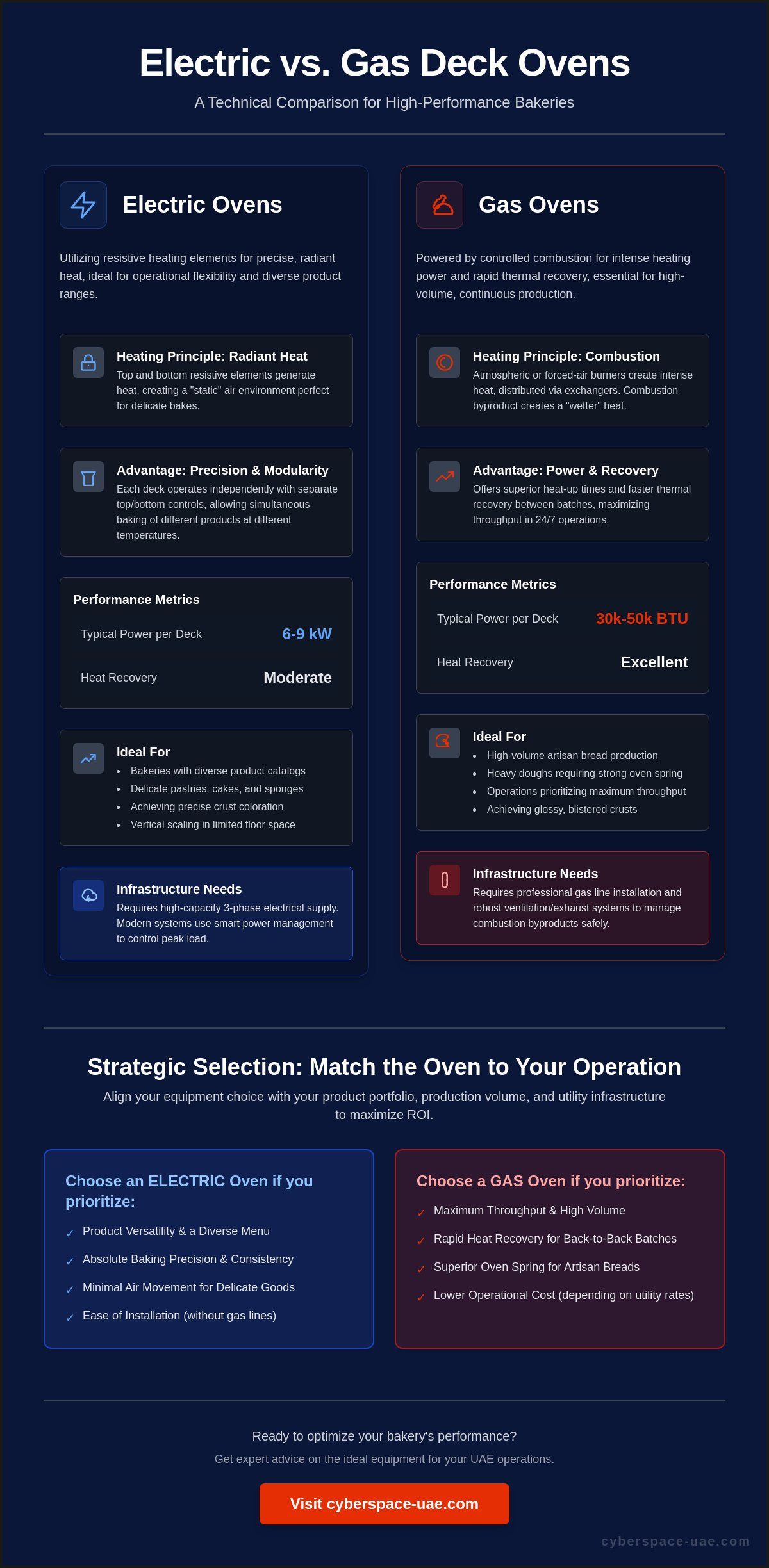
The primary mechanical distinction between an electric vs gas deck oven for bakeries lies in the energy conversion method. Electric systems utilize resistive heating elements to generate thermal energy. Gas systems rely on controlled combustion within a burner assembly. Selecting the correct thermal profile is essential for maintaining high-volume production schedules in the UAE's competitive industrial bakery sector. Performance varies significantly based on how these systems manage heat distribution and energy density.
In a commercial environment, thermal capacity is measured in kilowatts (kW) for electric units and British Thermal Units (BTU) for gas. A standard high-performance electric deck often requires 6-9 kW of power. A gas equivalent may generate between 30,000 and 50,000 BTU per deck. Understanding these specifications is the first step in evaluating Industrial Ovens for large-scale operations. The efficiency of this conversion impacts both your hourly throughput and your monthly utility overheads.
The Physics of Electric Radiant Heat
Electric deck ovens feature heavy-duty resistive elements positioned at the top and bottom of each baking chamber. This configuration enables precise radiant heat transfer directly to the product. Because there's no active combustion, the air inside the chamber remains "static." This environment is necessary for delicate pastries and sponges that require minimal air movement to maintain structural integrity during the rise.
Consistency in an electric system depends on element density. Professional-grade decks use closely spaced elements to ensure edge-to-edge uniformity. This engineering prevents the "cold door" effect often found in entry-level equipment. Operators can adjust top and bottom heat independently. This level of control allows for specific crust development that's difficult to replicate in single-source heat environments.
Combustion and Airflow in Gas Decks
Gas deck ovens utilize either atmospheric burners or forced-air systems. Atmospheric burners are traditional and quieter, relying on natural draft for oxygen. Forced-air systems use a blower motor to mix gas and air. This results in a more intense flame and significantly faster heat-up times. Heat exchangers channel this energy under the deck stones and through the top of the chamber to provide a balanced bake.
The internal atmosphere of a gas oven differs from electric models. Combustion produces water vapor as a natural byproduct. This creates a "wetter" heat. For artisan bread producers, this moisture can assist in achieving a glossy crust and better oven spring. However, it requires robust ventilation systems to safely manage exhaust gases. Effective thermal distribution in gas models relies on the burner's ability to maintain a consistent flame length across the entire deck width. Without precise calibration, gas decks can develop "hot spots" near the burner ignition point.
Precision Control: Why Professional Bakeries Prioritise Electric Modularity
Electric systems provide a level of operational granularity that gas burners cannot match. This is primarily due to the independent nature of electric heating circuits. In a multi-deck configuration, each chamber functions as a standalone unit. This allows a facility to produce high-hydration sourdough at 250°C in one deck while simultaneously baking butter-heavy croissants at 180°C in the deck below. This versatility is a decisive factor when evaluating an electric vs gas deck oven for bakeries with diverse product catalogs.
Modularity also enables vertical scaling. Industrial bakeries can add decks to an existing stack as demand increases without expanding their floor footprint. This vertical growth is essential in high-rent commercial areas across the UAE. Smart power management further enhances this modularity. Modern controllers stagger the activation of heating elements. This prevents a massive amperage spike during the morning pre-heat cycle, which is critical for managing peak electrical loads. In Dubai and Sharjah, where utility providers apply slab-based tariffs and fuel surcharges, these systems help control operational overheads by smoothing out energy consumption patterns.
Independent Temperature Zoning
Precision is achieved through separate top and bottom heat settings within each deck. Industrial bakers use these controls to manage crust thickness and base coloration with mathematical accuracy. This level of zoning reduces waste. If production volume is low, operators only power the specific decks required. This avoids the inefficient energy expenditure of heating a large, single-source gas chamber for a partial load. For facilities planning a new installation, consulting Professional Baking Deck Oven Suppliers: Industrial Procurement Guide 2026 offers deeper technical insights into multi-zone configurations.
Advanced Steam Injection Systems
Steam quality is a significant technical differentiator. Electric deck ovens typically feature dedicated, high-pressure boilers for each individual deck. These independent generators provide rapid steam recovery. This ensures that the fifth batch of bread receives the same volume of moisture as the first. This consistency is vital for "crust bloom" and achieving a professional sheen on artisan loaves. Unlike the ambient moisture found in gas combustion, electric steam is precisely metered and bone-dry until injected. This level of humidity control is easier to maintain in high-production 24/7 environments. Regular maintenance of these independent generators ensures consistent performance, especially when considering the varied water mineral content across the Emirates. Reviewing technical specifications for industrial deck ovens helps ensure your steam capacity matches your production mass.
Industrial Throughput: Evaluating Recovery Times in Gas-Fired Decks
Thermal recovery measures how fast a deck returns to its set temperature after loading. It's a critical metric for high-volume shifts. When comparing an electric vs gas deck oven for bakeries, gas systems usually provide superior raw recovery speeds for high-mass loads. This is due to the intense energy density of gas combustion. A typical industrial gas deck utilizes high-BTU burners that generate heat rapidly. When 50kg of dough enters a chamber, the temperature drops instantly. Gas burners respond with a high-intensity flame. This reheats the deck stone and the air chamber faster than standard resistive electric elements. For 24/7 bakeries in the UAE, this minimized downtime between batches translates to higher daily output.
Consistency challenges do exist within this high-power framework. Operators must manage the "flare-up" during burner cycles. This occurs when the system overshoots the target temperature during a rapid recovery phase. Modern gas controllers have improved this, but it requires more oversight than the steady radiance of electric elements. In a 24/7 production environment, the throughput advantage often outweighs the need for constant calibration.
Quantifying High-Volume Recovery
Gas heat exchangers store significant thermal mass. During the loading phase, these exchangers release stored energy to counteract the temperature dip. The relationship between a burner's BTU rating and recovery time is direct. High BTU ratings cut wait times. Gas is the standard for industrial-scale hearth bread production because it maintains floor heat under constant loading. While electric models are improving with power-boost features, gas burners still hold the advantage for continuous, heavy-duty dough loads in large-scale UAE facilities.
Durability and Industrial Longevity
Industrial gas decks are built for longevity. They require specific maintenance protocols to remain efficient. Burner orifices must stay clean to ensure a consistent air-to-gas ratio. This prevents carbon buildup and inefficient fuel consumption. Deciding on an electric vs gas deck oven for bakeries requires analyzing the specific mass of your dough loads and your maintenance capacity. The life expectancy of a high-grade gas heat exchanger often exceeds ten years in commercial applications. For operations requiring even higher throughput for standardized products, comparing these decks against an Industrial Rotary Baking Oven: Professional Procurement Guide 2026 is a logical next step. Maintaining gas systems involves checking safety valves and ventilation integrity. This ensures the unit complies with UAE municipal safety standards.
Infrastructure and Utility Requirements for National UAE Operations
Utility infrastructure determines the practical feasibility of an electric vs gas deck oven for bakeries within UAE industrial zones. Each power source requires specific facility modifications and carries distinct long-term cost implications. In Abu Dhabi, the ADDC commercial rate remains fixed at AED 0.20/kWh as of June 2026. Operators in Dubai or Sharjah face higher overheads. DEWA commercial rates range from AED 0.23 to AED 0.38/kWh plus a 6.0 fils fuel surcharge. SEWA implements a base rate of AED 0.35/kWh with additional peak and fuel surcharges. These regional variations significantly impact the ROI of high-consumption equipment.
HVAC systems must also account for the thermal output of the chosen machinery. Gas ovens release higher levels of ambient heat and moisture into the workspace. This requires increased cooling capacity to maintain safe ambient temperatures for staff and dough stability. Electric units are generally better insulated. This reduces the load on your facility's climate control systems. With UAE fuel prices increasing by nearly 8% in June 2026, managing total energy consumption across both baking and cooling systems is essential for protecting profit margins.
Electrical Capacity and Phase Loading
High-volume electric decks require substantial 3-phase power capacity. A standard 4-deck modular system can demand between 24 kW and 36 kW of total power. Facilities must undergo professional electrical calibration to ensure the building's main breaker can handle this load alongside mixers and blast chillers. Future-proofing is a critical consideration. Installing a larger distribution board during the initial setup allows for vertical modular expansion without expensive rewiring later. If your facility lacks the necessary amperage, the infrastructure upgrade costs may outweigh the initial equipment savings. For detailed planning, review the Professional Baking Equipment in Dubai: Industrial Procurement Guide 2026.
Gas Safety and Ventilation Compliance
Industrial gas installations must comply with strict municipal safety standards in the UAE. This includes the mandatory installation of purpose-built flues and high-capacity extraction hoods. Proper airflow management is necessary to ensure complete combustion and prevent the buildup of carbon monoxide. Gas piping must be certified by approved contractors and undergo regular pressure testing. While gas can offer faster recovery times, the cost of specialized ventilation and ongoing safety certification adds to the total cost of ownership. Ensure your site plan meets all local fire and safety regulations before committing to a gas-fired system. You can find high-performance professional baking equipment designed to meet these rigorous industrial standards.
Strategic Selection: Matching Oven Power to Your Product Portfolio
The final decision between an electric vs gas deck oven for bakeries depends on the specific thermal requirements of your menu. Heavy hearth breads and high-volume flatbread production favor the intense energy and "wet" heat of gas burners. In contrast, delicate pastry lines and high-sugar recipes require the zoned precision of electric elements. A strategic decision matrix balances these production needs against the operational ROI of the equipment. Infrastructure dictates capacity; if your facility already has 3-phase power, electric modularity offers a lower entry barrier.
Industrial operators should evaluate the total cost of ownership over a ten-year cycle. While gas units might offer lower fuel costs in certain industrial zones, the maintenance of burners and safety flues adds operational complexity. Many high-output UAE bakeries now utilize hybrid setups. This allows them to leverage gas for bulk bread production while using electric decks for specialty items requiring independent top and bottom heat calibration. This redundancy also protects the facility against utility price volatility or supply interruptions.
Selecting for Artisan and Pastry Specialities
Electric precision is mandatory for technical lamination. Radiant heat from resistive elements provides the consistency needed for even expansion in croissants and puff pastry. High-sugar doughs are sensitive to temperature fluctuations. Electric decks maintain a tighter thermal window to prevent premature caramelization or uneven browning. When selecting a unit, verify deck stone quality. High-density refractory stones are necessary for thermal mass, especially when using electric heat for artisan loaves. Poorly insulated decks lead to excessive heat loss. This increases the load on your facility's HVAC systems and raises cooling costs in the UAE climate.
The Cyberspace Kitchen & Bakery Equipment Advantage for Commercial Bakeries
Procuring industrial baking machinery requires technical alignment with your facility’s utility capacity. Accessing high-performance deck ovens with custom specifications allows for optimized energy consumption and faster recovery times. Professional consultation ensures that your chosen kW or BTU output matches your hourly throughput targets precisely. This prevents under-utilization of equipment and ensures a streamlined path from installation to full-scale production. Assessing the thickness of the stone and the quality of the door seals is essential before finalizing any purchase to ensure long-term durability.
View Industrial Deck Oven Specifications to compare technical data and performance metrics for your next facility upgrade.
Optimizing Your Production Infrastructure for 2026
Final selection of an electric vs gas deck oven for bakeries requires reconciling batch mass with utility constraints. Gas provides the thermal inertia for high-volume bread lines. Electric modularity offers the precision required for premium pastry production. Balancing these factors against regional UAE electricity tariffs ensures a facility remains competitive in a shifting energy market.
Cyberspace Kitchen & Bakery Equipment serves as a specialized facilitator for these high-performance transitions. As a provider of professional-grade baking machinery, the business delivers expertise in high-end industrial solutions tailored for the UAE. Every unit is strictly new, high-performance commercial equipment designed to meet rigorous municipal safety and operational standards.
View Industrial Deck Oven Specifications to evaluate the performance metrics of our current inventory. Securing the right thermal infrastructure today prepares your bakery for the production demands of the coming years.
Frequently Asked Questions
Is gas or electric better for sourdough bread in a commercial setting?
Gas-fired decks are generally superior for large-scale sourdough production. The combustion process creates a humid environment that assists in crust expansion and oven spring. Electric decks are capable but require high-performance steam generators to match the natural moisture levels found in gas chambers.
Which deck oven type is more energy-efficient for a 24-hour bakery?
Efficiency depends on the production volume and local utility rates. For a 24-hour bakery producing high volumes of bread, gas often results in lower fuel costs per batch. In Abu Dhabi, with electricity at AED 0.20/kWh, the gap narrows, making electric decks competitive for diversified product lines where individual decks are powered down during low-demand periods.
What are the electrical requirements for a 3-deck industrial electric oven?
A 3-deck industrial electric oven typically requires a 3-phase power supply with a total load between 18 kW and 27 kW. Each deck generally draws 6 kW to 9 kW depending on its size and element density. Facility managers must ensure the distribution board can support the specific amperage requirements and peak loading.
Do gas deck ovens require more maintenance than electric models?
Gas deck ovens require a more rigorous maintenance schedule than electric models. Burner assemblies, safety valves, and ventilation flues must be inspected regularly to prevent carbon buildup and ensure complete combustion. Electric models are simpler, primarily requiring periodic checks of the heating elements and steam generator descaling.
Can I install a gas deck oven in a facility without existing gas lines?
Installation is possible but requires a certified gas infrastructure. Facilities must install either an LPG tank system or connect to a municipal gas network, both of which must comply with UAE Civil Defence safety standards. This adds significant initial setup costs compared to the 3-phase electrical connections required for an electric vs gas deck oven for bakeries.
How does recovery time differ between electric and gas deck ovens?
Gas ovens demonstrate faster recovery times after loading heavy dough batches. The high-BTU output of gas burners reheats the stone floor and air chamber more rapidly than resistive electric elements. This minimizes wait times between batches, increasing the total hourly throughput for 24/7 operations.
Which oven type provides better steam distribution for crust development?
Electric deck ovens often provide more consistent and pressurized steam distribution. These systems utilize independent boilers for each deck, allowing for precise moisture injection regardless of the burner cycle. While gas combustion creates a "wetter" heat, the controlled injection of electric boilers is often preferred for achieving a specific professional sheen on artisan crusts.
Is it possible to have a hybrid gas and electric deck oven system?
Hybrid systems are a viable solution for diversified bakeries. Operators can stack electric decks for pastries and gas-fired decks for bulk bread within the same facility. This strategy allows the business to leverage the specific thermal advantages of each power source based on the product portfolio.