
Heavy Duty Spiral Mixer Dubai: Industrial Capacity & Procurement Guide 2026
Bowl volume is a deceptive metric for industrial production planning. Selecting a heavy duty spiral mixer Dubai based solely on liter capacity often leads to motor burnout or inconsistent dough development. Most professional bakers recognize the frustration of a machine that stalls when processing low-hydration sourdough or high-protein flour. These mechanical failures create immediate bottlenecks that halt production and inflate repair costs. It's a risk that modern commercial bakeries cannot afford in a competitive market.
This guide provides the technical framework required to align machinery specifications with your specific output demands. You'll find a precise method for calculating batch sizes to prevent overflow and ensure uniform gluten development. We've included a reliable capacity reference chart and a breakdown of industrial features that allow equipment to handle stiff doughs without overheating. This reference ensures your procurement strategy for 2026 focuses on long-term operational efficiency and mechanical reliability.
Key Takeaways
- Identify mechanical differences in industrial mixers through synchronized bowl and hook rotation analysis.
- Apply the 60% hydration rule to calculate accurate batch sizes for a heavy duty spiral mixer Dubai and avoid motor strain.
- Verify essential material standards including AISI 304 stainless steel and integrated safety wire grid guards.
- Synchronize dough preparation cycles with deck and rotary oven throughput to maintain continuous production flow.
- Evaluate procurement options for high-performance machinery designed for the specific demands of large-scale industrial bakeries.
Technical Specifications of Heavy Duty Spiral Mixers
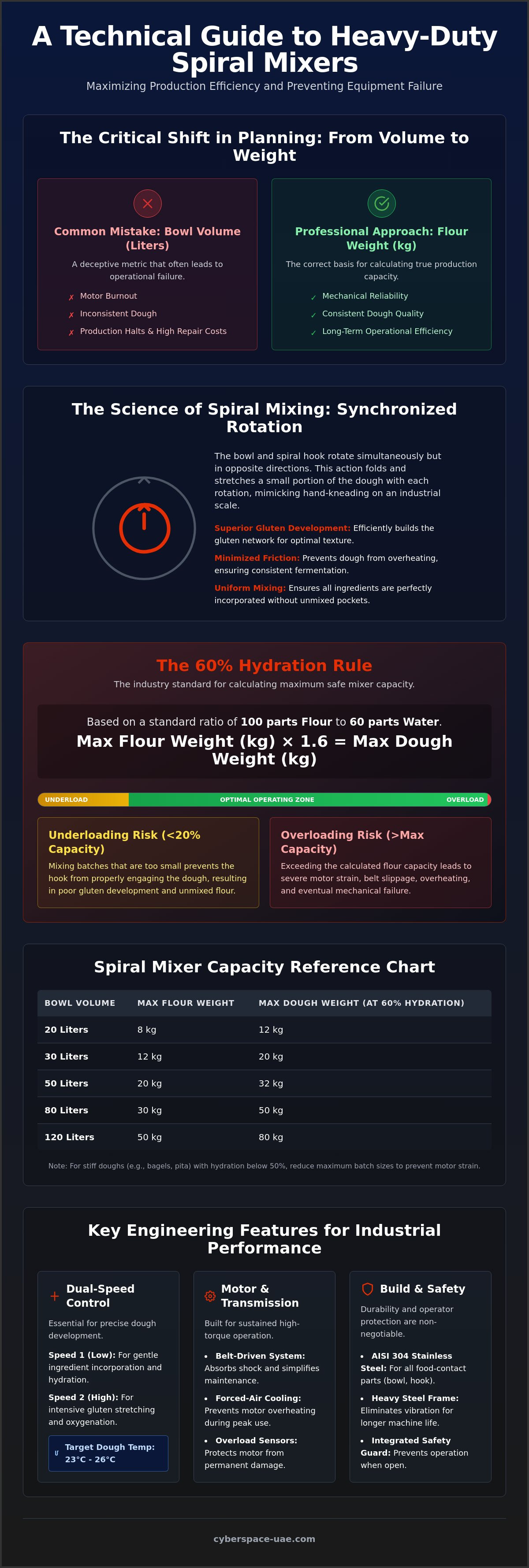
Industrial dough production requires equipment capable of sustained mechanical stress. A heavy-duty spiral mixer is defined by its ability to handle large volumes of flour without compromising dough quality. The primary mechanical distinction lies in the synchronized rotation of the bowl and the spiral hook. This configuration allows the machine to work a specific section of the dough mass repeatedly. It results in superior gluten development compared to standard vertical mixers. Spiral mixers are specifically engineered to minimize friction, which prevents premature dough fermentation.
The architecture of these machines centers on high-capacity stainless steel bowls, reinforced spiral hooks, and high-torque motors. Hooks are constructed from hardened steel to resist bending under the pressure of low-hydration doughs. The bowl must maintain a consistent gap between the hook and the side walls to ensure no unmixed flour remains at the bottom of the batch. Industrial food service operations rely on these machines to produce consistent results across multiple shifts. The synchronization between the bowl's rotation and the hook's movement ensures that the dough is folded and stretched rather than simply spun. This mechanical action mimics hand-kneading at a massive industrial scale.
Heavy-duty models are often built with cast iron or thick-gauge steel frames to eliminate vibration during high-speed cycles. This stability extends the life of the internal bearings and ensures the machine remains stationary on the bakery floor. For a heavy duty spiral mixer Dubai, these build standards are non-negotiable for long-term reliability. This process is vital for high-hydration artisanal breads and dense bagel doughs alike.
The Role of Dual Speed Functionality
Dual-speed functionality is essential for industrial dough processing. Speed one focuses on hydration, slowly incorporating water into dry ingredients to create a uniform mass. Once the dough forms, speed two provides the kinetic energy for intensive gluten stretching and oxygenation. Operators must manage these phases to control friction. High-speed mixing generates heat. Maintaining the final dough temperature between 23°C and 26°C is critical for consistent yeast activity across large batches.
Heavy Duty Motor and Transmission Systems
Transmission systems in a heavy duty spiral mixer Dubai are typically belt-driven for shock absorption and easier maintenance. These systems protect motors from torque spikes during heavy loads. In high-ambient temperature environments, motors require robust thermal management. Forced-air cooling and high-grade insulation prevent thermal shutdown during peak hours. Integrated overload sensors provide a final layer of protection, cutting power before permanent mechanical damage occurs to the internal windings.
Spiral Dough Mixer Capacity Chart: Flour vs. Dough Weight
Total bowl volume is a volumetric measurement, not a production rating. Relying on liter capacity alone for procurement often results in chronic equipment failure. A heavy duty spiral mixer Dubai requires specific headroom to allow for dough expansion and mechanical movement during high-speed cycles. The industry standard for safe operation is the 60% hydration rule. This ratio assumes 60 parts water to 100 parts flour. Adhering to this calculation ensures the motor maintains optimal torque without exceeding its thermal limits.
Motor strain is the primary consequence of incorrect capacity planning. Overloading the bowl forces the transmission to work beyond its rated resistance. This leads to belt slippage, gear fatigue, and eventual motor burnout. Conversely, mixing batches that are too small is equally inefficient. Most industrial spiral hooks require a minimum of 20% of the maximum bowl capacity to engage the dough mass effectively. Without this resistance, the hook cannot properly stretch the gluten, resulting in poor dough development and unmixed flour pockets.
Standard Capacity Reference Table
The following table outlines operational limits for standard industrial models based on 60% hydration. These figures represent the maximum safe load for continuous commercial use.
| Bowl Volume (L) | Max Flour Weight (kg) | Max Dough Weight (kg) |
|---|---|---|
| 20L | 8 kg | 12 kg |
| 30L | 12 kg | 20 kg |
| 50L | 20 kg | 32 kg |
| 80L | 30 kg | 50 kg |
| 120L | 50 kg | 80 kg |
Operational requirements change when processing stiff doughs for pita or bagels. These recipes often feature hydration levels below 50%. This lack of moisture increases mechanical resistance significantly. For these applications, reduce the maximum flour weight by 20% to prevent transmission damage. Professional bakeries can view industrial dough processing specifications to match specific machinery to their daily output requirements.
Calculating Capacity for High-Hydration Doughs
High-hydration doughs, such as sourdough or ciabatta, often exceed 75% hydration. While these mixtures offer less resistance to the motor, they occupy more physical volume in the bowl. The increased liquid content makes the dough more fluid, increasing the risk of overflow during the oxygenation phase. When working with 75%+ hydration, maintain a 30% safety margin in bowl volume. This prevents dough from climbing the spiral hook or escaping through the wire grid guard during high-speed mixing. Precise volume management is essential for maintaining a clean and safe industrial kitchen environment.
Key Engineering Features for Industrial Mixing Performance
Industrial performance relies on material durability and operator safety. Every food contact surface in a heavy duty spiral mixer Dubai must utilize AISI 304 stainless steel. This alloy provides the necessary corrosion resistance against yeast, acid, salt, and humidity. Safety protocols are integrated directly into the mechanical design through specific components:
- Wire grid guards: These prevent limb entry while allowing visibility and ingredient addition.
- Safety interlock switches: These terminate power immediately upon lifting the guard.
- Emergency stop buttons: Prominent, mushroom-head buttons positioned for immediate access.
Control systems define the level of precision in a bakery's workflow. Manual panels utilize analog timers and physical switches. They offer simplicity and ease of repair. Digital control panels provide programmable multi-phase mixing cycles. These systems automatically switch from low to high speed based on pre-set duration. This eliminates human error and ensures uniform dough development across different shifts. Reversible bowl rotation is a specific engineering feature that facilitates two functions. First, it assists in the initial blending of dry ingredients. Second, it simplifies the extraction of finished dough by breaking the suction between the dough mass and the bowl wall. This reduces physical strain on the operator during the unloading process.
Structural Integrity and Vibration Control
Mechanical stability is a prerequisite for high-capacity mixing. Cast iron frames provide superior vibration dampening compared to standard steel. Heavy-gauge reinforced steel frames offer a balance of rigidity and weight for 24/7 industrial operations. Anti-vibration leveling feet are essential for maintaining machine position during high-torque cycles. These components prevent the mixer from "walking" across the floor when processing stiff doughs. Modern engineering also focuses on noise reduction. Precision-machined pulleys and high-tension multi-groove belts reduce decibel levels, creating a safer acoustic environment in high-volume production facilities.
Maintenance and Hygiene Standards
Hygiene standards require seamless bowl welding to eliminate bacterial harbor points. The interior finish must be polished to prevent dough adhesion and facilitate rapid sanitization. All electrical components, including the control housing, should carry an IP-54 rating or higher to protect against dust and moisture ingress during wash-down procedures. Maintenance efficiency is achieved through easy-access side and rear panels. These allow technicians to perform belt tensioning, lubrication, and motor inspections without disassembling the primary drive train. Using a heavy duty spiral mixer Dubai with these engineering standards reduces long-term maintenance costs and ensures compliance with Dubai Municipality food safety regulations.
Selecting Mixers for High-Volume National Bakery Operations
Operational scaling in the UAE bakery market, currently projected to grow at a CAGR of 5.5% through 2032, requires precise equipment synchronization. Mixer output must align directly with the throughput of deck ovens and rotary ovens. A mismatch creates production bottlenecks or underutilized heating capacity. Calculating cycles per hour is the standard method for determining procurement needs. A standard industrial mixing cycle typically spans 12 to 18 minutes, including loading and extraction. This allows for approximately three to four batches per hour per machine.
Commercial kitchen space optimization is a critical factor for urban production centers. Selecting a heavy duty spiral mixer Dubai with a vertical footprint minimizes floor usage while maximizing batch weight. High-volume facilities prioritize machines with integrated hydraulic lifters to facilitate rapid dough transfer. Reliability depends on the availability of local technical support. Procurement strategies must prioritize suppliers with a verified inventory of spare parts within the UAE. This ensures that component failures don't lead to extended production halts during peak demand periods.
Pizza and Bakery Specific Requirements
High-volume pizzeria operations require specific torque profiles to handle low-hydration doughs consistently. Stiff doughs for regional breads like pita or saj place maximum stress on the transmission system. Franchise operations utilize these machines to maintain product uniformity across multiple locations. Precise timing and speed control ensure that the crumb structure and crust texture remain identical regardless of the operator. This mechanical consistency is fundamental for brand integrity in competitive retail environments.
Integrating Mixers into the Production Line
Efficient dough flow requires synchronization between the mixer and downstream dough processing equipment. Once mixing is complete, the dough must move quickly to dividers, rounders, and provers to maintain fermentation schedules. Workflow ergonomics focus on reducing manual handling. Utilizing mixers with removable bowls or tilting discharge systems speeds up this transition. This integration reduces labor costs and minimizes the risk of dough over-proofing on the floor. Facilities looking to optimize these cycles can consult with industrial equipment specialists to refine their production layout.
Industrial Dough Processing Solutions from Cyberspace Kitchen & Bakery Equipment
Cyberspace Kitchen & Bakery Equipment serves as a specialized facilitator for industrial bakery procurement in the UAE. We provide the technical infrastructure required for high-volume dough production. Our inventory focuses exclusively on new, professional-grade machinery designed for industrial longevity. The heavy duty spiral mixer Dubai range we offer is engineered to withstand the mechanical stress of continuous shifts. Each unit features the high-torque motors and reinforced transmission systems necessary for consistent gluten development in large-scale operations.
Technical consulting is a core component of our service. We assist bakery operators in calculating ROI based on batch cycles and equipment throughput. It's essential that your investment aligns with the projected growth of the local bakery market. Our team evaluates your current production layout to identify potential bottlenecks. We then recommend machinery that optimizes floor space while maximizing output. This methodical approach ensures that every piece of equipment contributes to long-term operational efficiency.
Why National Bakeries Choose Cyberspace Kitchen & Bakery Equipment
National production facilities require more than just individual machines; they need integrated systems. Cyberspace Kitchen & Bakery Equipment provides a comprehensive range of thermal and mechanical solutions. This includes high-capacity Deck Ovens for traditional bread production and specialized Rational combi oven for bakery units for diverse pastry requirements. We strictly avoid used or refurbished equipment. This commitment to brand-new, high-end tools ensures that your facility maintains the hygiene and safety standards required by Dubai Municipality regulations. Our expertise extends to the synchronization of spiral mixers with downstream dough sheeters and rotary ovens.
Procurement and Next Steps
The path from selection to installation is streamlined to minimize downtime. Operators can request detailed technical specifications for any heavy duty spiral mixer Dubai in our catalog. This allows your engineering team to verify electrical and spatial requirements before purchase. We provide industrial quotes that reflect current market realities for professional-grade equipment. Once procurement is finalized, Cyberspace Kitchen & Bakery Equipment manages national delivery across the UAE. Our professional installation services include mechanical calibration and initial safety testing. Contact our specialized consultants today to receive a technical assessment of your equipment requirements and secure the tools necessary for industrial-scale success.
Scaling Industrial Production with Technical Precision
Operational success in large-scale dough processing depends on the alignment of machinery specifications with specific production requirements. Applying the 60% hydration rule and verifying motor torque ratings are essential steps to prevent mechanical failure. These technical considerations ensure that your facility maintains consistent output without compromising dough quality or equipment longevity. High-performance engineering remains the standard for professional bakeries seeking sustainable growth in a competitive market.
Procuring a heavy duty spiral mixer Dubai from a specialized supplier guarantees access to brand-new, industrial-grade tools. Cyberspace Kitchen & Bakery Equipment focuses on high-end solutions that meet the rigorous demands of the UAE food sector. Our team provides the expertise necessary to integrate new machinery into existing production lines effectively. This commitment to quality ensures your investment delivers reliable results across every shift. View our range of industrial spiral mixers and request a technical quote to begin your procurement process. Modernizing your equipment is the most direct path to achieving long-term operational excellence.
Frequently Asked Questions
What is the difference between a spiral mixer and a planetary mixer for commercial use?
Spiral mixers are engineered specifically for dough production through the synchronized rotation of the bowl and the spiral hook. This specialized action minimizes friction and prevents dough overheating during intensive mixing. Planetary mixers utilize a stationary bowl with interchangeable attachments, making them versatile for whisking and blending but less efficient for high-volume bread dough development.
How much flour can a 50-liter spiral mixer handle for bread dough?
A 50-liter heavy duty spiral mixer Dubai typically accommodates a maximum of 20 kg of flour. This results in approximately 32 kg of total dough when following the standard 60% hydration rule. Adhering to these limits is essential to prevent motor strain and ensure uniform gluten development across the entire batch.
Why do heavy-duty spiral mixers have two speeds?
Dual speeds facilitate two distinct phases of the mixing process. The first speed focuses on ingredient hydration and initial blending at a low RPM. The second speed provides the high-torque kinetic energy required for gluten stretching and dough oxygenation. This phased approach ensures a consistent crumb structure in professional baking applications.
Can I mix small batches of dough in a high-capacity spiral mixer?
Industrial spiral mixers require a minimum load to engage the dough mass effectively. Most machines need at least 20% of their maximum bowl capacity to ensure the spiral hook can stretch the dough against the bowl wall. Mixing batches below this threshold often leads to unmixed flour pockets and poor dough development.
What maintenance is required for an industrial spiral dough mixer?
Standard maintenance involves daily sanitization of all food contact surfaces using non-abrasive agents. Technical requirements include weekly inspections of belt tension and monthly lubrication of the primary drive chain. Professional bakeries should schedule annual electrical inspections to verify motor insulation and safety interlock functionality.
Is a 3-phase power supply necessary for heavy-duty spiral mixers?
Most heavy duty spiral mixer Dubai models with a capacity exceeding 30 liters require a 3-phase power supply. This electrical configuration provides the necessary torque for processing stiff doughs without overstressing the motor. Single-phase units are available for smaller operations but generally lack the endurance required for continuous industrial cycles.
How does dough hydration affect the maximum capacity of a mixer?
Low-hydration doughs, such as those for bagels or pita, increase mechanical resistance and require a 20% reduction in total flour weight. High-hydration mixtures occupy more physical volume and can climb the hook during high-speed cycles. Operators must maintain a 30% safety margin in bowl headroom when processing doughs with 75% hydration or higher.
What safety certifications should I look for in bakery equipment in the UAE?
CE certification is the standard requirement for commercial kitchen equipment imported into the UAE. Some electrical components may also require ESMA or ECAS registration for local compliance. Ensure the machinery features integrated safety interlocks on the wire guard and accessible emergency stop buttons to meet Dubai Municipality safety standards.