
ROI Commercial Kitchen Equipment: Industrial Procurement Analysis 2026
With prices for glass-integrated components like combi ovens and blast chillers rising by 12.3% in early 2026, the cheapest machinery often results in the highest total cost of ownership. Industrial operators face mounting pressure from rising energy costs and chronic labor shortages. It's clear that a low initial price tag doesn't solve the problem of inconsistent dough processing or high product waste. Calculating the ROI commercial kitchen equipment provides requires a shift from procurement cost to operational throughput.
Success in the current market demands a rigorous technical framework for evaluating professional-grade tools. This analysis delivers that formula. You'll learn how investing in premium rotary ovens, spiral mixers, and Rational units reduces overhead through energy efficiency and precise automation. We'll provide the data needed to justify high-performance procurement and secure production slots in an increasingly competitive industrial landscape.
Key Takeaways
- Analyze the technical difference between simple acquisition price and long-term Total Cost of Ownership (TCO).
- Identify how production throughput in Deck and Rotary ovens accelerates the ROI commercial kitchen equipment delivers.
- Leverage automation in Spiral Mixers and Rational units to offset rising labor expenses and dough processing errors.
- Quantify financial gains from shelf-life extension and batch failure mitigation through Blast Chiller integration.
- Establish a 5-year equipment replacement framework to prioritize high-impact industrial assets based on operational savings.
Defining ROI in the Commercial Food Sector
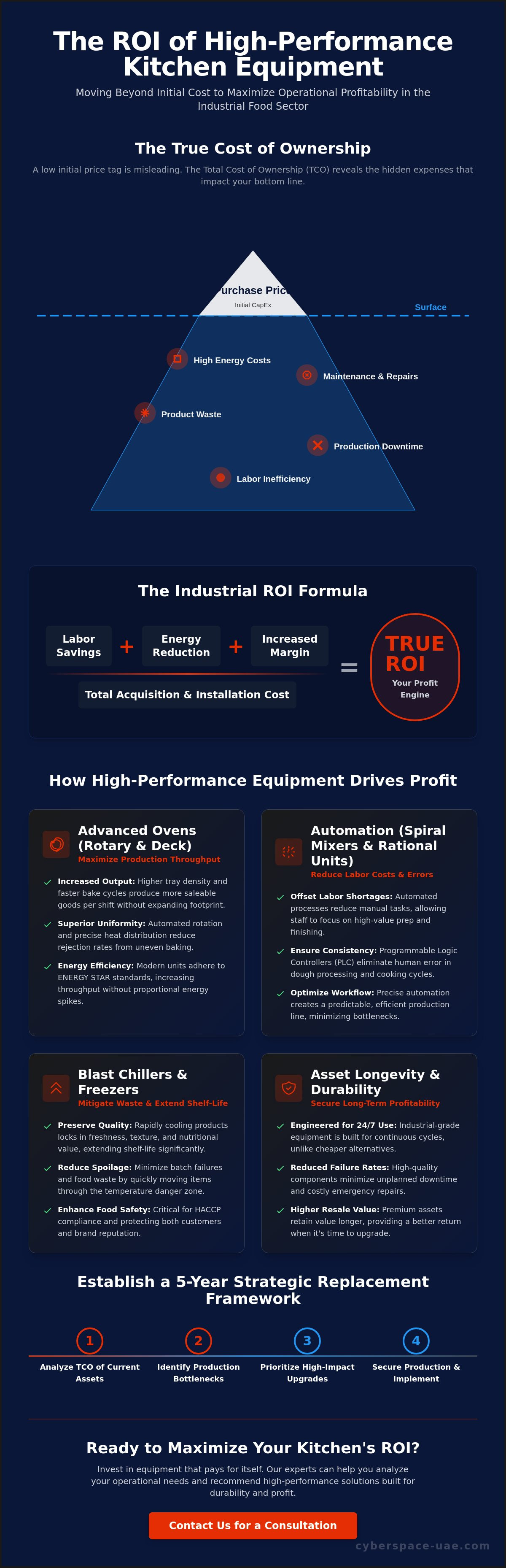
Industrial procurement requires a shift from simple accounting to deep operational analysis. In the commercial food sector, Return on Investment (ROI) is the ratio between net income and the cost of the investment. For heavy-duty assets, this calculation determines the speed at which a machine pays for itself through improved efficiency and output. Relying solely on the initial purchase price ignores the long-term fiscal impact of ROI commercial kitchen equipment. High-performance machinery carries a higher entry cost but delivers superior durability and lower operational overhead over a ten-year cycle.
Initial price is a misleading metric for professional procurement. A cheap oven that requires frequent repairs or consumes excessive energy quickly becomes more expensive than a premium alternative. Asset longevity is the cornerstone of professional-grade gear. Industrial Deck Ovens and Rotary Ovens are engineered for continuous 24-hour cycles. Choosing equipment based on durability ensures the investment remains a profit center rather than a recurring maintenance liability.
The ROI Formula for Industrial Machinery
Industrial ROI equals the sum of annual labor savings and energy reductions plus increased production margin, divided by the total cost of acquisition and installation. Upgrading to advanced Rotary Ovens or Spiral Mixers isn't just a hardware swap; it's a strategic move to capture net annual profit increases. Procurement teams must factor in the cost of capital and the physical installation expenses to reach an accurate figure. Simple profit formulas used by competitors often fail because they overlook the depreciation cycles and maintenance schedules of high-volume kitchen assets. A true calculation tracks how much more product a Rational unit can produce per hour compared to legacy systems.
Total Cost of Ownership (TCO) vs. Initial CapEx
Initial capital expenditure (CapEx) represents only a small fraction of an asset's lifetime cost. Total Cost of Ownership (TCO) accounts for hidden variables like routine maintenance, spare parts availability, and the cost of unplanned downtime. In the UAE, high ambient temperatures increase the load on cooling systems, making the energy consumption of industrial ovens and blast chillers a critical variable. Investing in professional baking equipment Dubai operators trust ensures that machinery withstands these harsh industrial demands. ROI commercial kitchen equipment remains high when the asset longevity extends beyond the standard five-year depreciation window. When a primary Deck Oven fails, the loss isn't just the repair bill. It's the lost revenue from every unbaked batch. High-quality components reduce these failure rates and keep production lines moving.
Throughput Gains: How Advanced Ovens Accelerate Payback
Production capacity serves as the primary driver of financial return in high-volume culinary operations. While simple efficiency metrics look at energy, throughput measures the volume of saleable goods produced per shift. Upgrading to advanced ovens directly impacts ROI commercial kitchen equipment by increasing output without expanding the physical footprint. Modern systems often adhere to ENERGY STAR certified kitchen equipment standards to ensure that higher throughput doesn't result in proportional energy spikes. Programmable logic controllers (PLC) further accelerate payback by minimizing human error and ensuring every batch meets quality specifications. These systems allow for precise control over steam injection and fan speeds, which is vital for reducing the rejection rate of high-value ingredients.
Throughput Analysis of Industrial Rotary Ovens
Industrial rotary ovens are engineered for maximum volume and uniform results. These units utilize rotating rack systems to ensure consistent airflow across every tray, eliminating the need for manual rotation. This uniformity directly increases product yield by reducing rejection rates caused by uneven browning or raw centers. Large-scale operations benefit from fast bake cycles and high tray density, which are critical when managing the 20-24 week procurement lead times currently seen in the 2026 market. For a detailed breakdown of capacity specifications, consult the industrial rotary baking oven procurement guide. Efficient heat distribution ensures that even delicate pastries achieve consistent internal temperatures, protecting the profit margin of each batch. By automating the rotation process, these ovens also reduce the physical labor required per rack, allowing staff to focus on prep and finishing tasks.
Deck Ovens and Artisan Production Value
Deck ovens provide the thermal mass necessary for artisan bread production. Stone-deck baking allows for a premium price point that isn't achievable with standard convection methods. Unlike rotary systems, multi-deck ovens offer versatility by allowing simultaneous production lines at different temperatures. Fast temperature recovery speeds are essential for maintaining hourly output during back-to-back loading cycles. High-performance deck ovens maintain a stable environment, ensuring that ROI commercial kitchen equipment is realized through superior product quality and brand consistency. Rapid recovery prevents the "cold hearth" syndrome that can stall production in lower-grade machinery. Operators should view high-performance ovens to match thermal capacity with their specific hourly production requirements. This strategic alignment ensures that every square foot of the kitchen generates maximum revenue, even during peak demand periods.
Labor Reduction and Workflow Optimization
Rising labor costs in the UAE industrial sector necessitate a transition toward automated systems. High-performance machinery serves as a critical hedge against these mounting operational expenses. By integrating smart kitchen technology, facilities reduce their reliance on large teams for repetitive tasks. This transition optimizes the ROI commercial kitchen equipment provides by shifting staff focus toward quality control and finishing. Automated workflows minimize the impact of skilled labor shortages while maintaining strict production schedules. Streamlining these processes ensures that the facility operates at peak efficiency during every shift.
Automation in Dough Processing
Manual lamination and mixing represent significant bottlenecks in industrial baking. Replacing manual processes with high-capacity Dough Sheeters drastically reduces the labor hours required for pastry production. Industrial Spiral Mixers and Planetary Mixers ensure precise dough hydration and gluten development across every batch. These machines eliminate the variability inherent in manual mixing, ensuring that product quality remains constant. Consistency gains lead to fewer rejected batches and better ingredient utilization. Ergonomic designs in these machines also reduce physical strain on operators, decreasing the likelihood of injury-related downtime. High-capacity mixers allow a single operator to manage double the volume of a manual station, effectively doubling the output per labor hour.
Smart Features of Rational iCombi Pro
The Rational iCombi Pro integrates intelligence into the core cooking process to minimize human intervention. One of its primary labor-saving features is the automated self-cleaning cycle. This system eliminates the hours typically spent on manual scrubbing, allowing staff to reallocate their time to high-value prep work. Multi-cook functionality allows the unit to replace several specialized appliances, simplifying the kitchen layout and reducing the training time required for new employees. Remote monitoring and data logging enable multi-site managers to track performance and compliance without being physically present. This level of oversight ensures that ROI commercial kitchen equipment is maximized through consistent operational uptime and reduced maintenance needs. Centralized data logging also streamlines the documentation required for food safety audits, further reducing administrative labor. These smart features turn the cooking center into a predictable, high-output asset.
Waste Mitigation and Food Safety ROI
Financial losses in industrial food production often stem from batch failure and excessive ingredient waste. Inconsistent machinery causes product rejection, which directly erodes the ROI commercial kitchen equipment provides. Effective waste mitigation requires precise temperature and humidity control during every production stage. Utilizing advanced Blast Chillers and Provers allows facilities to standardize output and protect their profit margins. HACCP compliance acts as a fundamental risk management strategy, preventing costly food safety incidents and inventory disposal. High-performance equipment ensures that every batch meets rigorous safety standards while maintaining the sensory qualities customers expect. Reducing waste isn't just about saving ingredients; it's about reclaiming the labor and energy already invested in the production cycle.
Blast Chilling and Shelf-Life Extension
The physics of rapid cooling is essential for moisture retention and texture preservation. Industrial Blast Chillers lower core temperatures through the danger zone quickly, preventing the formation of large ice crystals that damage cellular structure. This technology enables cook-chill production models, allowing facilities to produce larger batches and store them safely without quality loss. Reducing inventory waste through extended shelf life improves the overall efficiency of the supply chain. For detailed technical requirements, review the commercial blast chiller Dubai safety guide. These systems ensure that products remain fresh for longer periods, facilitating better production scheduling and reducing the frequency of small-batch runs. It's a critical component for maintaining consistent stock levels in high-demand environments.
Consistency and Quality Retention
Standardizing output across multiple shifts requires programmable machinery that eliminates manual guesswork. Humidity-controlled Provers prevent over-proofing losses by maintaining exact atmospheric conditions for dough development. This precision ensures maximum final product volume and protects brand reputation through repeatable excellence. Protecting the integrity of each batch is a direct investment in the operation's financial health. Facilities that prioritize technical accuracy in proofing and chilling see a marked reduction in total food waste. Investing in professional equipment minimizes the risk of human error during critical fermentation stages. Reliable equipment ensures that the final crust and crumb structure meet industrial specifications every time. To optimize your facility's output, browse industrial food safety solutions and secure your production consistency.
Strategic Procurement and Implementation
Strategic procurement requires a 5-year equipment replacement roadmap to ensure long-term fiscal stability. High-impact assets like Rotary Ovens and Rational units should be prioritized for immediate ROI. These machines offer the fastest recovery through labor reduction and energy savings. Local technical support and parts availability are mandatory criteria for any industrial acquisition. Downtime in a high-volume facility quickly negates any initial savings from choosing a less-supported brand. A structured implementation plan prevents the operational shock of simultaneous equipment failures. It allows the facility to stagger capital expenditures while steadily improving throughput. Identifying which assets are nearing the end of their lifecycle helps avoid emergency purchases that often carry premium shipping costs and limited selection.
Calculating Payback Periods
Calculate the payback period by dividing the total investment by the sum of annual energy savings, labor reductions, and increased throughput. For a high-efficiency oven, these combined savings often cover the acquisition cost within 18 to 24 months. This calculation must include the reduction in product waste discussed in previous sections. Premium industrial brands maintain a higher resale value, which should be factored into the final asset valuation. Using data logs from smart kitchen systems allows operators to verify these projected efficiency gains against actual performance metrics. This data-driven approach ensures that ROI commercial kitchen equipment remains a measurable metric rather than a theoretical projection. Accurate tracking of utility bills before and after installation provides concrete evidence of the machine's performance. High-performance Deck Ovens and Provers often show the most immediate impact on utility consumption in industrial baking environments.
Partnering with Industrial Specialists
Supplier technical expertise is as important as the machinery itself. Professional after-sales service ensures that critical assets like Spiral Mixers and Blast Chillers remain operational during peak production. In industrial contexts, brand-new equipment is the only viable option for ensuring reliability and compliance with current safety standards. Used machinery often carries hidden costs in the form of accelerated wear and lack of manufacturer support. New equipment also ensures compliance with the latest environmental regulations, such as the 2026 HFC phasedown rules. For specialized baking and kitchen solutions, contact Cyberspace Kitchen & Bakery Equipment to align your procurement strategy with high-performance industrial requirements. Evaluating a supplier's ability to provide rapid technical response is essential for maintaining 24/7 production cycles. A reliable partner facilitates a streamlined user journey from discovery to installation.
Final Procurement Checklist:
- Audit current energy and labor costs per production unit.
- Verify local spare parts availability for all primary assets like Combi ovens and mixers.
- Prioritize replacements based on throughput capacity gains and waste reduction potential.
- Document the expected lifespan and projected resale value of each unit.
- Confirm compliance with 2026 food safety and ventilation standards.
- Ensure the primary keyword ROI commercial kitchen equipment is the central metric for every purchase decision.
Optimizing Industrial Output for 2026 and Beyond
Modern industrial procurement requires a transition from price-based selection to performance-driven investment. This analysis has demonstrated that ROI commercial kitchen equipment is maximized through high-volume throughput, automated labor savings, and the mitigation of ingredient waste. Facilities that implement a technical replacement roadmap secure a competitive advantage against rising utility costs and labor shortages. Reliable assets like high-efficiency ovens and blast chillers pay for themselves by maintaining consistent production cycles and protecting brand reputation. Every square meter of the kitchen must contribute to the bottom line through measurable efficiency gains.
Cyberspace Kitchen & Bakery Equipment serves as an authorized dealer for high-efficiency Rational units and industrial ovens. Our focus remains strictly on brand-new, high-performance baking machinery that meets specific UAE industrial kitchen standards. Our technical expertise ensures that every procurement decision aligns with the operational realities of large-scale culinary production. Precise equipment selection is the most effective hedge against market volatility and operational overhead. Start your transition to a high-output facility today.
Consult with Cyberspace Kitchen & Bakery Equipment specialists for high-ROI equipment solutions and secure the future of your industrial operation.
Frequently Asked Questions
What is a good ROI for commercial kitchen equipment in the UAE?
A good ROI is typically achieved when the machine pays for itself within 18 to 36 months through operational savings and increased output. In the UAE market, high utility costs and labor expenses mean that ROI commercial kitchen equipment must focus on long-term durability rather than just the initial purchase price. Superior engineering ensures that the asset remains a profit center throughout its ten-year lifecycle.
How does energy efficiency affect the ROI of industrial ovens?
Energy efficiency directly reduces monthly utility overhead, which shortens the payback period. Modern industrial ovens with high-density insulation and precise heat recovery systems minimize thermal loss during continuous baking cycles. These technical specifications ensure that the facility maintains high production volume without proportional increases in electricity or gas consumption. Efficient heat management also reduces the load on kitchen cooling systems.
Is it better to buy multi-functional equipment like Combi ovens for ROI?
Multi-functional units like Rational Combi ovens provide a higher ROI by replacing several specialized appliances and reducing the overall kitchen footprint. These units consolidate various cooking processes, which lowers the total cost of ownership and simplifies maintenance schedules. This consolidation leads to more efficient workflow and lower training requirements for staff. Smaller footprints also reduce the capital required for kitchen ventilation and floor space.
How do I factor maintenance costs into my ROI calculation?
Maintenance costs should be calculated as an annual percentage of the initial investment, including spare parts and technical service fees. Factoring in these recurring expenses provides a realistic Total Cost of Ownership (TCO). High-performance machinery often has lower long-term maintenance costs due to component durability and better engineering standards. Unplanned downtime costs must also be included to account for lost production revenue during repairs.
Can upgrading dough processing equipment reduce labor costs significantly?
Upgrading to industrial Dough Sheeters and Spiral Mixers reduces labor costs by automating repetitive manual tasks. This automation allows a single operator to manage larger production volumes with greater consistency. Reducing manual intervention minimizes errors in dough hydration and gluten development, leading to higher product yield. Automated mixing and sheeting also decrease the physical strain on staff, reducing the risk of workplace injuries.
What is the average payback period for a high-end Deck Oven?
The average payback period for a high-end Deck Oven ranges from 24 to 48 months depending on production volume and product margins. While the initial CapEx is higher, the ability to produce premium artisan goods at a higher price point accelerates the financial return. Durability ensures the asset remains profitable long after the initial investment is recovered. High thermal mass in stone decks ensures faster recovery times during peak shifts.
Does professional installation impact the ROI of baking machinery?
Professional installation is critical for ensuring that equipment operates within its designed technical specifications. Incorrect setup can lead to energy inefficiency, frequent mechanical failures, and voided warranties. Proper calibration during installation maximizes the ROI commercial kitchen equipment offers by ensuring immediate operational peak performance. Technical experts ensure that utilities like water filtration and ventilation are correctly integrated to protect the machinery.
How does blast chilling improve the profitability of a bakery?
Blast chilling improves profitability by extending product shelf life and reducing inventory waste. Rapid cooling preserves texture and moisture, allowing for cook-chill production models that optimize kitchen staff schedules. This technology enables bakeries to produce larger batches during off-peak hours, reducing labor costs and ensuring consistent stock availability. Effective chilling prevents the bacterial growth that leads to batch failure and financial loss.