
Commercial Bakery Equipment Checklist: Industrial Essentials for 2026
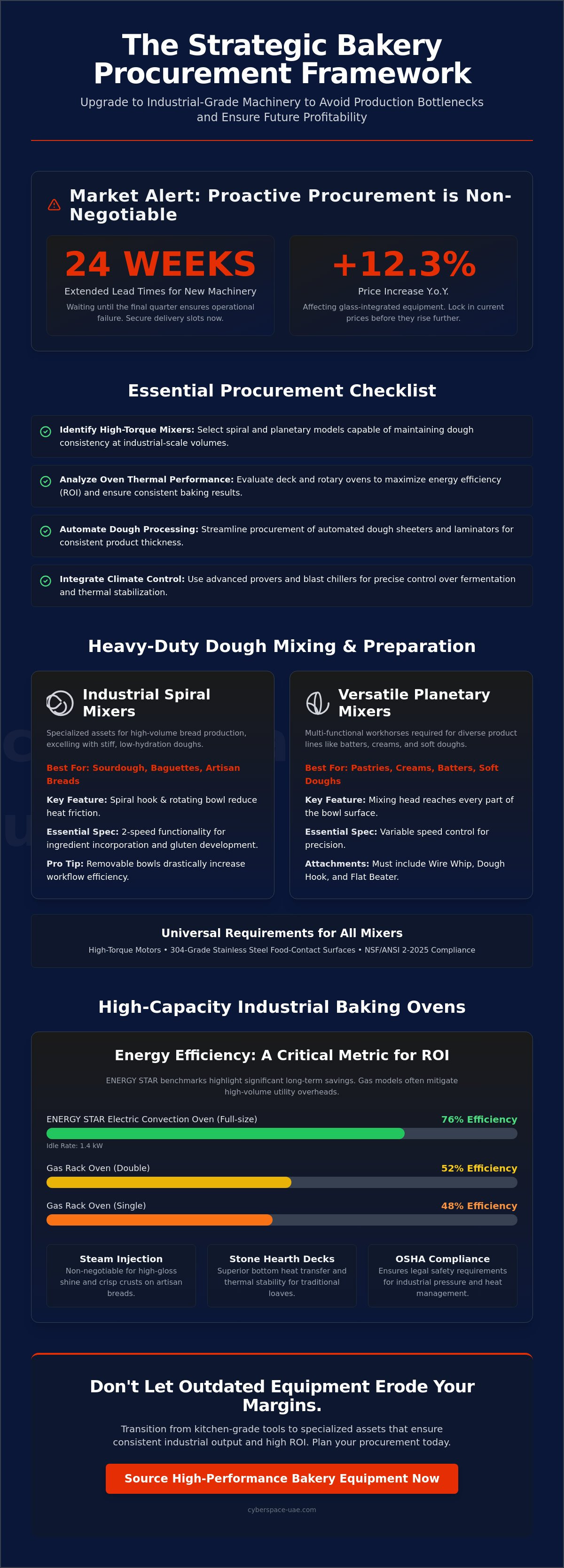
Waiting until the final quarter to source machinery ensures operational failure in 2026. With glass-integrated equipment prices rising 12.3% year-over-year and lead times stretching to 24 weeks, procurement is now a strategic race. You likely recognize that underpowered mixers and inefficient ovens are more than just nuisances. They are production bottlenecks that erode margins. Utilizing a professional commercial bakery equipment checklist is the only way to avoid the inconsistent quality and high energy costs that plague under-equipped facilities.
This guide provides a professional-grade procurement framework for selecting high-performance industrial machinery. You'll learn how to transition from kitchen-grade tools to specialized assets that ensure consistent industrial output and high ROI. We'll examine essential specifications for spiral mixers, rotary ovens, and dough sheeters. The analysis includes the latest NSF/ANSI 2-2025 sanitation requirements and ENERGY STAR efficiency benchmarks. This ensures your facility remains compliant, scalable, and cost-effective.
Key Takeaways
- Identify high-torque spiral and planetary mixers capable of maintaining dough consistency at industrial-scale volumes.
- Analyze thermal performance criteria for deck and rotary ovens to maximize energy efficiency and operational ROI.
- Apply a professional commercial bakery equipment checklist to streamline the procurement of automated dough sheeters and laminators.
- Integrate advanced provers and blast chillers to maintain precise climate control over fermentation and thermal stabilization cycles.
- Leverage multi-functional combi ovens and programmable technology to optimize production capacity within condensed commercial footprints.
Heavy-Duty Dough Mixing and Preparation Station
The industrial mixing station dictates the ceiling of your production capacity. It's the primary foundation for Commercial baking operations where consistency is non-negotiable. High-volume output depends entirely on motor torque. Industrial mixers require high-torque motors engineered to maintain consistent RPM under the heavy resistance of low-hydration dough masses. Stalling during a peak shift halts the entire production line. This makes motor specifications a priority on any commercial bakery equipment checklist.
Construction materials must prioritize 304-grade stainless steel for all food-contact surfaces. This ensures long-term durability against corrosive ingredients and rigorous cleaning cycles. It also ensures your facility remains compliant with the NSF/ANSI 2-2025 food equipment standard. When evaluating machinery, bowl capacity must align with specific hourly production targets. A 60-quart mixer is insufficient for a facility aiming for 500 loaves per hour. Calculate your batch times, including loading and unloading intervals, to determine the required bowl volume. Precision at this stage prevents the production bottlenecks that erode profit margins.
Industrial Spiral Mixers for Bread Production
Spiral mixers are specialized assets for high-volume bread production. They excel with stiff, low-hydration doughs such as sourdough and baguettes. The spiral hook rotates while the bowl spins, which significantly reduces heat friction during the mixing process. Fixed bowls are suitable for smaller footprints; however, removable bowl options increase workflow efficiency in industrial settings. They allow one batch to mix while another is shaped. Look for two-speed functionality. Low speed incorporates ingredients effectively. High speed develops the gluten structure required for professional-grade crumb texture.
Planetary Mixers for Versatile Pastry Applications
Planetary mixers offer the multi-functional capabilities required for diverse product lines. They handle batters, creams, and high-hydration doughs with equal precision. The mixing head rotates on an offset shaft, reaching every part of the bowl surface. Professional models must include three essential attachments: a wire whip for aeration, a dough hook for soft doughs, and a flat beater for heavy batters. Variable speed control is an essential feature. It provides the precision needed for delicate confectionery, which is crucial for businesses that maintain the high quality found at varakedibleluxury.com, and prevents ingredient splashing. Including these versatile units in your commercial bakery equipment checklist ensures your facility can adapt to changing market demands without additional capital expenditure.
High-Capacity Industrial Baking Ovens
The industrial oven is the primary heat engine of your facility. Choosing between radiant heat and convection airflow depends entirely on your product profile. Radiant heat provides the thermal mass necessary for heavy crust development. Forced convection airflow ensures rapid, uniform heat transfer for high-volume batches. When evaluating machinery for your commercial bakery equipment checklist, verify that every unit adheres to OSHA Bakery Equipment Safety Standards. This ensures your installation meets legal safety requirements for industrial pressure and heat management.
Energy efficiency is a critical metric for long-term ROI. ENERGY STAR certified electric convection ovens (full-size) require 76% cooking energy efficiency with an idle rate of 1.4 kW. Gas rack ovens provide 48% to 52% efficiency depending on single or double configurations. High-volume operations often favor gas models to mitigate utility overhead. Steam injection is another non-negotiable specification for artisan production. It facilitates the gelatinization of surface starches, producing the high-gloss shine and crisp crust expected in professional-grade bread. Capacity planning must account for the number of decks or rack positions required to meet peak hourly demand.
Procurement timelines have shifted significantly. Current market data suggests initiating quote requests 20 to 24 weeks before installation to lock in prices and secure delivery slots. This is especially vital for equipment with glass components, which saw a 12.3% price increase in early 2026. For high-performance thermal solutions, you can source professional-grade deck and rotary ovens designed for industrial durability.
Professional Deck Ovens for Artisan Consistency
Stone hearth decks are the standard for superior bottom heat transfer. They provide the thermal stability required for traditional European-style loaves. Independent temperature controls for the top and bottom of each deck allow for diverse product baking within a single footprint. This modularity prevents production bottlenecks when handling multiple recipes simultaneously. Consult with baking deck oven suppliers to determine the optimal deck height and stone material for your specific crust requirements.
Rotary Ovens for High-Volume Uniformity
Mechanical rack rotation ensures perfectly even heat distribution across every tray in the stack. This eliminates the need for manual tray rotation, which significantly reduces labor costs and heat loss. These units are the standard for high-volume pastry, cookies, and sandwich bread production. They offer high-speed throughput while maintaining product uniformity. For specific technical specifications and footprint requirements, refer to the industrial rotary baking oven guide.
Automated Dough Processing and Lamination
Mechanical consistency is the primary driver of industrial profitability in 2026. Manual dough processing is labor-intensive and prone to human error, which results in product variance. Transitioning to automated systems ensures that every unit meets strict quality specifications. This shift is reflected in market trends; the "Molders and Sheeters" category is projected to be the fastest-growing equipment segment with an 8.61% CAGR from 2026 to 2031. High-performance automation is no longer optional for facilities targeting industrial-scale output.
Space-saving considerations are vital for facility planning. Tabletop models offer a condensed footprint for boutique operations, while floor-standing units provide the high-torque performance required for continuous industrial output. Safety features are non-negotiable. Industrial units must include emergency stop buttons and physical finger guards to prevent operator injury. These safety components are essential for compliance with modern industrial standards.
Hygiene protocols require equipment with easy-access cleaning paths. Synthetic belts must resist ingredient absorption and allow for rapid sanitation. Regular belt maintenance prevents tracking issues and premature wear, ensuring the longevity of your investment. Including these maintenance requirements in your commercial bakery equipment checklist prevents unexpected downtime during peak production hours.
Industrial Dough Sheeters for Puff Pastry
Precise thickness control is essential for consistent lamination. Automated sheeters maintain uniform layers in puff pastry and croissants, which is impossible to achieve manually at scale. High-durability belts are engineered for heavy daily use and resist tearing under tension. Reversible belt operation accelerates processing times by allowing the operator to pass dough back and forth without manual repositioning. This efficiency is a core requirement on any professional commercial bakery equipment checklist.
Dough Dividers and Rounders
Exact weight consistency is critical for portion control and margin protection. Industrial dividers achieve high-precision results, reducing dough handling time significantly. Minimizing contact prevents premature fermentation caused by heat transfer from hands or extended ambient exposure. Hydraulic systems are the standard for large-scale production, providing the force necessary for high-density doughs. Manual lever systems are typically reserved for lower-volume specialty lines where speed is less critical than customization. Integrating these tools ensures a streamlined workflow from preparation to the baking stage.
Advanced Proofing and Thermal Control Systems
Industrial thermal control is the primary driver of predictable fermentation. Relying on ambient kitchen temperatures creates operational instability. Fluctuations in heat and humidity lead to inconsistent proofing times and product variance. High-performance climate control systems eliminate these variables. Managing humidity levels is particularly critical. It prevents dough skinning, which occurs when the surface dehydrates and forms a restrictive crust. Skinning prevents proper oven spring and ruins the final product's volume. Relying on kitchen "warm spots" is an amateur strategy that leads to product failure and inconsistent results.
Insulation quality directly impacts your facility's energy consumption. High-density polyurethane insulation maintains stable internal temperatures with minimal compressor or heater load. This reduces utility costs and extends the lifespan of the equipment. Modern units feature digital timers and programmable cycles. These allow for precise control over complex fermentation schedules without manual intervention. Including these technical specifications in your commercial bakery equipment checklist ensures long-term operational efficiency. Advanced units often feature AI-powered sensors that can potentially reduce energy costs by 15% to 25% through optimized temperature management.
Commercial Dough Provers and Retarders
Retarder-provers provide the ability to extend fermentation times. This slow process enhances flavor development and improves dough handling characteristics. These units offer an automatic transition from chilling to proofing. This allows dough to be prepared the previous day and proofed automatically for early morning bakes. Capacity planning is essential. Your proving volume must match your oven throughput to prevent production bottlenecks. If your oven handles 20 trays per hour, your prover must accommodate the same volume to maintain a continuous workflow. You can source industrial provers and retarders to stabilize your production schedule.
Industrial Blast Chillers for Food Safety
Blast chillers are essential for maintaining food safety and product quality in a high-volume bakery. They rapidly reduce core temperatures, ensuring compliance with strict HACCP standards. This process prevents the growth of harmful bacteria during the cooling phase. Beyond safety, blast chilling preserves moisture and texture in par-baked or finished goods. It prevents the formation of large ice crystals that damage cellular structure. For detailed safety protocols and technical requirements, consult the commercial blast chiller Dubai guide. Integrating these units into your commercial bakery equipment checklist protects both your customers and your brand reputation.
Multi-Functional Technology and Procurement Strategy
Multi-functional technology is the primary solution for bakeries operating within condensed commercial footprints. These units combine multiple cooking processes into a single footprint, maximizing output per square meter. Standardizing industrial output is now achieved through programmable intelligent cooking paths. These systems store precise temperature and humidity parameters. This ensures product uniformity across different shifts and operators. This level of automation is a critical entry on any commercial bakery equipment checklist for 2026. It eliminates the variance inherent in manual operations.
Evaluating the ROI commercial kitchen equipment is essential for long-term profitability. While used machinery may appear cost-effective initially, it lacks the energy efficiency and manufacturer warranties provided by new equipment. ENERGY STAR certified models can save up to $2,000 annually on utility bills. New machinery also eliminates the risk of hidden mechanical fatigue. Given that equipment with glass components saw a 12.3% price increase in Q1 2026, investing in new, warrantied assets protects against future inflation and unexpected repair costs. The bakery processing equipment market is projected to reach $15.97 billion in 2026. This growth underscores the need for durable, high-performance assets that can withstand continuous industrial use.
Rational Combi Ovens for Modern Bakeries
Rational systems utilize iCombi Pro technology to manage diverse baking and roasting tasks simultaneously. These units adjust climate parameters in real-time. This ensures optimal results regardless of load size. Automated cleaning systems are a vital feature. They reduce labor costs by eliminating manual scrubbing and ensuring consistent hygiene standards. High-density loading capabilities allow for maximum throughput without compromising airflow or heat distribution. These combi ovens are high-performance assets for facilities requiring extreme versatility. They allow you to switch from bread production to pastry finishing with zero downtime for manual recalibration.
Final Procurement Checklist for 2026
The final stage of procurement requires technical verification of facility infrastructure. Ensure your site supports 3-phase power. High-torque mixers and industrial ovens require significant electrical loads that standard wiring cannot handle. Assessment of ventilation and extraction hood capacity is equally important. This manages thermal output and maintains air quality. For regional specificities and localized standards, consult the professional baking equipment Dubai procurement guide. Locking in your commercial bakery equipment checklist early is vital. Current market conditions require initiating quote requests 20 to 24 weeks before installation to secure delivery slots and current pricing.
- Confirm 3-phase power availability for all heavy machinery.
- Verify extraction hood CFM ratings meet local fire and safety codes.
- Review manufacturer warranty terms for all new assets to ensure long-term coverage.
- Initiate procurement 24 weeks in advance to mitigate supply chain delays.
Optimizing Industrial Bakery Output for 2026
Industrial success depends on a professional-grade commercial bakery equipment checklist that prioritizes motor torque, energy efficiency, and automated consistency. Transitioning to specialized machinery, such as high-capacity rotary ovens and programmable dough sheeters, ensures a streamlined production workflow. Integrating advanced thermal systems, including blast chillers and retarder-provers, protects product quality and meets modern food safety standards. These assets are critical for facilities aiming to scale industrial output while managing rising energy and labor costs.
Securing new, warrantied machinery is a strategic requirement to avoid the operational risks of used alternatives. As an authorized distributor of Rational iCombi Pro, we provide specialized industrial-grade machinery backed by professional B2B support and full warranty coverage. Our portfolio includes deck ovens, spiral mixers, and planetary mixers engineered for high-performance environments. This equipment facilitates the precision required for consistent, high-volume production.
Browse our full range of industrial bakery machinery to finalize your procurement strategy. Professional equipment investment is the most direct path to operational excellence.
Frequently Asked Questions
What is the most essential piece of equipment for a startup commercial bakery?
A high-torque mixer and a professional-grade industrial oven are the primary requirements for any startup. These units form the foundation of your production capacity and product quality. You should prioritize these assets on your commercial bakery equipment checklist to ensure consistent output from day one. Selecting durable machinery with a manufacturer's warranty prevents early operational failures and protects your initial capital investment.
Should I choose a spiral mixer or a planetary mixer for bread dough?
Spiral mixers are the superior choice for heavy, low-hydration bread doughs. The rotating bowl and spiral hook design minimize friction heat, which preserves dough temperature and improves gluten development. Planetary mixers are better suited for versatile applications like batters and creams. For high-volume bread production, the efficiency and torque of a spiral mixer are necessary to maintain industrial-scale throughput.
What are the electrical requirements for industrial deck ovens in the UAE?
Industrial deck ovens in the UAE typically require a 3-phase power supply, operating at 400V and 50Hz. High-wattage heating elements in these units exceed the capacity of standard single-phase residential wiring. You must verify your facility's total electrical load capacity before procurement. Consult with a certified electrical contractor to ensure your infrastructure meets DEWA or ADDC regulations for industrial kitchen installations.
How does a blast chiller improve bakery production efficiency?
Blast chillers accelerate the cooling process to meet HACCP food safety standards in a fraction of the time required by ambient cooling. This rapid thermal reduction prevents moisture loss and preserves the cellular structure of par-baked products. It allows for faster transition to storage or packaging. This efficiency increases your total daily throughput and reduces the floor space required for cooling racks in high-volume facilities.
Is a Rational Combi oven suitable for a high-volume bakery?
Rational iCombi Pro models are highly effective for high-volume bakeries requiring multi-functional capabilities. These units use AI-driven sensors to adjust temperature and humidity in real-time, ensuring uniform results across high-density loads. They are ideal for finishing pastries, roasting, and specialty baking tasks. The automated cleaning cycles also reduce labor requirements, making them a high-performance asset for modern, streamlined production lines.
What is the difference between a prover and a retarder prover?
A standard prover provides controlled heat and humidity to accelerate dough fermentation. A retarder prover adds a refrigeration cycle, allowing you to delay the proofing process by chilling the dough overnight. The unit then automatically transitions to a warming cycle for early morning baking. This technology provides greater control over production schedules and enhances flavor development through extended, slow fermentation cycles.
How do I calculate the ROI of upgrading to new industrial baking machinery?
Calculate ROI by analyzing utility cost reductions, labor hours saved through automation, and the increase in total unit output. Utilizing a commercial bakery equipment checklist helps identify specific inefficiencies in your current line. New ENERGY STAR certified ovens can reduce annual energy overhead by approximately $2,000. Factor in the elimination of repair costs associated with older machinery to determine the total long-term profitability of the investment.
Why is a dough sheeter necessary for professional pastry production?
A dough sheeter is necessary to achieve the precise, uniform thickness required for high-quality puff pastry and croissants. Manual rolling is inconsistent and labor-intensive, which leads to product variance and higher waste. Automated sheeters with reversible belts allow for rapid, repetitive lamination without overworking the dough. This mechanical consistency is vital for maintaining professional standards and margin protection in a commercial pastry operation.