
Industrial Spiral Mixer for Stiff Dough: A Technical Explainer
A standard planetary mixer is often the primary cause of premature motor failure in bakeries specializing in low-hydration products. High-torque mixing for bagels, pretzels, or pita dough puts extreme stress on internal gears and drive systems. You likely recognize the smell of an overheating motor or the frustration of inconsistent gluten development during a long shift. Investing in a dedicated spiral mixer for stiff dough is a mechanical necessity to prevent these operational failures and ensure equipment longevity.
This technical explainer analyzes the advantages of spiral technology for high-resistance loads. We examine torque distribution, friction reduction, and the structural requirements for industrial environments. The following sections detail how specific engineering choices, such as dual-motor systems and Grade 304 stainless steel construction, reduce maintenance costs. We also cover compliance with UAE regulatory standards, including ECAS conformity and IP44 ratings, to ensure your equipment meets local safety and hygiene mandates. This guide provides the technical data needed to improve product consistency and streamline your production workflow.
Key Takeaways
- Understand the mechanical superiority of rotating bowl systems compared to stationary bowl configurations for processing low-hydration loads.
- Identify how breaker bars and dual-motor engineering prevent dough climb and reduce stress on internal drive components.
- Compare gluten development efficiency and structural durability between different mixer types in high-torque, industrial applications.
- Apply the 60% capacity rule and two-speed timer settings to optimize a spiral mixer for stiff dough in high-volume production.
- Review essential procurement criteria for industrial machinery, including technical support and installation requirements for commercial kitchens.
What is a Spiral Mixer and Why is it Essential for Stiff Dough?
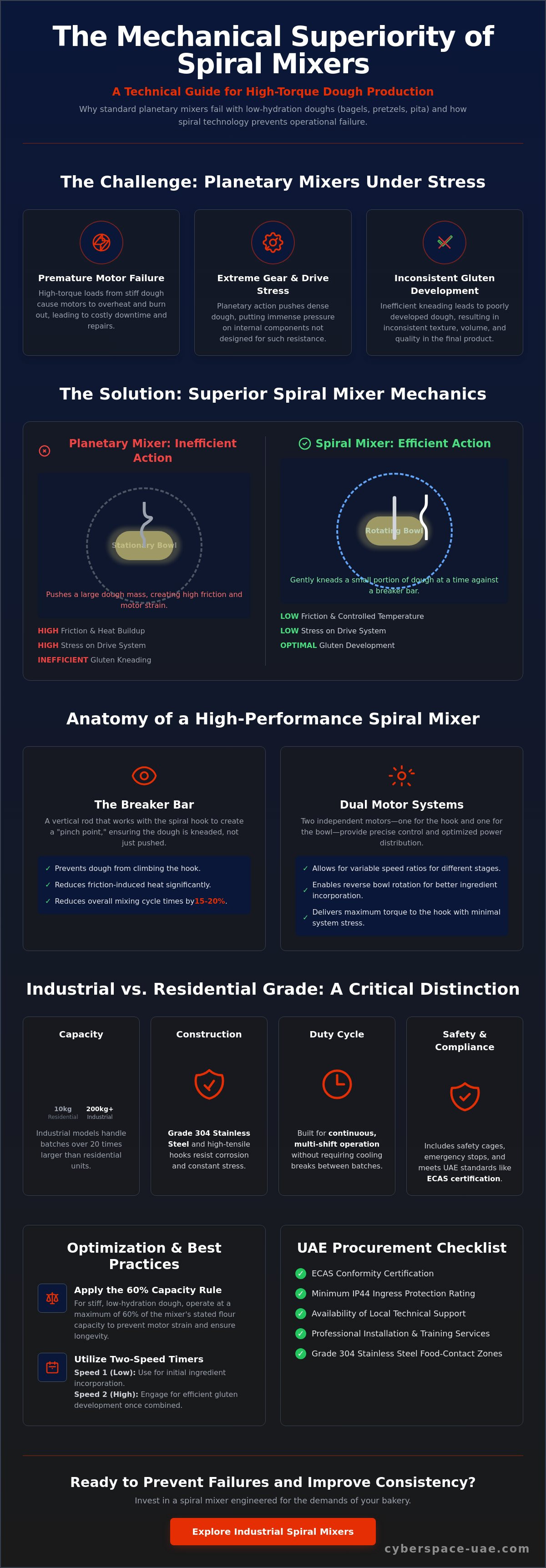
Industrial production of bagels, pretzels, and heavy rye requires equipment capable of handling high-torque resistance. To understand What is a Spiral Mixer, one must look at the drive configuration. The system uses a rotating bowl while the spiral hook remains in a fixed position. This differs from planetary mixers that utilize a stationary bowl and a revolving attachment. It's a mechanical necessity for high-volume environments. A spiral mixer for stiff dough ensures that only a small portion of the dough mass is processed at any given moment. This reduces friction and prevents excessive heat buildup during long mixing cycles.
Low-hydration doughs present specific challenges for commercial equipment. These mixtures typically have hydration levels between 45% and 55%. Less water results in a dense mass that is resistant to deformation. Standard mixers often push this mass around the bowl rather than kneading it effectively. The spiral mixer forces the dough against a central breaker bar. This action develops gluten rapidly while keeping the dough temperature low. Temperature control is critical for final product texture and yeast activity.
The Mechanics of Low-Hydration Dough Mixing
Mixing stiff dough requires significantly more mechanical force than high-hydration variants. The physics of dough resistance against the mixing hook creates high torque requirements. As hydration levels drop, the dough becomes less pliable and exerts more pressure on the drive system. Stiff dough hydration levels typically fall below 55%. The rotating bowl design allows the hook to penetrate the dough mass more efficiently. This mechanical advantage ensures thorough gluten development without stalling the motor.
Industrial vs. Residential Spiral Mixer Capabilities
Commercial bakeries require equipment rated for continuous operation. Industrial spiral mixers differ from residential models in capacity, construction, and duty cycles. Choosing an industrial spiral mixer for stiff dough ensures compliance with high-volume production demands.
- Capacity: Residential units typically peak at 5kg to 10kg. Industrial models range from 20kg to over 200kg per batch.
- Construction: High-tensile steel hooks and Grade 304 stainless steel bowls are standard for industrial units. These materials resist the corrosive effects of salt and withstand constant mechanical stress.
- Duty Cycle: Industrial mixers are built for multi-shift environments. They feature reinforced drive systems that don't require cooling breaks between batches.
- Safety and Compliance: Industrial units must comply with UAE standards, including Emirates Conformity Assessment Scheme (ECAS) certification. They include emergency stop buttons and safety cages that are absent or simplified on residential models.
Technical Components: Breaker Bars and Dual Motor Systems
High-resistance dough requires specialized internal components to manage extreme mechanical stress. Standard mixers often lack the structural reinforcement needed for low-hydration loads. A professional spiral mixer for stiff dough utilizes a specific component architecture to ensure consistent performance under load. Key features include integrated breaker bars and dual motor configurations. These systems work in tandem to maximize torque while minimizing heat friction. Reliability in a commercial bakery depends on these technical specifications.
The Engineering of the Breaker Bar
The breaker bar is a vertical rod positioned in the center of the mixing bowl. Its primary function is to create a "pinch point" between the rotating bowl and the spiral hook. This facilitates efficient gluten development by forcing the dough through a narrow gap. It also prevents the dough from climbing the hook, a common issue in high-torque applications. Adjustable bars allow operators to fine-tune the gap based on batch size and hydration levels. Reducing dough-to-hook contact time through this mechanism significantly lowers friction-induced heat. Efficient kneading reduces overall cycle times by 15% to 20% compared to machines without a central bar.
Dual Motor Synchronization and Power
Industrial models typically feature two independent motors. One motor drives the spiral hook, while the second motor powers the bowl rotation. This separation allows for varied speed ratios, which is essential for different stages of the mixing process. For instance, reverse bowl rotation is used during the initial stage to incorporate dry ingredients without overworking the flour. Dual motors prevent overheating by distributing mechanical load across two distinct drive systems.
- Independent Speed Control: Allows for low-speed ingredient blending and high-speed gluten development.
- Reverse Functionality: Essential for clearing the hook and ensuring total ingredient pickup.
- Load Management: Separate circuits prevent a single motor from drawing excessive current during peak resistance.
- Operational Redundancy: Reduces the risk of total machine failure during high-volume production shifts.
Torque transmission in heavy-duty mixers is achieved through either belt-driven or gear-driven systems. Multi-belt drive systems are standard in 80-liter to 100-liter models. They offer a balance of power and vibration dampening. This is particularly useful when processing dough with 45% hydration. Gear-driven systems provide direct power transfer suitable for the densest rye doughs but require more intensive maintenance. Heat dissipation remains a critical engineering focus. Industrial units often utilize heavy-duty cast iron frames that act as heat sinks, drawing warmth away from the dough bowl. Proper ventilation in the motor housing ensures the equipment maintains a minimum Ingress Protection (IP) rating of IP44, protecting against dust and moisture in the kitchen.
Review our range of high-performance spiral mixers for professional kitchen environments.
Spiral Mixer vs. Planetary Mixer for Heavy Load Applications
Planetary mixers are versatile tools for multi-product bakeries. They support various attachments for whipping, creaming, and light blending. However, they lack the structural integrity required for heavy load applications. A spiral mixer for stiff dough is engineered specifically for high-torque environments where lateral stress is constant. In a planetary system, the mixing head rotates around a stationary bowl. This creates significant leverage against the agitator shaft. For low-hydration dough, this force often leads to mechanical failure or bent attachments.
Batch consistency remains a primary differentiator. Spiral mixers ensure every gram of flour is hydrated uniformly by rotating the bowl into the hook. Planetary mixers often leave "dead zones" at the bottom of the bowl when handling dense loads. This results in inconsistent gluten development across a single batch. Energy consumption is also lower in spiral systems. Moving a rotating bowl requires less wattage than driving a heavy mixing head through a dense, stationary mass. For industrial facilities, this efficiency reduces long-term utility overhead.
Mechanical Stress and Gearbox Longevity
Planetary gearboxes utilize complex internal gear sets to achieve orbital motion. When processing stiff dough, the resistance causes gears to slip or teeth to shear over time. Spiral mixers utilize a fixed hook and rotating bowl, distributing stress more evenly across the drive system. This design results in a longer service life for bread-focused operations. For a detailed breakdown of these mechanical differences, see our Spiral Mixer vs Planetary Mixer: Industrial Technical Comparison 2026.
Temperature Control and Dough Friction
Friction is a byproduct of mechanical energy. Planetary mixers generate higher friction because the agitator moves through the entire dough mass at high speeds. This increases the "friction factor," often raising dough temperature beyond optimal levels for yeast activity. Spiral mixers minimize this. The rotating bowl brings only a portion of the dough to the hook at once. This keeps temperatures lower, protecting the crumb structure and extending the shelf life of the final product. Maintaining a cool dough temperature is essential for achieving the tight, uniform crumb required in commercial bagel and pretzel production.
- Friction Factor: Spiral mixers typically add 0.5°C to 1°C per minute, while planetary mixers can add up to 2°C.
- Gluten Development: Spiral hooks achieve full development in 8 to 12 minutes. Planetary mixers often require 15 to 20 minutes for the same hydration levels.
- Motor Load: Spiral motors operate at a consistent RPM, reducing the risk of amperage spikes during the final stage of kneading.
Selection Criteria for Industrial Spiral Mixers
Procuring a spiral mixer for stiff dough requires a precise evaluation of mechanical specifications. Industrial environments demand equipment that balances throughput with motor longevity. Selecting a unit based solely on bowl volume often leads to operational failure. You must consider torque requirements, power supply, and safety certifications to ensure the machinery survives high-resistance applications. Commercial kitchens in the UAE must also verify that equipment meets ECAS and Dubai Municipality standards for hygiene and safety.
Calculating Required Capacity for Stiff Dough
Stiff dough requires significantly more headspace than high-hydration mixtures. Low-hydration loads don't flow; they clump and exert lateral pressure on the bowl walls. Professionals utilize the 60% rule: for a 100-liter bowl, the maximum dough capacity for stiff mixtures is typically 60kg. Overloading leads to belt slippage and motor burnout. When planning your workflow, compare these requirements against your current planetary mixer bowl capacity to see if a dedicated spiral unit is necessary. A higher ratio of flour to water increases motor strain, necessitating a larger motor-to-bowl ratio.
Programmable Controls and Automation
Consistency in large-scale production depends on precise timing. Two-speed timers are essential. The first speed incorporates ingredients at low RPM, while the second speed develops the gluten structure. Digital control panels offer higher precision and can store multiple programs for different recipes. Manual controls remain popular for their durability and ease of repair in high-heat environments. Integrating these mixing cycles with other dough processing equipment ensures a seamless transition from the mixer to the divider or sheeter.
Electrical requirements are a critical selection factor. Industrial spiral mixers with capacities exceeding 50 liters almost exclusively require 3-phase power. This configuration provides the constant torque necessary to move the hook through dense dough without stalling. Ensure your facility's voltage matches the equipment's 380V-415V requirements. Safety features must include:
- Emergency Stop Buttons: Positioned for immediate access during operation.
- Stainless Steel Bowl Guards: Interlocked systems that cut power when the guard is lifted.
- IP44 Ratings: Protection against moisture and dust ingress in the kitchen.
- Thermal Overload Protection: Automatic shut-off to prevent motor damage during excessive resistance.
View our inventory of industrial spiral mixers to find the right capacity for your bakery production needs.
Procuring Industrial Spiral Mixers in the UAE
Procuring professional-grade machinery in the UAE necessitates strict adherence to regional regulatory frameworks. All commercial catering equipment must possess a valid Certificate of Conformity (CoC) under the Emirates Conformity Assessment Scheme (ECAS) as per Cabinet Resolution No. 35 of 2016. Sourcing a brand-new spiral mixer for stiff dough ensures your facility meets these legal requirements while maximizing operational reliability. Secondary market units often lack necessary documentation and carry higher risks of mechanical fatigue. High-volume commercial kitchens in Dubai and Abu Dhabi must also adhere to the Dubai Food Code and ADAFSA standards regarding equipment materials and hygiene. Grade 304 stainless steel is the mandatory standard for all food-contact surfaces to ensure non-porous and non-toxic operation.
Industrial Durability and Maintenance
Maintaining a spiral mixer for stiff dough requires a structured protocol to prevent drive system failure. Belt-driven models necessitate quarterly tension inspections to ensure efficient power transfer. Over-tightened belts cause premature bearing wear. Loose belts lead to slippage and inconsistent mixing. Lubrication of the main bowl drive chain and hook bearings should occur every 500 operating hours using food-grade lubricants. Cyberspace Kitchen & Bakery Equipment provides the necessary calibration and emergency repair services required for industrial-scale operations in the UAE.
- Inspect drive belt tension quarterly to prevent slippage under load.
- Lubricate the bowl drive chain every 500 hours of operation using food-grade grease.
- Verify the integrity of IP44 seals to protect electrical components from moisture.
- Test emergency stop and safety interlock functionality at the start of every shift.
Equipment must also comply with the UAE Fire and Life Safety Code, particularly regarding electrical installations and fire suppression in the kitchen environment. Accessing local technical support is vital for minimizing downtime during high-volume production cycles.
Optimizing Production Workflow
Integrating a spiral mixer into a complete production line improves throughput for bread and pastry operations. The output from the mixer should transition directly to downstream processing to maintain dough temperature and hydration consistency. Pairing these units with commercial dough sheeters allows for rapid processing of stiff doughs into final products like pita, crackers, or flatbreads. The Middle East food service equipment market is projected to reach USD 4,554.0 million by 2033. This growth reflects a shift toward automated, high-capacity bakery lines in the region. Professional procurement ensures that every component is synchronized for maximum efficiency. Electrical kitchen equipment exposed to wet environments must have a minimum Ingress Protection rating of IP44. For detailed guidance on technical requirements and installation, Contact Cyberspace Kitchen & Bakery Equipment for professional bakery equipment specifications.
Optimizing Industrial Dough Production
Selecting a dedicated spiral mixer for stiff dough is a critical requirement for high-volume commercial bakeries. These machines provide the necessary torque and temperature control to handle low-hydration loads without risking motor failure. Integrated breaker bars and dual-motor systems ensure consistent gluten development while minimizing mechanical stress. This engineering focus translates to lower maintenance costs and reduced operational downtime compared to planetary alternatives. Reliability in high-torque applications depends on structural integrity and specific component synchronization.
Success in the UAE market requires equipment that meets strict ECAS and Dubai Municipality standards. Cyberspace Kitchen & Bakery Equipment specializes in industrial-grade baking machinery, providing professional support for commercial kitchens across the region. High-performance equipment is essential for maintaining product quality in intensive environments. Procuring brand-new machinery ensures your facility remains compliant with local safety codes and hygiene regulations. Transitioning to a specialized spiral system secures your production line for long-term growth and operational excellence. It's the most efficient way to scale bakery operations while maintaining technical precision.
View Industrial Spiral Mixers and Bakery Equipment to upgrade your facility today.
Frequently Asked Questions
Is a spiral mixer better for stiff dough than a planetary mixer?
Yes, spiral mixers are mechanically superior for high-resistance loads. They utilize a rotating bowl and a fixed hook to manage lateral stress more effectively. Planetary mixers often suffer from gear slippage or motor burnout when processing dense, low-hydration mixtures. The spiral design ensures consistent torque and prevents equipment fatigue in industrial environments.
Can I mix small batches of stiff dough in a large industrial spiral mixer?
Efficiency decreases if the batch size is too small. Most industrial units require a minimum of 10% to 25% of the bowl's total capacity to function correctly. Without sufficient volume, the dough won't engage the breaker bar or the hook effectively. This leads to poor ingredient incorporation and inconsistent gluten development in the final product.
What is the ideal hydration level for a spiral mixer for stiff dough?
Ideal hydration levels for these machines typically range from 45% to 55%. This specific range is common for bagels, pretzels, and heavy rye breads. Using a specialized spiral mixer for stiff dough allows you to process these dense mixtures without the excessive friction heat common in other mixer types. It maintains dough integrity while protecting the drive system from overload.
How does a breaker bar improve the mixing of heavy dough?
The breaker bar acts as a stationary anchor in the center of the rotating bowl. It creates a pinch point that forces the dough against the spiral hook for intensive stretching and kneading. Without this bar, stiff dough tends to climb the hook or spin in a single mass. This component is essential for achieving rapid, uniform gluten development in industrial batches.
Does a spiral mixer heat the dough during the mixing process?
All mechanical mixing generates friction heat, but spiral systems are more efficient at limiting it. They typically increase dough temperature by only 0.5°C to 1°C per minute. This is significantly lower than planetary mixers, which move through the entire dough mass at once. Keeping temperatures low is vital for controlling yeast activity and ensuring a consistent crumb structure.
What electrical requirements are needed for an industrial spiral mixer?
High-capacity industrial mixers generally require a 3-phase power supply (380V to 415V). This electrical configuration provides the constant torque needed to move the hook through dense dough without stalling. Smaller units under 50 liters may operate on single-phase 220V power. Always verify that your facility meets the specific voltage and amperage requirements stated on the equipment's technical data plate.
How long does it take to develop gluten in stiff dough using a spiral mixer?
Full gluten development usually occurs within 8 to 12 minutes. This process is divided into a low-speed stage for ingredient incorporation and a high-speed stage for intensive kneading. The spiral mixer for stiff dough accelerates this process by focusing mechanical energy on a small portion of the dough at a time. This results in shorter production cycles compared to versatile but slower planetary systems.
What is the difference between a fixed bowl and a removable bowl spiral mixer?
Fixed bowl mixers offer greater structural stability and are preferred for the most demanding industrial applications. They have fewer moving parts and are less prone to mechanical failure under high torque. Removable bowl models allow for easier cleaning and dough transport between production stations. However, the coupling mechanisms in removable systems require more frequent maintenance to ensure reliability during stiff dough processing.