
Spiral Mixer vs Planetary Mixer: Industrial Technical Comparison 2026
Selecting a high-capacity mixer based on bowl volume alone often results in motor strain and inconsistent gluten development. In the UAE commercial baking sector, where the Middle East and Africa region is projected to reach a 7.02% CAGR through 2031, precision in equipment selection is a baseline requirement for operational success. Choosing between a spiral mixer vs planetary mixer requires more than a cursory review of specifications. It demands an objective understanding of torque distribution, heat transfer, and mechanical friction factors.
You already know that dough overheating during long cycles can ruin a batch before it reaches the prover. This analysis provides the technical data necessary to minimize equipment downtime and reduce manual labor through optimized machinery. We'll examine mixing mechanisms, motor efficiency, and compliance with 2026 industrial regulations, including ECAS and ESMA certification requirements. This comparison serves as a technical framework for commercial procurement under the Make It In The Emirates 2026 initiative.
Key Takeaways
- Identify the mechanical differences between rotating bowl systems and orbital agitators to match equipment to specific dough hydration levels.
- Analyze the spiral mixer vs planetary mixer friction factors to maintain optimal dough temperatures and ensure superior gluten structure.
- Determine the ideal equipment configuration based on production volume requirements and the need for multi-functional kitchen versatility.
- Compare motor torque specifications and transmission durability to ensure long-term operational efficiency and reduced equipment strain.
- Evaluate UAE-specific procurement standards for industrial mixers to maintain compliance with 2026 technical and safety regulations.
Fundamental Mechanisms: Spiral vs. Planetary Mixing Actions
Industrial mixing efficiency depends on the mechanical interaction between the agitator and the mixing vessel. The Planetary and spiral mixers used in commercial bakeries employ fundamentally different kinetic principles. Understanding these mechanisms is essential for maintaining motor longevity and ensuring consistent product output.
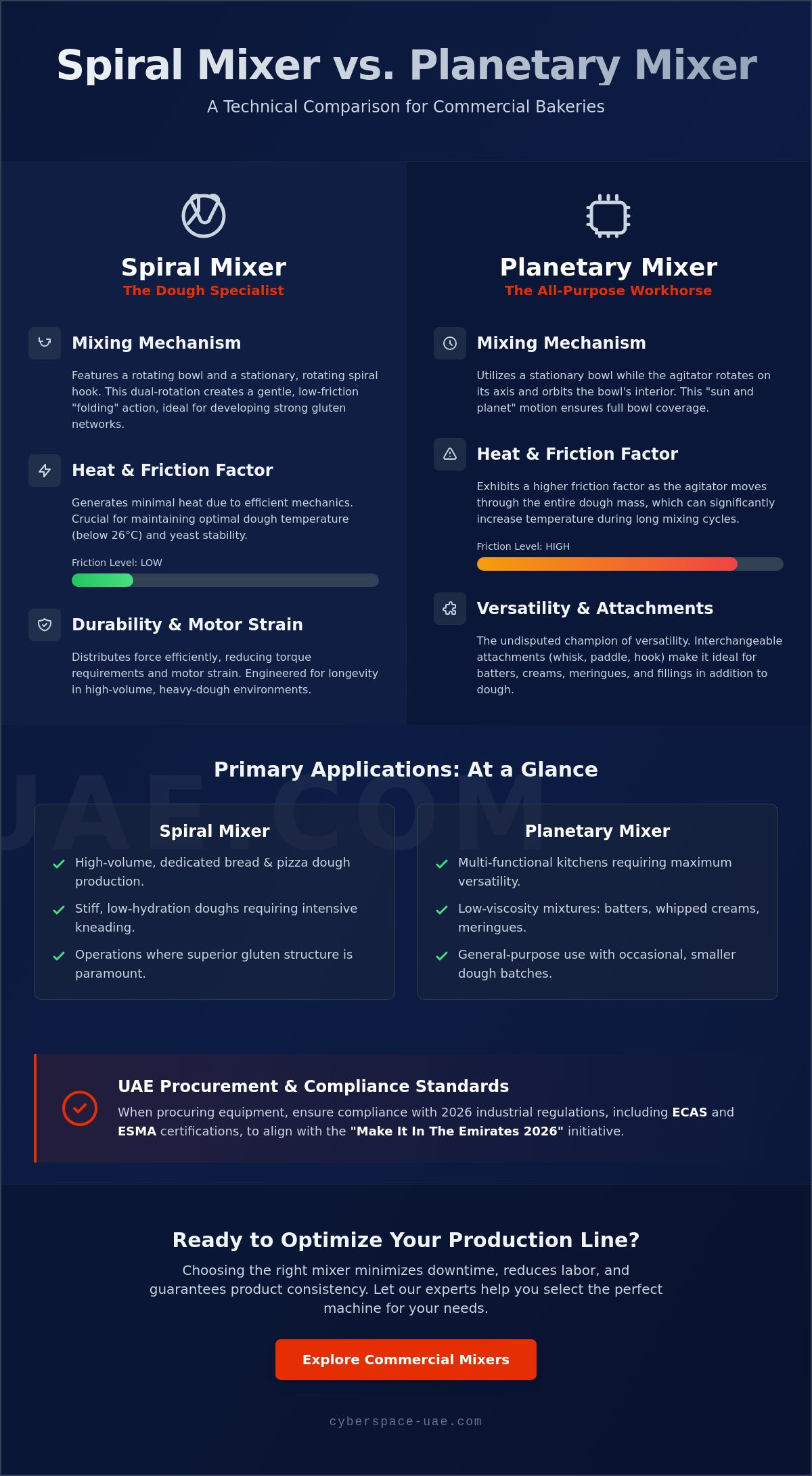
A planetary mixer utilizes a stationary bowl. The agitator rotates on its own axis while simultaneously moving in an orbital path around the bowl interior. This "sun and planet" motion ensures the agitator reaches every part of the vessel. In contrast, a spiral mixer features a rotating bowl. The spiral hook remains in a fixed position while rotating on its own axis. The bowl brings the ingredients to the hook, resulting in a localized, intensive kneading action.
Mechanical stress distribution varies significantly between these designs. Planetary mixers often face high gear wear when processing heavy dough because the entire mass creates resistance against the orbiting agitator. Spiral mixers distribute force more efficiently. The rotating bowl carries the weight of the dough, reducing the torque required by the hook to fold and stretch the mixture. This leads to lower motor strain and extended transmission life in high-volume environments. When comparing a spiral mixer vs planetary mixer, the choice often hinges on this mechanical durability under load.
The Planetary Orbital System
Planetary systems are defined by their versatility. The fixed bowl design allows for interchangeable attachments, including whisks, paddles, and dough hooks. The ratio between agitator rotation and orbital speed is engineered to maximize aeration. This makes the planetary mixer the standard for low-viscosity mixtures, such as sponges, batters, and whipped creams. The complex transmission required for orbital movement provides multi-functional utility but can be a point of failure under the constant load of stiff bread doughs.
The Spiral Dual-Rotation System
The spiral system is a specialized tool for dough production. Synchronized bowl and hook rotation allow for a "folding" action rather than the "punching" action found in other designs. This synchronized movement reduces mechanical friction. Specialized hook geometry ensures that only a small portion of the dough is worked at any given time, preventing the mass from climbing the hook. This efficiency is critical for high-absorption formulas and stiff doughs that require intensive gluten development without temperature spikes. For dedicated bread lines, the spiral dual-rotation system offers superior mechanical reliability and consistent performance.
Technical Performance: Dough Consistency and Heat Friction Analysis
Heat management is the primary technical challenge in industrial dough production. Selecting between a spiral mixer vs planetary mixer depends largely on the friction factor generated during the mixing cycle. Excessive friction leads to premature fermentation and compromised gluten networks. Precise temperature control ensures that the final product maintains structural integrity throughout the baking process.
Temperature Control in Intensive Mixing
Friction factor is the heat energy transferred to dough during mechanical agitation. Planetary mixers typically exhibit a higher friction factor because the agitator moves through the entire mass with greater resistance. In high-volume environments, this can increase dough temperature significantly per minute of operation. Spiral mixers maintain lower temperatures by rotating the bowl, which reduces the relative speed between the hook and the dough. This mechanical efficiency is vital for maintaining yeast stability.
In the UAE, where ambient kitchen temperatures often fluctuate, managing these variables is critical for production consistency. High heat accelerates yeast activity, leading to inconsistent results in the prover. For operations using professional spiral mixers, the lower friction coefficient allows for longer mixing times without exceeding the critical 26°C dough temperature threshold. This stability is essential for high-output industrial bakeries.
Gluten Matrix Formation
Gluten development requires specific shear forces to align proteins into a resilient matrix. Spiral mixers provide a localized, folding shear that develops gluten without tearing the fibers. This results in superior crumb structure and improved gas retention. Planetary mixers apply more aggressive vertical force. While effective for rapid development, this motion risks over-mixing delicate formulas and breaking down protein bonds prematurely.
Hydration levels also dictate equipment performance across different dough types:
- 50% Hydration (Stiff dough): Spiral mixers are superior. The motor torque is optimized for high resistance and consistent folding.
- 80% Hydration (High hydration dough): Planetary mixers are often preferred for their ability to incorporate air and manage liquid-heavy mixtures effectively.
Final product consistency across large industrial batches depends on oxygen incorporation. Spiral mixers limit oxidation, which preserves flour pigments and natural flavors. Planetary mixers incorporate more oxygen into the mix. This is beneficial for high-volume white sandwich breads but less desirable for artisanal products requiring a creamy crumb color and complex flavor profile.
Operational Utility: Production Volume and Versatility Requirements
Operational utility in a commercial kitchen depends on the alignment between equipment capabilities and production diversity. The decision between a spiral mixer vs planetary mixer often dictates the entire workflow of a facility. Specialized bakeries focusing on high-volume bread production require different mechanical efficiencies than multi-product kitchens handling pastries, creams, and doughs simultaneously. Production volume and space-to-output ratios serve as the primary metrics for procurement decisions.
Batch size limitations vary significantly between these units. Industrial planetary mixers often require a minimum volume of approximately 25% of the total bowl capacity to ensure the agitator maintains contact with the ingredients. In contrast, spiral mixers can often handle batches as small as 10% of their maximum capacity due to the synchronized bowl rotation. This flexibility allows for small-batch testing without specialized equipment. Cleaning protocols also differ; planetary mixers typically feature removable bowls for easier sanitation, while large-scale industrial spiral mixers often utilize fixed-bowl systems with specialized drainage to manage high-output hygiene requirements.
The Versatility of Planetary Systems
Planetary mixers function as the primary multi-tool in culinary environments. Their design accommodates interchangeable attachments, making them indispensable for confectionery and general prep. Selecting the correct planetary mixer bowl capacity is essential for scaling production of batters, meringues, and light doughs. However, these systems face limitations in high-torque applications. Constant processing of heavy bread dough in a planetary unit increases the risk of gear failure and motor burnout. They remain the preferred choice for kitchens requiring a single machine to perform multiple tasks across different product categories.
The Efficiency of Spiral Systems
Spiral mixers are engineered for throughput and dough quality. They excel in the production of high-volume bread, pizza, and pastry dough. By focusing on a single mixing action, these units achieve faster development times and higher hourly output than their planetary counterparts. This efficiency is critical when integrating with other industrial tools. For example, high-speed dough production often precedes the use of commercial dough sheeters for laminated products like croissants or puff pastry. The reduced mixing time of a spiral system prevents dough from warming during the process, ensuring the fat layers remain intact during subsequent sheeting stages. For dedicated dough lines, the spiral system maximizes floor space by delivering higher output per square meter of equipment footprint.
Engineering Specifications: Capacity, Power, and Durability Standards
Engineering specifications for industrial mixers focus on mechanical endurance and power transmission. When evaluating a spiral mixer vs planetary mixer, procurement teams must distinguish between nominal horsepower and actual torque delivery. Horsepower indicates the motor's total output capacity, but torque defines the rotational force available to overcome dough resistance. High-torque systems ensure that motors don't stall during the final stages of gluten development.
Power Delivery and Torque
Spiral mixers utilize a dual-motor system in many industrial configurations. One motor drives the bowl while the second drives the hook. This separation allows for higher torque delivery at lower energy consumption levels compared to planetary units of similar capacity. Planetary mixers require significant horsepower to move an orbital agitator through a stationary mass of heavy dough. This creates higher mechanical stress on the transmission and often results in higher electrical loads for the facility.
Modern industrial units incorporate inverter technology. This allows for variable speed control and soft-start capabilities, which protect the motor from initial load spikes. Transmission durability depends on the drive system:
- Belt-driven systems: These provide shock absorption and quieter operation. They require periodic tension adjustments but protect the motor from sudden resistance spikes.
- Gear-driven systems: These offer direct power transmission for heavy-duty applications. They require consistent lubrication and professional maintenance to prevent gear tooth wear.
Capacity Scaling for Industrial Output
Selecting the correct bowl size requires calculating the ratio between flour weight and water absorption. A 100L bowl capacity doesn't equate to 100kg of dough production. Most industrial standards suggest a 50% to 60% fill rate for optimal mixing. Overloading leads to motor strain and inconsistent hydration, while underloading prevents the agitator from making proper contact with the ingredients.
Facility footprint is a critical constraint. A 200L spiral mixer requires substantial floor space but provides significantly higher throughput than multiple smaller units. Consistent output also depends on the precision of secondary stages. This includes calibrating dough processing equipment to match the output characteristics of the primary mixer. For high-performance facilities, sourcing industrial mixing solutions from reliable providers ensures equipment longevity and operational safety.
Durability standards demand high-grade materials. All food-contact surfaces, including the bowl and hook, must utilize AISI 304 stainless steel. Safety features are non-negotiable in commercial settings. These include emergency stop buttons with rapid-response braking, interlocked bowl guards to prevent operation when open, and automatic overload protection to prevent motor burnout during intensive cycles.
Industrial Mixing Equipment Procurement in the UAE
Procurement of industrial machinery in the UAE requires strict adherence to local safety and technical standards. All imported equipment must comply with ECAS (Emirates Conformity Assessment Scheme) or ESMA (Emirates Authority for Standardization and Metrology) certifications. These regulations ensure that high-voltage industrial mixers operate safely within the regional electrical infrastructure. With a 5% customs duty applied to imported industrial equipment, procurement teams must focus on the total cost of ownership rather than initial capital expenditure alone.
The choice between a spiral mixer vs planetary mixer significantly impacts long-term operational costs. High-uptime operations prioritize machinery with readily available spare parts and localized technical support. Industrial facilities should evaluate the durability of transmission systems and motor efficiency to minimize maintenance intervals. Investment analysis shows that brand-new, professional-grade machinery reduces the risk of equipment downtime, which is critical in a market where the Middle East and Africa region is projected to lead bakery equipment growth through 2031.
Selection Criteria for UAE Commercial Kitchens
Brand-new machinery is a baseline requirement for industrial performance. Used equipment often lacks the necessary warranty protections and fails to meet 2026 energy efficiency standards. Commercial facilities must source equipment that supports the "Make It In The Emirates 2026" initiative by prioritizing localized procurement and technical reliability. Direct procurement from Cyberspace Kitchen & Bakery Equipment ensures that the equipment features the latest safety guards and emergency stop mechanisms required by the updated Civil Transactions Law of 2026.
Optimizing the Baking Production Line
Efficiency depends on the seamless integration of mixing, proving, and baking stages. High-volume dough production from spiral mixers must be synchronized with the throughput of professional deck ovens to prevent bottlenecking. If the mixing cycle is too fast for the oven capacity, dough quality degrades during the wait time. Conversely, a slow mixing cycle leaves expensive baking equipment idle.
Operational excellence requires a balanced production line. Synchronizing these cycles ensures consistent product quality and reduces manual labor requirements. For facilities planning a new installation or upgrading existing lines, contacting Cyberspace Kitchen & Bakery Equipment for specialized technical consultations provides the data necessary for optimized equipment selection. Precise configuration of the mixing area, including the placement of spiral and planetary units, maximizes floor space and streamlines the workflow from ingredient intake to the final bake.
Future-Proofing Commercial Dough Production
Operational success in the 2026 industrial landscape requires a precise alignment between mechanical capabilities and production goals. The technical decision regarding a spiral mixer vs planetary mixer directly influences the thermal stability of products and the longevity of the facility's power transmission systems. As established, spiral units provide the localized torque necessary for high-volume bread lines, while planetary systems offer the multi-functional utility required for diverse confectionery outputs. Balancing these mechanical actions with the 2026 safety and electrical standards ensures a resilient production floor.
Cyberspace Kitchen & Bakery Equipment is a specialized UAE industrial equipment supplier providing technical expertise in high-capacity dough processing. All inventory consists of brand-new, professional-grade machinery designed for high-uptime industrial environments. Aligning equipment selection with operational hydration levels and throughput targets minimizes manual labor and optimizes product quality. Selecting the correct mixing platform today establishes the foundation for scalable growth and mechanical reliability in the evolving regional market.
View Industrial Spiral and Planetary Mixer Specifications
Precise equipment integration drives operational excellence and ensures long-term mechanical reliability.
Frequently Asked Questions
Can I use a planetary mixer for stiff bread dough?
Planetary mixers can process stiff dough, but they aren't the most efficient choice for high-volume production. Stiff dough creates significant resistance against the orbital agitator, which increases the risk of gear wear and motor strain. For consistent production of low-hydration doughs, a dedicated spiral system provides better torque and mechanical longevity.
Why do spiral mixers have a center breaker bar?
The center breaker bar prevents the dough from spinning as a single mass in the center of the bowl. It redirects the dough into the path of the rotating hook, ensuring every portion of the mixture is folded and stretched. This component is essential for achieving uniform hydration and consistent gluten development across the entire batch.
How does bowl rotation affect the mixing process in a spiral mixer?
Bowl rotation brings the ingredients to the hook, which allows for localized kneading rather than moving the entire dough mass at once. This synchronized movement reduces the energy required for mixing and minimizes heat generation. This mechanical efficiency is a primary factor when evaluating a spiral mixer vs planetary mixer for temperature-sensitive artisan breads.
What is the maximum capacity for a commercial planetary mixer?
Commercial planetary mixers typically reach a maximum capacity of approximately 140 to 160 liters in standard industrial floor models. Beyond this volume, the mechanical complexity of the orbital head becomes a limiting factor for power transmission. Operations requiring volumes exceeding 200 liters generally utilize spiral systems, which scale more effectively for massive dough loads.
Are spiral mixers more difficult to clean than planetary mixers?
Fixed-bowl spiral mixers require more manual effort to clean because the bowl cannot be removed for washing. Removable-bowl models are available but represent a higher capital investment. Planetary mixers feature removable bowls and attachments as a standard design, which simplifies sanitation protocols in kitchens that process multiple different product types daily.
Which mixer type is better for high-hydration sourdough?
Spiral mixers are technically superior for high-hydration sourdough production. The gentle folding action develops the gluten matrix without over-oxidizing the dough, which preserves the carotenoid pigments and complex flavors. This results in the characteristic open crumb structure and superior crust color required for professional sourdough products.
How much heat does a planetary mixer add to dough compared to a spiral mixer?
Planetary mixers generate higher friction because the agitator moves through the entire dough mass with more aggressive vertical force. This can result in a temperature rise of approximately 1 degree Celsius per minute of mixing. Spiral mixers distribute force more efficiently, keeping dough temperatures significantly lower during intensive kneading cycles.
What safety certifications are required for industrial mixers in the UAE?
Industrial mixers in the UAE must have ECAS or ESMA certification to comply with national safety and electrical regulations. These certifications ensure the equipment meets specific standards for emergency stops, interlocked bowl guards, and overload protection. Procurement teams should verify these documents to ensure legal compliance and operational safety in commercial facilities.