
Double Rack Rotary Oven: Technical Reference and Industrial Performance Guide
The double rack segment of the commercial rotating rack oven market held the largest share in 2023, yet many high-volume facilities still struggle with thermal equilibrium across dual rotating masses. Scaling production often leads to inconsistent bake quality and excessive energy consumption. You know that maximizing throughput per square meter is essential for operational efficiency, but achieving a uniform crust and crumb across 30 or more trays remains a significant technical challenge. Integrating a double rack rotary oven into your workflow requires more than just floor space; it demands precise airflow engineering and a deep understanding of industrial performance metrics.
This technical reference provides a comprehensive analysis of double rack mechanics and industrial procurement criteria. You'll learn how to evaluate heat recovery systems and hygienic designs that meet 2026 global food safety standards. We'll also examine the updated ANSI/ASB Z50.1 safety requirements and how specific equipment choices can reduce labor via rack-based loading. This guide outlines the path to achieving consistent high-volume output while maintaining strict control over your bakery's energy footprint.
Key Takeaways
- Identify the operational capacity of a double rack rotary oven and its ability to handle simultaneous rotation of dual racks for high-volume output.
- Analyze the mechanical architecture of high-efficiency heat exchangers and forced air circulation patterns necessary for thermal consistency across 30+ trays.
- Compare throughput metrics and energy efficiency per unit to calculate the performance advantages of dual-rack systems over single-rack configurations.
- Review industrial procurement specifications including floor loading requirements, utility phases, and ventilation parameters for high-ambient kitchen environments.
- Understand the integration of Programmable Logic Controllers (PLC) to automate multi-stage baking cycles and minimize manual labor requirements.
Defining the Double Rack Rotary Oven in Industrial Baking
A double rack rotary oven serves as a high-capacity convection baking unit designed for intensive industrial use. Unlike standard batch ovens, these systems utilize a specialized rotation mechanism to ensure uniform heat distribution across multiple trays. According to this Industrial Ovens Overview, rotary rack ovens are essential components in professional baking environments. The primary function involves the simultaneous rotation of two independent or joined racks within a single heated chamber. This configuration allows facilities to process double the volume of a single rack unit without significantly increasing the machine's footprint. It's an engineering solution focused on raw throughput and operational consistency.
Maximizing vertical and horizontal chamber volume is the core advantage of these systems. By utilizing the full height and width of the oven, operators increase throughput per square meter of floor space. This efficiency is critical for facilities facing space constraints or those needing to scale production rapidly. Industrial bakeries utilize these systems for several specific applications:
- High-volume bread and bun production.
- Pastry and viennoiserie at scale.
- Industrial biscuit manufacturing.
- Heavy sourdough and baguette cycles requiring high steam density.
The Mechanics of Rotating Rack Technology
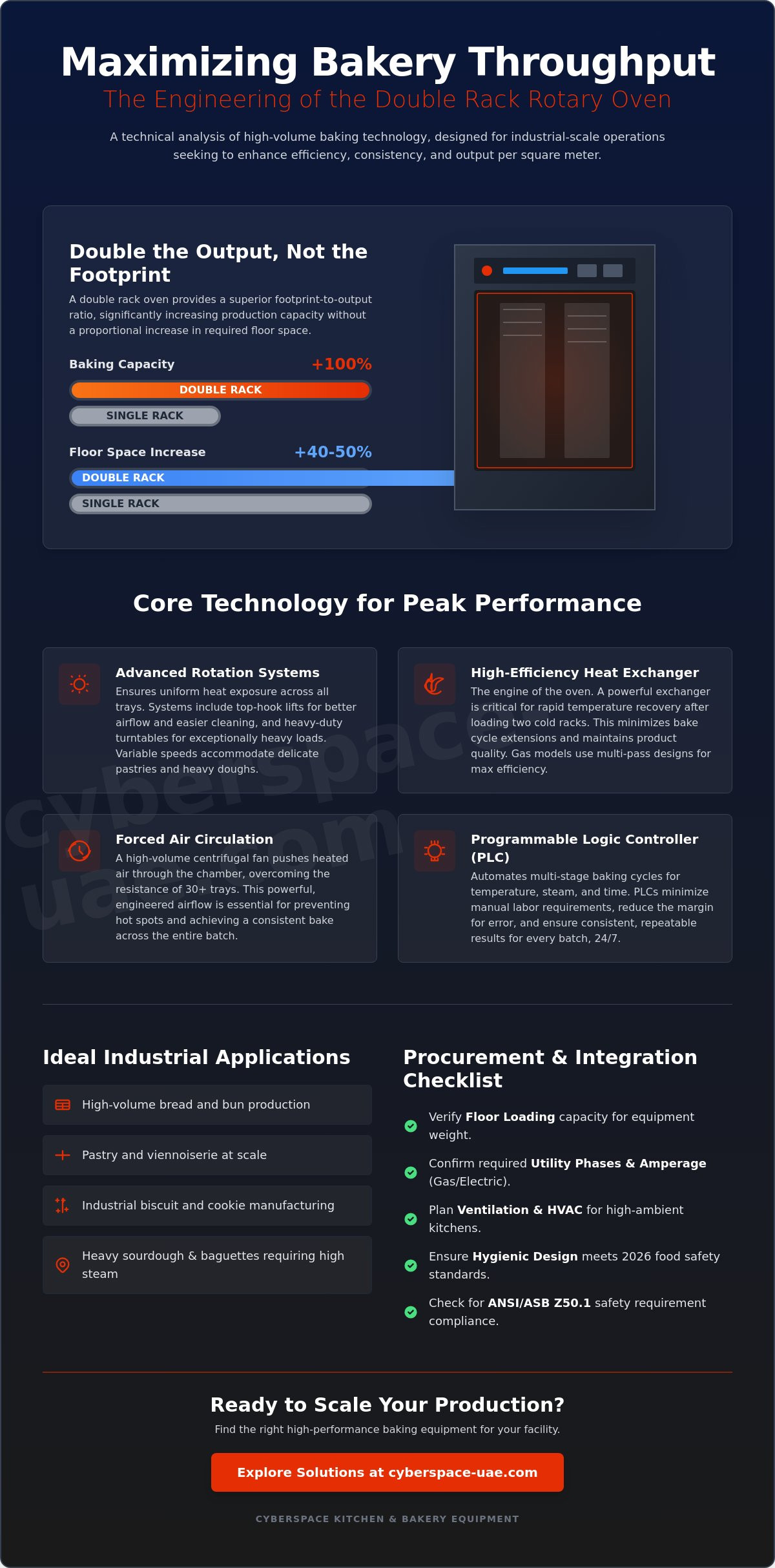
The rotation mechanism usually relies on either a top-hook lift or a heavy-duty turntable system. Top-hook designs lift the rack off the floor, which allows for easier cleaning and better airflow underneath the product. Turntable systems are often preferred for exceptionally heavy loads. Rotation is the primary defense against hot spots. Continuous movement ensures every tray surface receives equal exposure to the forced air currents. Modern units allow for variable rack speeds. Slower speeds prevent structural damage to delicate pastries, while faster rotations assist in the rapid crust development required for heavy doughs. The oven doesn't just heat the product; it manages the environment around it.
Distinguishing Double Rack from Single Rack Configurations
Choosing between a single and a double rack rotary oven depends on specific output targets and facility logistics. A double rack unit offers a superior footprint-to-output ratio, providing roughly 100% more capacity while occupying only about 40% to 50% more floor space. However, thermal mass is a critical factor. Loading two cold racks simultaneously causes a significant temperature drop in the chamber. The oven's heat exchanger must be powerful enough to recover quickly so the bake cycle isn't compromised. While artisan bakeries might prioritize the flexibility of single racks, industrial-scale operations require the throughput of double rack systems to meet daily quotas efficiently.
Mechanical Architecture and Heat Exchange Systems
The engineering of a double rack rotary oven centers on the heat exchanger's ability to transfer thermal energy without contaminating the baking chamber. High-efficiency exchangers in gas models utilize multi-pass designs to extract maximum heat from combustion gases. Electric models rely on high-density armored heating elements. These components are detailed in Rotary Oven Technical Specifications, which highlight the importance of recirculation fans in maintaining temperature stability. In a dual-rack chamber, the physics of convection requires a high-volume centrifugal fan to push air through the exchanger and into the distribution ducts. This forced air circulation must overcome the resistance of 30 to 40 loaded trays to ensure each loaf receives identical thermal energy.
Burner and Heating Element Engineering
Recovery time is the primary performance metric for industrial throughput. Gas burners must deliver high BTU output to compensate for the thermal drop caused by loading two cold racks. Counterflow heat exchange principles are applied here; air flows in the opposite direction of combustion gases. This maximizes fuel efficiency. Electric systems require robust electrical phases to power high-wattage elements. Rapid temperature recovery after door openings is essential. Without it, the bake cycle extends and product quality degrades. Precise burner modulation prevents overshooting the setpoint, saving energy during long production runs.
Airflow Optimization and Steam Distribution
Directing heat between two rotating racks requires adjustable air slots. These shutters allow technicians to fine-tune the velocity and volume of air hitting specific zones of the rack. Steam management is equally complex. The double rack rotary oven requires the Cascad steam system or similar high-capacity generators to saturate the chamber instantly. This ensures uniform crust development on all levels, from the top tray to the bottom. Managing exhaust is critical during the steam release cycle. Automated dampers must clear the chamber of excess moisture before the final drying phase. This prevents soggy crusts and maintains product integrity.
Industrial environments demand strict insulation standards. High-density mineral wool or ceramic fiber layers keep the heat inside the chamber. This maintains external cool-touch surfaces, protecting staff and reducing the load on kitchen HVAC systems. Efficient insulation directly impacts the bottom line by reducing standby energy loss. For facilities looking to upgrade their production line, exploring technical specifications for a new rotary oven is the first step toward optimizing industrial performance.
Performance Analysis: Double Rack vs. Single Rack Systems
Evaluating the transition from single to double rack configurations requires a focus on raw throughput and resource allocation. A double rack rotary oven effectively doubles the output per bake cycle without doubling the labor or energy costs. In high-volume environments, this means moving from 15-20 trays to 30-40 trays per cycle. The mechanical advantage is clear: one burner and one motor drive the production of twice the volume. This consolidation reduces the total number of moving parts compared to operating two separate single-rack units, though the rotation motors in double rack systems are specifically designed for higher torque and heavier loads.
Production Capacity and Throughput Metrics
A direct comparison of 18-tray versus 36-tray output cycles reveals significant operational gains. For a standard 600g loaf, a single rack might yield 180 units per cycle, while a double rack produces 360 units. Over a 24-hour production schedule, this translates to thousands of additional units. Calculating the ROI of industrial rotary baking oven systems involves assessing these throughput gains against the initial utility load. While the energy surge during the recovery phase is higher, the energy consumption per unit of product is lower because the thermal chamber is utilized at its maximum density. This makes the double rack configuration the standard for 24/7 industrial bakeries where floor space is at a premium.
Operational Flexibility for Varied Product Lines
Operational flexibility remains a key consideration for facilities with diverse catalogs. Double rack chambers can often accommodate different rack heights or tray sizes, provided the rotation diameter is compatible. However, performance varies depending on product type. When analyzing rotary oven vs deck oven for pastry, the rotary system excels in consistency for high-volume items like croissants or danishes. Managing mixed loads in a double rack rotary oven requires technical precision. Loading two racks with different dough weights can lead to uneven baking if the airflow is not balanced. Best practices dictate loading identical products to maintain thermal equilibrium across all 36 trays.
Labor efficiency improves through streamlined loading and unloading. A single operator can manage the movement of 36 trays in two rack movements rather than multiple manual transfers. This reduces the time the oven door stays open, preserving the internal thermal mass. Maintenance protocols for these heavy-duty units focus on the rotation assembly. Given the increased weight, lubrication of the top-hook or turntable bearings is a critical weekly task to prevent downtime in continuous operation environments.
Operational Parameters for High-Volume Production
Industrial baking at scale requires strict control over environmental and mechanical variables. In high-output facilities, a double rack rotary oven must maintain thermal precision despite external factors. Managing these parameters ensures consistency across multiple shifts and prevents equipment fatigue. Standardizing these operational settings is the only way to achieve predictable results in a 24/7 production environment.
Climate Considerations and Heat Management
UAE industrial kitchens face extreme ambient temperatures and high humidity. These conditions directly impact oven recovery times and cooling cycles. High-efficiency extraction hoods are mandatory to remove the massive heat load generated by dual-rack cycles. Makeup air systems must be balanced to prevent negative pressure. Negative pressure interferes with burner combustion and steam retention, leading to inconsistent crust profiles and increased energy waste. Ambient heat also slows the cooling of finished products. Integrating a high-capacity blast chiller into the workflow is often necessary to manage these cooling timelines without compromising food safety or production speed. Proper ventilation isn't just about comfort; it's a technical requirement for oven efficiency.
Digital Control and Recipe Standardization
Programmable Logic Controllers (PLC) are the standard for modern double rack rotary oven units. These interfaces store multi-step recipes, controlling temperature, steam duration, and fan speed for each phase. Standardization is the primary goal. It ensures the same crust profile regardless of the operator's experience level. Digital interfaces also track burner performance and energy consumption in real-time. Modern systems offer remote connectivity for industrial fleet management. This allows managers to analyze bake data across multiple sites to optimize energy usage and identify production bottlenecks. Data-driven adjustments replace guesswork, ensuring that every batch meets the required quality specifications.
Safety protocols are integrated into the PLC logic to protect personnel in fast-paced environments. Automatic rotation stops activate the moment the door latch is released. This prevents operator injury from moving racks. Emergency extraction systems quickly clear the chamber of steam and heat during a cycle interruption. For seamless production, these ovens must integrate with pre-bake equipment like provers. Synchronizing the prover's humidity levels with the oven's steam injection creates a controlled environment for dough development. This end-to-end integration is vital for maintaining the throughput targets discussed in previous sections. Proper synchronization reduces the risk of dough collapse during the transfer from prover to oven.
Industrial Procurement and System Integration
Procuring a double rack rotary oven requires a transition from performance analysis to facility integration. Success depends on precise site preparation and utility alignment. Industrial bakeries must treat the installation as a complex systems integration rather than a simple equipment delivery. Failure to meet specific technical requirements leads to operational delays and increased installation costs. This section outlines the essential checklist for professional procurement and facility planning.
Site requirements start with floor loading capacity. These units exert significant point loads, especially when fully loaded with two heavy racks. Reinforced concrete flooring is a standard prerequisite. Ceiling height is equally critical. You must account for the oven's physical height plus the clearance required for industrial exhaust hoods and maintenance access to the rotation motor. When evaluating professional baking equipment Dubai suppliers, prioritize those who provide detailed CAD blocks for layout planning.
Technical Specifications for Facility Planning
Logistics planning must include door clearance and the turning radius required for rack maneuvering. A double rack rotary oven demands wider paths than single rack units. Operators need sufficient space to pivot and align two racks simultaneously without obstructing other workflow zones. Utility connections require specific parameters:
- Gas Pressure: Stable supply for high-BTU burners to ensure rapid recovery.
- Electrical Phases: Typically 3-phase power for rotation motors and high-capacity fans.
- Water Filtration: Mandatory for steam injection units to prevent calcium buildup and scale.
- Drainage: Dedicated lines for steam condensate and cleaning runoff.
Electrical load balancing is a primary concern for high-capacity electric rotary ovens. These systems draw significant current during the initial heating and recovery phases. Your facility's electrical panel must handle these surges without affecting adjacent equipment like spiral mixers or blast chillers.
Selecting an Industrial Equipment Partner
Choosing an equipment partner involves evaluating technical response times and spare parts availability. Industrial baking is a high-uptime environment; any delay in part replacement halts production. Prioritize partners who maintain a local inventory of critical components like heating elements, gaskets, and PLC modules. The ROI of your facility relies on brand-new, high-performance machinery. While the initial investment is higher, new equipment offers superior energy efficiency and meets current global food safety standards. Avoid the hidden costs of refurbished units, such as frequent calibration and higher energy consumption.
Next steps involve requesting comprehensive technical specifications and scheduling a site survey. Professional suppliers will verify your utility capacities before delivery. Post-installation support must include technician-led calibration, staff training on PLC interfaces, and a documented preventative maintenance schedule. This ensures your investment continues to deliver the high-volume performance discussed throughout this guide.
Optimizing High-Volume Industrial Baking Performance
Transitioning to a high-capacity production model requires a precise alignment of mechanical capability and facility infrastructure. A double rack rotary oven provides the necessary throughput for industrial scaling. Success depends on the technical integration of heat exchange systems and climate-specific ventilation. Standardizing recipes via PLC interfaces ensures that output remains consistent across 24/7 shifts; this is essential for maintaining a competitive edge in high-ambient environments.
We serve as an authorized distributor of high-end industrial baking machinery. Our focus remains strictly on brand-new, professional-grade commercial equipment. We provide technical support for national industrial food service operations to ensure long-term equipment reliability and performance. Evaluating site-specific parameters like floor loading and utility phases is the final step in securing your facility's ROI. This systematic approach to procurement guarantees that your equipment meets the rigorous demands of modern industrial baking.
View Industrial Rotary Oven Specifications to evaluate the technical requirements for your next production upgrade. Achieving operational excellence in large-scale baking starts with precise technical selection.
Frequently Asked Questions
What is the tray capacity of a standard double rack rotary oven?
A standard double rack rotary oven typically accommodates 30 to 40 trays per cycle. Most industrial models are designed for 60x80 cm or 18x26 inch tray dimensions. The exact capacity depends on the vertical spacing between rack slides and the height of the product being baked. Maximizing this tray count is essential for achieving the throughput targets required in high-volume facilities.
Can a double rack rotary oven handle artisan sourdough bread?
These systems handle artisan sourdough by utilizing high-capacity steam generators to saturate the chamber instantly. While deck ovens offer traditional stone-baked results, a rotary system provides consistent crust development through forced convection. You can adjust variable fan speeds to manage airflow, preventing the dough surface from drying too quickly during the initial expansion phase.
What are the electrical requirements for an industrial rotary oven in the UAE?
Industrial ovens in the UAE generally require a 380-415V, 3-phase electrical connection. The total kilowatt (kW) rating varies depending on whether the unit is gas-fired or fully electric. Your facility's electrical infrastructure must support the high amperage required for the centrifugal fans and the heavy-duty rotation motor. Proper load balancing is necessary to prevent interference with other kitchen equipment.
How does a double rack system improve energy efficiency compared to multiple single ovens?
Consolidating production into a double rack rotary oven reduces energy waste by utilizing a single, high-efficiency heat exchanger. Operating one large burner is more efficient than maintaining the thermal mass of two separate single-rack chambers. This configuration minimizes surface area heat loss and optimizes the energy consumed per kilogram of finished product. It's a more sustainable choice for continuous, high-volume production schedules.
Is gas or electric heating better for high-volume rotary baking?
Gas heating is often preferred for high-volume operations because it offers faster temperature recovery after the door is opened. This is critical for maintaining short cycle times. Electric models provide high precision and are easier to install in facilities without gas lines. Your choice should depend on local utility costs and the specific recovery speed required for your production volume.
What maintenance is required for the rack rotation mechanism?
Weekly lubrication of the top-hook or turntable bearings is the most important maintenance task. You must also regularly inspect the drive belt tension and ensure the rotation path remains clear of debris. These steps prevent motor strain and ensure the rack assembly turns smoothly under heavy loads. Consistent maintenance prevents unplanned downtime during peak production hours.
Does a double rack oven require a specific type of proover?
You must use a roll-in prover that is dimensionally compatible with your oven racks. The prover capacity should match or exceed the oven's capacity to ensure a continuous production flow. Using a double-width prover allows you to prepare two racks simultaneously, preventing dough from over-proofing while waiting for the next bake cycle to begin.
What is the average lifespan of an industrial rotary rack oven?
A professional-grade industrial oven typically has an operational lifespan of 15 to 20 years. This longevity requires a strict preventative maintenance schedule and the use of high-quality spare parts. Components like door gaskets, sensors, and heating elements need periodic replacement. Investing in brand-new equipment ensures you benefit from the latest insulation and heat exchange technologies throughout the machine's life.