
Technical Guide to Deck Oven Steam Injection Systems for Industrial Bakeries
The global bakery deck oven market is projected to grow at a compound annual growth rate of 14.9% through 2033, yet many industrial facilities still struggle with thermal management. Achieving a consistent, high-quality crust across every level of a multi-deck system remains a persistent challenge for high-volume bakeries. Optimizing a deck oven steam injection system is not just about moisture. It's a critical thermal strategy for product standardization and operational efficiency.
Inconsistent textures and high energy costs often result from poor system calibration or scale buildup. This article serves as a professional reference on the mechanics, technical requirements, and ROI of automated steam systems. We examine specific differences between boiler-based and flash steam generation. Maintenance protocols for equipment longevity and alignment with current industrial standards are detailed below. Precise technical setup ensures peak performance and reduces downtime associated with mineral deposits and thermal inefficiency.
Key Takeaways
- Compare boiler-based and flash evaporation technologies to match steam delivery with specific production requirements.
- Review infrastructure specifications, including inlet water pressure and electrical load for a deck oven steam injection system.
- Analyze the mechanics of latent heat and humidity in controlling starch retrogradation and crust development.
- Evaluate industrial oven selection criteria based on steam production rates and independent deck control capabilities.
Understanding Deck Oven Steam Injection Principles
A deck oven steam injection system functions as a high-precision moisture delivery mechanism. It's designed to saturate the atmosphere within a sealed baking chamber during the initial stages of the bake cycle. Unlike standard convection, a deck oven relies on a static, pressurized environment to manage heat transfer. Different steam generation technologies utilize various methods to achieve this saturation, ensuring the dough surface remains moist during critical expansion phases.
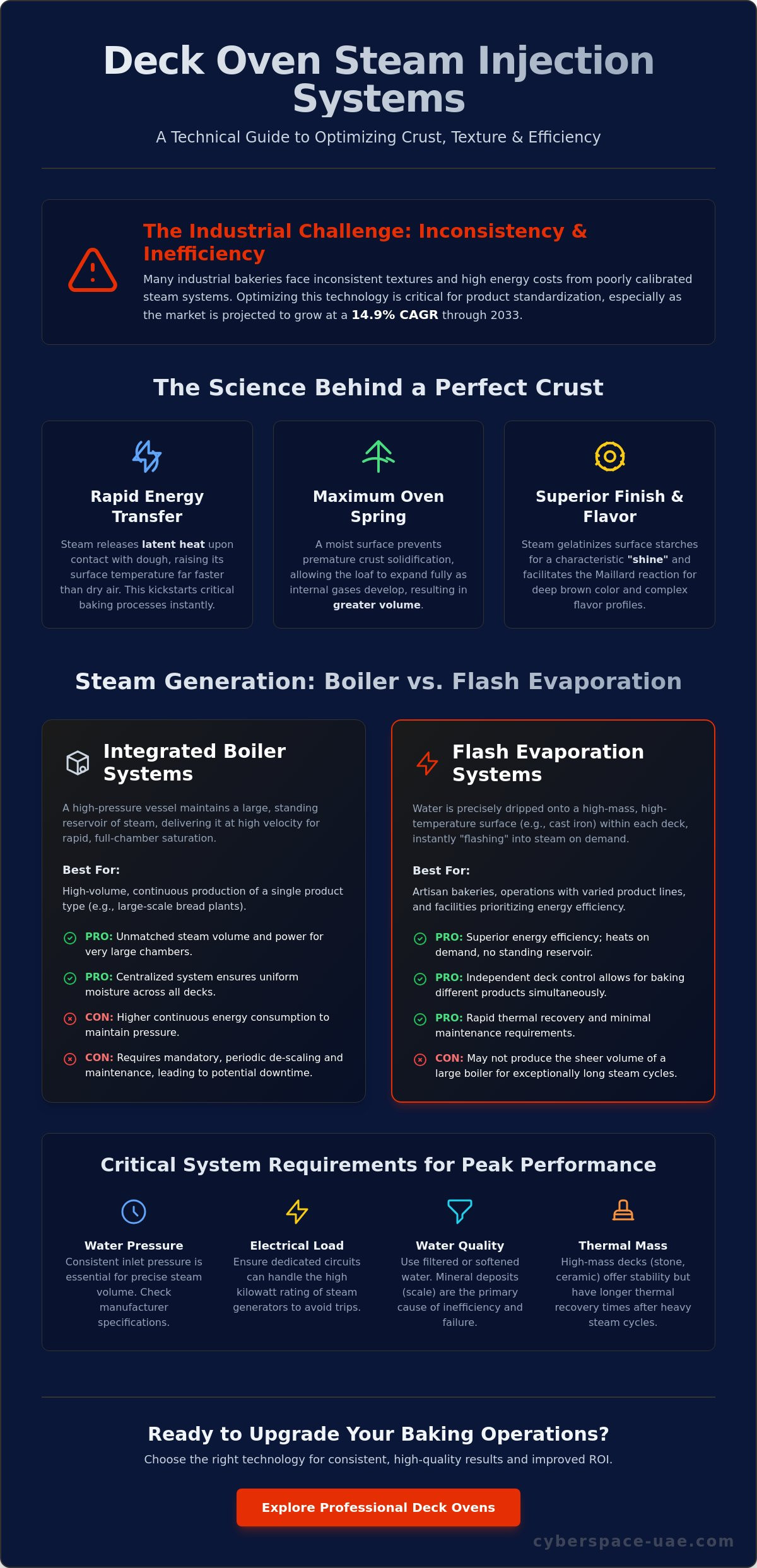
This process utilizes the properties of latent heat. When steam contacts the cooler surface of the dough, it undergoes a phase change back into liquid water. This transition releases a significant amount of energy instantly. It raises the surface temperature of the dough far more rapidly than dry air alone. This rapid energy transfer is the primary driver behind the professional crust characteristics required in industrial baking.
Maintaining a moist surface prevents premature crust solidification. This flexibility allows for maximum oven spring as internal gases and water vapor expand the dough structure. Without controlled humidity, the crust sets too early. This results in stunted loaf volume, surface tearing, and a dull finish. Effective humidity saturation within a sealed deck chamber ensures the entire batch receives uniform thermal treatment.
The Science of Gelatinisation
Steam interacts directly with surface starches to trigger gelatinisation. During this phase, starches swell and dissolve into a thin, viscous layer. This process is essential for creating the characteristic "shine" found on high-quality artisan breads. High-humidity environments also facilitate the Maillard reaction by dissolving surface sugars. This chemical reaction between amino acids and reducing sugars produces the deep brown color and complex flavor profiles expected in professional products. Proper steam application also improves crumb elasticity. It allows the internal structure to set without the resistance of a hard, dry outer shell.
Thermal Recovery and Steam Volume
Thermal recovery is a critical metric for industrial throughput. Every time a deck oven steam injection system activates, it consumes energy from the oven's thermal mass. Recovery time is the interval required for the deck and chamber air to return to the programmed baking temperature. High-mass decks, often constructed from refractory stone or heavy ceramic, provide better stability but require more energy to reheat after a heavy steam cycle.
Calculating required steam volume depends on the chamber's cubic capacity. An undersized system won't reach the necessary saturation point fast enough to affect the crust. Conversely, excessive steam leads to water pooling and energy waste. Industrial operators must balance the kilowatt rating of the steam generator with the total volume of the deck to ensure consistent results across consecutive baking cycles. Precise calibration prevents equipment strain and ensures product uniformity across multi-deck configurations.
Steam Generation Technologies: Boiler vs. Flash Systems
Selecting the correct steam hardware is a prerequisite for industrial consistency. Industrial bakeries typically utilize one of two primary technologies: integrated boiler systems or flash-evaporation units. The choice of a deck oven steam injection system depends on production volume, product variety, and energy efficiency targets. It doesn't just affect the crust; it impacts the entire thermal profile of the bake. Each technology manages the conversion of water to vapor through different mechanical principles.
Boiler-based systems maintain a standing reservoir of pressurized steam. Flash systems rely on the thermal energy stored in high-density materials like cast iron or ceramic. These differences impact the "dryness" of the steam and the speed of recovery between cycles. Understanding these technical nuances is essential for optimizing the baking environment.
Integrated Boiler Systems
Integrated boilers are high-pressure vessels designed for high-volume production. They deliver steam at high velocity. This ensures rapid chamber saturation. These systems are often centralized. One boiler unit feeds multiple decks through a network of injection valves. This configuration provides uniform moisture across all levels. It's ideal for facilities producing large batches of the same product. Maintenance is a significant factor. Internal pressure vessels require periodic inspection and mandatory de-scaling. Scale buildup reduces heat transfer efficiency and increases energy consumption. Failure to maintain a deck oven steam injection system leads to inconsistent steam volume and potential equipment downtime.
Flash Evaporation and Ceramic Elements
Flash-evaporation systems utilize localized heat sinks within each deck. Modern electric deck ovens frequently employ ceramic heating cartridges or cast iron blocks for this purpose. When the injection cycle begins, water is sprayed directly onto these pre-heated surfaces. Evaporation occurs at a rate of several ml/sec. This method allows for independent deck operation. Operators can apply different steam profiles to each level simultaneously. This modularity is a major advantage for bakeries with diverse product lines. Flash systems generally have lower idle energy consumption compared to boilers. They're more efficient because they only consume peak power during the recovery phase after an injection.
Steam quality also varies between these technologies. Boiler systems often produce saturated "wet" steam. This is effective for products requiring a thick, chewy crust. Flash systems can achieve higher surface temperatures. This produces a "drier" vapor that minimizes condensation on the oven floor. This drier steam is often preferred for achieving a thin, crisp crust with a high-gloss finish. Industrial bakeries should evaluate their specific crust requirements before selecting a generation method. Reviewing high-performance Deck Ovens is a practical step for facilities looking to upgrade their steam capabilities.
Impact of Controlled Humidity on Industrial Crust Development
Industrial crust development relies on the precise management of starch retrogradation. A deck oven steam injection system prevents the surface from drying too quickly. It keeps starches in a gelled state longer. The result is a high-gloss shine that signifies professional quality. This isn't just aesthetic. It indicates a properly hydrated surface that's undergone complete enzymatic breakdown. Proper moisture levels during the first few minutes of baking are essential for this transition.
Crust thickness is a primary variable for extended shelf-life requirements. Thicker crusts act as a moisture barrier. They protect the crumb from staling. High-volume bakeries use steam to delay the set of the crust. This allows the loaf to expand fully before the outer layer hardens. A controlled injection cycle ensures the crust achieves a specific thickness without becoming excessively hard or brittle. It creates a product that retains its structural integrity during transport and display.
Managing high-sugar dough formulations requires specific humidity levels. Sugar accelerates browning. Without steam, these products often burn before they're fully baked. Steam lowers the surface temperature via evaporative cooling. This prevents premature browning. It allows for a longer bake time. This ensures the center is cooked while the exterior remains a golden, uniform color. Precise steam application is the only way to balance internal temperature with external coloration in enriched doughs.
Technical requirements differ for artisan stone deck ovens. The high thermal mass of stone decks requires a robust steam volume. Stone retains heat differently than steel. This necessitates a deck oven steam injection system that recovers quickly. It must deliver volume without dropping the deck temperature below the target threshold. Consistent heat and moisture are the dual pillars of artisan production.
Aesthetic and Structural Consistency
Automated injection timing eliminates dull crusts. It ensures every batch looks identical. Manual steaming is too variable for industrial standards. Automated systems distribute moisture evenly across 1, 2, or 3-door deck configurations. This prevents surface cracking caused by uneven moisture distribution. Standardization across all decks is required to maintain brand reputation and minimize waste in high-output environments.
Application-Specific Steam Profiles
Different products require unique steam profiles. Baguettes need heavy, immediate steam for maximum expansion. Heavy rye breads require moderate, sustained humidity to manage their dense structure. Conversely, commercial pizza deck ovens typically omit steam systems entirely. Pizza requires a dry environment for a crisp base. Once the expansion phase ends, operators must adjust programmable draft vents. Clearing moisture post-expansion is critical for final crust hardening.
Technical Requirements for Commercial Steam System Installation
Successful deployment of a deck oven steam injection system requires rigorous infrastructure planning. Industrial facilities must address four primary technical pillars: water pressure, electrical capacity, drainage, and ventilation. Overlooking these specifications leads to inconsistent steam quality and accelerated component wear. Professional installation ensures the system operates within manufacturer-defined tolerances for maximum reliability.
Inlet water pressure is the first critical metric. Most industrial steam generators require a constant pressure range to ensure uniform vapor density. Fluctuations in building water pressure cause erratic injection volumes, resulting in batch inconsistency. Electrical load is equally vital. Dedicated steam heating elements are high-draw components. They often require independent circuits to prevent voltage drops that could affect the main oven controllers. Operators must verify that the facility's total amperage can support both the radiant heat elements and the steam generation units simultaneously.
Moisture management post-injection is a safety and maintenance priority. High-output steam release necessitates robust ventilation and dedicated hood systems. Excess moisture that is not evacuated through the draft system can condense on nearby electronics or masonry, causing long-term structural damage. Proper drainage must include a heat-resistant runoff path for condensation and excess water, preventing pooling at the base of the equipment.
Water Quality and Filtration Standards
Water quality is the most significant factor in long-term system health. Hard water contains high levels of calcium and magnesium. These minerals solidify into scale when heated, clogging injection nozzles and coating boiler walls. Scale buildup acts as an insulator, significantly increasing the energy required to produce steam. Industrial bakeries must implement a multi-stage filtration strategy:
- Sediment Filtration: Removes physical particulates that can jam solenoid valves.
- Carbon Filtration: Eliminates chlorine and organics that cause corrosion.
- Scale Inhibition: Utilizes polyphosphates or ion exchange to prevent mineral bonding.
Plumbing and Drainage Integration
Piping materials must withstand high-temperature cycles. Stainless steel is the industrial standard for steam lines due to its superior corrosion resistance and thermal stability. Copper is acceptable but requires high-temperature solder to prevent joint failure. All plumbing must include backflow preventers to protect the potable water supply. Drainage systems require a visible air-gap to prevent back-siphonage and ensure sanitary operation. Finally, calibrate the motorised draft systems to sync with the injection cycle. This facilitates rapid moisture evacuation once the expansion phase is complete. For expert technical consultation on system integration, contact the specialists at Cyberspace UAE.
Selecting Professional Deck Ovens with Integrated Steam
Procuring high-performance machinery requires a data-driven approach to hardware specifications. The performance of a deck oven steam injection system is a primary determinant of batch consistency. Industrial operators must match the system's output capacity with their specific production targets. Evaluating equipment based on technical metrics rather than marketing claims ensures long-term operational success. Every component, from the heating elements to the control interface, must withstand the rigors of high-volume steam cycles.
Steam production rates are typically measured in litres per hour (L/h). High-output facilities require generators that can reach full saturation within seconds of activation. An undersized system fails to recover between back-to-back loads. This leads to a drop in crust quality for subsequent batches. Independent deck control is also a critical requirement for multi-product bakeries. This feature allows operators to program unique steam profiles for each level. One deck can produce high-humidity artisan loaves while another maintains a dry environment for different product types.
Control interfaces vary between manual and fully programmable models. Manual systems rely on operator timing and are prone to human error. Programmable interfaces allow for multi-stage injection. These systems can deliver an initial heavy burst followed by smaller, timed pulses to maintain humidity without cooling the deck. Precision timing is essential for achieving a uniform finish across thousands of units. Furthermore, review the insulation quality of the oven housing. High-grade insulation prevents steam from escaping into the internal chassis. Escaping vapor causes rapid corrosion of electrical components and compromises the structural integrity of the frame.
Operational Efficiency and ROI
Automated steam cycles significantly reduce labor costs by removing the need for manual monitoring. Modern ovens often include ECO or ECU energy management systems. These modules optimize power consumption during the steam recovery phase. They ensure the oven doesn't exceed peak amperage while reheating the thermal mass. Element material choice impacts the return on investment. Ceramic heating elements are superior to traditional metal sheaths. They offer better resistance to thermal shock and mineral buildup from hard water. This leads to fewer heating failures and reduced equipment downtime over a ten-year operational lifecycle.
Procurement at Cyberspace Kitchen & Bakery Equipment
Cyberspace Kitchen & Bakery Equipment facilitates access to high-end industrial deck ovens with precision steam capabilities. The selection process includes technical consultation to align equipment with national-scale commercial requirements. Specialized support ensures that the deck oven steam injection system integrates seamlessly with existing facility utilities. The inventory includes a comprehensive range of professional tools. Facilities can source full production lines, including high-capacity provers, spiral mixers, and planetary mixers. Standardizing a bakery lineup with compatible, high-performance machinery ensures a streamlined workflow and consistent product output for industrial-scale operations.
Optimizing Industrial Bakery Output
Integrating an advanced deck oven steam injection system is a fundamental requirement for industrial product standardization. High-volume consistency depends on the precise calibration of latent heat and humidity saturation within the baking chamber. Operators must prioritize technical infrastructure, specifically water filtration and pressure management, to ensure equipment longevity and prevent scale-related downtime. Choosing between boiler and flash-evaporation technologies depends on specific production goals and deck autonomy requirements. Professional automation reduces labor costs while maintaining strict quality control across every batch.
Cyberspace Kitchen & Bakery Equipment provides industrial-grade machinery with specialized technical support across the UAE. Our national distribution network ensures access to high-performance tools designed for rigorous commercial use. View Professional Deck Ovens with Integrated Steam to upgrade your facility's technical capabilities and operational efficiency. Achieving professional-grade crust quality starts with precision engineering and reliable technical setup.
Frequently Asked Questions
What is the primary purpose of steam in a deck oven?
Steam delays crust formation to allow for maximum oven spring. It also triggers starch gelatinisation on the dough surface. This process creates the characteristic shine and crisp texture required in professional baking. Steam facilitates rapid heat transfer through the release of latent heat upon contact with the cooler dough. Maintaining high humidity during the first phase of baking ensures the loaf expands fully without surface tearing.
How much water does a commercial deck oven use per steam cycle?
Water consumption depends on deck volume and the specific product profile. A standard industrial cycle typically utilizes between 100ml and 500ml of water. High-capacity systems are often rated by their hourly production capacity, such as 15 to 20 litres per hour. This ensures the generator can recover quickly between consecutive batches. Accurate water metering is essential for maintaining consistent humidity levels across different deck configurations.
Can I add a steam injection system to an existing deck oven?
Retrofitting is generally not recommended for standard industrial units. Integrated systems require specific chamber insulation, drainage paths, and electrical configurations. While some modular ovens allow for the addition of factory-certified steam kits, attempting to install third-party hardware often compromises the oven's thermal integrity and voids manufacturer warranties. It's more efficient to procure professional equipment with a built-in steam generation system from the outset.
Does a pizza deck oven require a steam injection system?
Pizza production does not require steam injection. Pizza deck ovens are designed to maintain a dry, high-heat environment to achieve a crisp base and properly charred toppings. Introducing steam would prevent the dough from crisping and negatively affect the texture of the cheese and other ingredients. Commercial pizza operations prioritize stone deck heat retention and rapid recovery over moisture delivery systems.
How often should I descale my oven steam generator?
Descale the steam generator every 3 to 6 months depending on usage and water hardness. Facilities with high mineral content in their water supply may require more frequent maintenance. Implementing a multi-stage filtration system with scale inhibitors is the most effective way to extend descaling intervals and protect internal components. Regular maintenance prevents nozzle blockages and ensures the system operates at peak thermal efficiency.
What water pressure is required for industrial deck oven steam systems?
Industrial systems typically require a constant water pressure between 2.0 and 4.0 bar. Pressure must remain stable to ensure uniform atomisation across the injection nozzles. Low pressure leads to inadequate steam density, while excessive pressure can cause water pooling on the deck or damage to the solenoid valves. Operators should install a pressure regulator to maintain these specifications regardless of building supply fluctuations.
Why is my bread crust dull despite using steam injection?
Dull crusts often result from insufficient steam volume or incorrect injection timing. If the chamber doesn't reach saturation before the crust sets, starch gelatinisation remains incomplete. This issue is frequently caused by scale buildup within the deck oven steam injection system, which restricts vapor flow and reduces the effective moisture delivery to the product. Verifying the injection volume and checking for mineral deposits are the first steps in troubleshooting.
What is the difference between manual and automatic steam injection?
Manual injection requires the operator to trigger and time the steam burst, which often leads to batch variation. Automatic systems utilize programmable logic controllers to deliver exact water volumes at precise intervals. Automation improves consistency, reduces labor requirements, and optimizes energy consumption by managing the recovery of the thermal mass more efficiently. Modern digital interfaces allow for multi-stage steaming tailored to specific bread varieties.