
Deck Oven Temperature for Bread: Industrial Calibration Guide 2026
What if your bakery's highest waste factor isn't ingredient cost, but thermal inconsistency? Achieving a professional artisan finish requires more than just a high-quality recipe; it requires absolute thermal precision. Most commercial bakeries face challenges with inconsistent crust coloration and insufficient oven spring, which often lead to product rejection and high energy waste. You understand that even minor fluctuations in deck oven temperature for bread can compromise the structural integrity of a sourdough loaf or a baguette. Relying on generic settings is no longer sufficient for industrial operations targeting 2026 market standards.
This guide delivers the technical data required to standardize your baking protocols. You'll learn how to calibrate independent top and bottom heat ratios to optimize crust thickness and crumb expansion. We'll examine specific temperature profiles for various dough types, the critical timing of steam injection, and methods for increasing thermal efficiency. By the end of this article, you'll have a clear framework for achieving superior artisan quality through precise equipment management and industrial-grade calibration techniques.
Key Takeaways
- Identify the standard industrial deck oven temperature for bread to maintain consistency across lean and enriched dough formulations.
- Master the calibration of independent top and bottom heat ratios to achieve specific crust characteristics and crumb structures for artisan loaves.
- Implement specialized temperature profiles for sourdough and baguettes that balance steam injection with rapid heat transfer.
- Optimize thermal stability in multi-deck systems through staggered loading protocols and standardized preheating schedules.
- Evaluate equipment specifications like PID controllers and high-density insulation to improve energy efficiency in industrial bakery environments.
Determining the Optimal Deck Oven Temperature for Bread
Determining the optimal deck oven temperature for bread is a technical requirement for any industrial bakery aiming for consistency. Professional stone-sole ovens function differently than convection models, primarily due to their reliance on thermal mass. Unlike air-driven systems, Industrial Baking Ovens of the deck variety utilize high-density ceramic or stone plates to store energy. This stored heat is transferred directly to the dough upon contact, providing a localized energy burst that convection cannot replicate.
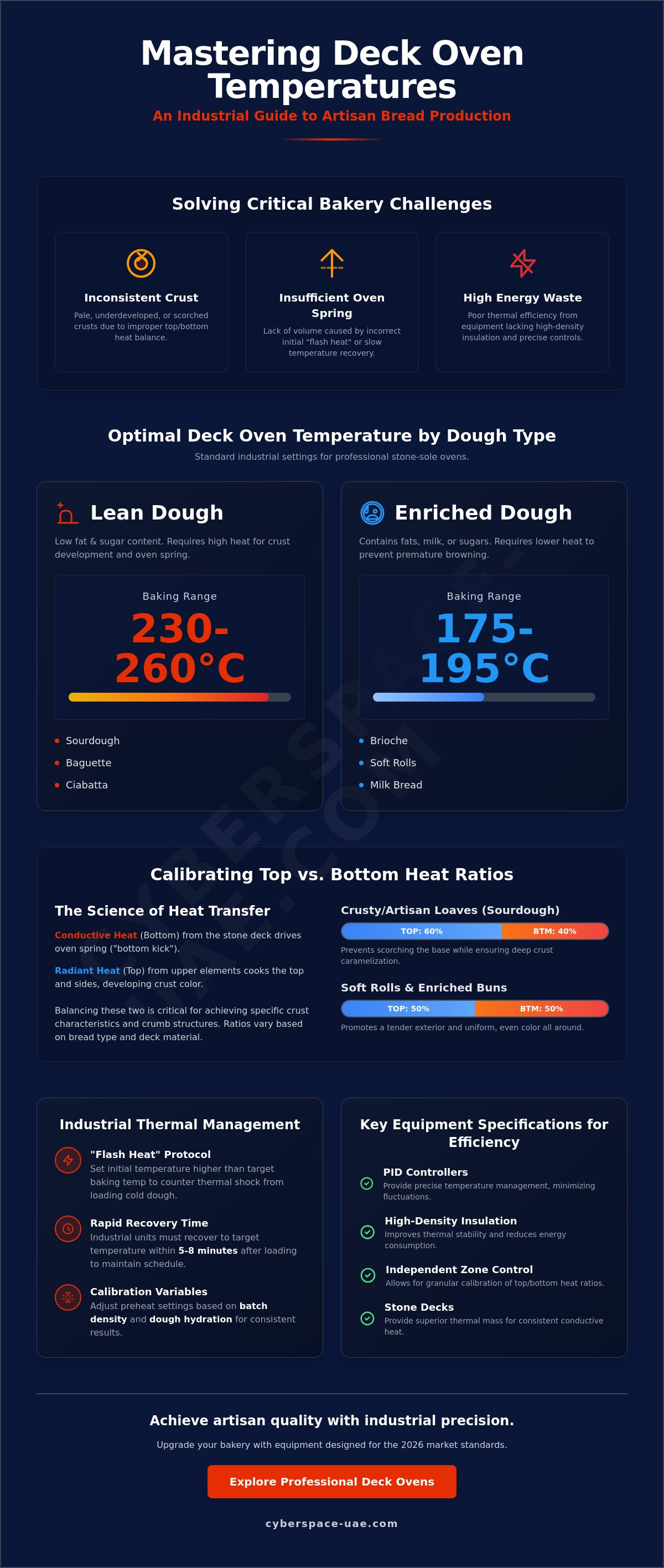
Standard industrial temperature ranges vary significantly based on dough composition. Lean doughs, such as sourdough or ciabatta, typically require settings between 230°C and 260°C. This high heat triggers the Maillard reaction and caramelization rapidly, resulting in a thick, dark crust and complex flavor profile. Conversely, enriched doughs containing fats, milk, or sugars require lower settings, usually between 175°C and 195°C. Excessive heat on enriched dough causes premature browning or scorching before the crumb structure is fully set.
Deck ovens require higher initial temperatures than convection systems because they lack forced air movement. They rely on the intensity of radiant heat and the stability of the stone deck. This setup is preferred for artisan production where crust quality is the primary objective. The stone deck acts as a heat battery, ensuring that the base of the loaf receives constant energy throughout the baking cycle.
The Science of Radiant and Conductive Heat
Thermal transfer in a deck oven occurs through two primary channels. Conduction is the direct transfer of heat from the stone deck to the base of the dough. This immediate energy transfer is responsible for the "bottom kick" that drives oven spring. Simultaneously, radiant heat from the upper heating elements cooks the top and sides of the loaf. Balancing these forces is essential. Too much bottom heat leads to scorched bases; insufficient top heat results in pale, underdeveloped crusts.
Initial Set-Points vs. Actual Baking Temperatures
Loading a batch of cold dough into a hot chamber causes a significant drop in ambient air temperature, known as thermal shock. To counter this, operators must set the initial deck oven temperature for bread higher than the target baking temperature. This "flash heat" provides the necessary energy for the first 10 minutes of expansion. Consider these operational variables when calibrating your equipment:
- Batch Density: Larger loads require higher preheat settings to compensate for greater heat absorption by the dough.
- Dough Hydration: High-hydration doughs absorb heat faster and often require a more aggressive initial set-point to maintain surface tension.
- Recovery Time: Industrial units must recover to the target temperature within 5 to 8 minutes after loading to maintain the production schedule.
Adjusting set-points based on dough weight ensures that the internal temperature of the loaf reaches the 96°C threshold required for structural stability without over-baking the exterior. Precision in these initial stages determines the final quality of the crumb and the shelf life of the product.
Calibrating Top Heat vs. Bottom Heat Ratios
Precision in deck oven temperature for bread depends on the independent management of top and bottom heating zones. Modern multi-deck units allow operators to set specific power percentages or temperature offsets for each zone. This granular control is necessary because different bread varieties require unique thermal balances to achieve their target profiles. While convection ovens provide uniform air temperature, deck ovens rely on a specific ratio of conductive heat from the base and radiant heat from the ceiling.
Standard ratios for artisan production often favor a top-heavy distribution. For crusty sourdough or rustic loaves, a ratio of 60% top heat and 40% bottom heat is common. This prevents the base from scorching while ensuring the crust undergoes sufficient caramelization. Soft rolls and enriched buns typically require a 50/50 balanced ratio to maintain a tender exterior and uniform color. If you experience pale crusts despite long bake times, the radiant top heat is likely insufficient. Conversely, burnt or overly thick bottom crusts indicate excessive conduction from the deck.
Deck material significantly influences these ratios. Steel decks transfer heat rapidly and require lower bottom settings to prevent flash-burning. Stone decks provide superior thermal mass and stability, making them the preferred choice for high-volume artisan shifts. Understanding the benefits of stone deck oven systems is critical for bakeries transitioning from convection to traditional hearth baking. Stone requires a longer preheat but offers a more forgiving heat release during the loading cycle.
High Top Heat for Crust Development
Increasing top heat is the primary method for achieving a dark, bold crust. Radiant energy drives the Maillard reaction on the surface of the dough, creating the complex flavors associated with high-end artisan bread. High top heat also supports scoring expansion. The intense radiation sets the "ear" of a baguette or boule before the internal structure fully solidifies. For sugar-heavy doughs, reduce top heat by 15% to 20%. High sugar content accelerates browning, and excessive top heat will cause the product to look finished before the center is baked. Analyzing Temperature Profiles for Commercial Bread can help you determine the exact moment to reduce radiant intensity during the bake.
Bottom Heat and Crumb Structure
Bottom heat provides the initial energy burst required for oven spring. During the first phase of baking, conductive heat from the stone deck rapidly expands the gases within the dough. This process must be managed carefully. If the deck is too hot, the bottom crust sets too quickly, restricting the overall volume of the loaf. For those utilizing a bakery deck oven electric model, digital PID controllers offer the most reliable way to maintain these ratios within a 1-degree tolerance. Consistent bottom heat ensures an open crumb structure and prevents the "collapsed" look often seen in under-heated decks. If you're looking to improve your production consistency, consider upgrading to professional deck ovens with independent zone calibration.
Temperature Profiles for Commercial Bread Varieties
Every bread variety demands a unique thermal trajectory. The deck oven temperature for bread must be adjusted to account for hydration levels and ingredient density. Artisan sourdough requires high initial energy to maximize volume, while enriched doughs need a gentler approach to prevent surface burning. Precision in these settings ensures that the internal crumb structure sets at the same rate the exterior crust develops.
Sourdough production thrives on high hydration, often exceeding 75%. This moisture requires significant energy to convert into steam within the loaf. Baguettes, by contrast, rely on rapid heat transfer and high surface-to-volume ratios. Both benefit from the intense radiant heat of a deck system. Enriched breads containing sugar or fats brown prematurely if temperatures exceed 200°C. Lowering the set-point allows the center to bake without charring the exterior. Rye and heavy whole grains require a soaking heat. This means extended bake times at moderate temperatures, typically 190°C to 210°C, to ensure full gelatinization of starches without drying out the crumb.
Sourdough and High-Hydration Loaves
Start with an initial blast of 250°C. This aggressive setting maximizes oven spring before the crust hardens. After the first 15 to 20 minutes, implement stepped temperature reductions. Lowering the heat to 220°C for the remainder of the bake ensures the interior reaches the necessary 98°C. Humidity control is vital here. Utilize a deck oven steam injection system to keep the crust pliable during the expansion phase. This prevents premature tearing. It allows for a more open crumb and a thinner, crispier crust. Proper steam management also improves the gloss and color of the final product.
Industrial Pizza and Flatbread Settings
Industrial pizza production requires the highest thermal limits of the equipment. For a pizza deck oven commercial application, temperatures should range between 280°C and 320°C. These settings facilitate short bake times of 90 to 120 seconds. This rapid heat transfer produces characteristic leopard-spotting on the crust while keeping the toppings moist. The primary challenge in high-volume shifts is floor temperature recovery. Each pizza absorbs heat from the stone deck. If the recovery cycle is too slow, subsequent batches will have undercooked bases. Modern PID controllers manage these recovery phases. They ensure the deck returns to the set-point within seconds of unloading, maintaining a consistent pace for the production line.
Managing Temperature Stability in Multi-Deck Systems
Operational efficiency in high-volume bakeries relies on maintaining a stable deck oven temperature for bread across all active units. In multi-deck configurations, each chamber operates as an independent thermal environment. However, they share a structural frame and often a centralized power supply. Improper loading sequences lead to heat bleed between decks or excessive energy draw, compromising the consistency of the final product. Managing these variables requires a systematic approach to thermal mass and recovery cycles.
Staggering the loading times between decks is a primary strategy for stability. If all decks are loaded simultaneously, the total system experiences a massive temperature drop, and the recovery time for each deck increases significantly. By staggering loads by 10 to 15 minutes, you ensure that the heating elements can focus energy on one or two decks at a time. This maintains a more consistent thermal profile across the entire stack and prevents the "cold deck" syndrome that ruins oven spring.
Monitoring deck-to-deck variance is equally critical. In many stacked systems, the top deck tends to run hotter due to rising heat from the lower units. Operators must calibrate each deck individually, often setting the top deck 5°C to 10°C lower than the bottom units to achieve identical results. Regular calibration of sensors ensures that the digital display matches the actual stone temperature, preventing batch-to-batch discrepancies.
Preheating and Thermal Equilibrium
A mandatory 60 to 90 minute preheating period is required for stone-sole ovens. While air temperature sensors may indicate the chamber is ready within 20 minutes, the stone core remains cold. Loading dough onto an under-preheated deck results in poor bottom crust development and extended bake times. Use infrared thermometers to verify that the stone surface has reached the target deck oven temperature for bread before the first shift begins. For off-peak hours, utilize energy-saving standby modes. These systems maintain a base temperature, reducing energy waste while allowing the oven to reach full baking heat within 15 minutes when production resumes.
Batch Loading and Heat Recovery
Calculating recovery times is essential for maintaining production throughput. A standard 20mm stone deck typically requires 8 to 12 minutes to recover its base temperature after a full load. To mitigate localized cooling, implement a "checkerboard" loading pattern. Instead of filling one deck completely in a single row, distribute the loaves to allow radiant heat to circulate around each piece. This prevents "cold spots" on the stone surface. When running partial loads, reduce top heat by 10% to 15%. Smaller loads have less thermal mass to absorb radiant energy, which can lead to premature browning if settings are not adjusted.
Optimize your bakery's thermal performance and consistency by integrating high-insulation deck ovens into your industrial production line.
Professional Deck Ovens for UAE Industrial Bakeries
Industrial bakeries in the UAE operate in high-ambient temperature environments. Maintaining an accurate deck oven temperature for bread requires equipment with superior insulation and advanced thermal management. Standard insulation often fails under the thermal load of local summer climates, leading to energy loss and external cabinet heating. Selecting units with high-density mineral wool or ceramic fiber ensures that heat remains within the baking chamber. This preserves thermal stability and reduces the workload on facility cooling systems.
Advanced PID (Proportional-Integral-Derivative) controllers are necessary for national operations. These systems minimize temperature overshoot, keeping the deck within a 1-degree tolerance of the set-point. For multi-deck configurations, this level of control ensures that each chamber performs identically. Implementing a robust equipment strategy involves partnering with reputable baking deck oven suppliers who provide hardware capable of these specifications. Consistent hardware leads to consistent product quality across multiple facility locations.
High-Performance Deck Oven Specifications
Technical specifications determine the versatility of your production line. Look for these core features when evaluating industrial-grade machinery:
- Digital Interfaces: Precise top and bottom heat management through touchscreen or tactile controllers.
- Heavy-Duty Stone Decks: High-density refractory stone provides the heat retention needed for back-to-back baking cycles.
- Steam-Ready Configurations: Integrated boilers or external steam connections are required for professional artisan crust development.
- Independent Deck Control: The ability to shut down unused decks during low-volume shifts to conserve energy.
These features allow for the precise calibration of the deck oven temperature for bread, ensuring that sourdough, baguettes, and pastries all reach their target profiles in the same facility.
Industrial Procurement and Support
Procuring equipment for a 24/7 bakery environment requires an analysis of duty cycles. Industrial units must withstand high-volume schedules without component failure. Technical support and calibration services are vital for maintaining national operations. Professional calibration ensures that the thermal sensors remain accurate over years of heavy use. This prevents the gradual drift in temperature that causes inconsistent batch results.
Technical consulting helps in developing custom temperature profiles for specific flour types or localized humidity levels. For organizations seeking to meet professional baking equipment Dubai standards, contact Cyberspace technical specialists. Our team provides the expertise required to select, install, and calibrate high-performance deck ovens for the most demanding production environments. Precision equipment is the foundation of operational excellence in the modern baking industry.
Optimizing Industrial Baking Performance
Standardizing deck oven temperature for bread across your facility is the primary requirement for commercial consistency. Success in large-scale artisan production depends on the technical balance of conductive and radiant heat. By implementing the zone-specific calibration and staggered loading protocols outlined in this guide, you eliminate thermal instability and product rejection.
Cyberspace serves as an authorized distributor of high-end industrial baking machinery across the UAE. We specialize in multi-deck stone-sole systems engineered for superior heat retention and recovery. Our national technical support team ensures your equipment maintains peak calibration for 24/7 production requirements. View Professional Deck Ovens for Industrial Bakeries to upgrade your facility standards. Secure your production quality with industrial-grade thermal precision.
Frequently Asked Questions
Why is my bread burning on the bottom but remaining pale on top in a deck oven?
This imbalance indicates an incorrect top vs. bottom heat ratio. Excessive conduction from the stone deck causes the base to scorch, while insufficient radiant heat from the upper elements prevents crust coloration. Adjust your settings to a ratio of 60% top heat and 40% bottom heat for artisan varieties. Reducing the bottom set-point by 10°C to 15°C often resolves base burning without affecting the overall bake time.
How long should I preheat a commercial stone deck oven before the first batch?
Industrial stone deck ovens require 60 to 90 minutes of preheating to reach thermal equilibrium. Air temperature sensors often signal readiness within 20 minutes, but the stone core remains cold. Loading dough onto a surface that isn't fully saturated with heat results in poor oven spring and inconsistent bottom crusts. Use an infrared thermometer to verify that the stone surface matches the digital set-point before loading.
Can I use the same temperature for sourdough and baguettes in a deck oven?
No, these varieties require distinct thermal trajectories. Sourdough thrives with an initial 250°C blast to drive expansion in high-hydration dough, followed by a reduction to 220°C. Baguettes generally require a constant high deck oven temperature for bread to achieve a thin, crisp crust and rapid coloration. Using a single temperature for both compromises the crumb structure of the sourdough or the crust texture of the baguette.
What happens to the deck temperature when I inject steam?
Injecting steam causes an immediate drop in the chamber's air temperature as the water absorbs sensible heat. However, the resulting humidity increases the rate of heat transfer to the dough surface through latent heat release. High-performance industrial ovens utilize PID controllers to detect this drop and trigger the heating elements, ensuring the chamber returns to the target set-point within seconds to maintain baking consistency.
How do I adjust deck oven temperature for high-altitude baking in the UAE?
While most UAE bakeries operate at sea level, facilities in higher elevations like Al Ain must reduce temperatures by 3°C to 5°C. Lower atmospheric pressure causes moisture to evaporate faster, which can lead to a premature crust set. Slightly lowering the deck oven temperature for bread allows the loaf to expand fully before the exterior hardens. You should also increase hydration by 1% to 2% to compensate for faster evaporation.
What is the ideal recovery time between batches for a 3-deck industrial oven?
A standard 20mm stone deck requires 8 to 12 minutes to recover its base temperature after a full load is removed. In a 3-deck system, staggering the loading times by 10 minute intervals is the most efficient protocol. This prevents a simultaneous power draw across all decks and ensures that each stone surface has sufficient time to reclaim lost thermal energy before the next batch is introduced.
How does ambient UAE humidity affect deck oven temperature settings?
High ambient humidity levels, common in coastal UAE regions, interfere with the dough's ability to shed moisture during the final baking stage. This often results in a "leathery" crust. To counter this, increase the final bake temperature by 5°C or open the steam vents 5 minutes earlier than usual. This encourages rapid moisture escape and ensures the crust reaches the desired crispness despite external environmental conditions.
Should I turn off the deck oven between baking shifts to save energy?
Do not turn off the oven if the next shift starts within 4 to 6 hours. Stone decks act as thermal batteries and require significant energy to reheat from a cold state. It's more efficient to use a standby or "Eco" mode that maintains a base temperature of 150°C. This preserves the internal thermal mass and allows the unit to reach production temperatures quickly when the next shift begins.